
Assets – WorkDo Dash SaaS Add-On Guide
Learn how to manage assets, tracking, and asset records in WorkDo Dash SaaS.
Introduction
The Asset Management Add-On is a simple tool used to manage all company assets in one place. It helps users add, view, update, search, filter, and delete asset records easily. It also keeps track of important details like asset information, costs, status, and how the asset is used over time. The system shows quick summaries and charts to help users understand asset performance and usage at a glance. Overall, it helps organizations keep accurate records and manage the full life of their assets in an easy and organized way.
How To Install The Add-On?
To Set Up the Assets Add-On, you can follow this link: Setup Add-On.
How To Use The Assets Add-On ?
Manage Category
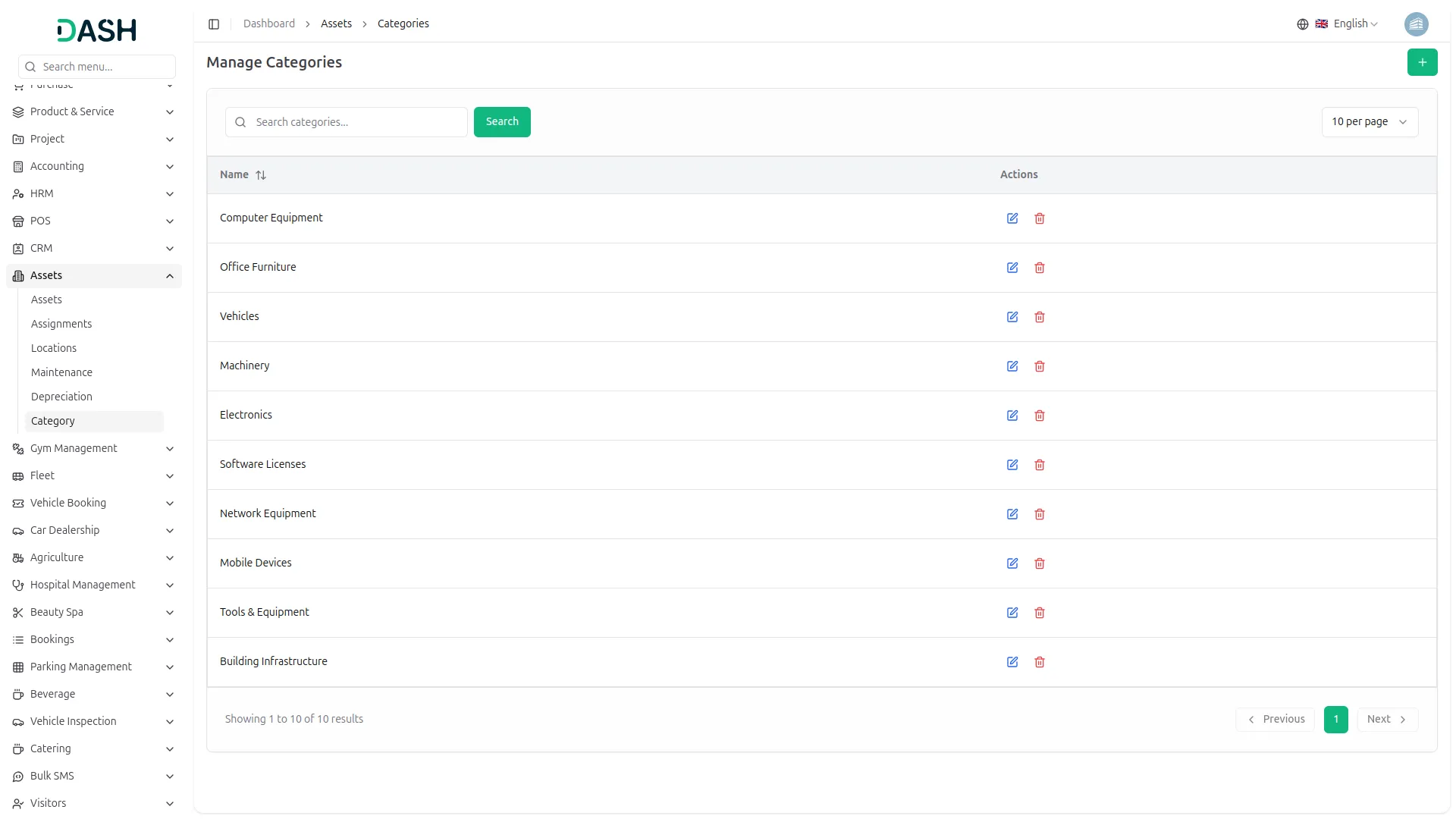
- To create a new category, click the “Create” button on the Manage Categories page. This opens the Create Category form, where you’ll enter a Name.
- The Manage Categories page lists all categories in a simple table showing Name and Actions. Use the search bar to find a specific category.
- In the Actions column for each category, click the Edit button to update the category name or the Delete button to trash it.
Manage Locations
- To create a new location, click the “Create” button on the Manage Locations page. This opens the Create Location form, where you’ll enter the location’s details.
- Enter a Name and Code for the location, then select a Type from the dropdown (Building, Warehouse, Site, Floor, or Room). Optionally, select a Parent Location to nest it under an existing location in the hierarchy.
- Fill in the Address, City, State, Country, and Postal Code fields to record where the location is situated, along with a Contact Person, Contact Phone, and Contact Email for the point of contact.
- Add a Description with any additional details, and use the Active toggle to mark whether the location is currently in use.
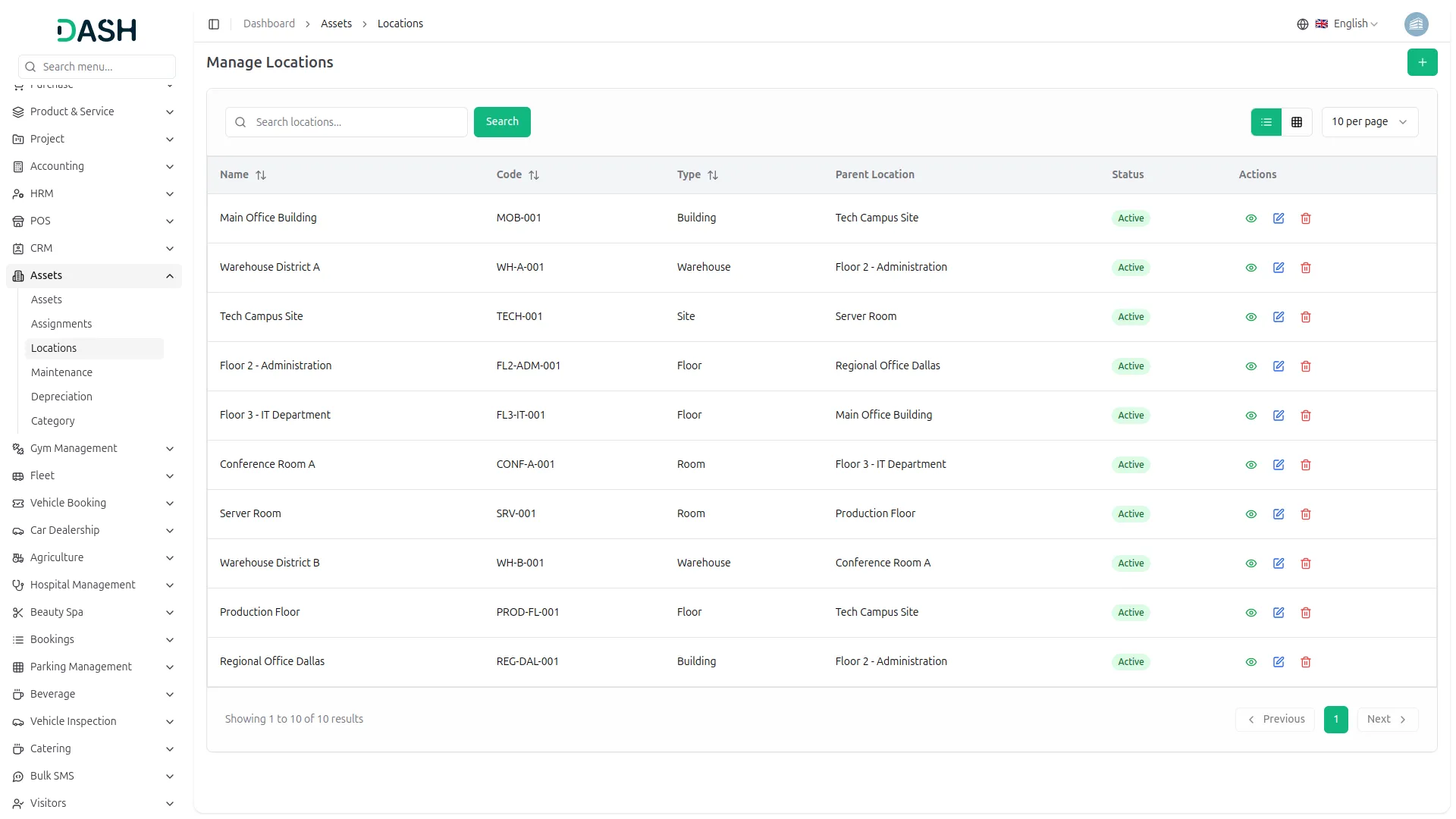
- The Manage Locations page lists all locations in a table showing Name, Code, Type, Parent Location, Status (Active or Inactive), and Actions. Use the search bar to find locations. You can switch between list view and grid view using the toggle buttons.
- Click “Filters” to narrow results by Type or Status; select your criteria and click “Apply” to filter or “Clear” to reset. This makes it easy to isolate, for example, only Active Rooms or Inactive Warehouses.
- In the Actions column for each location, click the View button to see details, the Edit button to update the location, or the Delete button to trash it.
Manage Assets
- To create a new asset, click the “Create” button on the Manage Assets page. This opens the Create Asset form, where you’ll enter the asset’s details.
- Enter a Name for the asset, then select a Purchase Date and, optionally, a Supported Date. Choose a Category from the dropdown; if the category you need doesn’t exist yet, click the “Create category” link to add one on the fly (comes from the category section).
- Enter a Serial Code to uniquely identify the asset, and specify the Quantity. Enter the Unit Price, and the Purchase Cost will be calculated automatically based on the quantity and unit price.
- Optionally, enter a Warranty Period and select a Location for the asset; if the location isn’t listed yet, click the “Create location” link to add a new one. Add a Description if needed, and upload an Image by clicking “Browse” or dragging a file into the Image field.
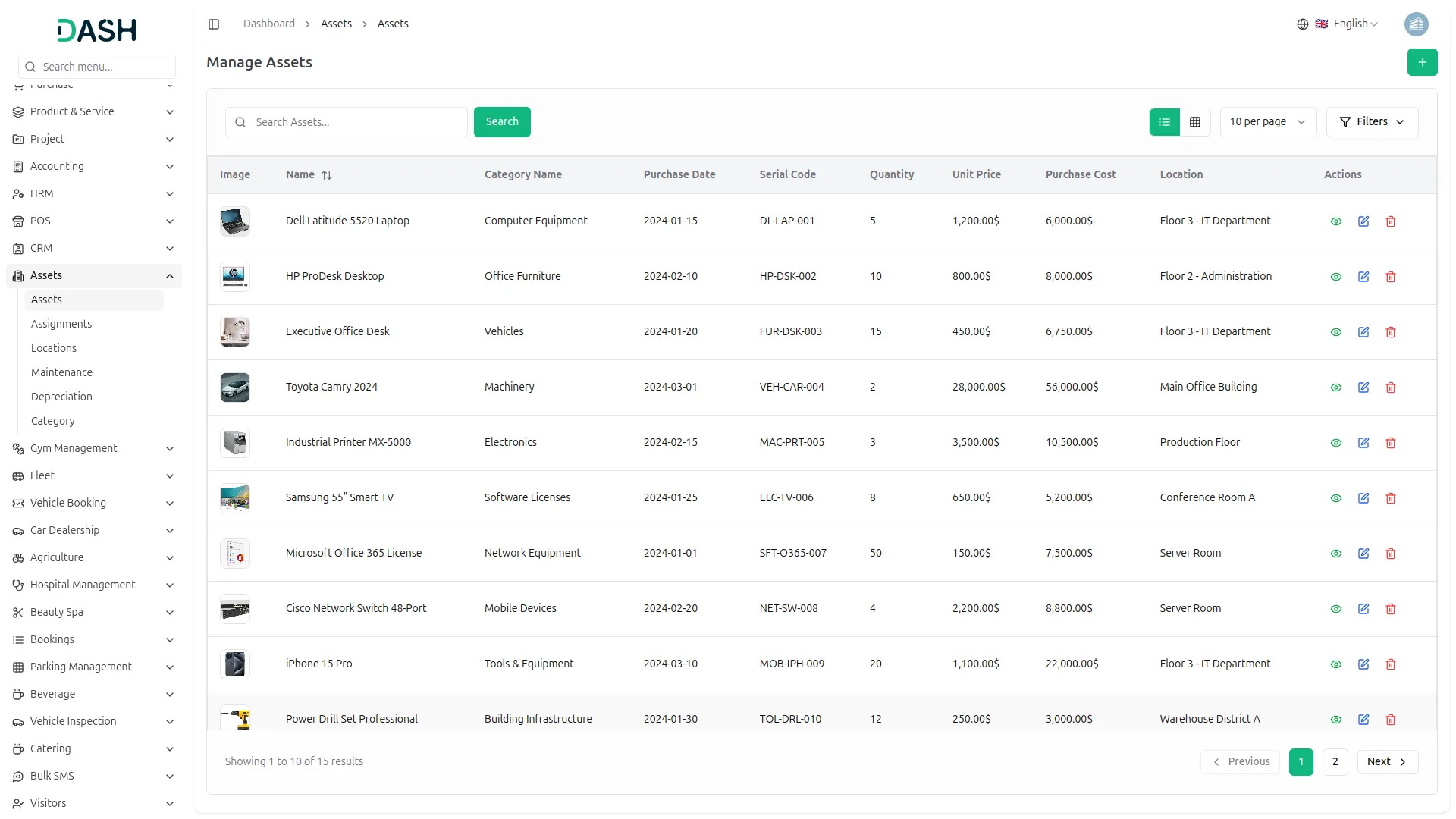
- The Manage Assets page displays four summary cards at the top: Total Assets, Available Assets, Under Maintenance, and Total Purchase Cost, giving you a quick overview of your asset inventory.
- Below that, assets are displayed as cards showing the asset name, category, image, Serial Code, Purchase Date, Location, Unit Price, Quantity, and Purchase Cost. Use the search bar to find a specific asset. You can switch between grid view and list view using the view toggle buttons.
- In the actions row at the bottom of each asset card, you can click the View button to see asset details, the Edit button to modify the asset data, or the Delete button to remove it.
Manage Assignments
- To create a new assignment, click the “Create” button on the Manage Assignments page. This opens the Create Assignment form, where you’ll enter the assignment’s details.
- Select an Asset from the dropdown; if the asset you need doesn’t exist yet, click the “Create asset” link to add one on the fly (comes from the asset section). Then select a user to Assign To; if the user isn’t listed yet, click the “Create user” link to add one (comes from the user management).
- Enter the Assigned Date and, optionally, an Expected Return Date. Choose a Condition on Assignment from the dropdown (Excellent, Good, Fair, or Poor), and optionally add Assignment Notes with any relevant details.
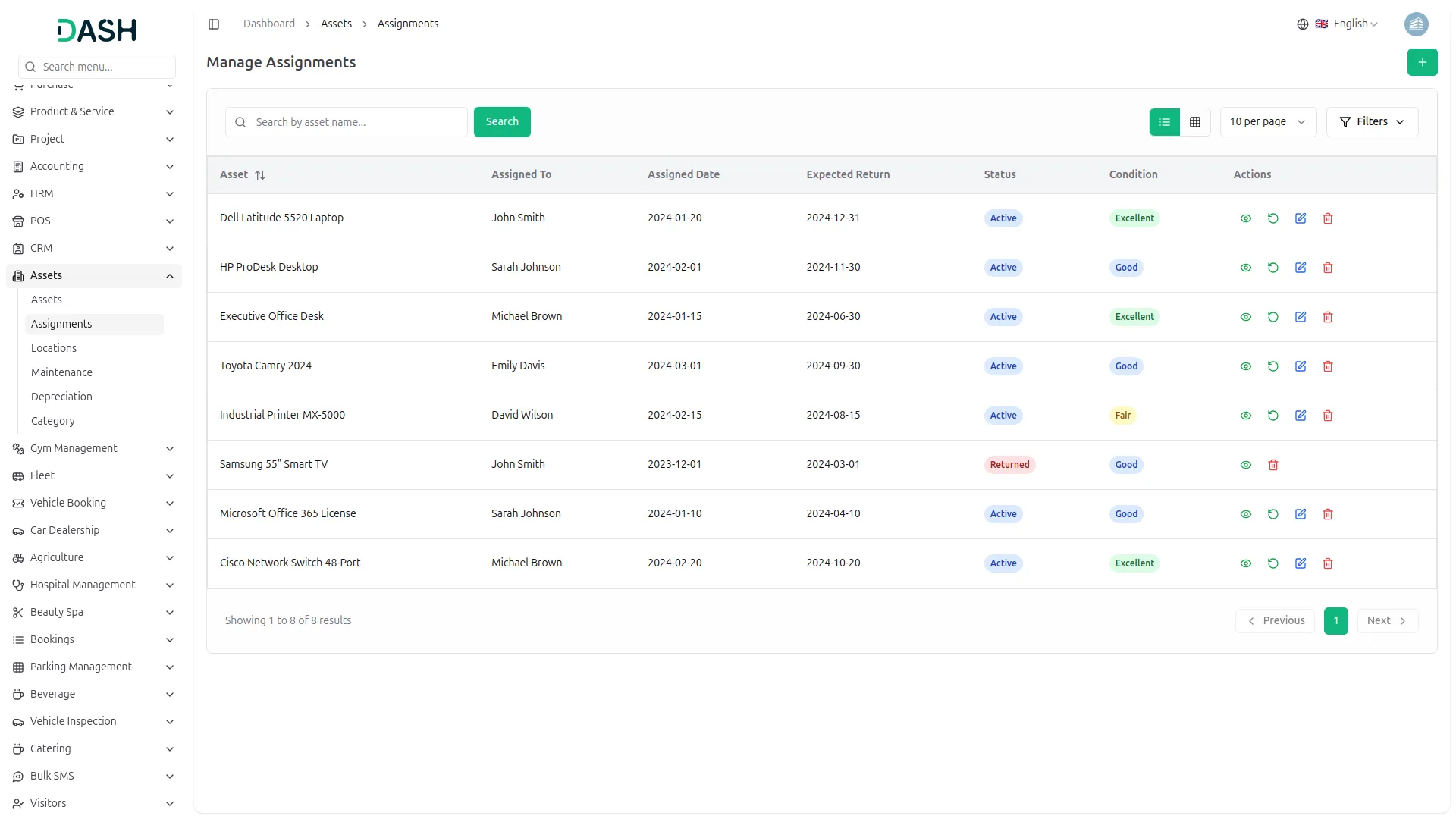
- The Manage Assignments page displays four summary cards at the top: Total Assignments, Active Assignments, Returned Assets, and Overdue Assignments, each with a percentage breakdown, giving you a quick overview of your assignment activity.
- Below that, assignments are displayed as cards showing the asset name, image, Assigned To user, Category, Serial Code, Assigned Date, and Expected Return date (overdue returns are flagged in red). Each card also shows the current Status and Condition of the asset.
- Use the search bar to find a specific assignment. You can switch between grid view and list view using the view toggle buttons.
- In the actions row at the bottom of each assignment card, you can click the Return button to open the Return Asset window, the view button to see assignment details, the Edit button to modify the assignment, or the Delete button to trash it.
- When you click the Return button, the Return Asset window opens, showing the Assignment Details for reference: Asset, Serial number, Assigned To, Assigned Date, Expected Return Date, and Original Condition.
- Select the Return Date and choose the Condition on Return from the dropdown. Optionally, add Return Notes about the asset’s condition or the return process. Click “Return Asset” to complete the return, or “Cancel” to discard it.
- Note: The Return action can only be performed once per asset. After a successful return, the Return and Edit buttons will no longer appear on that assignment card.
Manage Maintenance
- To create a new maintenance record, click the “Create” button on the Manage Maintenance page. This opens the Create Maintenance form, where you’ll enter the maintenance details.
- Select an Asset from the dropdown; if the asset you need doesn’t exist yet, click the “Create asset” link to add one on the fly. Choose a Type from the dropdown (Preventive, Corrective, or Emergency), then enter a Title.
- Add a Description with relevant details, then set the Scheduled Date and, once work is finished, the Completed Date.
- Enter the Cost and Technician Name, then choose a Status (Scheduled, In Progress, Completed) and Priority (Low, Medium, High, Critical) from their dropdowns. Optionally set a Next Maintenance Date. Add any additional details in Notes.
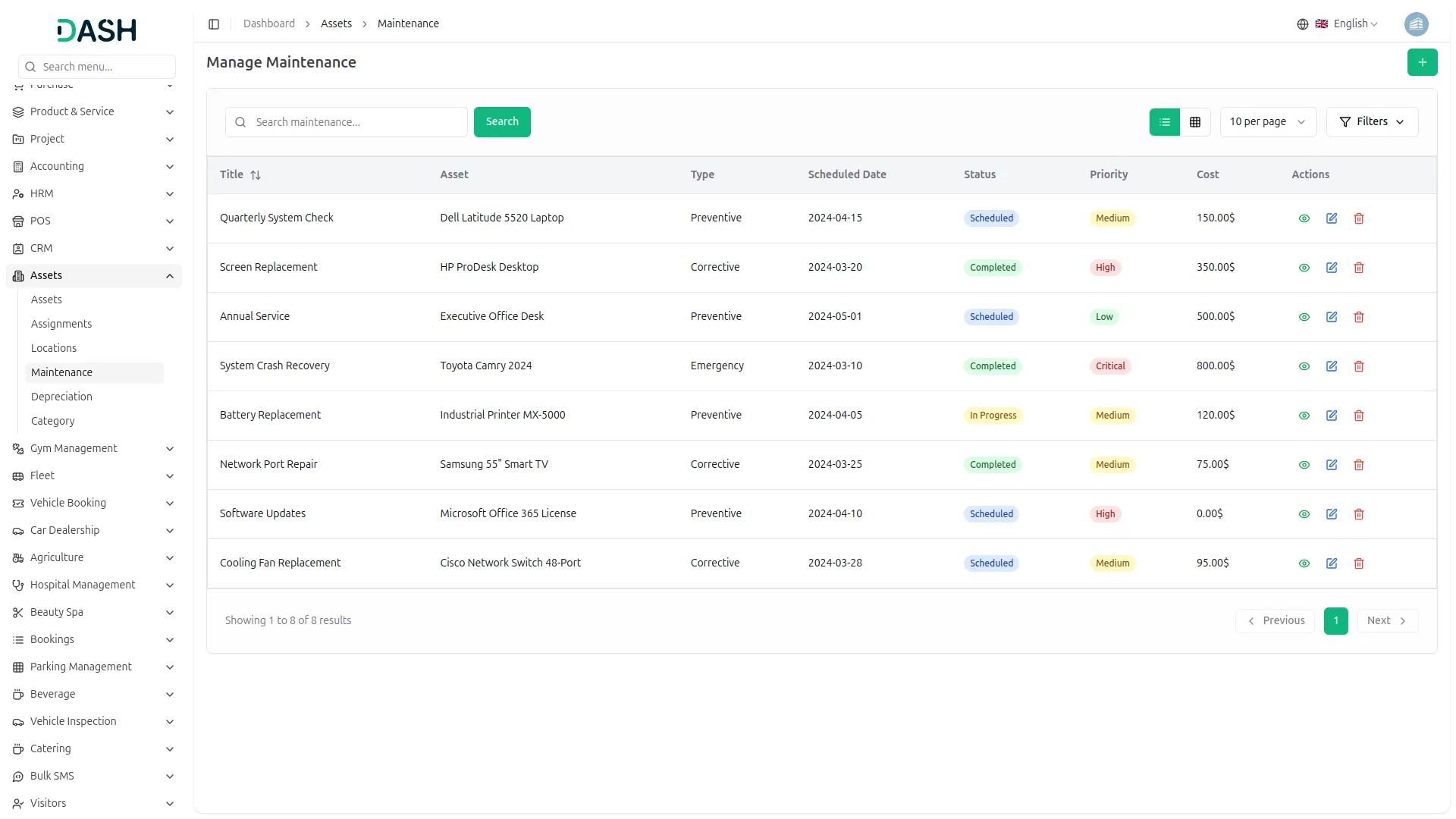
- The Manage Maintenance page lists all records in a table showing Title, Asset, Type, Scheduled Date, Cost, Status, Priority, and Actions.
- Use the search bar to find a specific record. You can switch between list view and grid view using the toggle buttons. Click “Filters” to narrow results by Asset, Scheduled Date Range, Type, Status, or Priority; select your criteria and click “Apply” to filter or “Clear” to reset.
- In the Actions column for each record, click the view button to see details, the edit button to modify the maintenance entry, or the delete button to trash it.
Manage Depreciation
- To create a new depreciation record, click the “Create” button on the Manage Depreciation page. This opens the Create Depreciation form, where you’ll enter the depreciation details.
- Select an Asset from the dropdown; if the asset you need doesn’t exist yet, click the “Create asset” link to add one on the fly (comes from the asset section). Choose a Depreciation Method from the dropdown(Straight Line, Declining Balance, or Sum of Years), and enter the Useful Life in years. Enter the Salvage Value and Start Date, and optionally add Notes with any relevant details.
- The Manage Depreciation page opens with five summary cards: Total Assets, Current Book Value, Annual Depreciation, Average Useful Life, and Fully Depreciated, giving you a quick snapshot of your asset depreciation activity.
- Below that, three panels visualize the data: a Depreciation Trend chart plotting monthly Annual vs Accumulated depreciation, an Assets by Status donut chart breaking down Partially Depreciated vs Fully Depreciated assets, and a Depreciation Methods panel showing the share of assets using each method (Straight Line, Declining Balance, Sum of Years).
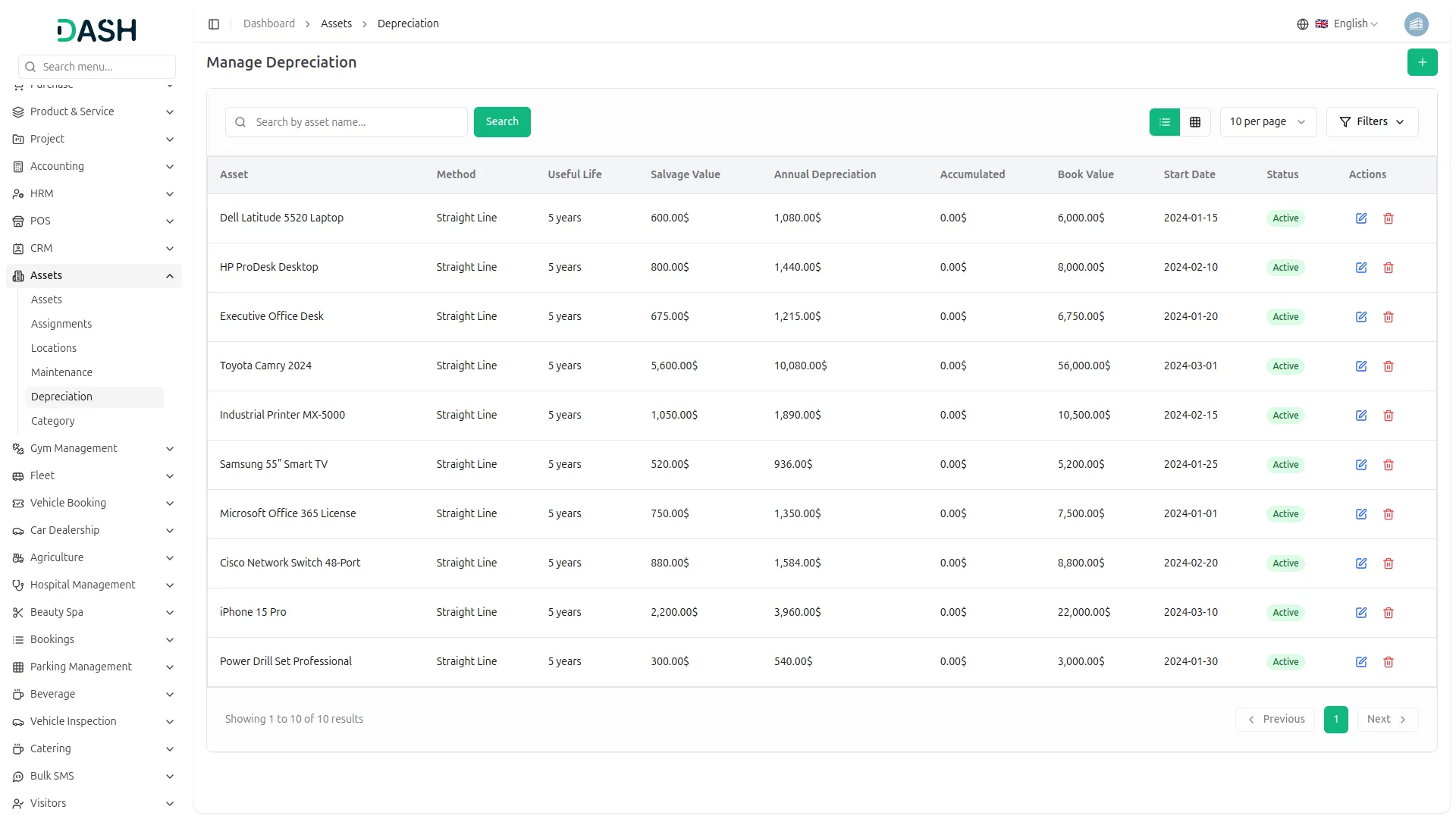
- Assets are displayed as cards showing the asset name, Start Date, Useful Life, Method, and Status (Active or Fully Depreciated), along with Salvage Value, Annual and Accumulated depreciation, and current Book Value.
- Use the search bar to find a specific asset. You can switch between grid view and list view using the view toggle buttons. The All Assets / All Methods / All Status dropdowns, the date range picker, and the green checkmark “Apply” button are are shown in this crop.
- In the actions row at the bottom of each card, click the View button to see details, the Edit button to update the depreciation record, or the Delete button to trash it.
Categories
Related articles
- Events Management – WorkDo Dash SaaS Add-On Guide
- Requests – WorkDo Dash SaaS Add-On Guide
- WhatsApp Messenger – WorkDo Dash SaaS Add-On Guide
- Shopify Module Guide – eCommerceGo SaaS
- Investment System – WorkDo Dash SaaS Add-On Guide
- Flexible Duration – BookingGo SaaS Add-On Guide
- Optical Eyecare Center – WorkDo Dash SaaS Add-On Guide
- Iyzipay – BookingGo SaaS Add-On Guide
- Marketplace List – eCommerceGo SaaS Add-On Guide
- Sign in with Outlook – eCommerceGo SaaS Add-On Guide
- Queue Management – WorkDo Dash SaaS Add-On Guide
- WhatsApp API – BookingGo SaaS Add-On Guide
We're Here to Help - Let's Talk
Have questions about our solutions, customization services, or business tools? Our team is here to help you. let's talk.