
Music Institute Integration in Dash SaaS
The Music Institute software is a comprehensive management system designed to help music schools and institutes efficiently manage their operations.
Introduction
The Music Institute Add-On is a comprehensive management solution designed to streamline every aspect of running a music institute. It provides a centralized platform covering the full student lifecycle, from enrollment and class scheduling to attendance tracking, exam management, and progress monitoring. Additional features, including instrument inventory, library resources, practice logs, maintenance records, and announcements, ensure that both administrative and academic operations are managed efficiently in one place. The built-in dashboard and reporting tools give administrators real-time visibility into key metrics, helping keep the institute running smoothly.
How to Install the Add-On?
To Set Up the Music Institute Add-On, you can follow this link Setup Add-On
How to Use the Music Institute Add-On?
Music Institute Dashboard
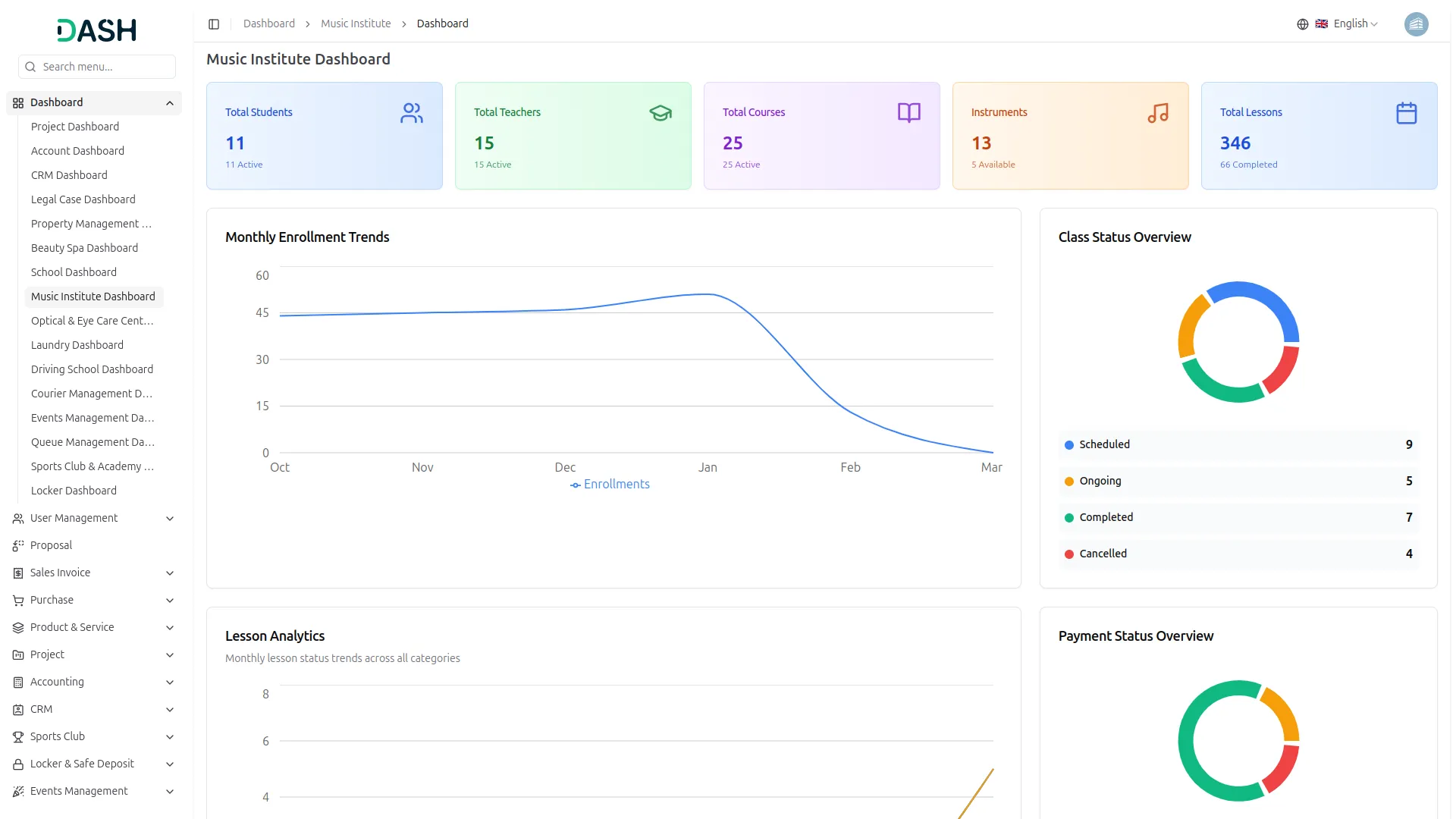
- The dashboard provides a complete overview of your music institute’s performance through various visual elements and quick access features.
- The dashboard displays important summary cards showing Total Students, Total Teachers, Total Courses, Instruments, and Total Lessons, giving you instant insights into your institute’s key metrics at a glance.
- The Monthly Enrollment Trends chart on the left displays enrollment performance over the past several months as a line graph, allowing you to track student enrollment patterns over time and identify your strongest and weakest enrollment periods.
- The Class Status Overview panel on the right displays a donut chart showing the distribution of classes across their current states, split between Scheduled, Ongoing, Completed, and Cancelled, giving you an at-a-glance view of your institute’s overall class activity and progression.
- The Lesson Analytics chart at the bottom left displays monthly lesson status trends across all categories as a multi-line graph, tracking Cancelled Lessons, Completed Lessons, Draft Lessons, Ongoing Lessons, and Scheduled Lessons over time. This allows you to monitor lesson delivery patterns and identify shifts in lesson activity across different status categories.
- The Payment Status Overview panel on the bottom right displays a donut chart showing the distribution of enrollment payments, split between Pending and Cleared, giving you an at-a-glance view of your institute’s current payment collection status and outstanding balances.
Role-Based Dashboard Access
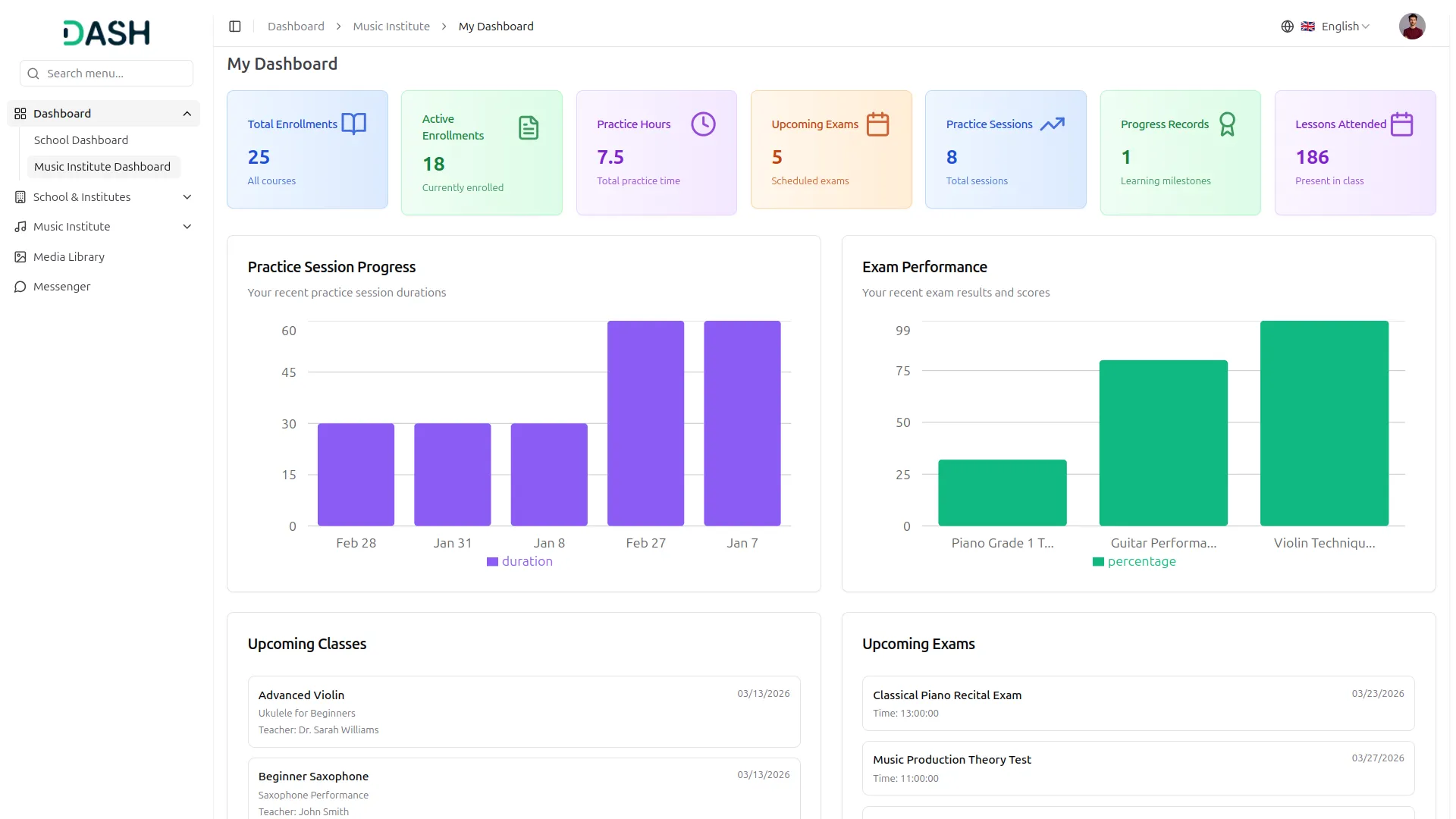
- When you log in as a Student, your dashboard displays summary cards for Total Enrollments, Active Enrollments, Practice Hours, Upcoming Exams, Practice Sessions, Progress Records, and Lessons Attended. It also includes a Practice Session Progress chart, an Exam Performance chart, an Upcoming Classes panel, an Upcoming Exams panel, and a Recent Practice Sessions section showing the duration, instrument, location, and date of your latest practice activities.
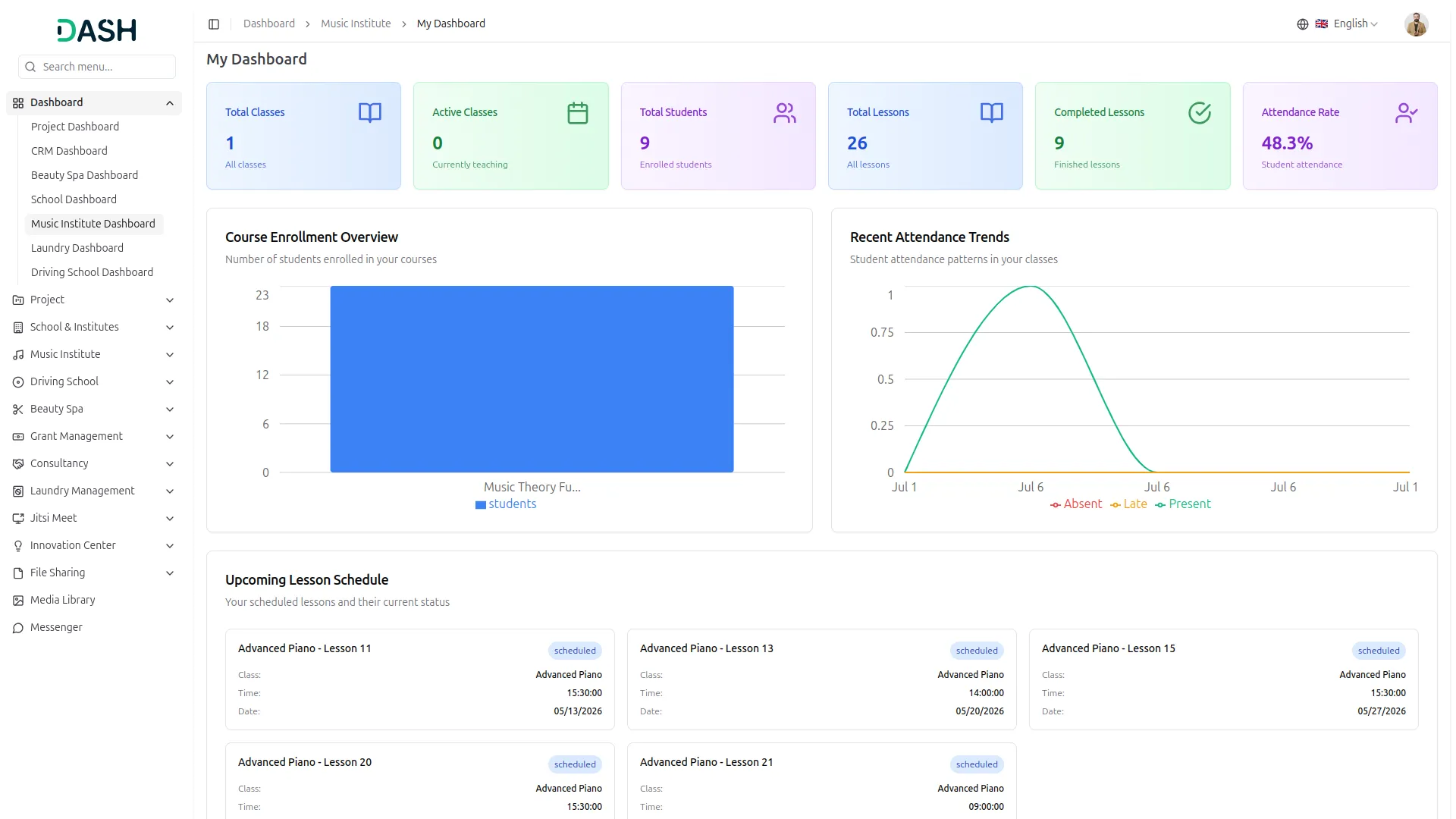
- When you log in as a Teacher, your dashboard displays summary cards for Total Classes, Active Classes, Total Students, Total Lessons, Completed Lessons, and Attendance Rate. It also includes a Course Enrollment Overview chart, a Recent Attendance Trends chart tracking Absent, Late, and Present patterns, an Upcoming Lesson Schedule panel, a My Courses panel showing your active courses and enrolled student counts, and a Recent Attendance Records panel displaying the latest attendance entries across your classes.
System Setup
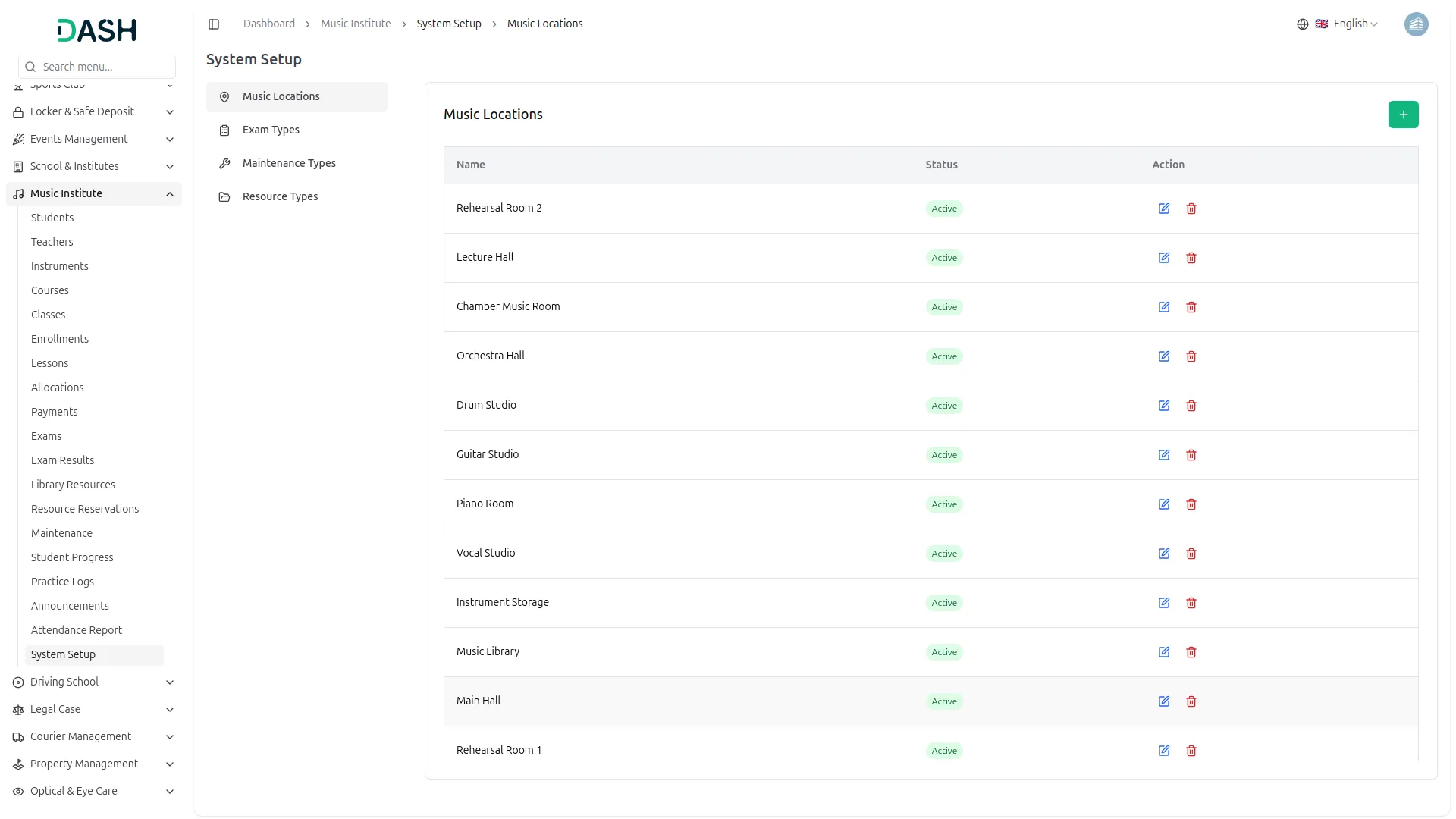
- The System Setup section allows administrators to configure foundational data used across the system. It currently includes Music Locations, Exam Types, Maintenance Types, and Resource Types, all of which are referenced when managing music operations throughout the platform.
Music Locations
- To add a new music location, click the “Create” button, which is located on the Music Locations page. In the form that opens, enter the Name of the location in the provided field. Toggle the Status switch to enable or disable the location upon creation.
- The Music Locations list displays all configured locations in a table with columns for Name, Status, and Action. The Status badge indicates whether a location is currently active within the system.
- Available Actions: use Edit to update or modify an existing music location, and Delete to permanently remove it from the system. Note that locations actively referenced in scheduling or room assignments should be managed carefully, as changes may affect existing records that reference them.
Exam Types
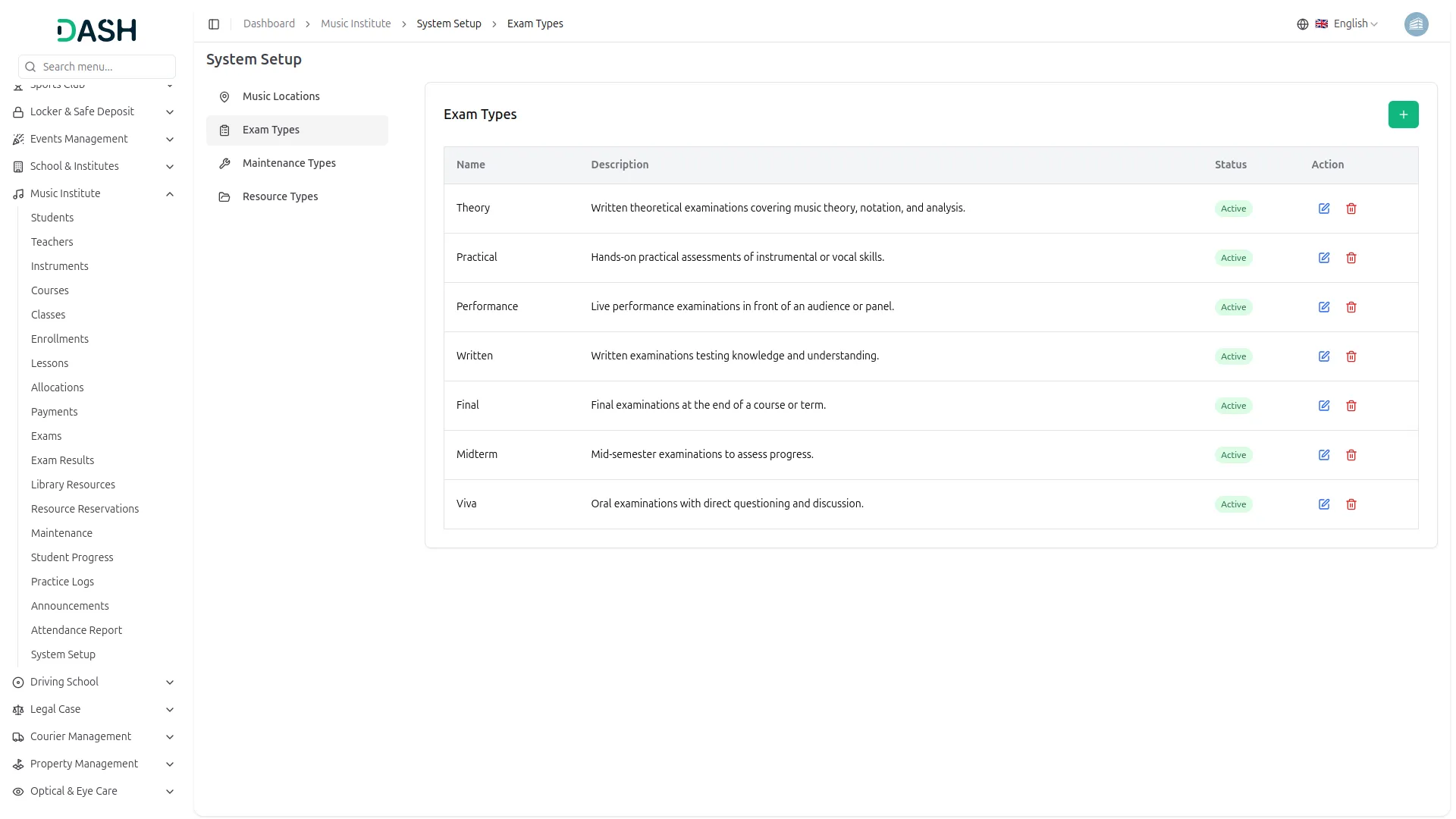
- To add a new exam type, click the “Create” button, which is located on the Exam Types page. In the form that opens, enter the Name of the exam type in the provided field. Optionally, add a Description to explain the nature or purpose of the exam type. Toggle the Status switch to enable or disable the exam type upon creation.
- The Exam Types list displays all configured types in a table with columns for Name, Description, Status, and Action. The Status badge indicates whether an exam type is currently active and available for use across the system.
- Available Actions: use Edit to update or modify an existing exam type, and Delete to permanently remove it from the system. Note that exam types actively associated with student assessments should be managed carefully, as changes may affect existing records that reference them.
Maintenance Types
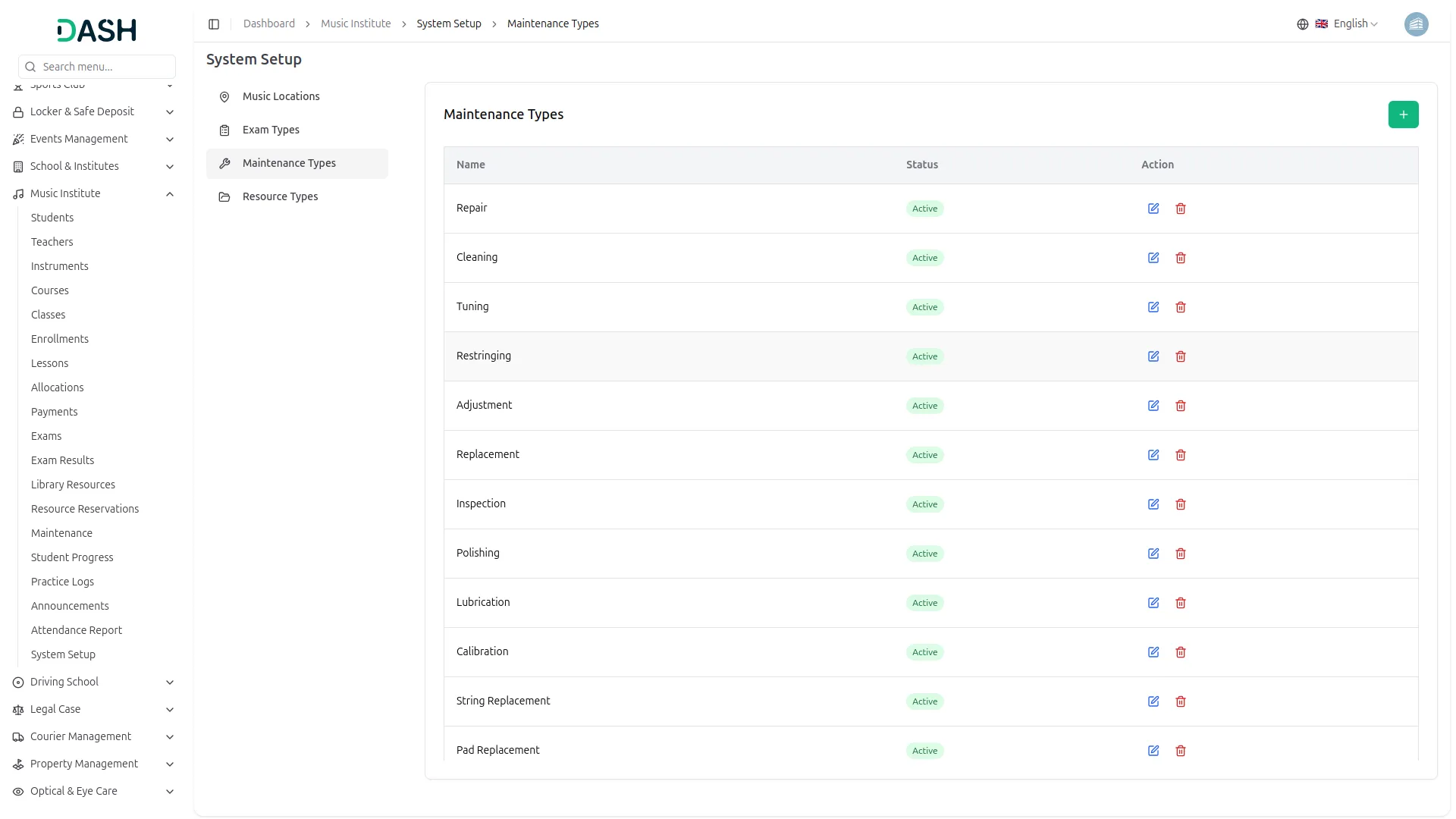
- To add a new maintenance type, click the “Create” button, which is located on the Maintenance Types page. In the form that opens, enter the Name of the maintenance type in the provided field. Toggle the Status switch to enable or disable the maintenance type upon creation.
- The Maintenance Types list displays all configured types in a table with columns for Name, Status, and Action. The Status badge indicates whether a maintenance type is currently active and available for logging maintenance activities.
- Available Actions: use Edit to update or modify an existing maintenance type, and Delete to permanently remove it from the system. Note that maintenance types actively linked to instrument or facility records should be managed carefully, as changes may affect existing maintenance logs that reference them.
Resource Types
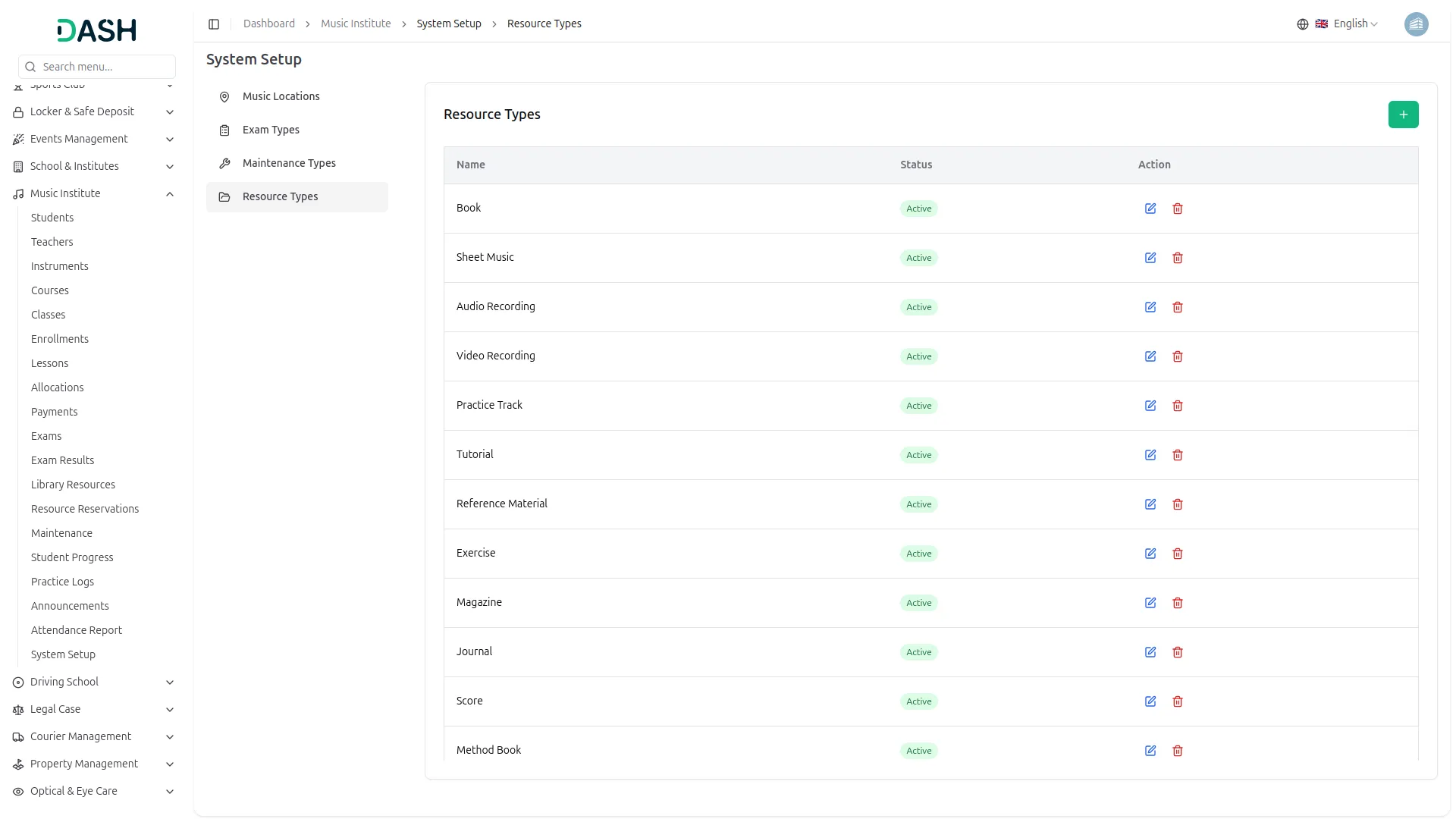
- To add a new resource type, click the “Create” button, which is located on the Resource Types page. In the form that opens, enter the Name of the resource type in the provided field. Toggle the Status switch to enable or disable the resource type upon creation.
- The Resource Types list displays all configured types in a table with columns for Name, Status, and Action. The Status badge indicates whether a resource type is currently active and available for categorizing learning or library materials across the platform.
- Available Actions: use Edit to update or modify an existing resource type, and Delete to permanently remove it from the system. Note that resource types actively used to categorize books, recordings, or other materials should be managed carefully, as changes may affect existing resource records that reference them.
Manage Students
- To add a new student, click the “Create” button which is located on the Manage Students page. In the form that opens, start by selecting a User from the dropdown. Note that only users with the Student role who are not already assigned to another student profile will appear in this list.
- Choose the Gender from the dropdown and set the Date of Birth using the date picker. Select Status from the dropdown (Active, Inactive, Graduate, Dropped). Then enter the student’s primary Instrument and preferred Language.
- Fill in the address fields: Address, City, State, Country, and Zip Code to complete the student’s location details.
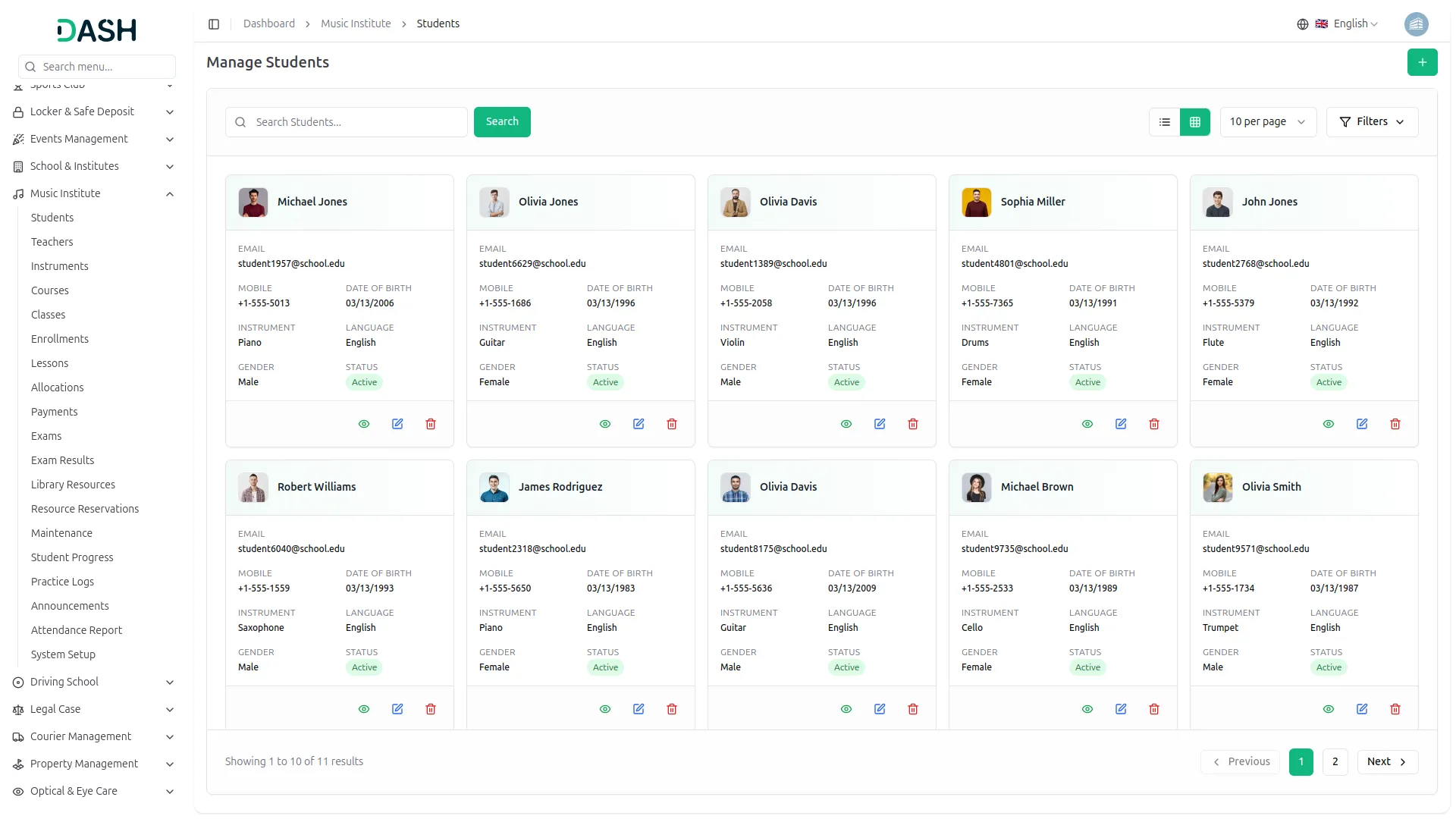
- The list page shows all students in a table with columns for Student (name with avatar), Email, Mobile, Date of Birth, Instrument, Language, Gender, Status, and Actions.
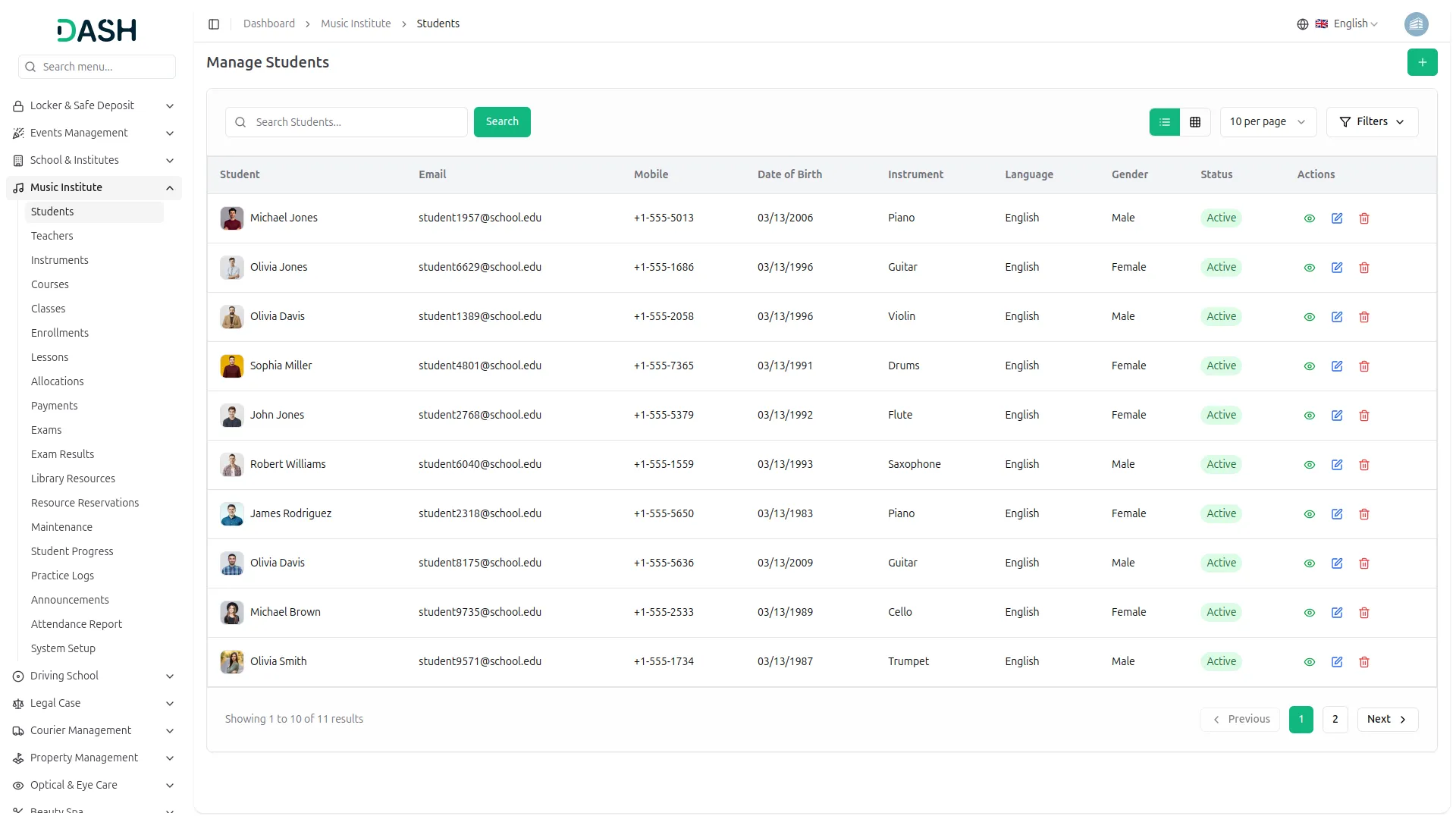
- Use the Search bar to find specific students by name, and apply filters using the Gender dropdown (Filter by Gender) and Status dropdown (Filter by Status). Click Apply to activate the selected filters or Clear to remove them. Toggle between list view and grid view using the view buttons.
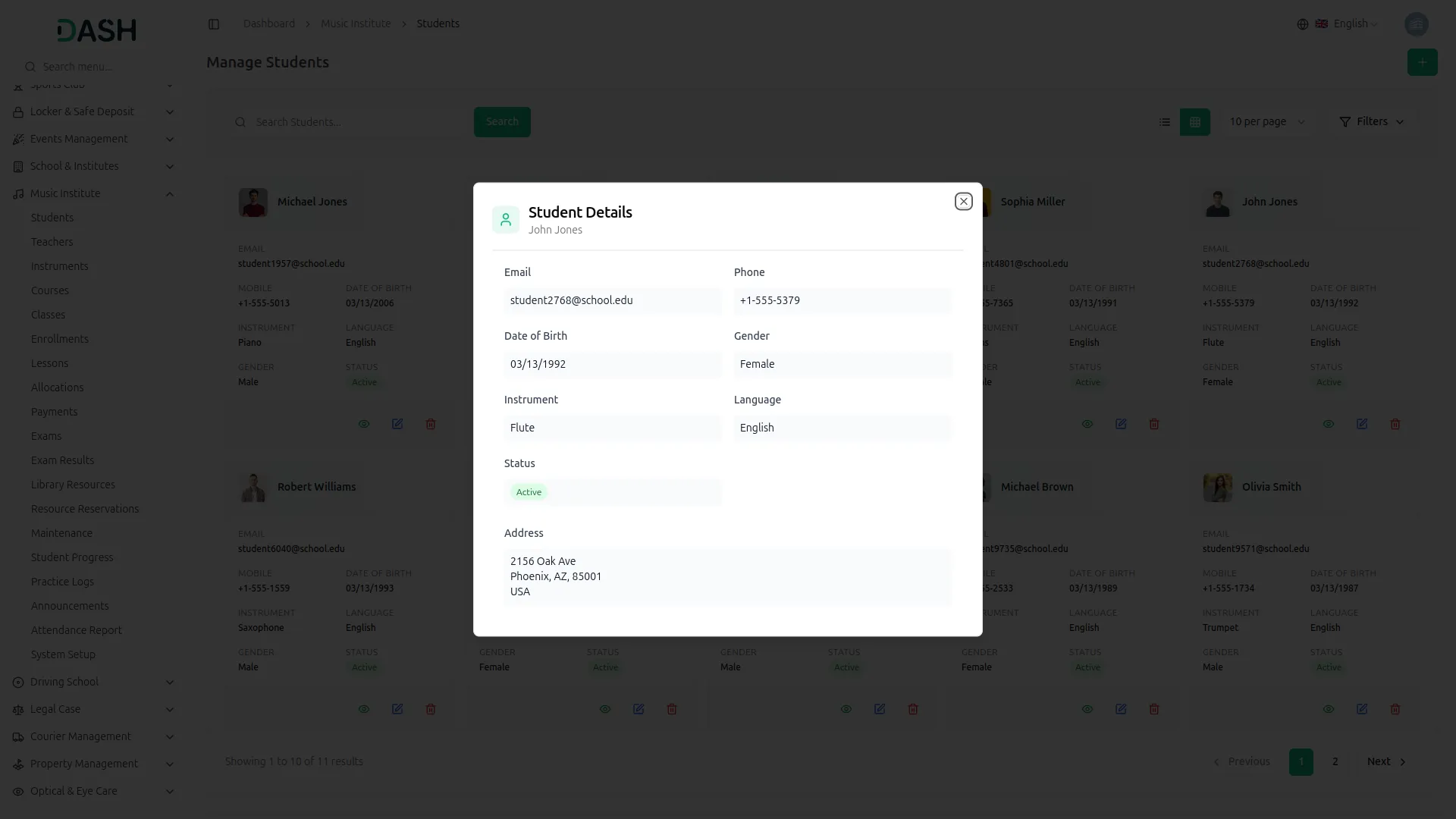
- Using the Actions column, select View to see full student details, Edit to modify an existing student’s information, and Delete to permanently remove the student from the system.
Manage Teachers
- To add a new teacher, click the “Create” button which is located on the Manage Teachers page. In the form that opens, start by selecting a User from the dropdown. Note that only users with the Employee role who are not already assigned to another teacher profile will appear in this list.
- Set the Date of Birth using the date picker and choose the Gender from the dropdown. Enter the teacher’s area of Expertise and specify their Hourly Rate in the provided field. Optionally, add Certification Detail to document any relevant qualifications or credentials held by the teacher.
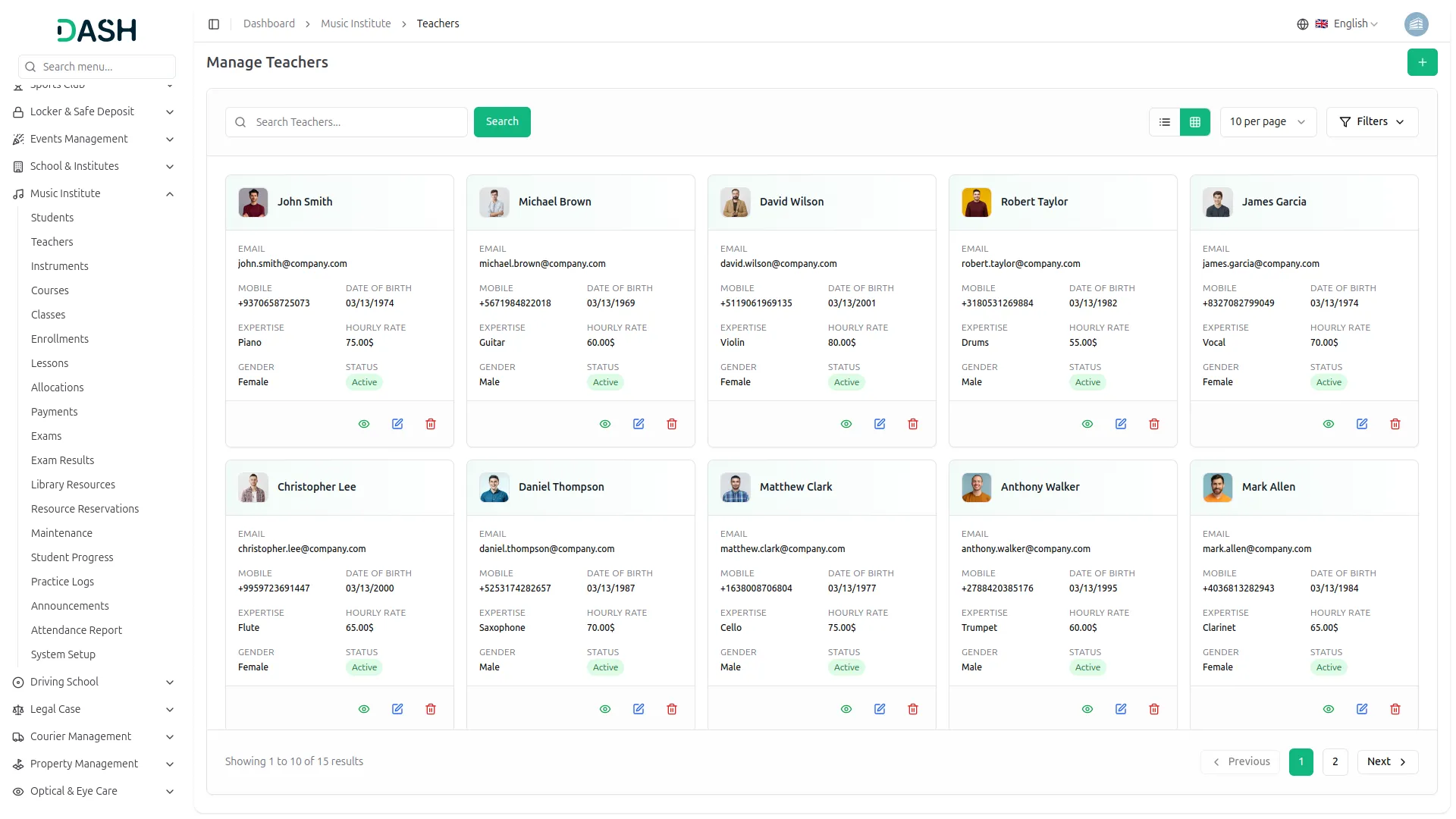
- The list page shows all teachers in a table with columns for Teacher (name with avatar), Email, Mobile, Date of Birth, Expertise, Hourly Rate, Gender, Status, and Actions.
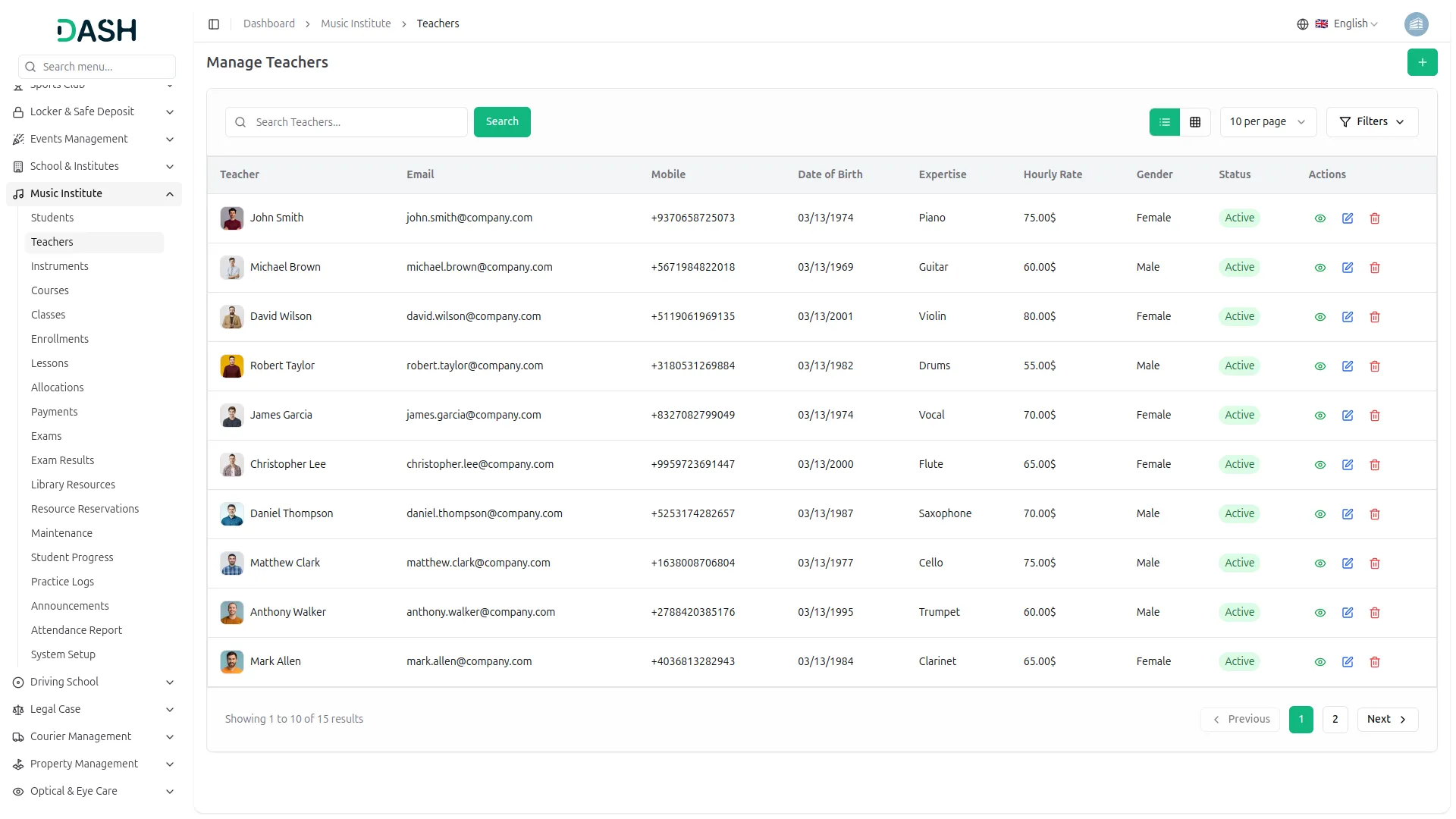
- Use the Search bar to find specific teachers by name, and apply filters using the Gender dropdown (Filter by Gender) and Status dropdown (Filter by Status). Click Apply to activate the selected filters or Clear to remove them. Toggle between list view and grid view using the view buttons.
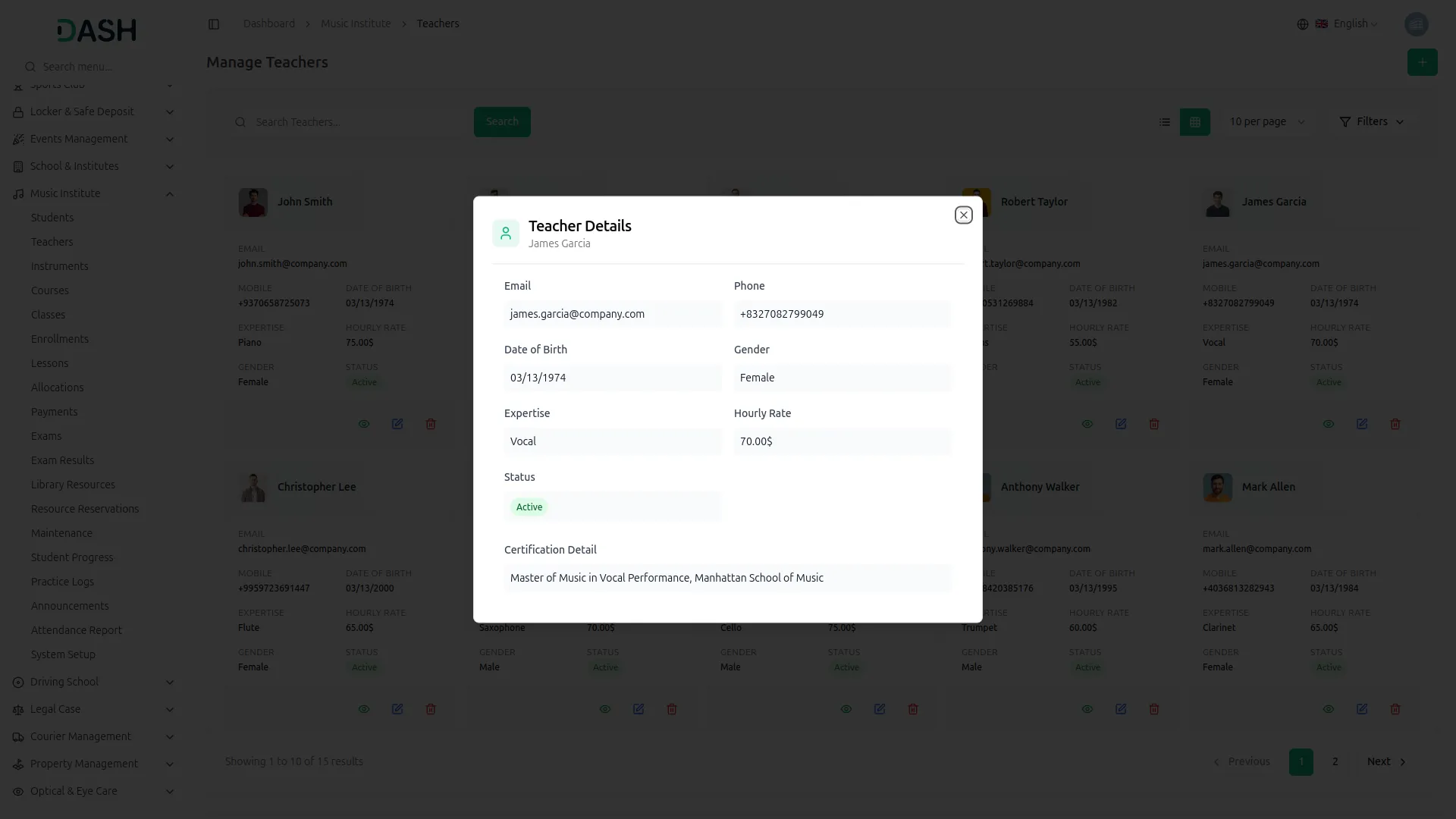
- In the Actions column, select View to see full teacher details, Edit to modify an existing teacher’s information, and Delete to permanently remove the teacher from the system.
Manage Instruments
- To add a new instrument, click the “Create” button which is located on the Manage Instruments page. In the form that opens, enter the Name of the instrument and its Brand. Provide the Model and optionally enter a Serial Number for tracking purposes.
- Set the Purchase Date using the date picker and enter the Price. Specify the Quantity available and select the Condition from the dropdown to reflect the current state of the instrument. Optionally, enter Warranty information and the assigned Technician responsible for the instrument. Upload an Image using the Browse button to attach a visual reference, and add any additional Notes if needed.
- The list page shows all instruments in a table with columns for Image, Name, Brand, Model, Serial Number, Quantity, Purchase Date, Price, Condition, and Actions.
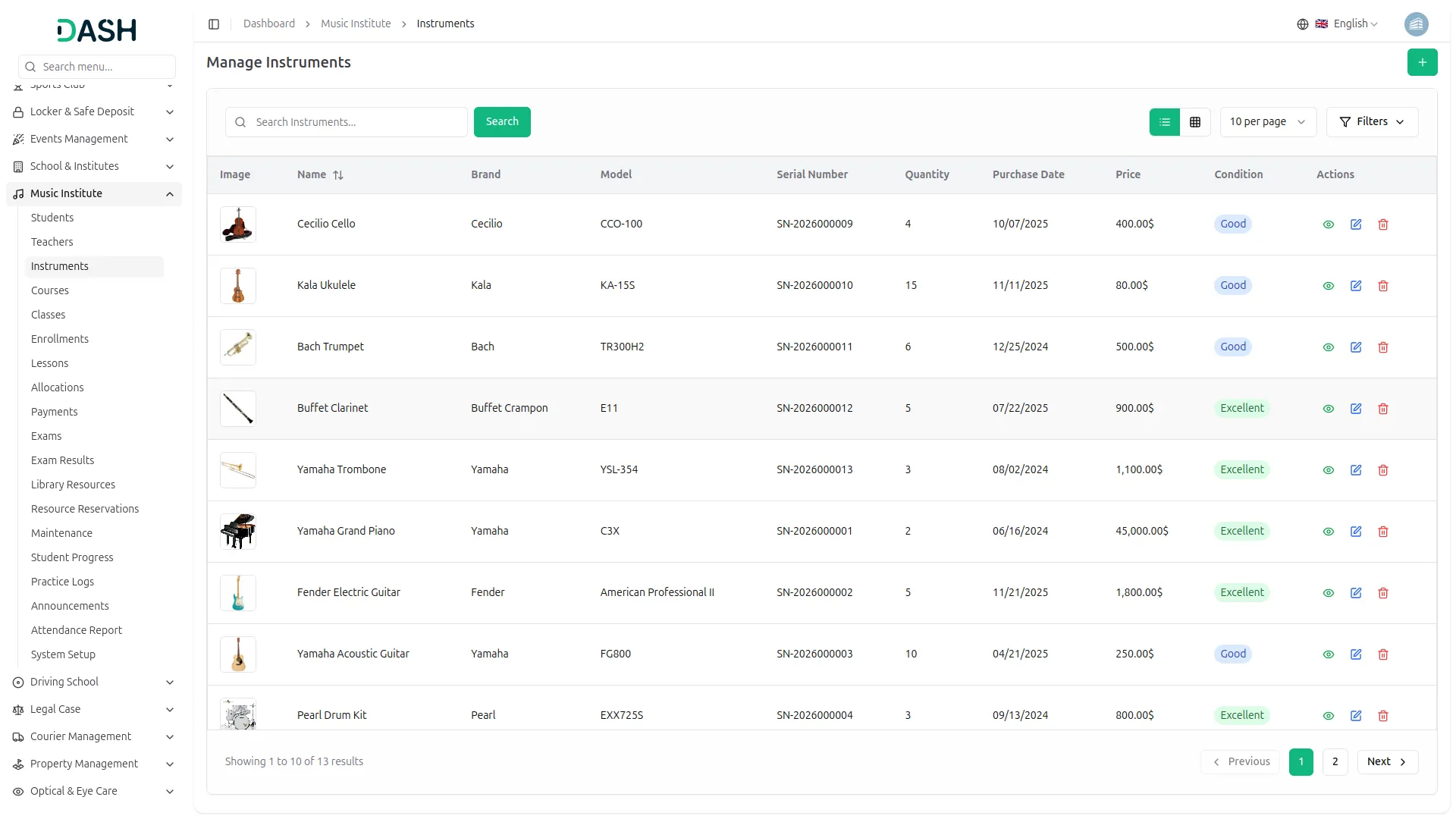
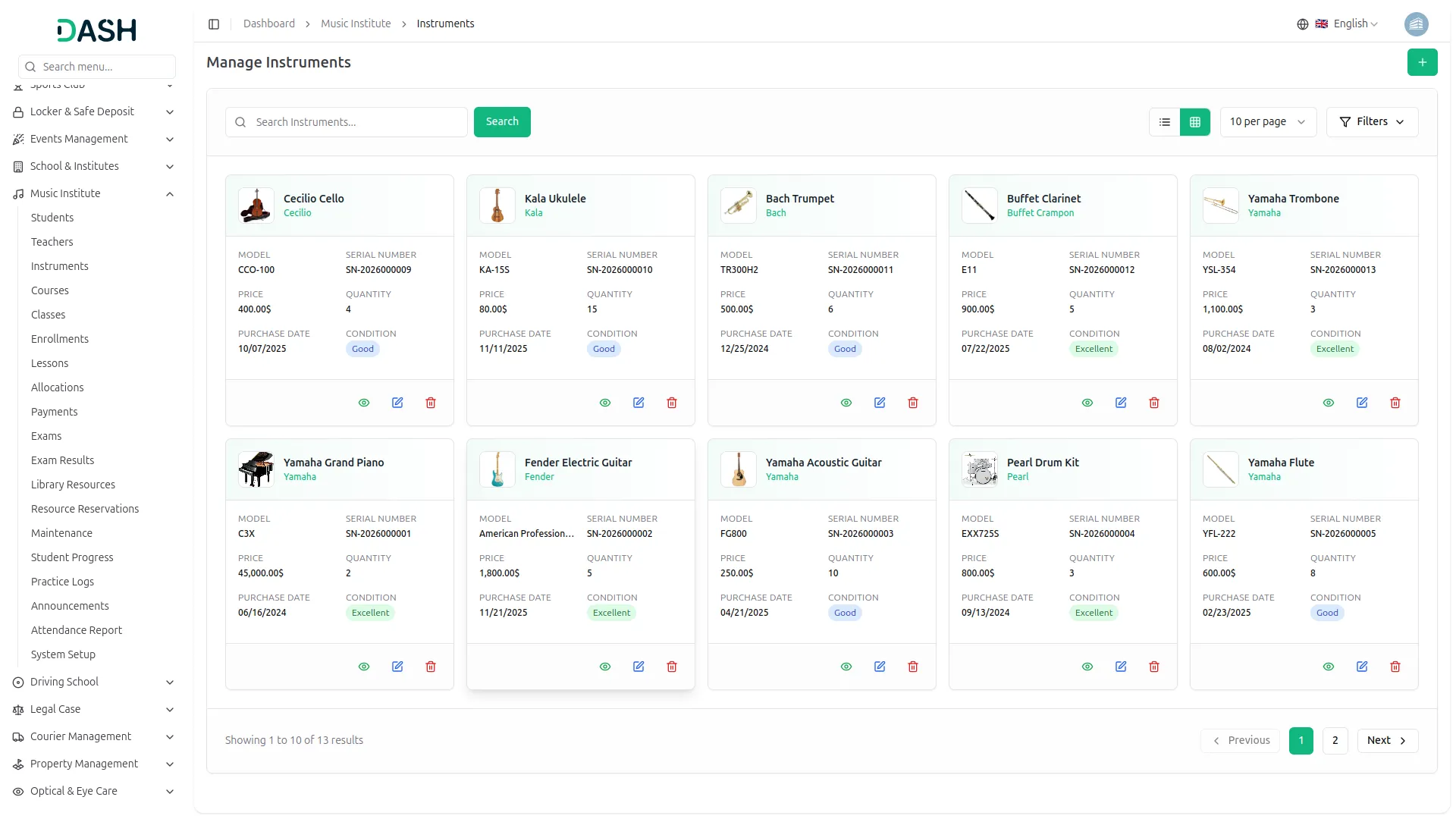
- Use the Search bar to find specific instruments by name, and apply filters using the Condition dropdown (Filter by Condition). Click Apply to activate the selected filter or Clear to remove it. Toggle between list view and grid view using the view buttons.
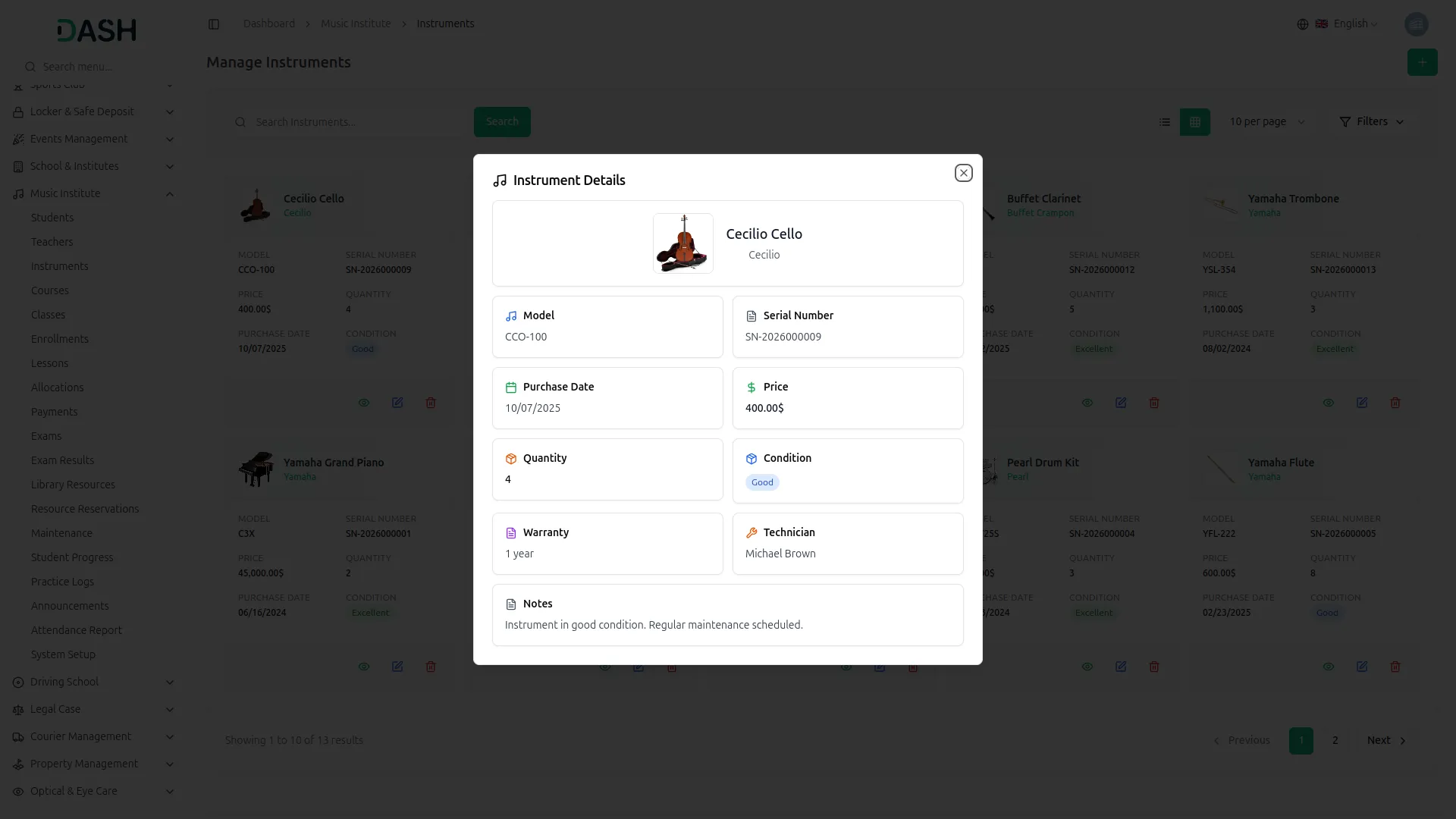
- Using the Actions column, select View to see full instrument details, Edit to modify an existing instrument’s information, and Delete to permanently remove the instrument from the system.
Manage Courses
- To add a new course, click the “Create” button which is located on the Manage Courses page. In the form that opens, enter the Course Name and select a Teacher from the dropdown to assign the course instructor. Optionally, add a Description to outline the course content and purpose.
- Enter the Duration Value and select the Duration Type to define the length of the course. Optionally, provide a Syllabus to detail the topics and structure covered throughout the course. Enter the Fee and select the Level from the dropdown to indicate the difficulty level of the course, such as Beginner, Intermediate, or Advanced.
- The list page shows all courses in a table with columns for Course Name, Teacher, Duration, Fee, Level, Status, and Actions.
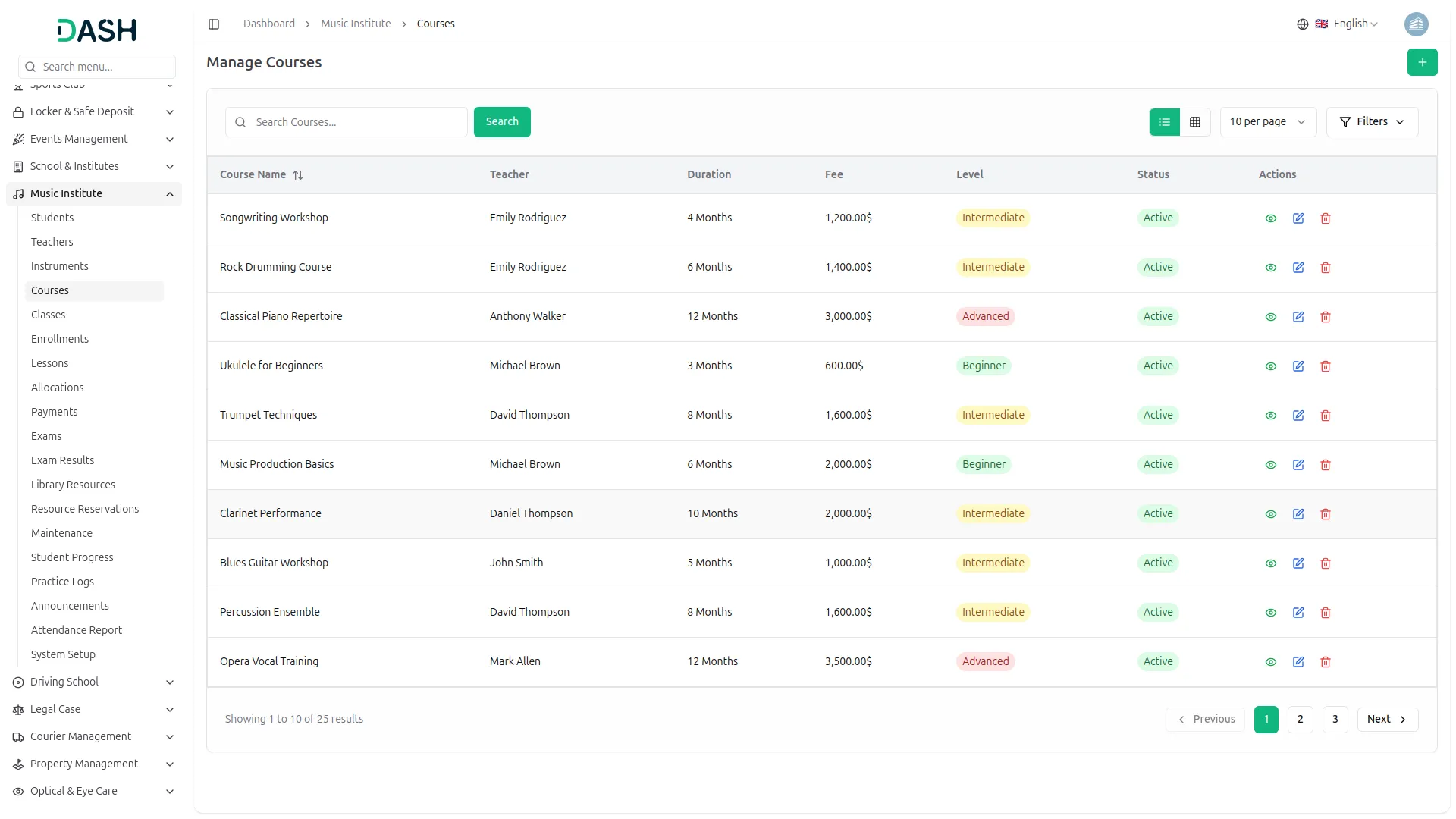
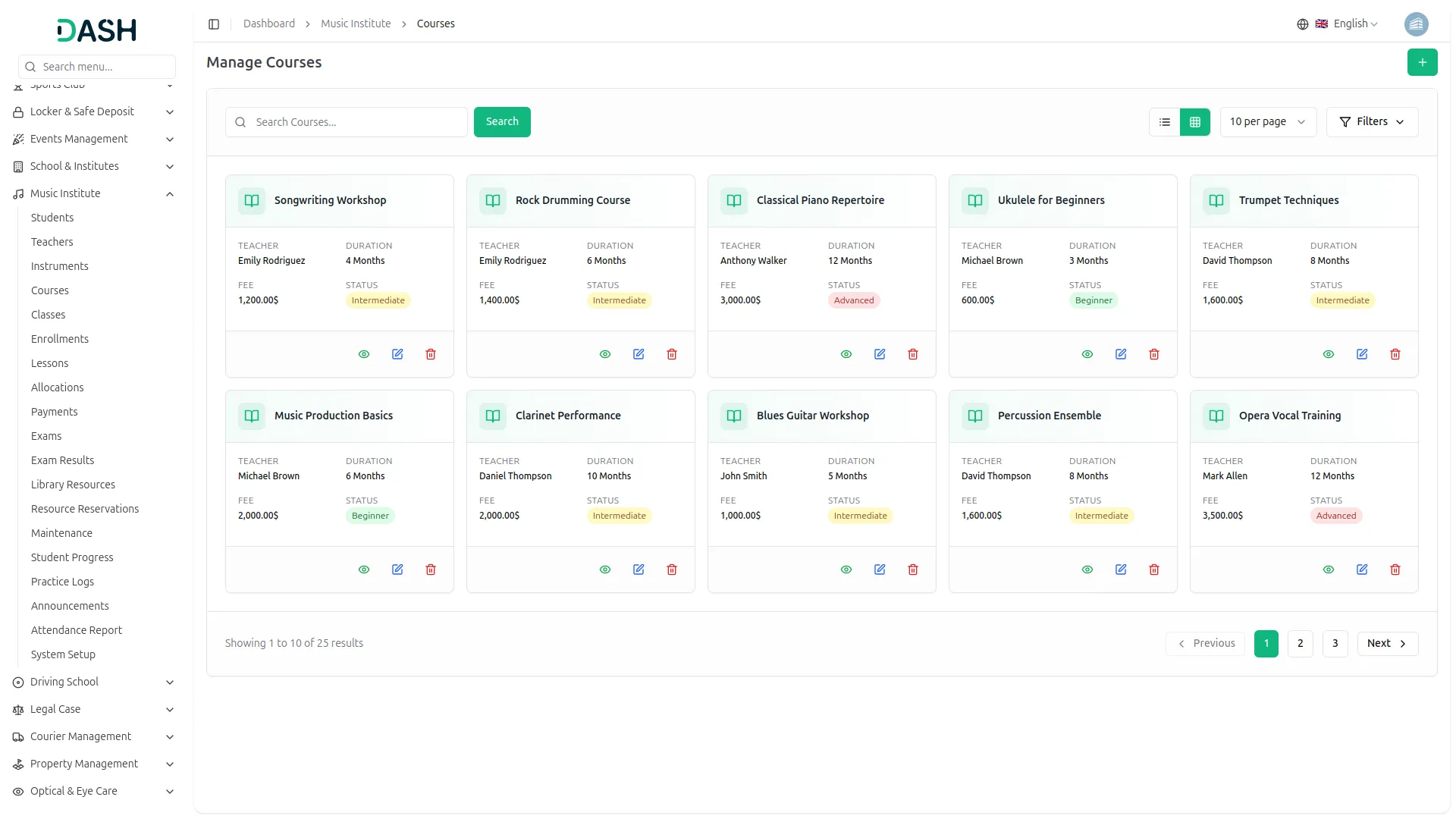
- Use the Search bar to find specific courses by name, and apply filters using the Level dropdown (Filter by Level) and Status dropdown (Filter by Status). Click Apply to activate the selected filters or Clear to remove them. Toggle between list view and grid view using the view buttons.
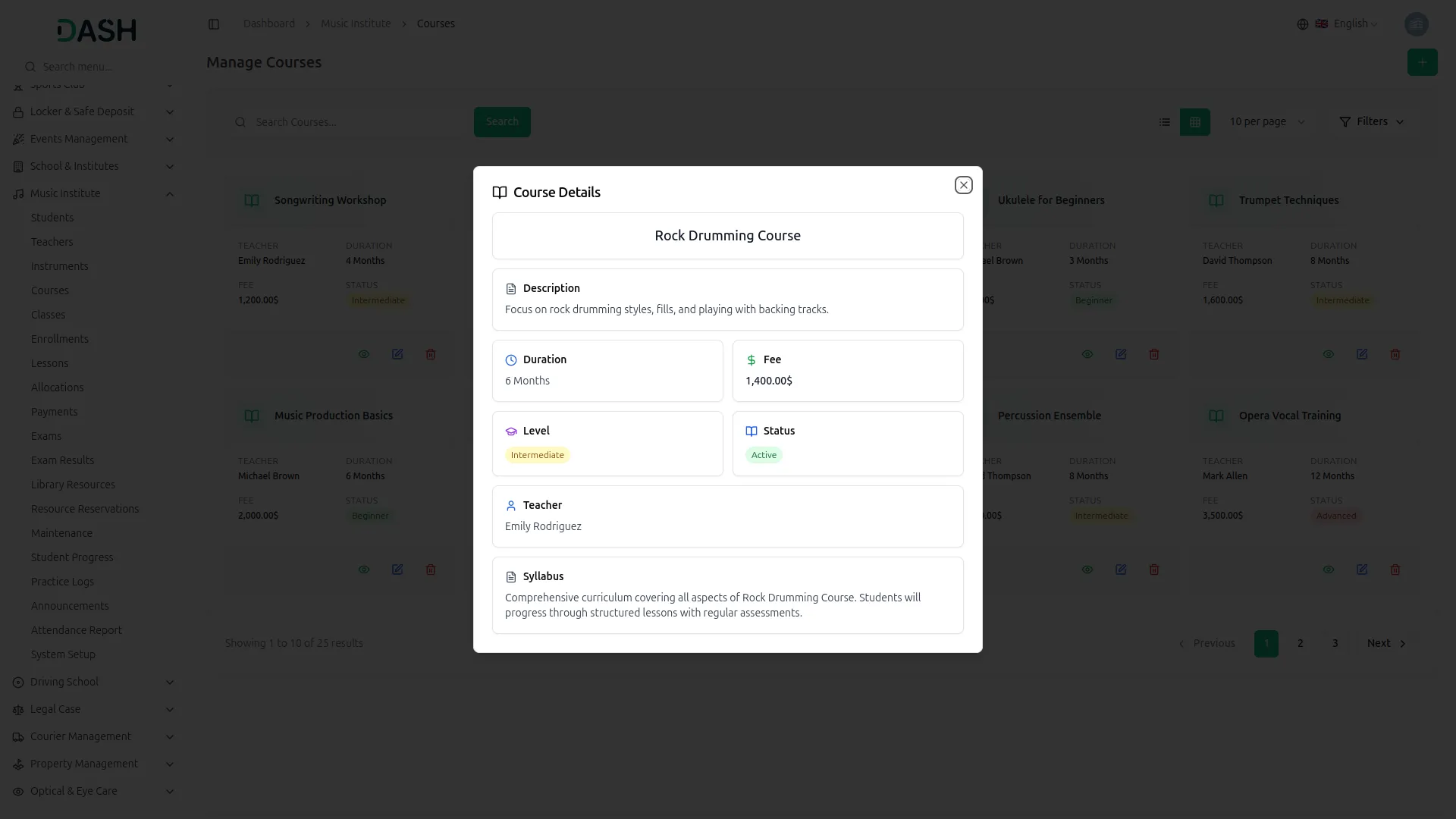
- In the Actions column, select View to see full course details, Edit to modify an existing course’s information, and Delete to permanently remove the course from the system.
Manage Classes
- To add a new class, click the “Create” button which is located on the Manage Classes page. In the form that opens, enter the Class Name and select a Course from the dropdown. Once a course is selected, the Teacher field will be populated accordingly. Select the Instrument to be used for the class.
- Set the Start Date Time and End Date Time using the date and time pickers to define the class schedule. Select a Location from the dropdown and choose the Schedule Type to indicate the frequency of the class. If a weekly schedule is selected, specify the Weekly Days on which the class will occur. Finally, select the Students to be enrolled in the class from the dropdown.
- Please note that once a class is created, the start/end time duration and schedule type cannot be updated.
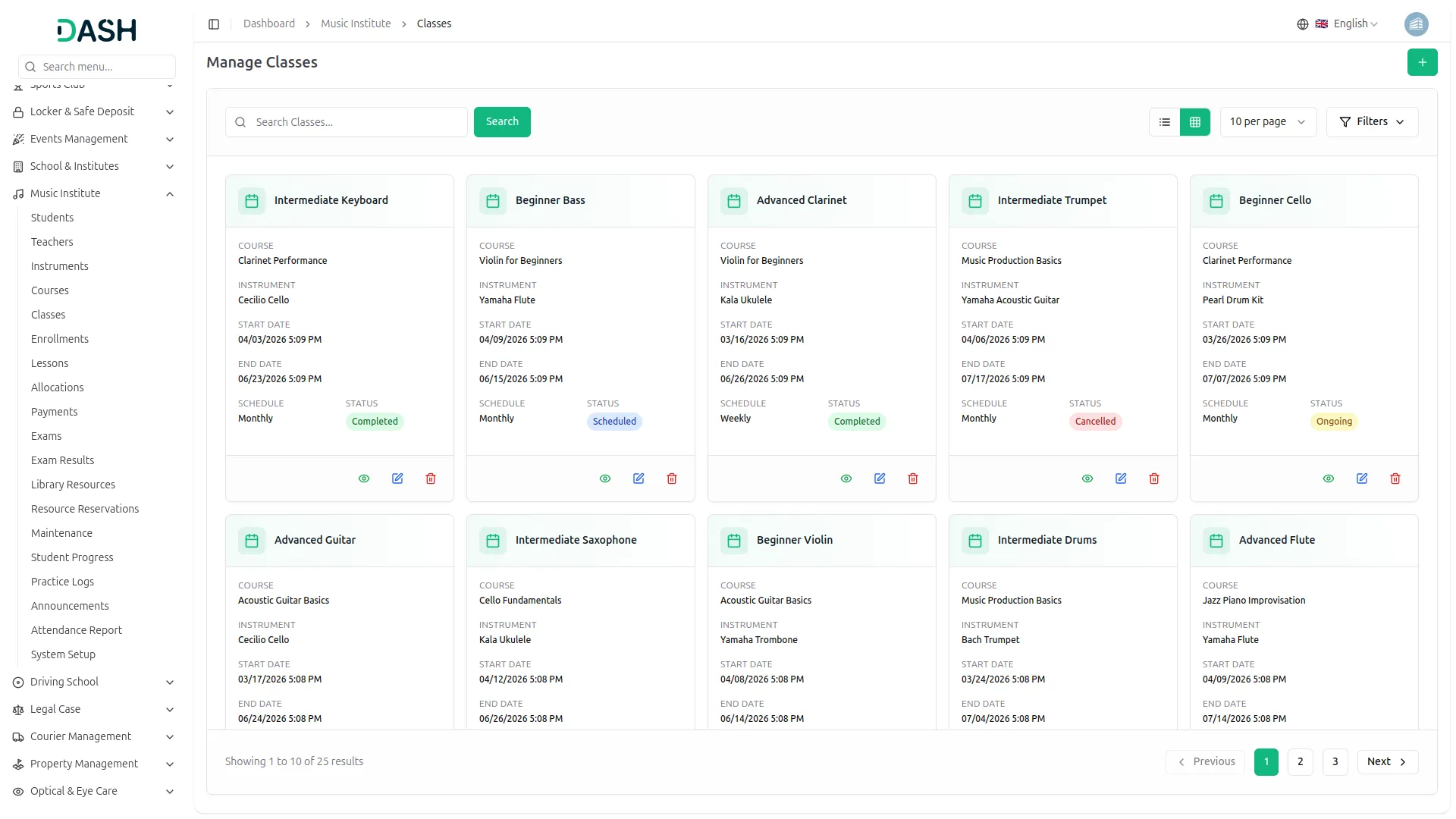
- The list page shows all classes in a table with columns for Class Name, Course, Instrument, Schedule Type, Start Date, End Date, Status, and Actions. The Status reflects the current state of the class, which may appear as Scheduled, Ongoing, Completed, or Cancelled.
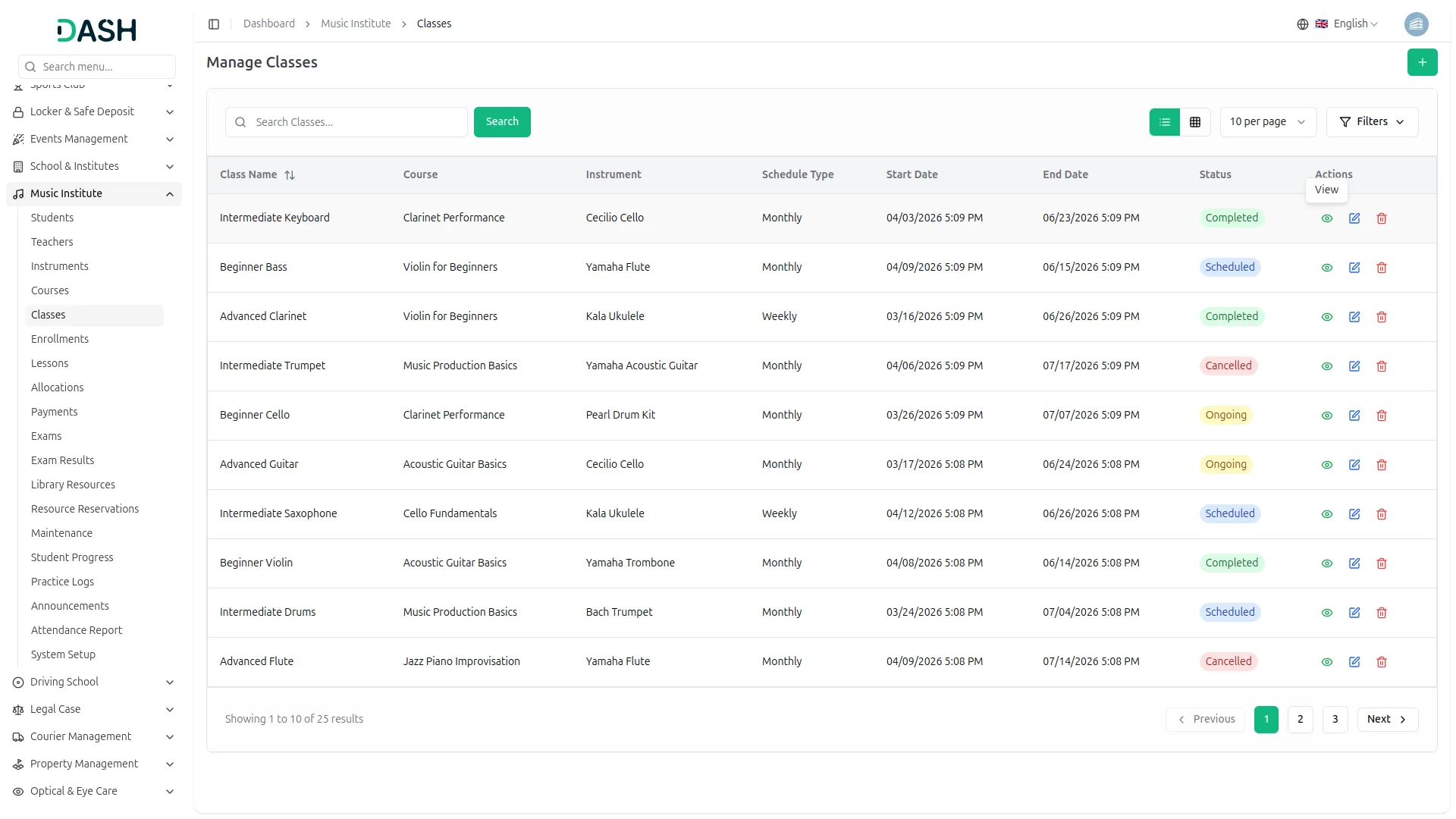
- Use the Search bar to find specific classes by name, and apply filters using the Schedule Type dropdown (All Schedule Types), Status dropdown (All Status), Teacher dropdown (All Teachers), and Course dropdown (All Courses). Click Apply to activate the selected filters or Clear to remove them. Toggle between list view and grid view using the view buttons.
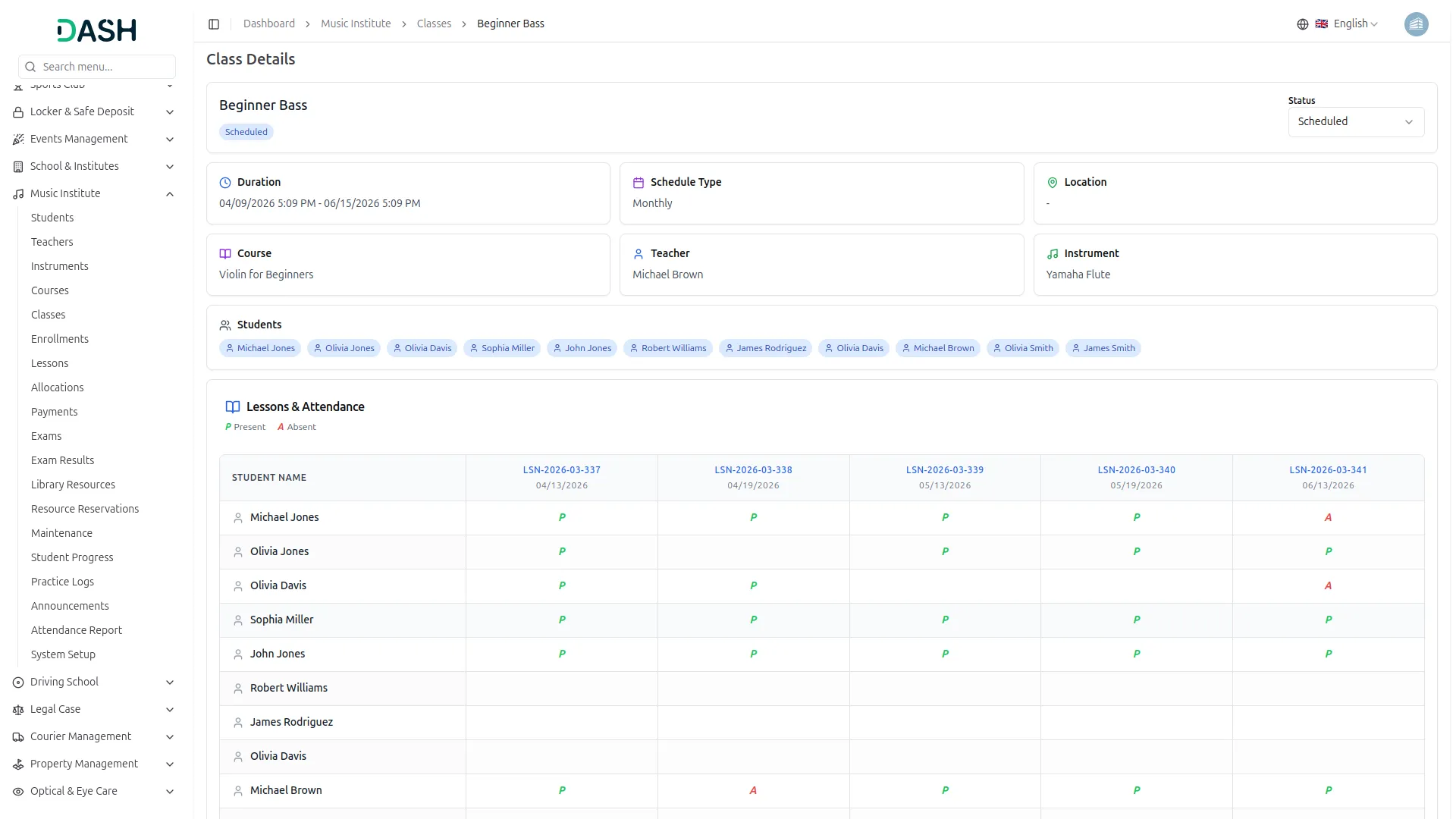
- Using the Actions column, select View to see full class details, Edit to modify an existing class’s information, and Delete to permanently remove the class from the system.
Manage Enrollments
- To add a new enrollment, click the “Create” button which is located on the Manage Enrollments page. In the form that opens, select a Course from the dropdown, then choose the Class associated with that course. Once a class is selected, the Student field will become available for selection. Set the Enrollment Date and Start Date using the date pickers, and optionally provide an End Date. The Enrollment Fee will be populated automatically based on the selected course. Add any additional Notes if needed.
- The list page shows all enrollments in a table with columns for Enrollment No, Student, Course, Class, Fee, Enrollment Date, Status, Payment, and Actions. The Enrollment No is displayed as a clickable reference for quick access to enrollment details. The Status column reflects the current state of the enrollment and can be updated directly from the list using the inline dropdown (pending, Approved, Rejected, Cancelled).
- Use the Search bar to find specific enrollments, and apply filters using the Enrollment Status dropdown (All Statuses), Payment Status dropdown (All Payments), Course dropdown (All Courses), and Class dropdown (All Classes). Click Apply to activate the selected filters or Clear to remove them. Toggle between list view and grid view using the view button.
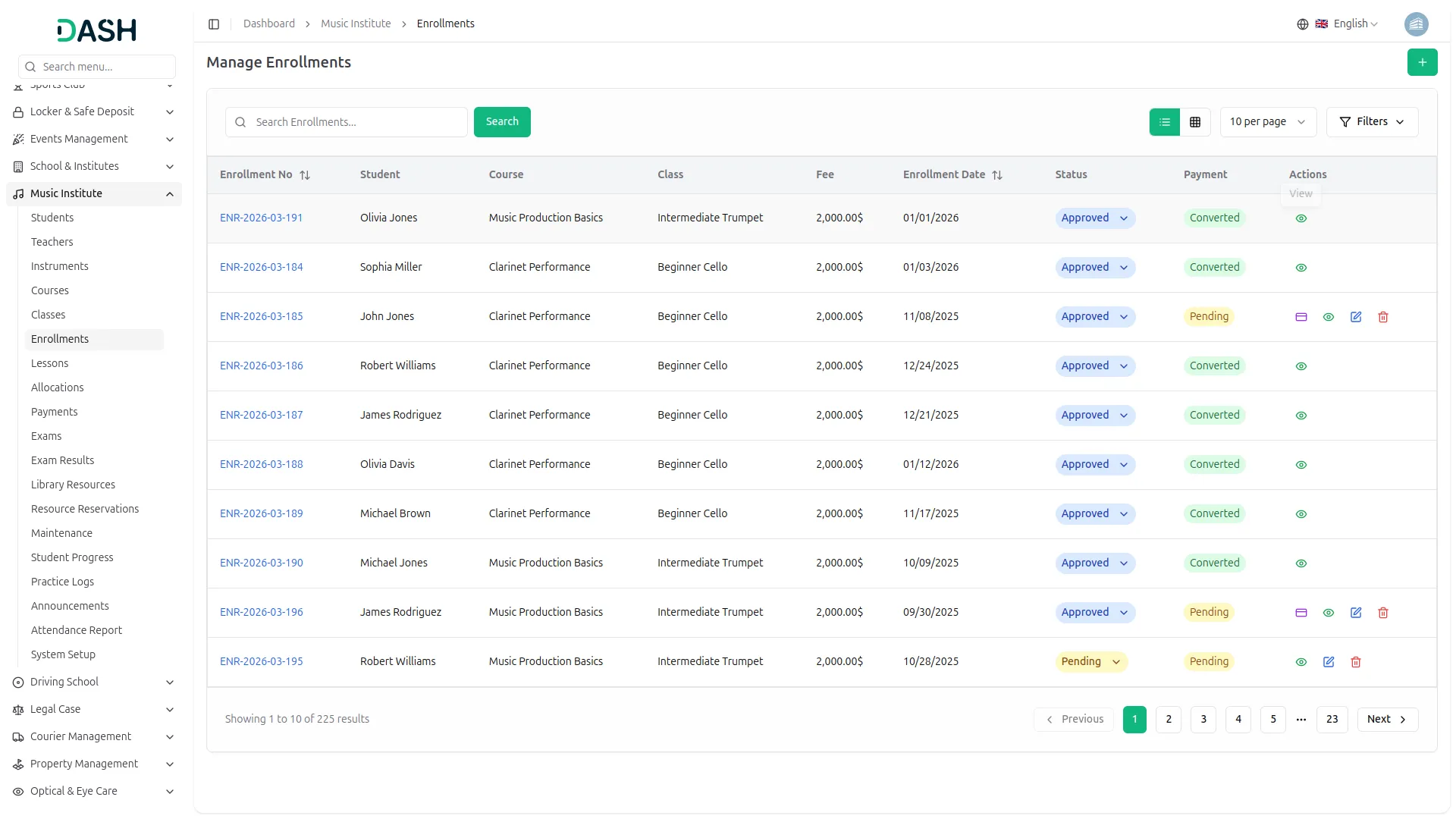
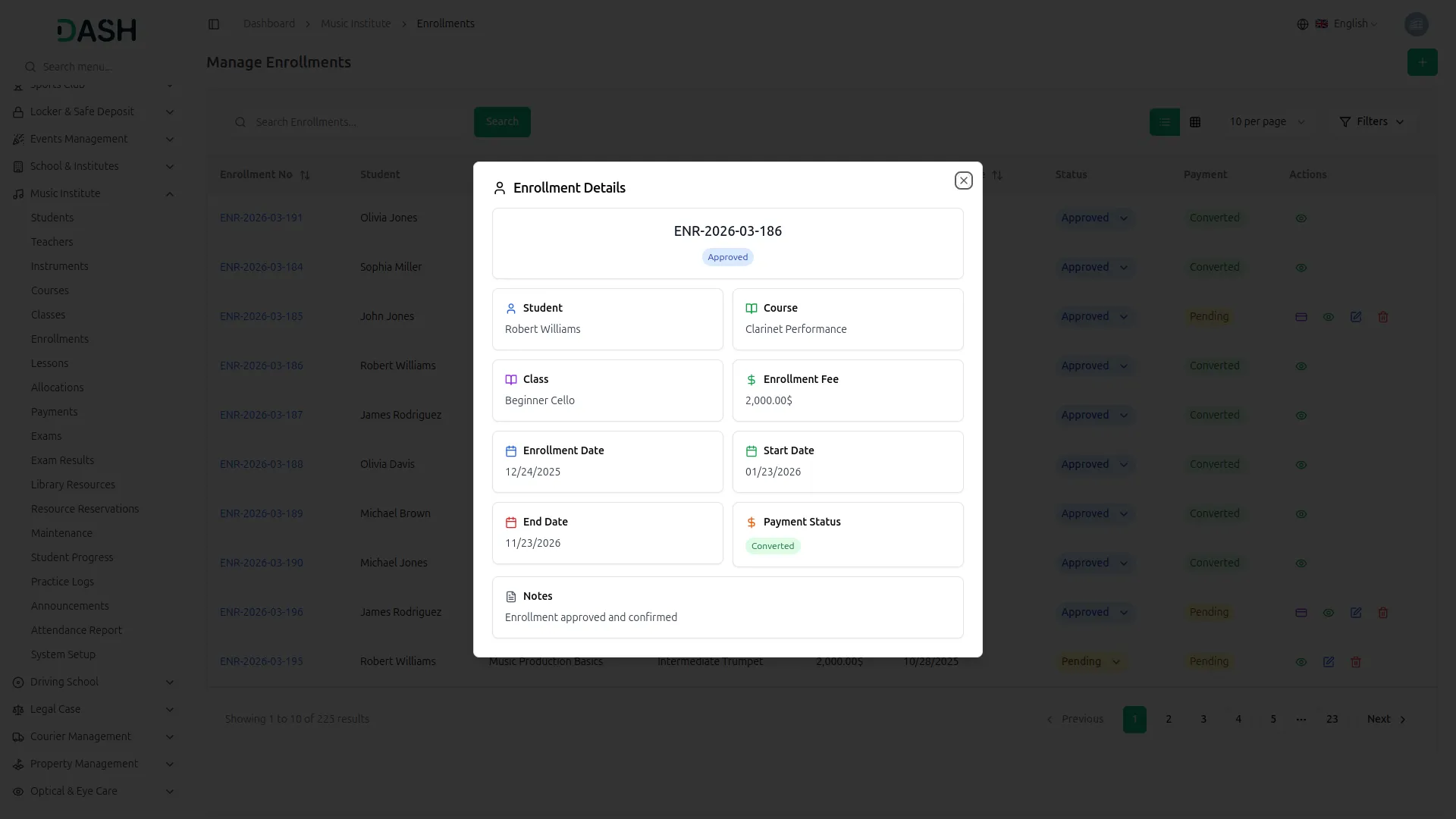
- In the Actions column, you can manage each enrollment using the available options. Select Add Payment to record a payment against the enrollment, View to see complete enrollment details, Edit to update existing enrollment information, or Delete to permanently remove the enrollment from the system.
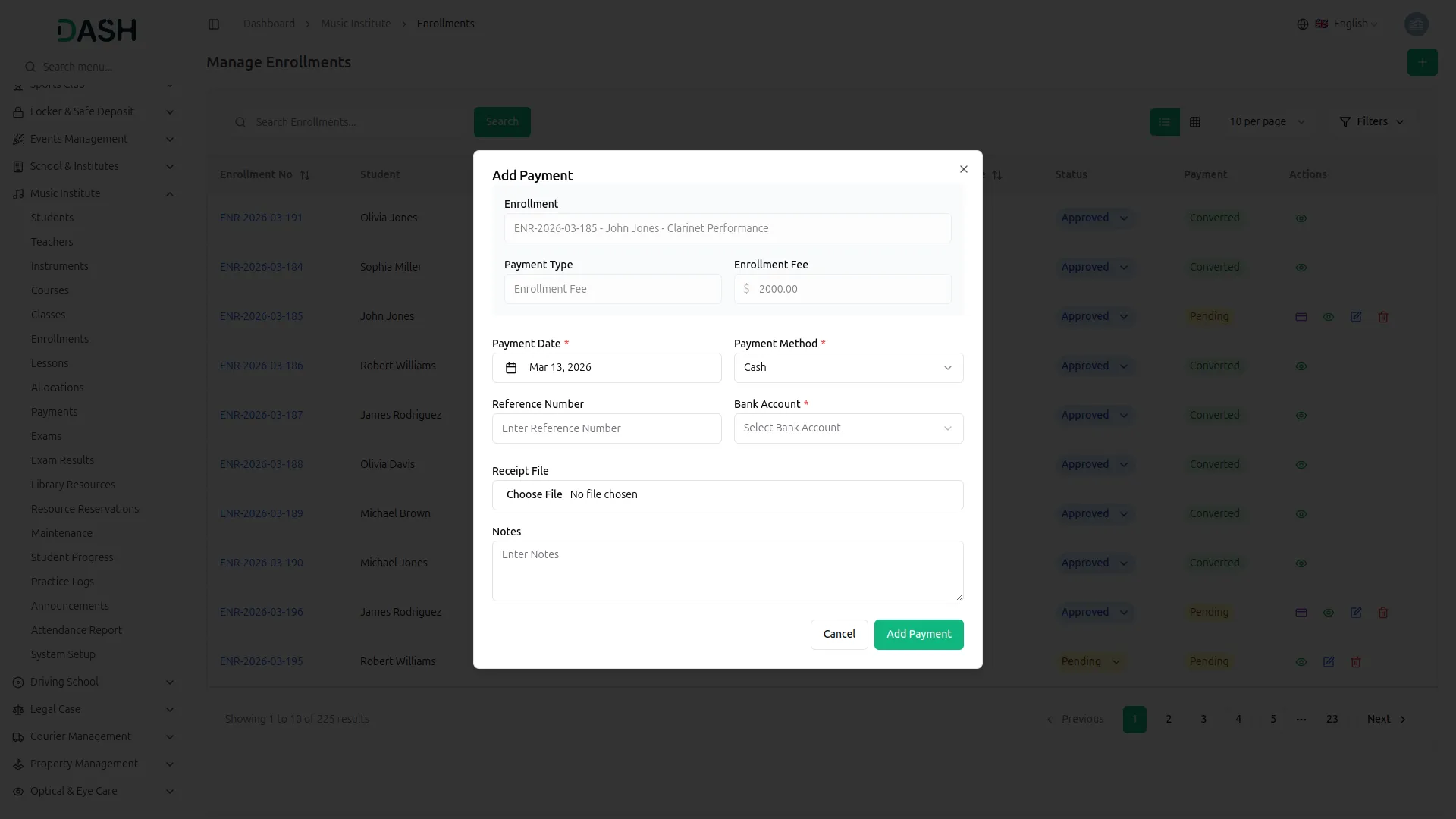
- When you click Add Payment, a form will open where the Enrollment Reference, Payment Type, and Enrollment Fee are displayed as read-only fields for your reference. You can then set the Payment Date and choose the Payment Method from the dropdown. Optionally, you may enter a Reference Number and select a Bank Account. If available, upload a Receipt File and add any relevant Notes before submitting the payment.
Manage Lessons
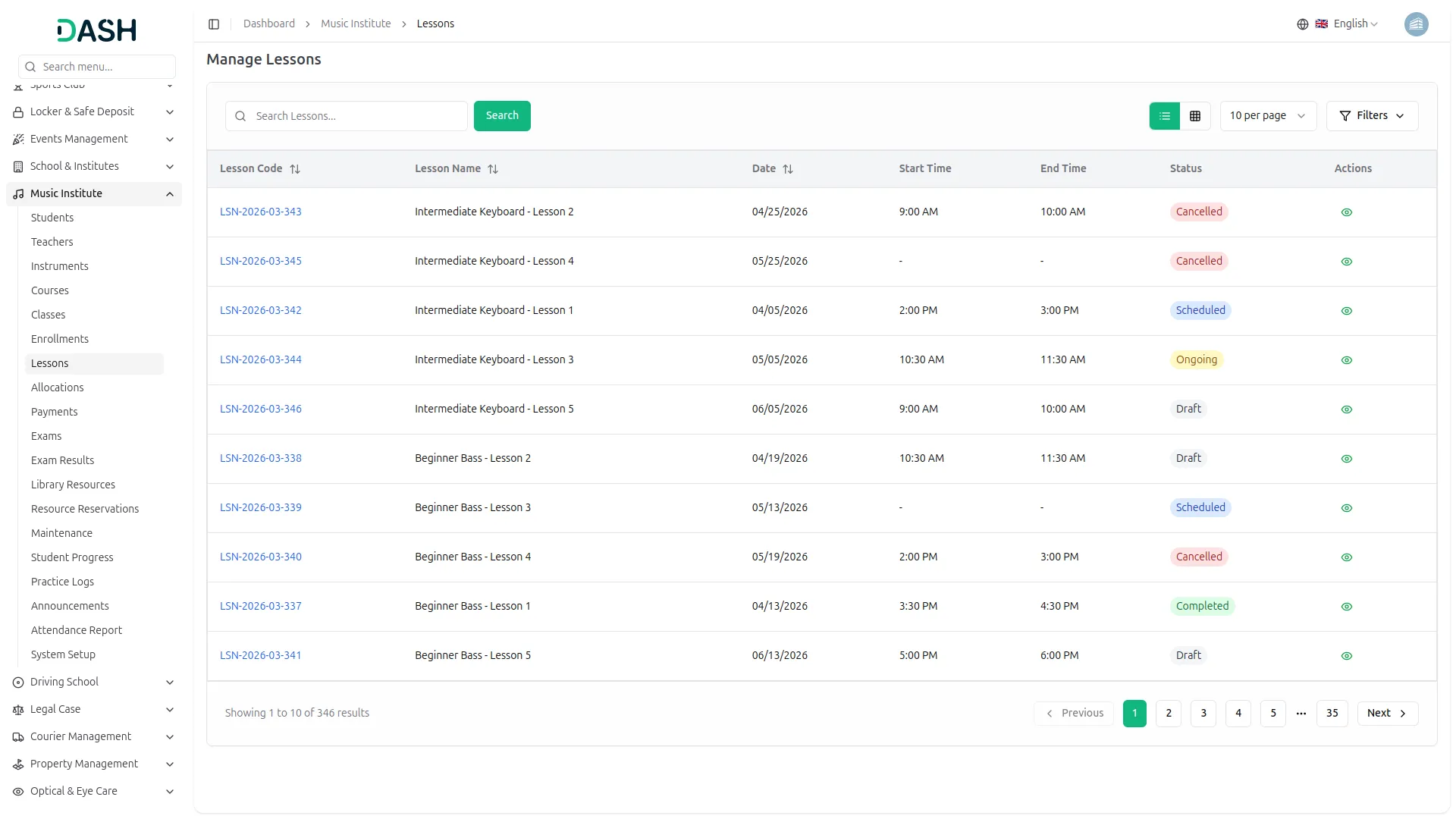
- Lessons are automatically generated by the system based on the class schedule and do not need to be created manually. The Manage Lessons page provides a consolidated view of all lessons across classe
- The list page shows all lessons in a table with columns for Lesson Code, Lesson Name, Date, Start Time, End Time, Status, and Actions. The Lesson Code is displayed as a clickable reference for quick access to lesson details. The Status reflects the current state of each lesson, which may appear as Draft, Scheduled, Ongoing, or Completed.
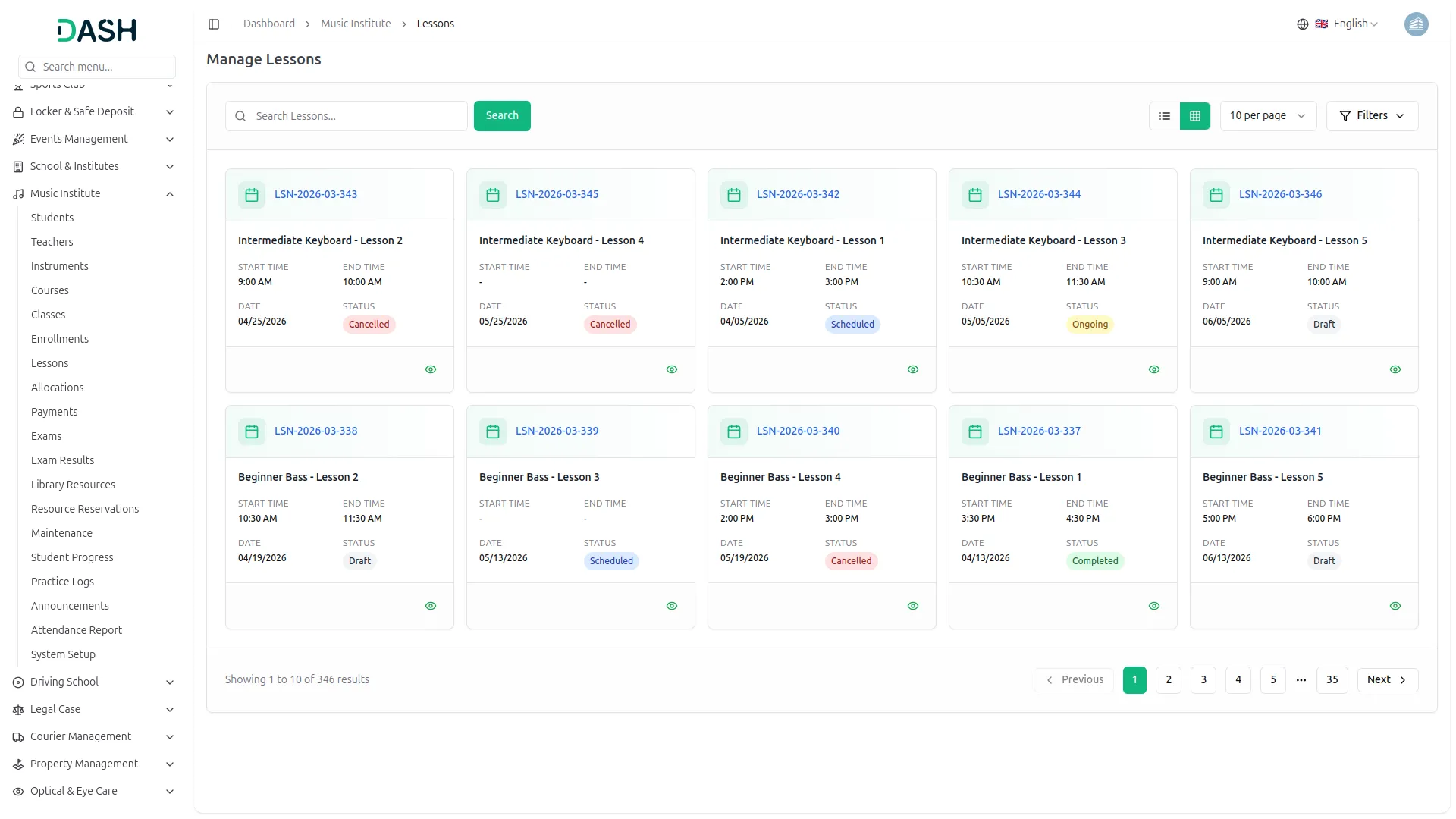
- Use the Search bar to find specific lessons by name, and apply filters using the Status dropdown (Filter by Status). Click Apply to activate the selected filter or Clear to remove it. Toggle between list view and grid view using the view buttons.
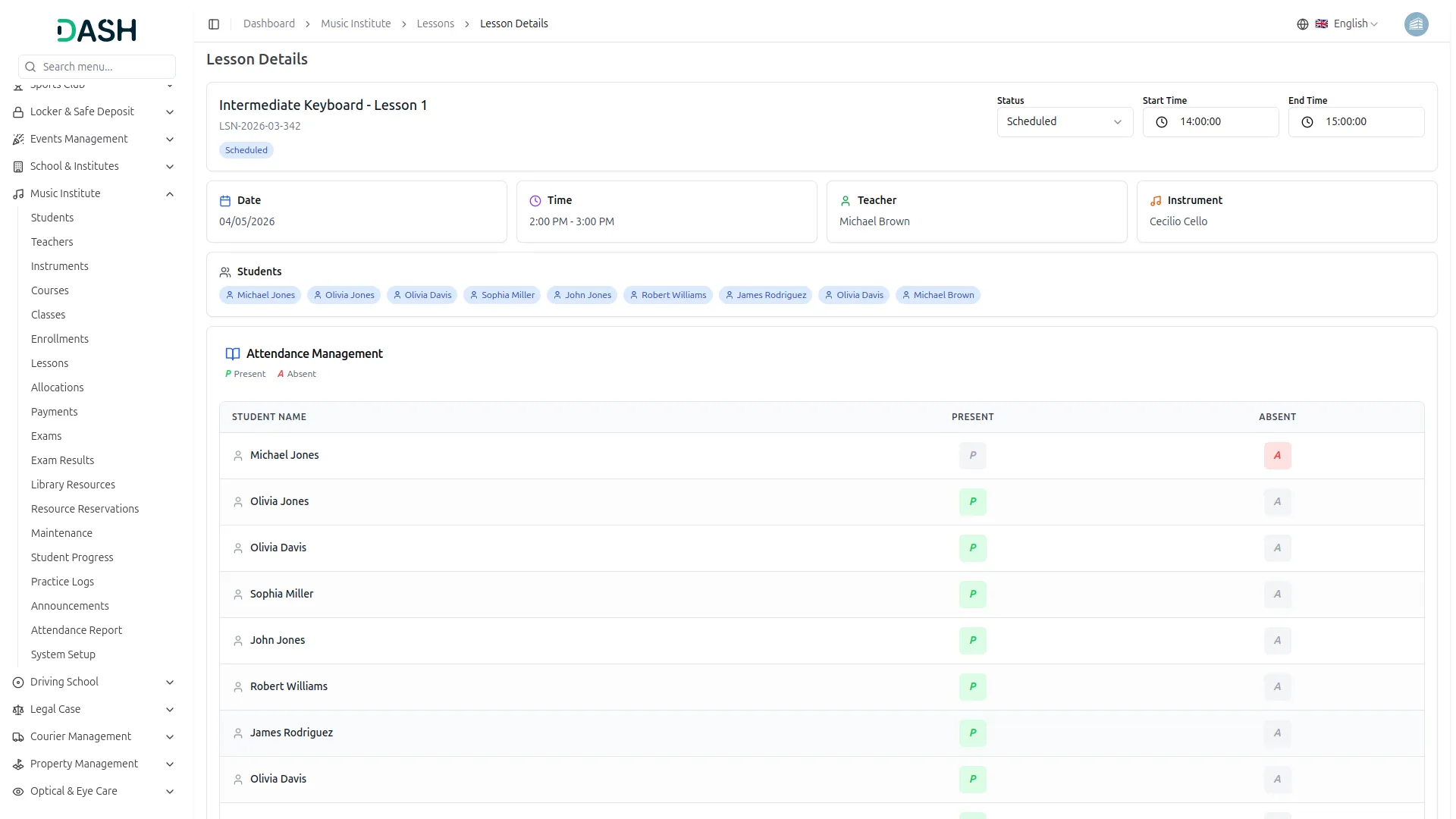
- In the Actions column, select View to open the full Lesson Details page. This page provides a complete overview of the selected lesson, including the Lesson Name and Lesson Code at the top, along with the current Status, Start Time, and End Time. Key information is neatly organized into four summary cards: Date, Time, Teacher, and Instrument.
- The Students section displays all students enrolled in the lesson’s class, shown as tagged entries for quick and easy reference.
- In the Attendance Management section, administrators can record attendance for each student. For every listed student, click “P” to mark them as Present or “A” to mark them as Absent. The selected option is visually highlighted for Present and red for Absent, making it easy to track attendance at a glance.
Manage Allocations
- To add a new allocation, click the “Create” button, which is located on the Manage Allocations page. In the form that opens, select the Instrument to be allocated from the dropdown.
- Choose the Allocate To type to specify whether the instrument is being assigned to a Student, Teacher, or a Class. Set the Allocation Date using the date picker and optionally provide an Expected Return date. Select the Condition of the instrument at the time of allocation from the dropdown.
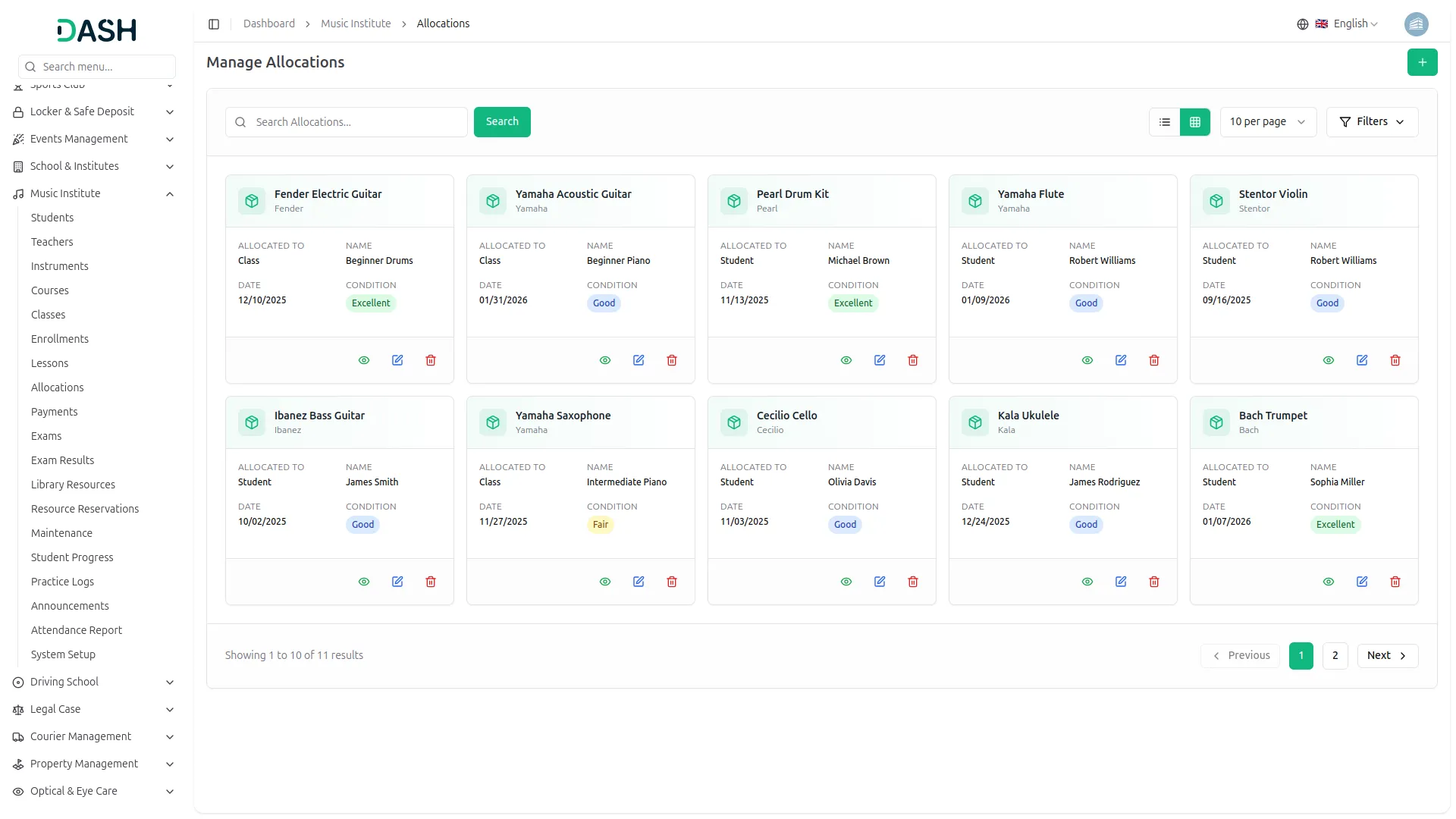
- The list page shows all allocations in a table with columns for Instrument, Allocated To, Name, Condition, Allocation Date, and Actions.
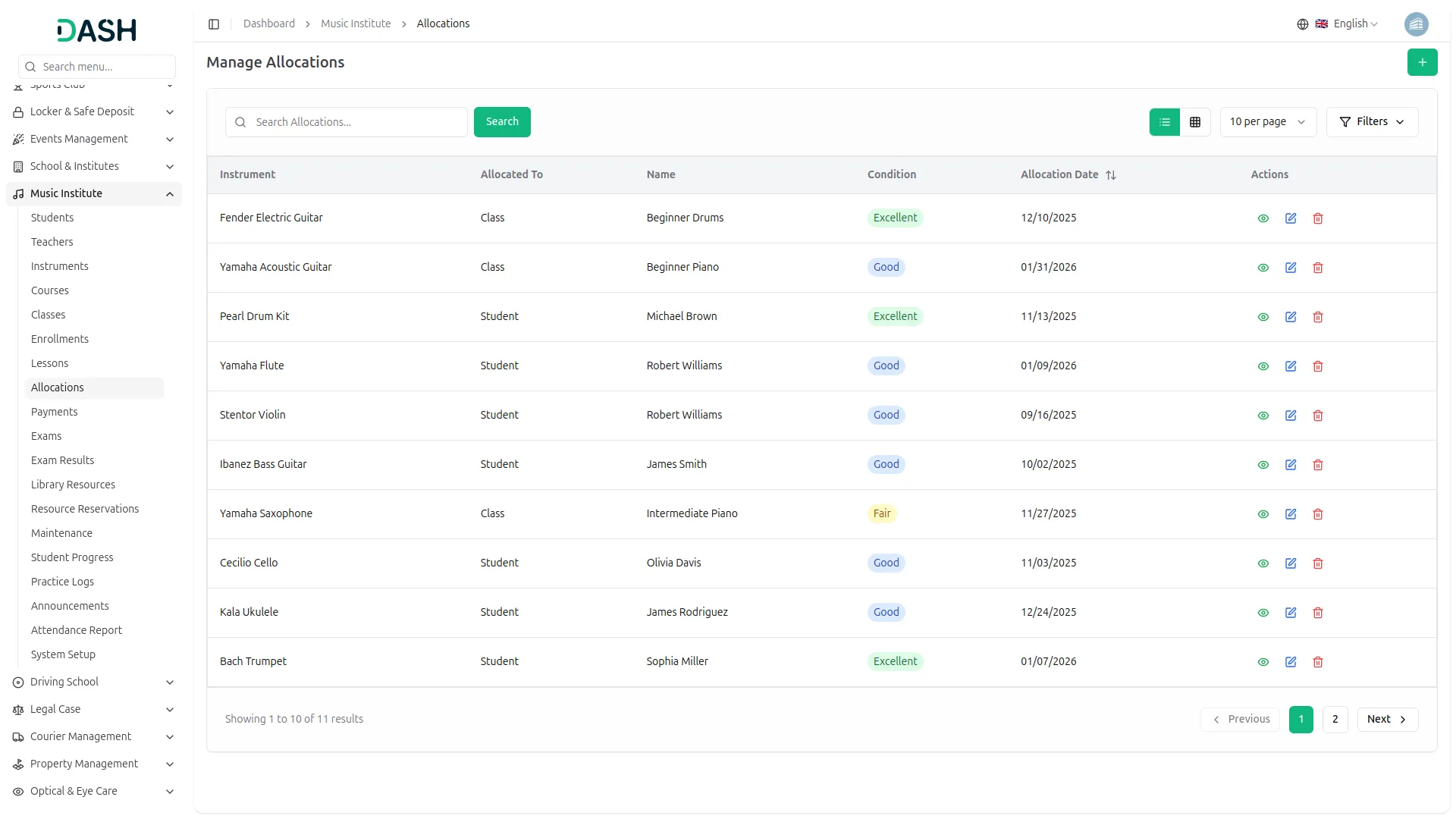
- Use the Search bar to find specific allocations, and apply filters using the Instrument dropdown (Filter by Instrument) and Condition dropdown (Filter by Condition). Click Apply to activate the selected filters or Clear to remove them. Toggle between list view and grid view using the view buttons.
- Using the Actions column, select View to see full allocation details, Edit to modify an existing allocation’s information, and Delete to permanently remove the allocation from the system.
Manage Payments
- The Manage Payments page provides a consolidated view of all payment entries recorded across enrollments. Payments are added from the Manage Enrollments section and are reflected here for tracking and management purposes.
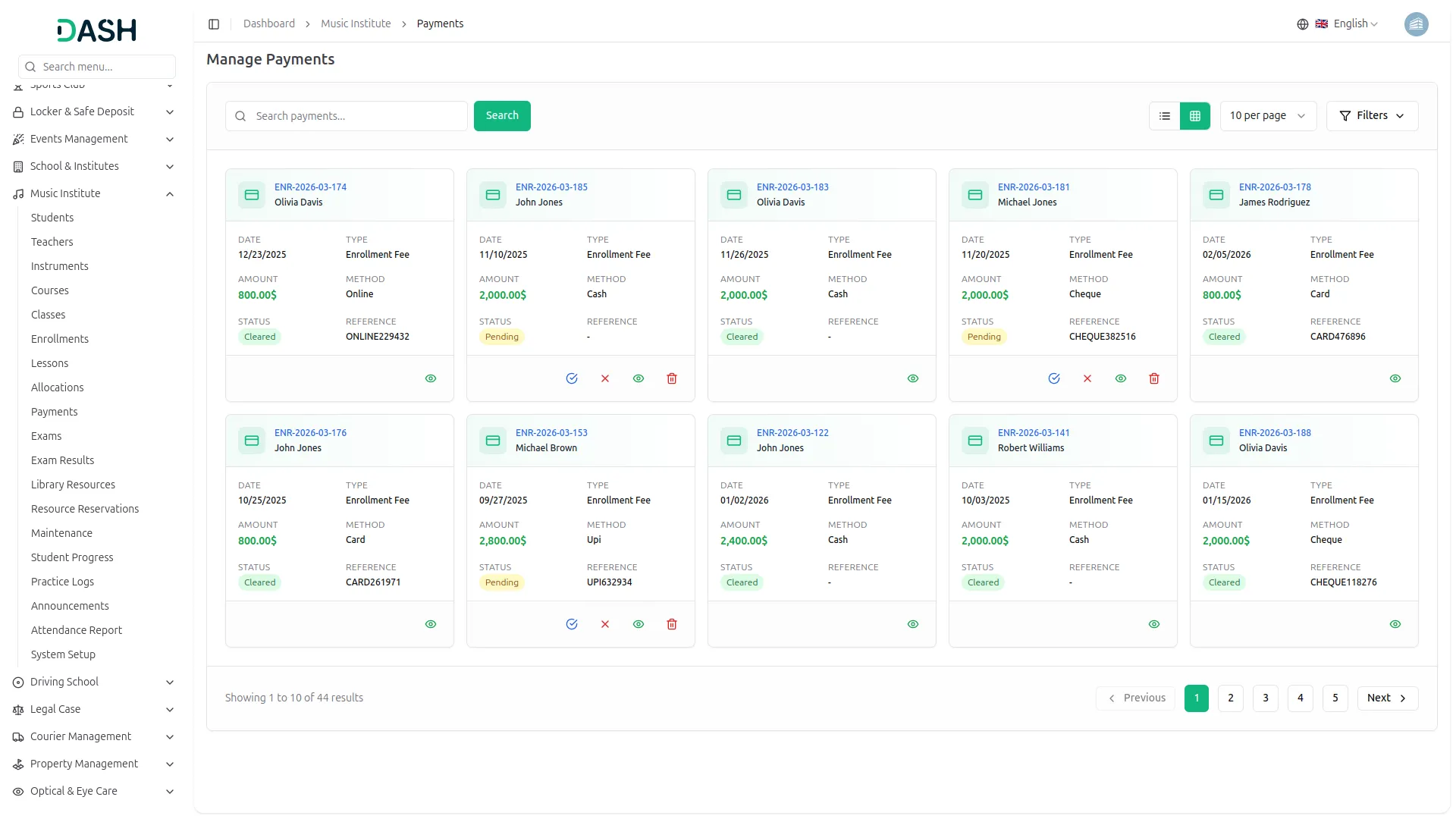
- The list page shows all payments in a table with columns for Payment For, Student, Date, Type, Amount, Method, Status, Reference, and Actions. The Payment For column displays the associated enrollment number as a clickable reference for quick access. The Status column indicates whether a payment is Pending or Cleared.
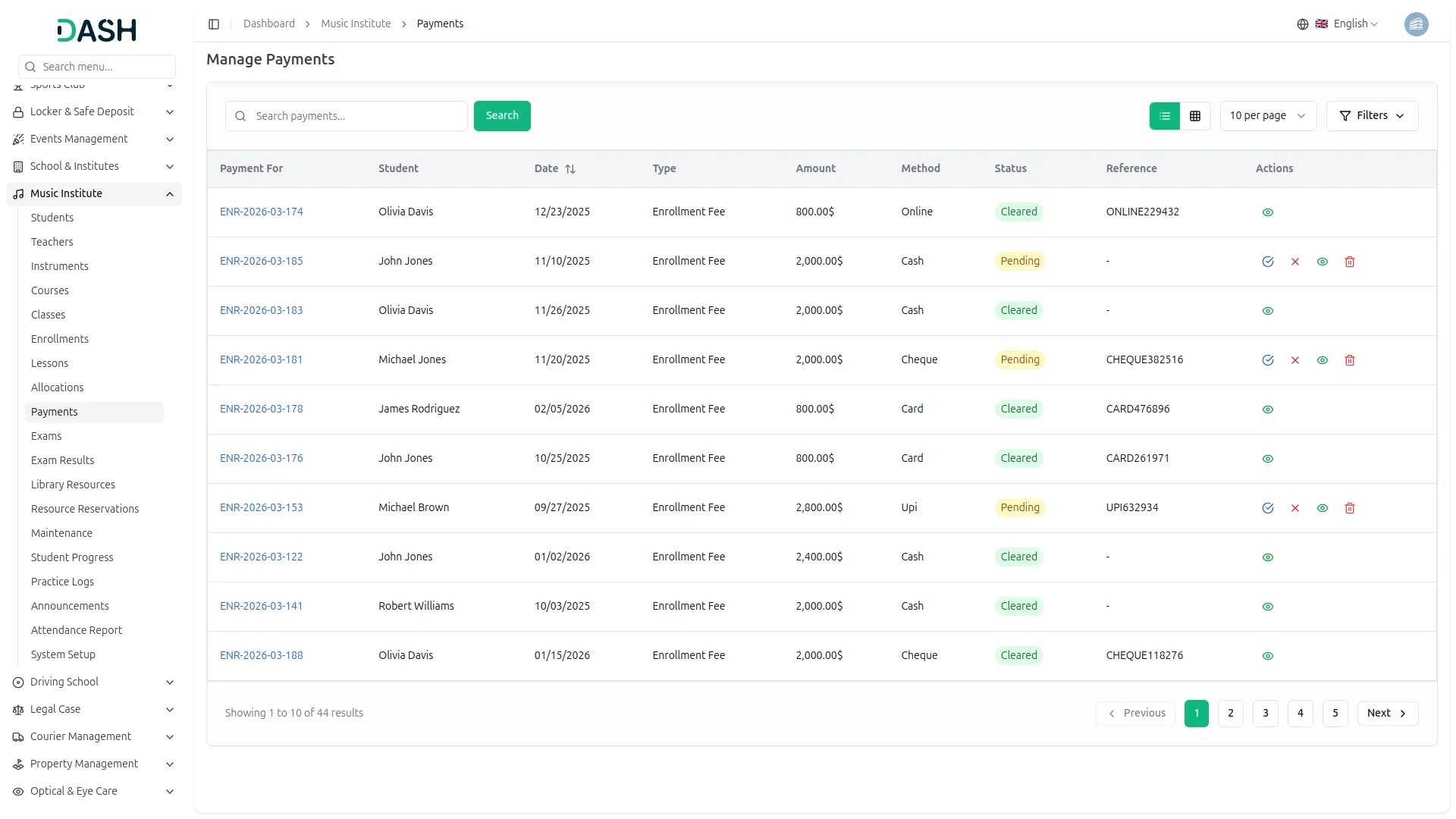
- Use the Search bar to find specific payments, and apply filters using the Payment Method dropdown (All Methods) and Status dropdown (All Status). Click Apply to activate the selected filters or Clear to remove them. Toggle between list view and grid view using the view buttons.
- In the Actions column, select Mark as Cleared to confirm and update a pending payment to a cleared status, View to see the full payment details, and Delete to permanently remove a pending payment entry from the system. Note that payments with a Cleared status only have the View option available, as cleared payments cannot be modified or deleted.
Manage Exams
- To add a new exam, click the “Create” button, which is located on the Manage Exams page. In the form that opens, enter the Exam Name and select the Exam Date using the date picker. Choose the Exam Type from the dropdown and select the Location where the exam will be held.
- Select the Class from the dropdown, and the associated Course will be populated automatically. Set the Start Time and End Time to define the exam duration. Optionally, add a Description to provide additional context about the exam. Enter the Max Marks and Passing Marks to define the scoring criteria.
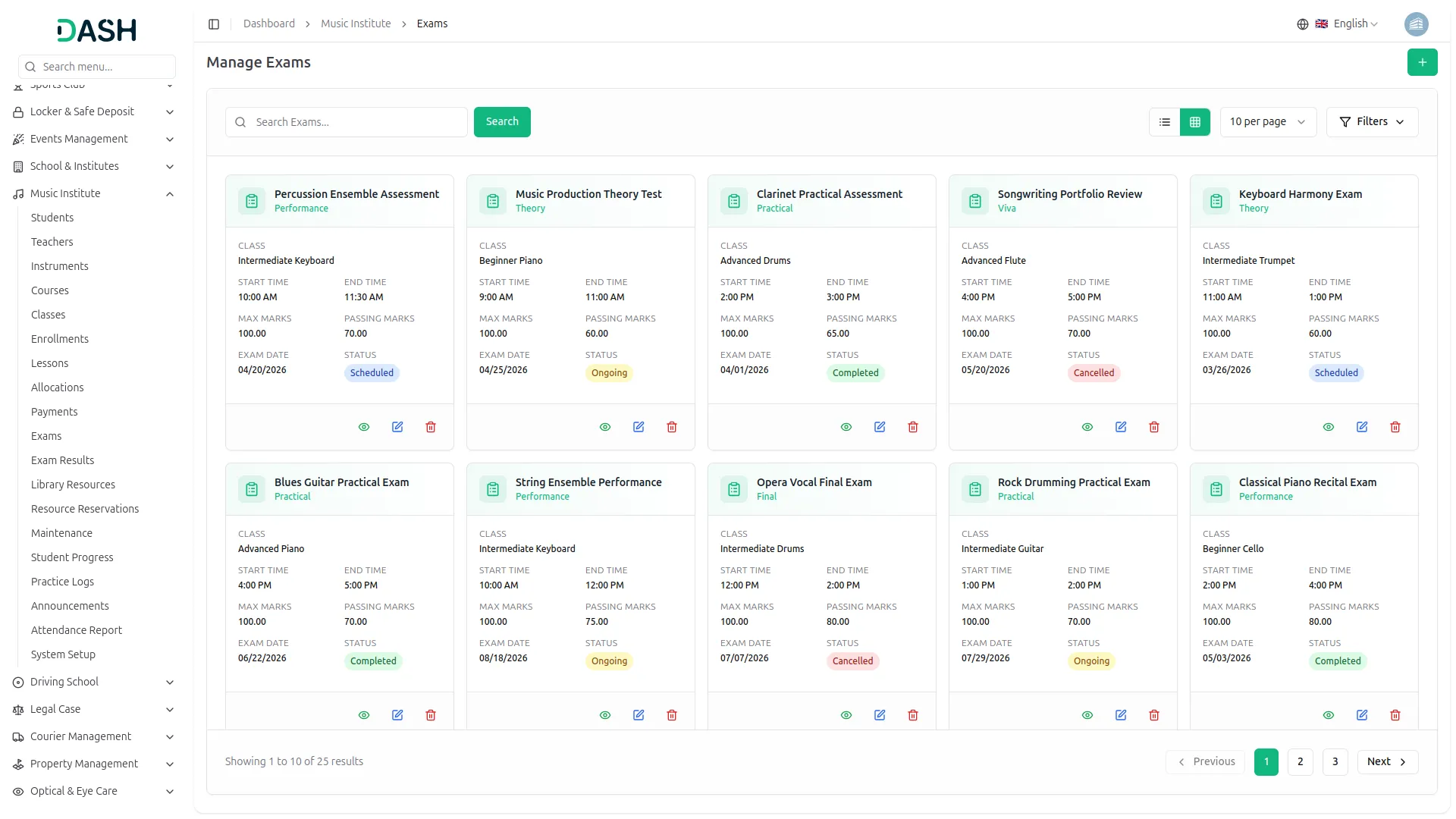
- The list page shows all exams in a table with columns for Exam Name, Exam Type, Class, Exam Date, Time, Marks, Status, and Actions. The Status column reflects the current state of each exam, which may appear as Scheduled, Ongoing, Completed, or Cancelled.
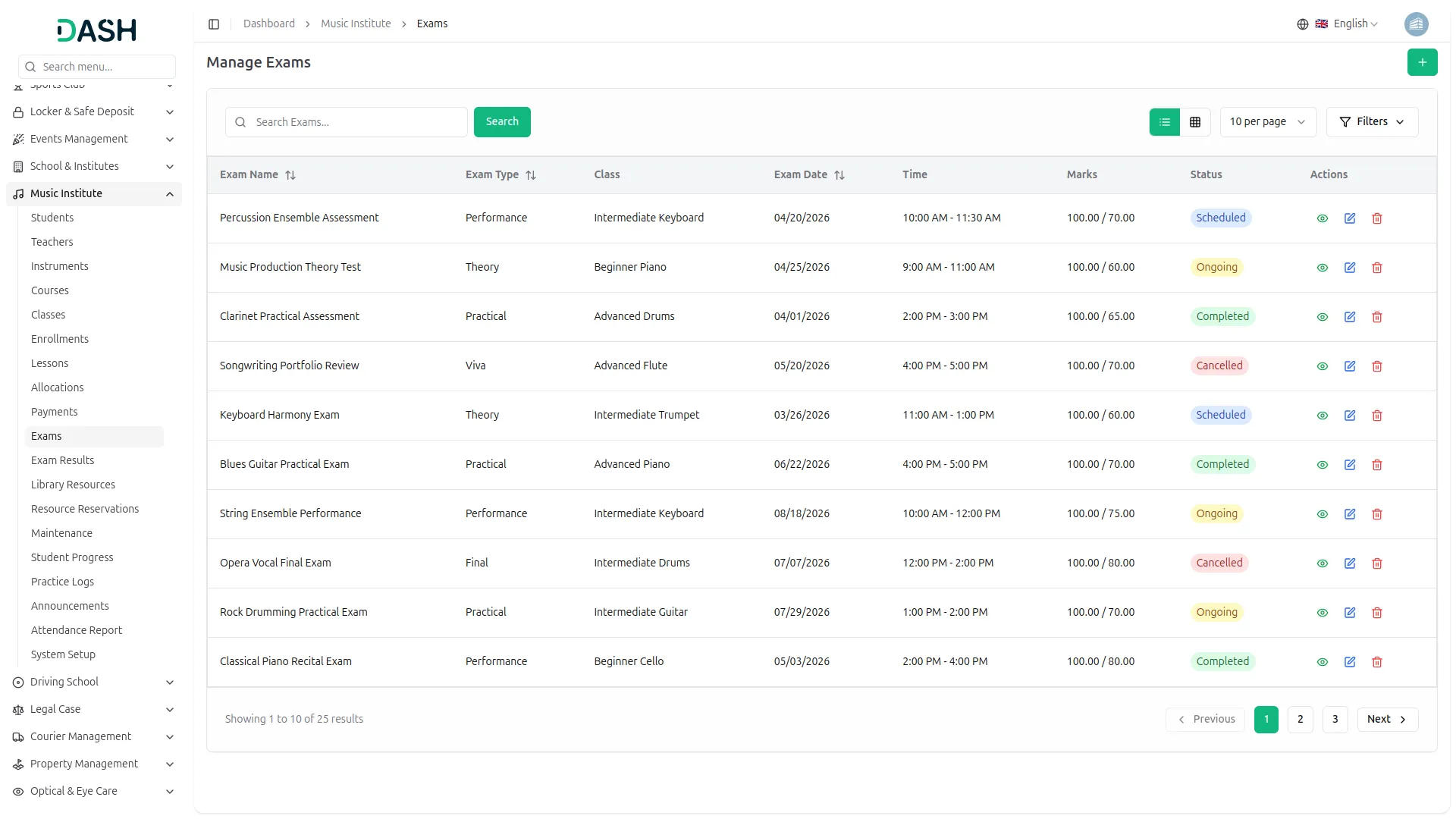
- Use the Search bar to find specific exams by name, and apply filters using the Exam Type dropdown (All Exam Types), Class dropdown (All Classes), and Status dropdown (All Statuses). Click Apply to activate the selected filters or Clear to remove them. Toggle between list view and grid view using the view buttons.
- Using the Actions column, select View to see full exam details, Edit to modify an existing exam’s information, and Delete to permanently remove the exam from the system.
Exam Results
- To add a new exam result, click the “Create” button, which is located on the Manage Exam Results page. In the form that opens, select the Exam from the dropdown, and the associated Class will be populated automatically. Once an exam is selected, the Student field will become available for selection.
- Enter the Marks Obtained and Percentage for the student. Select the Grade from the dropdown and optionally enter the Rank. Select the Result to indicate whether the student has Passed or Failed. Add any optional Remarks to provide additional context about the student’s performance.
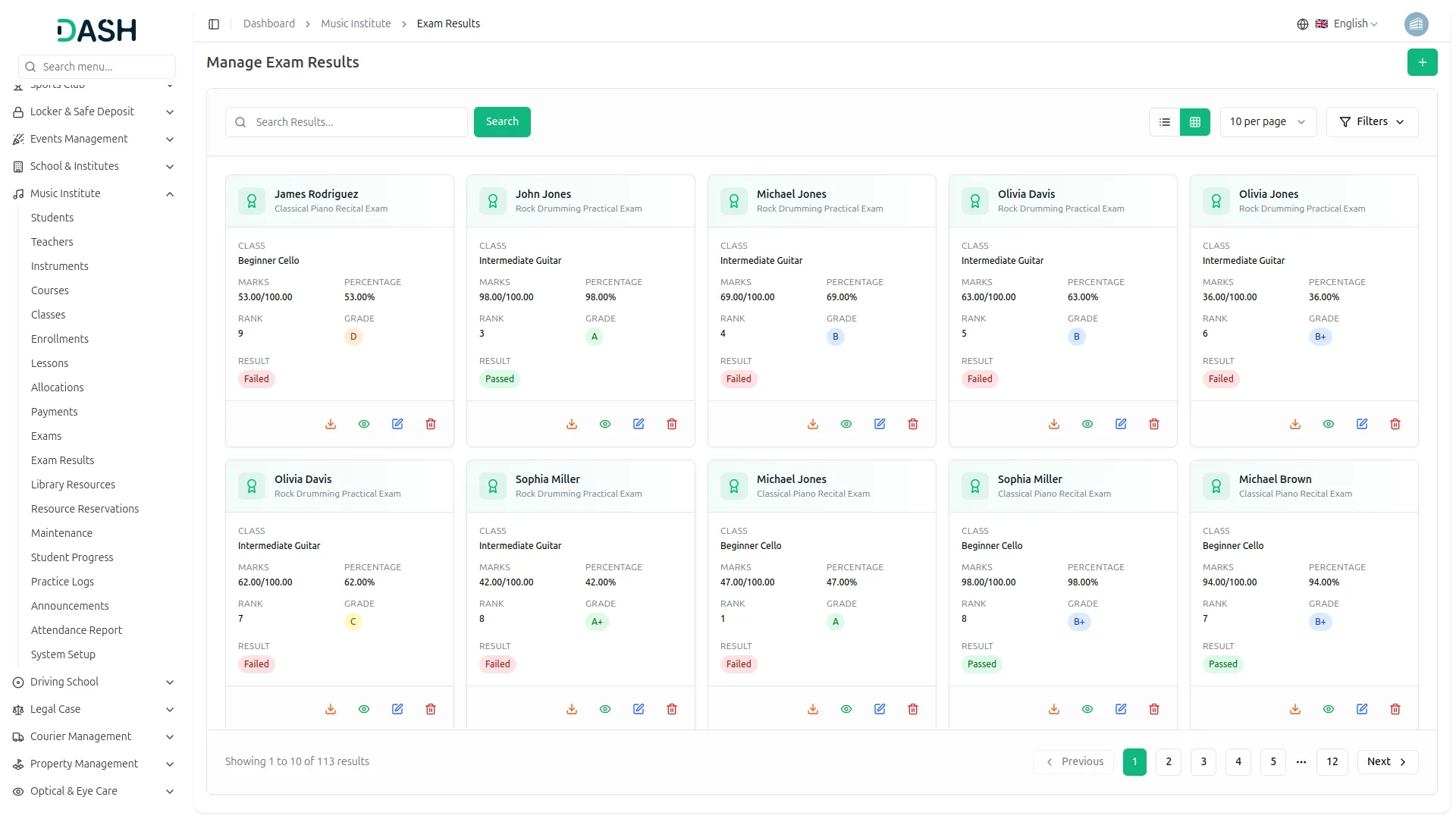
- The list page shows all exam results in a table with columns for Student, Exam, Class, Marks, Percentage, Grade, Result, Rank, and Actions.
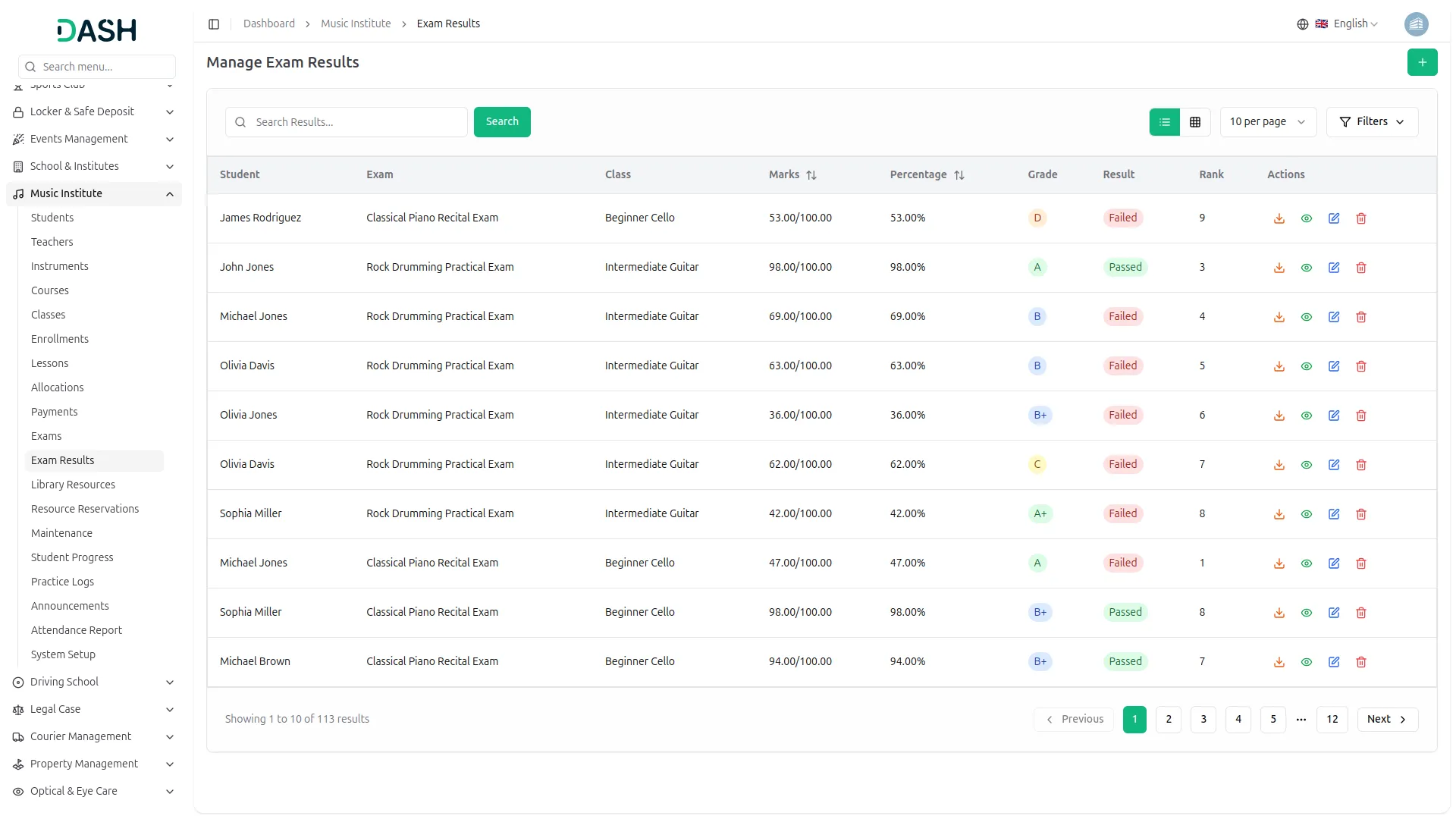
- Use the Search bar to find specific results, and apply filters using the Exam dropdown (All Exams), Student dropdown (All Students), Grade dropdown (All Grades), and Result dropdown (All Results). Click Apply to activate the selected filters or Clear to remove them. The page also allows you to toggle between list view and grid view.
- In the Actions column, select Download to export the result record, View to see full result details, Edit to modify an existing result’s information, and Delete to permanently remove the result from the system.
Library Resources
- To add a new library resource, click the “Create” button, which is located on the Manage Library Resources page. In the form that opens, enter the Title of the resource and the Author’s name.
- Select the Resource Type from the dropdown and enter the Category to classify the resource. Optionally, provide the ISBN, Publisher, and Publication Date for reference. Enter the Location where the resource is physically stored and specify the Total Copies available. Add a Description to provide additional context about the resource if needed.
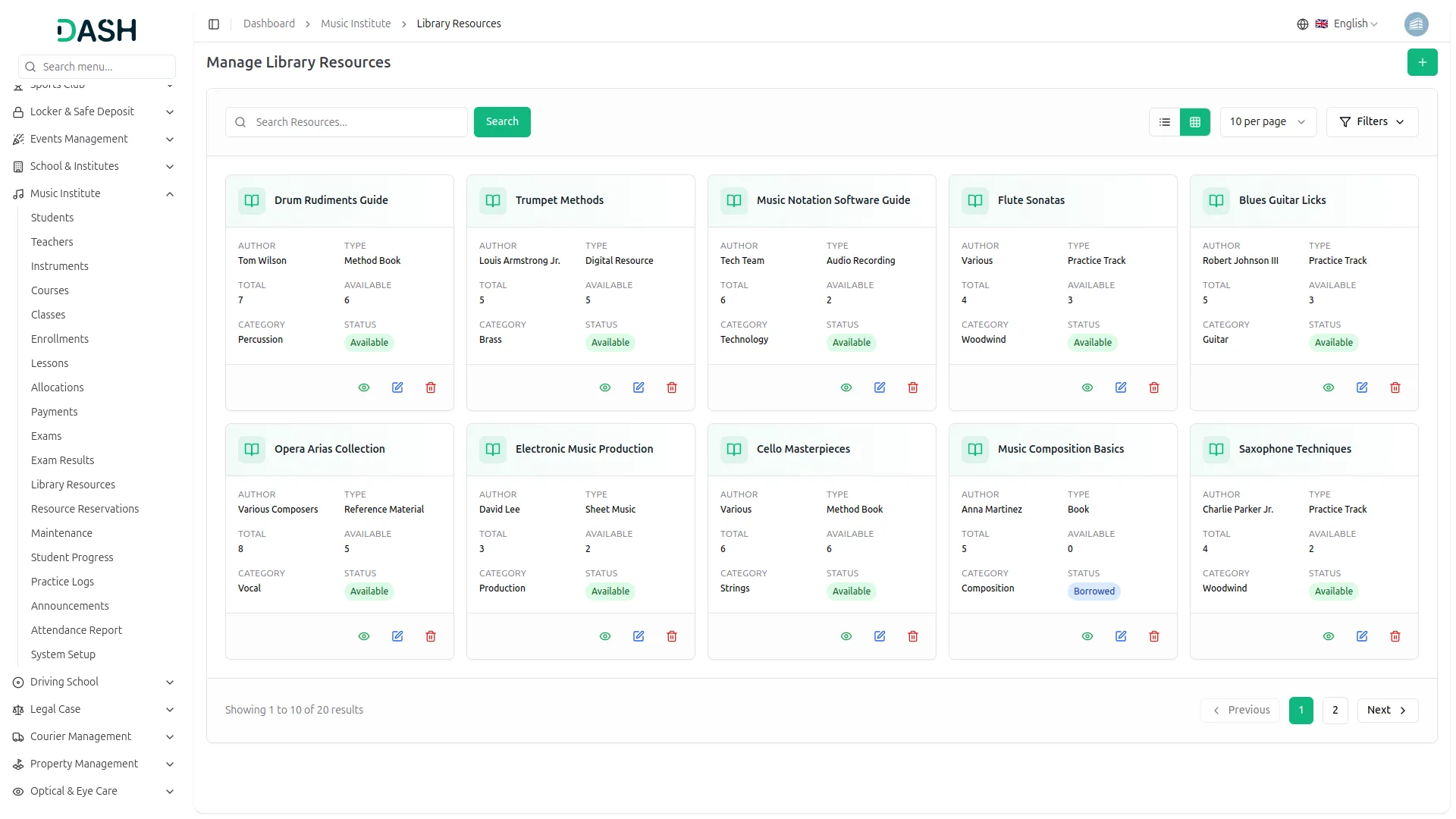
- The list page shows all library resources in a table with columns for Title, Author, Type, Category, Total, Available, Status, and Actions.
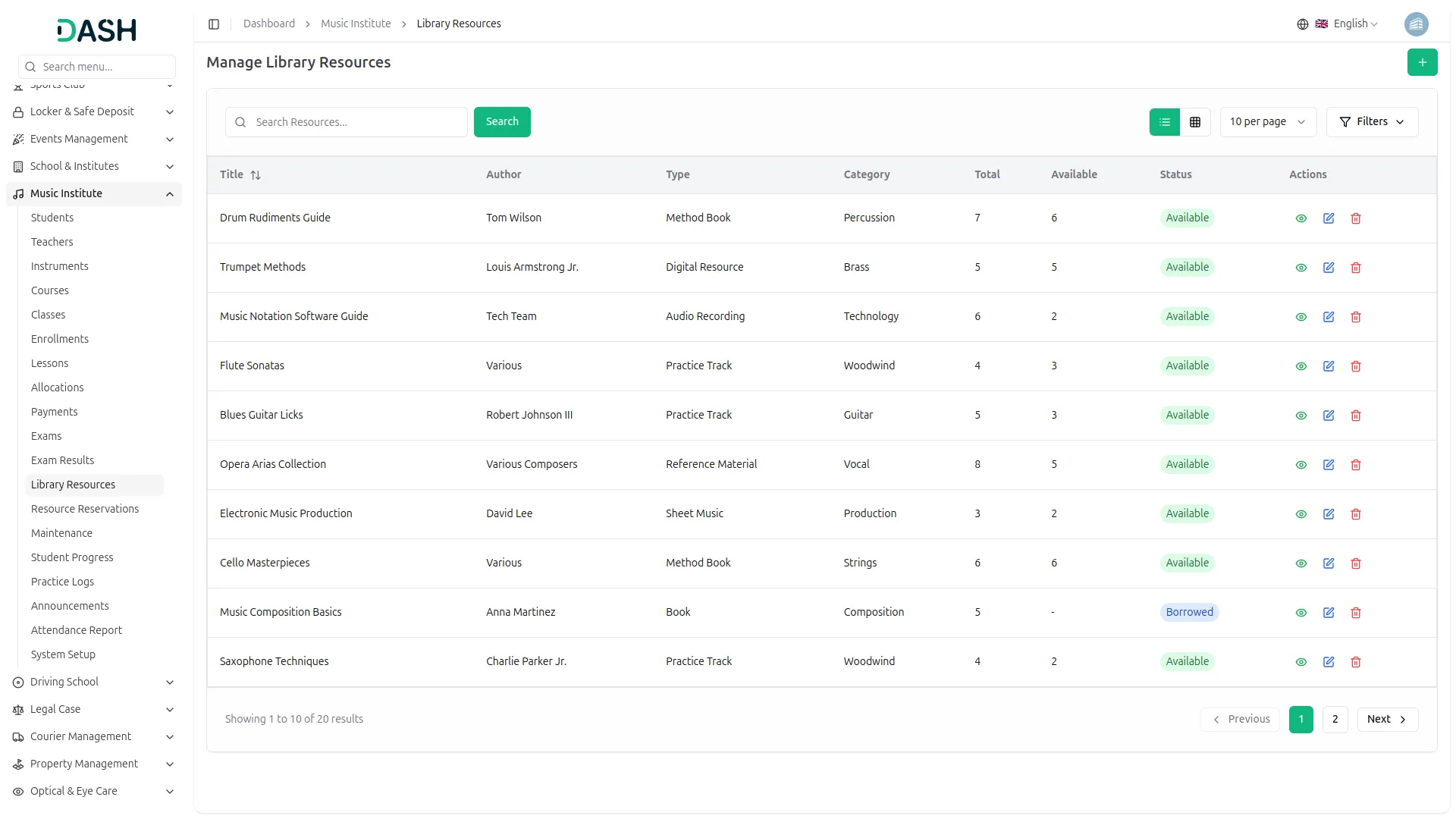
- Use the Search bar to find specific resources by title, and apply filters using the Type dropdown (Filter by Type) and Status dropdown (Filter by Status). Click Apply to activate the selected filters or Clear to remove them. The page also allows you to toggle between list view and grid view.
- Using the Actions column, select View to see full resource details, Edit to modify an existing resource’s information, and Delete to permanently remove the resource from the system.
Resource Reservations
- To add a new resource reservation, click the ”Create” button, which is located on the Manage Resource Reservations page. In the form that opens, select the Resource to be reserved from the dropdown and choose the Reserved By Type to specify whether the reservation is being made by a Student or a Teacher.
- Select the respective Student or Teacher from the dropdown that appears based on the type chosen. Set the Reserved Date using the date picker and optionally provide a Return Date. Select the Condition of the resource at the time of reservation and set the Status to reflect the current state of the reservation. Add any additional Notes if needed.
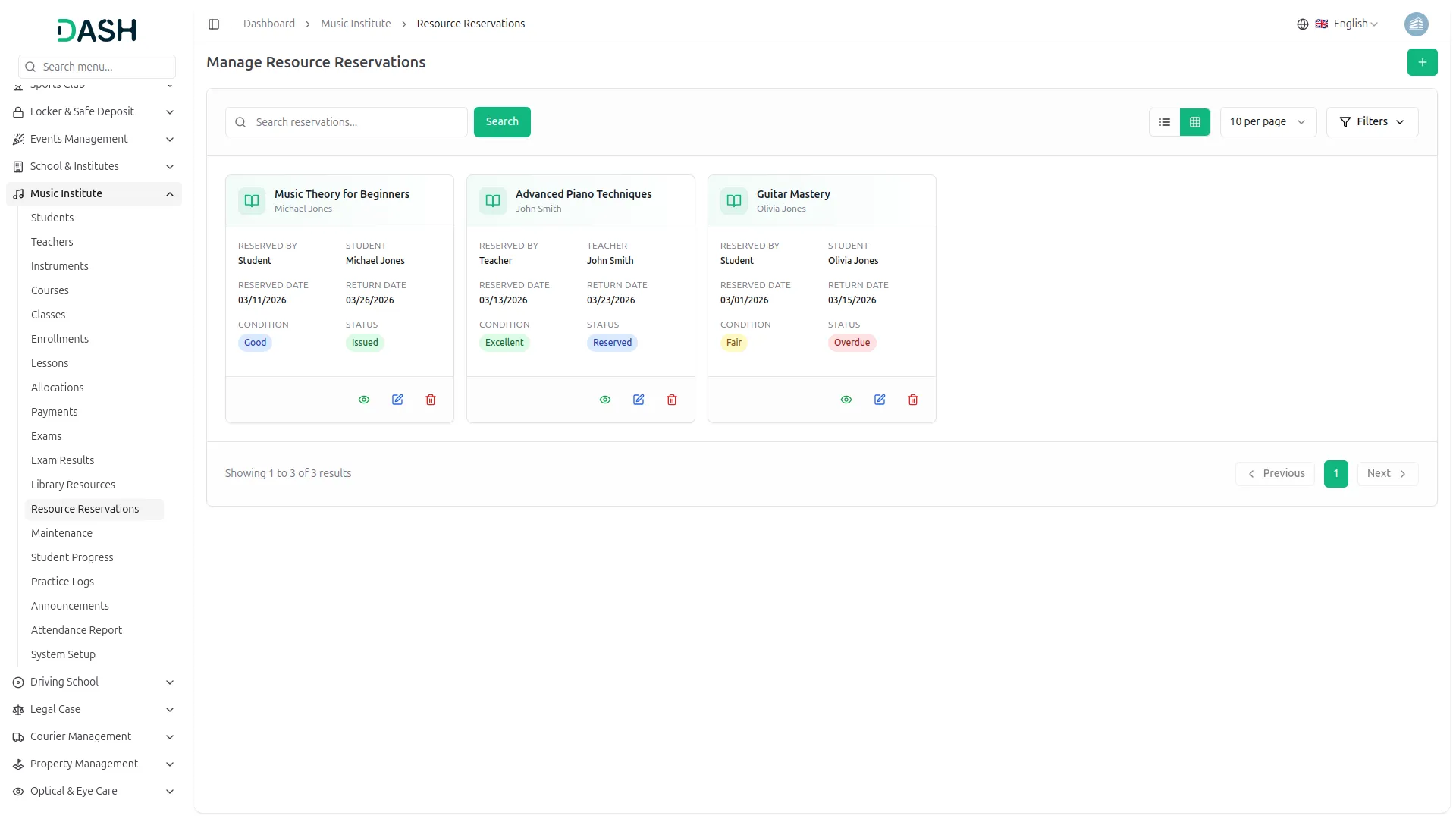
- The list page shows all resource reservations in a table with columns for Resource, Reserved By, Reserved Date, Return Date, Condition, Status, and Actions. The Status column reflects the current state of the reservation, which may appear as Reserved, Issued, or Overdue.
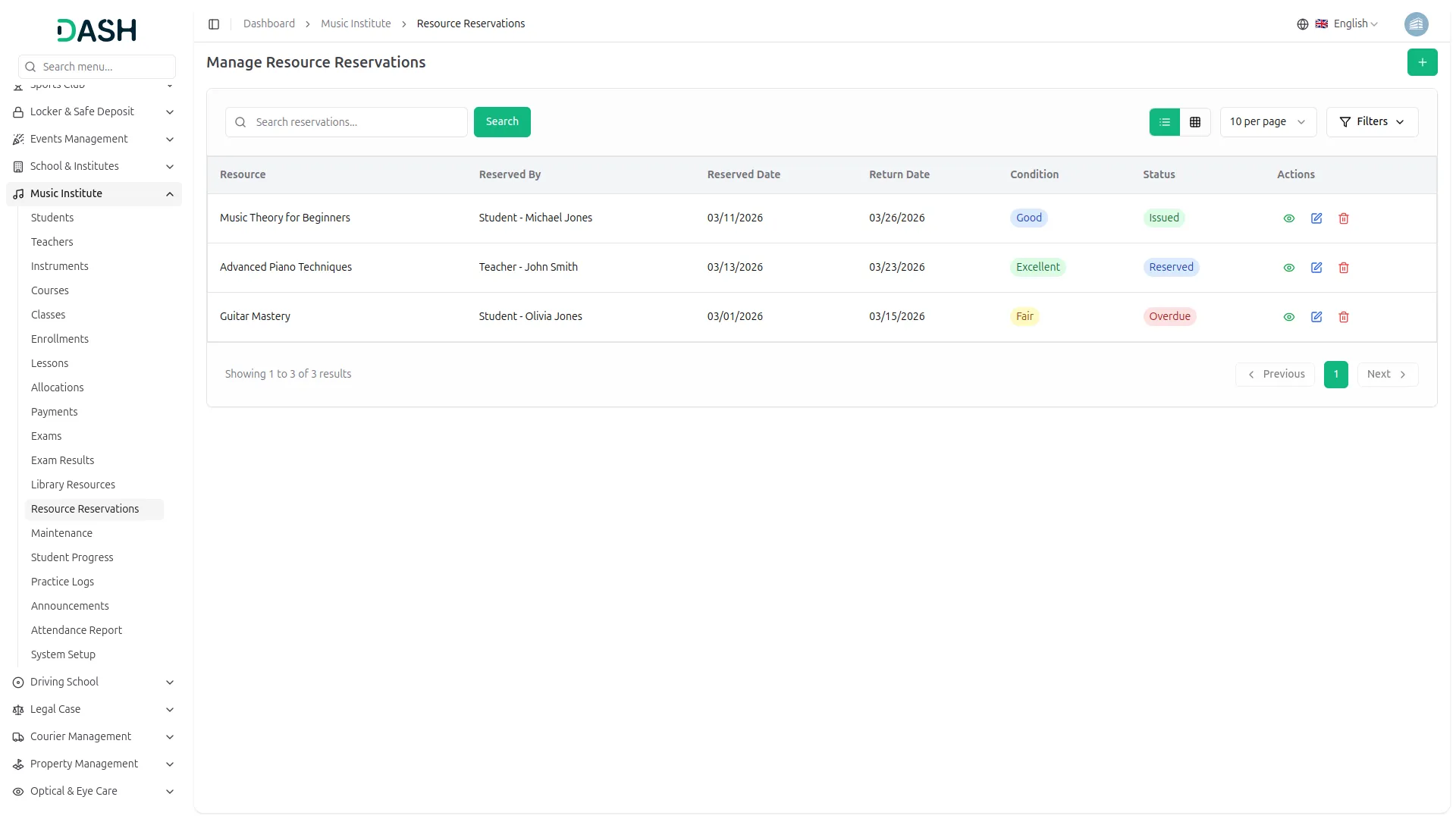
- Use the Search bar to find specific reservations, and apply filters using the Status dropdown (Filter by Status), Reserved By Type dropdown (Filter by Type), and Condition dropdown (Filter by Condition). Click Apply to activate the selected filters or Clear to remove them. The page also allows you to toggle between list view and grid view.
- In the Actions column, select View to see full reservation details, Edit to modify an existing reservation’s information, and Delete to permanently remove the reservation from the system.
Manage Maintenance
- To add a new maintenance record, click the ”Create” button, which is located on the Manage Maintenance page. In the form that opens, select the Instrument requiring maintenance from the dropdown. Set the Maintenance Date using the date picker and select the Type of maintenance to be performed.
- Enter a Description to detail the nature of the maintenance work. Specify the Cost and enter the name of the technician in the Performed By field. Select the Bank Account for payment reference and add any additional Notes if needed.
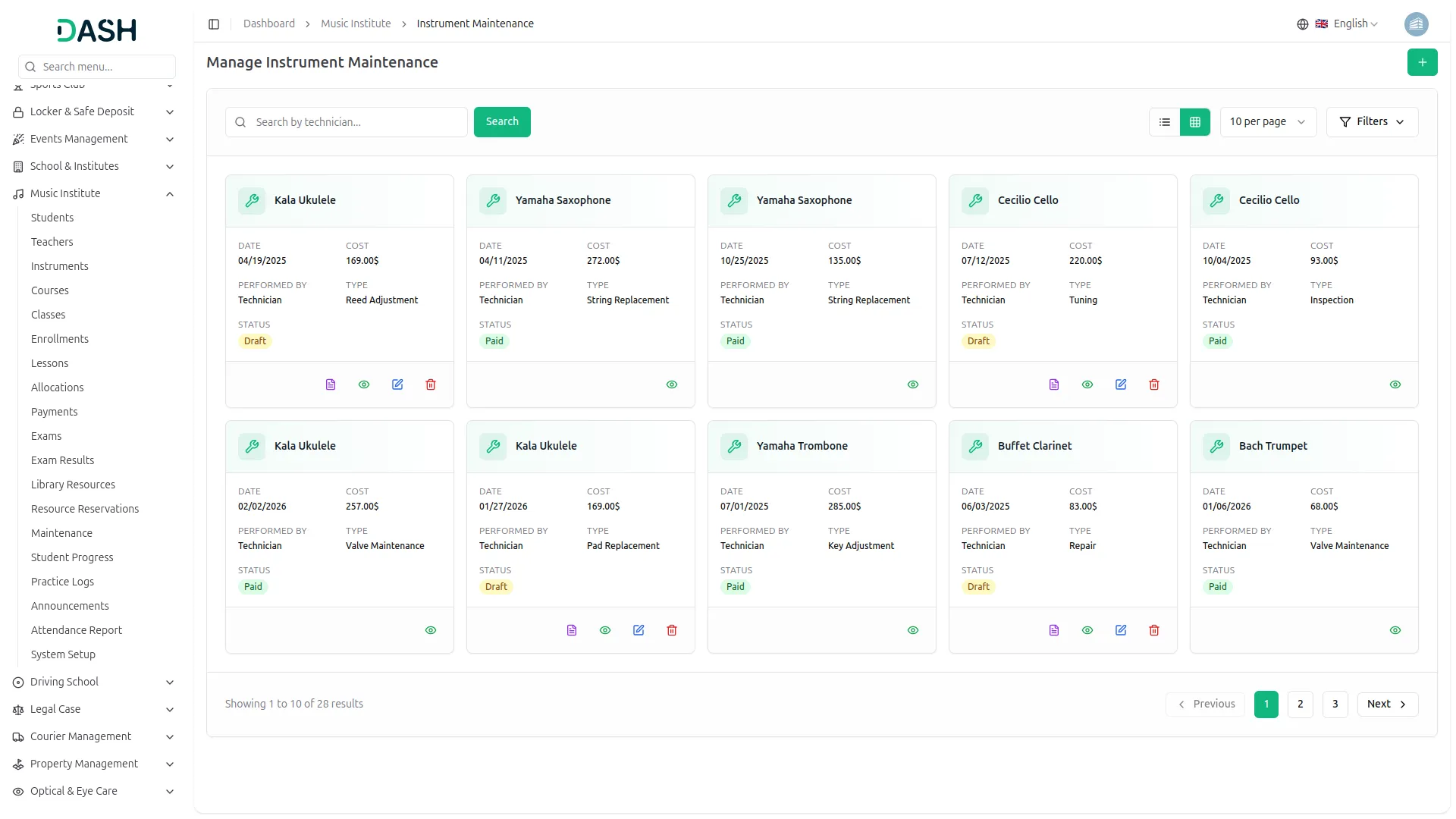
- The list page shows all maintenance records in a table with columns for Instrument, Date, Maintenance Type, Cost, Performed By, Status, and Actions. The Status column reflects the current state of each maintenance record, which may appear as Draft or Paid.
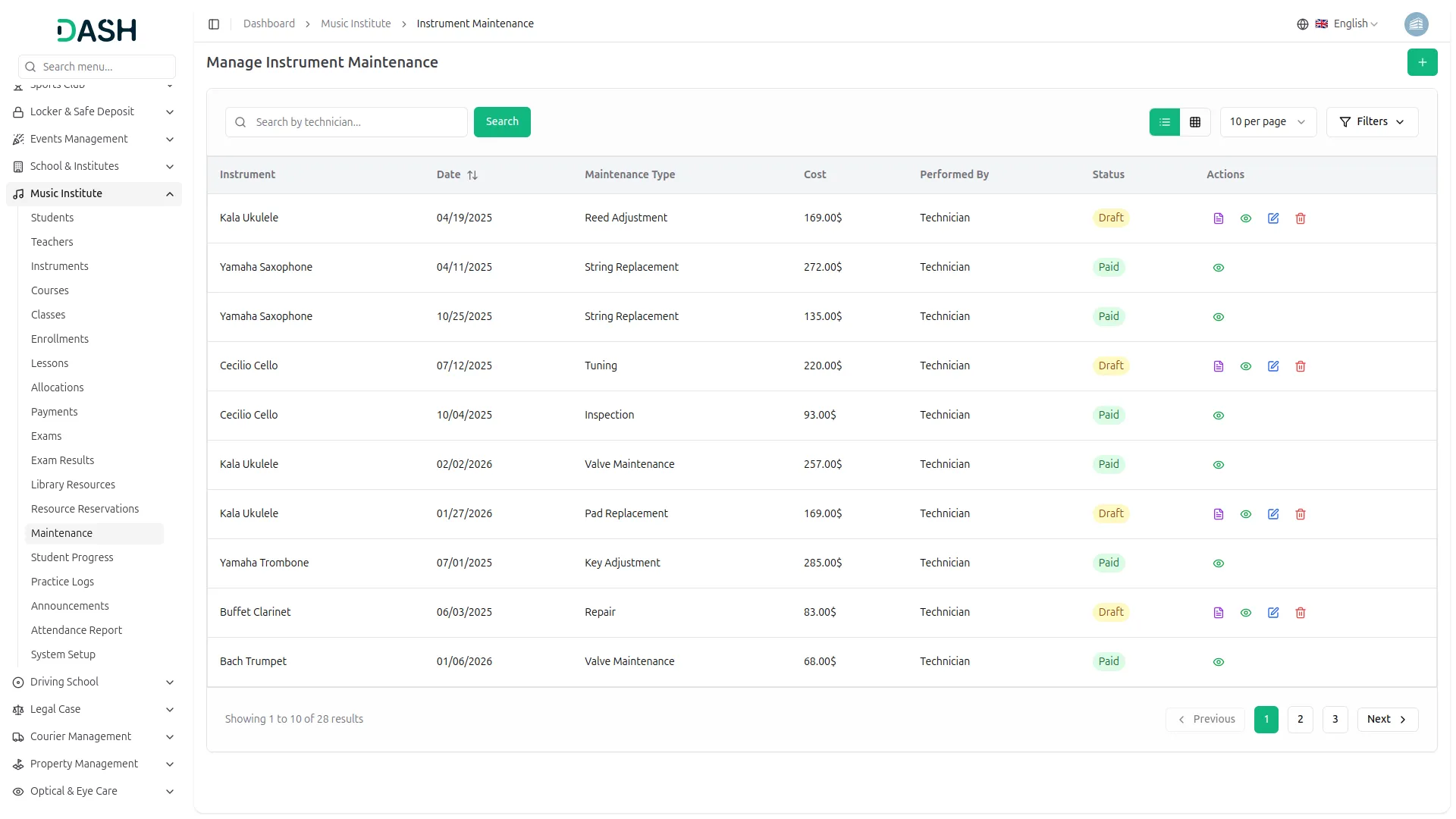
- Use the Search bar to find specific records by technician name, and apply filters using the Instrument dropdown (Filter by Instrument), Type dropdown (Filter by Type), and Status dropdown (Filter by Status). Click Apply to activate the selected filters or Clear to remove them. The page also allows you to toggle between list view and grid view.
- In the Actions column, select Post Maintenance to finalise and confirm the maintenance record, View to see full maintenance details, and Edit to modify an existing record’s information.
- Delete to permanently remove the maintenance record from the system. Note that records with a Paid status only have the View option available, as paid maintenance records cannot be modified or deleted.
Student Progress
- To add a new student progress record, click the ”Create” button, which is located on the Manage Student Progress page. In the form that opens, select the Student from the dropdown and optionally associate the record with a Course.
- Select the Skill Level to indicate the student’s current proficiency and enter an Overall Rating on a scale of 1 to 10. Optionally, describe any Areas for Improvement and provide Recommendations to guide the student’s development going forward.
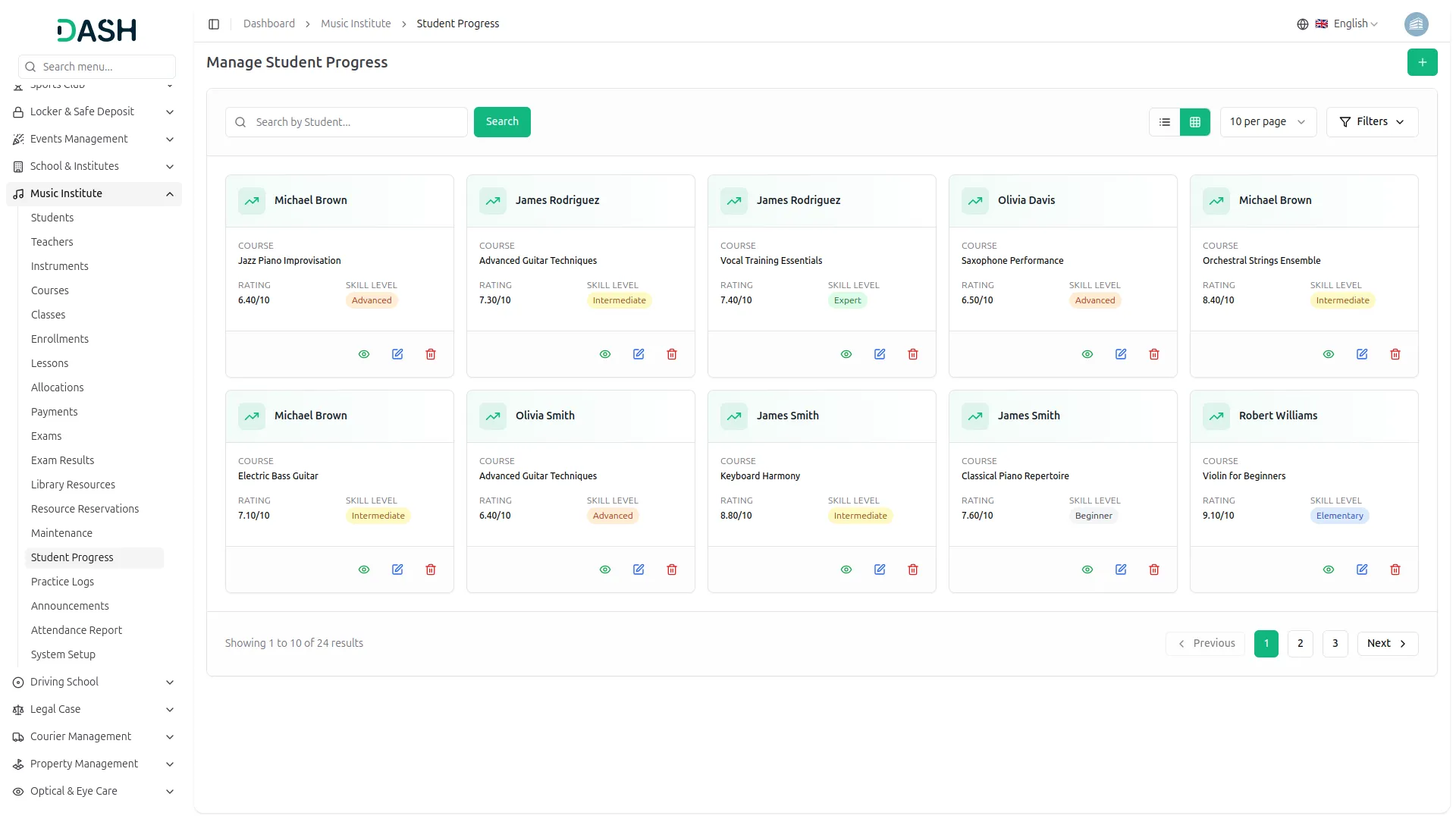
- The list page shows all student progress records in a table with columns for Student, Course, Skill Level, Overall Rating, and Actions.
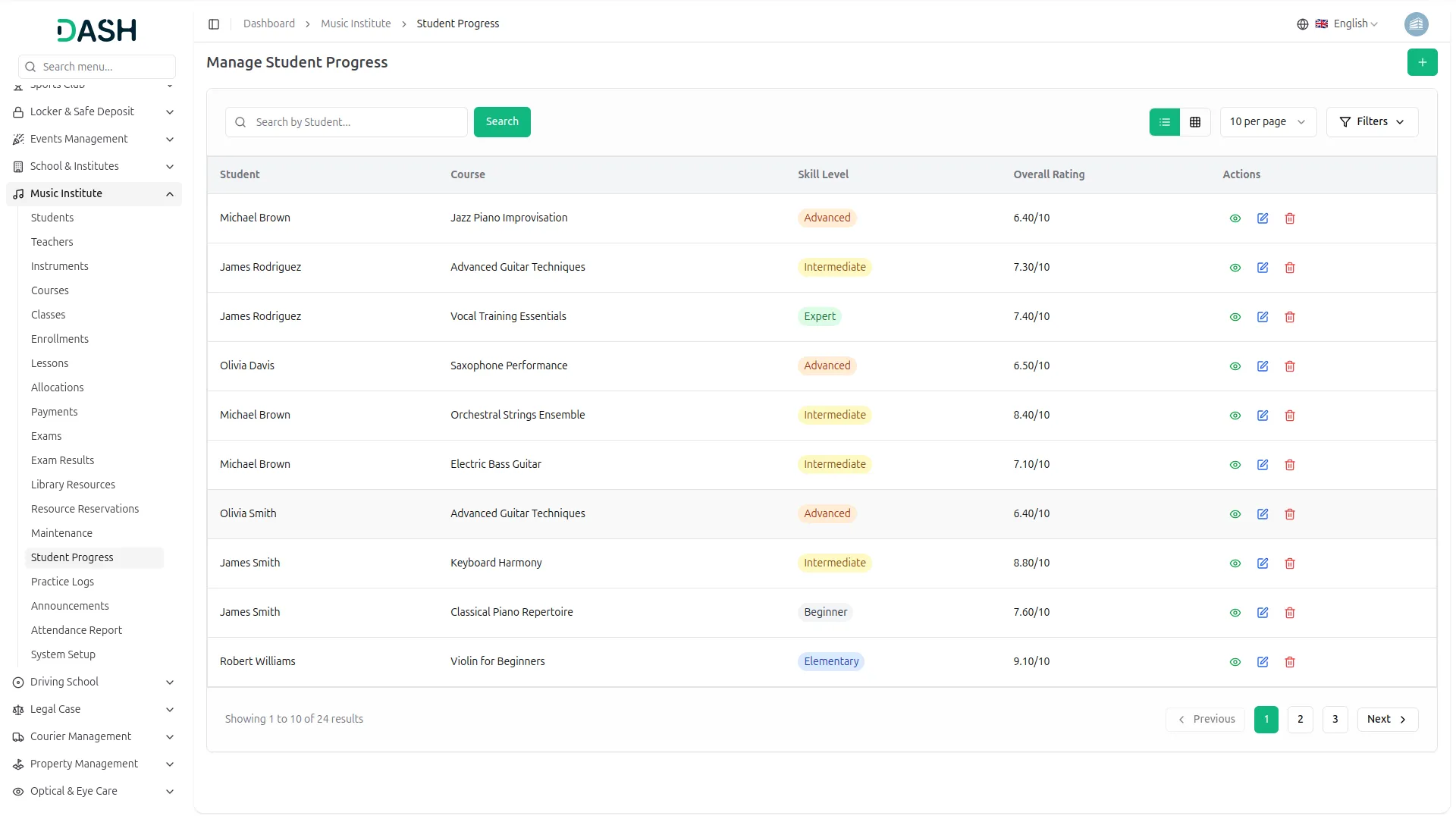
- Use the Search bar to find specific records by student name, and apply filters using the Skill Level dropdown (Filter by Skill Level) and Course dropdown (Filter by Course). Click Apply to activate the selected filters or Clear to remove them. The page also allows you to toggle between list view and grid view.
- In the Actions column, select View to see full progress details, Edit to modify an existing progress record, and Delete to permanently remove the record from the system.
Practice Logs
- To add a new practice log, click the ”Create” button, which is located on the Manage Practice Logs page. In the form that opens, select the Student from the dropdown and set the Practice Date using the date picker. Optionally, select the Class associated with the practice session and choose the Instrument used.
- Set the Start Time and End Time to define the duration of the practice session and select the Location where it took place. Enter the Topics Practiced to describe what was covered during the session, and add any additional Notes or observations if needed.
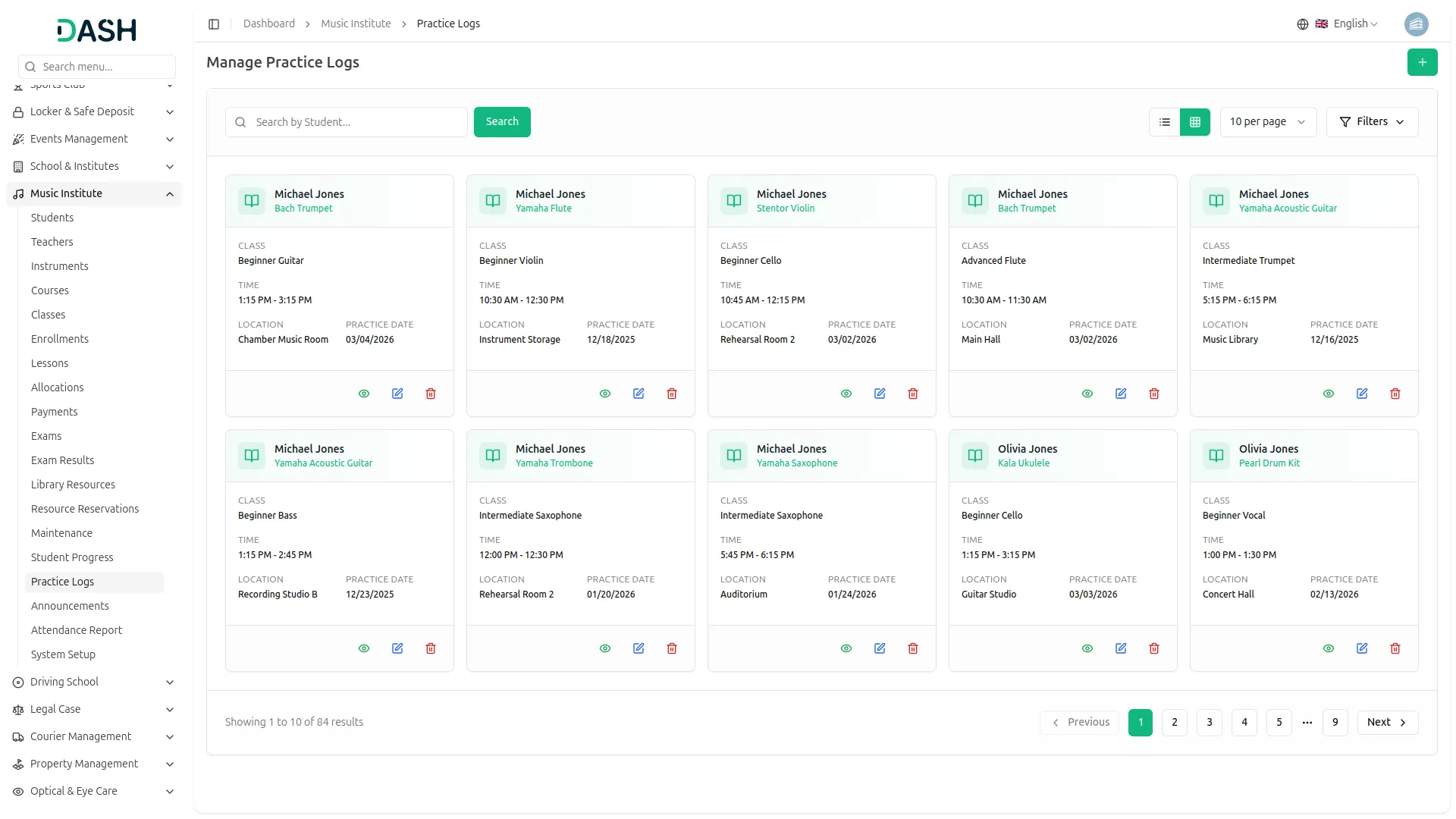
- The list page shows all practice logs in a table with columns for Student, Class, Instrument, Location, Practice Date, Time, and Actions.
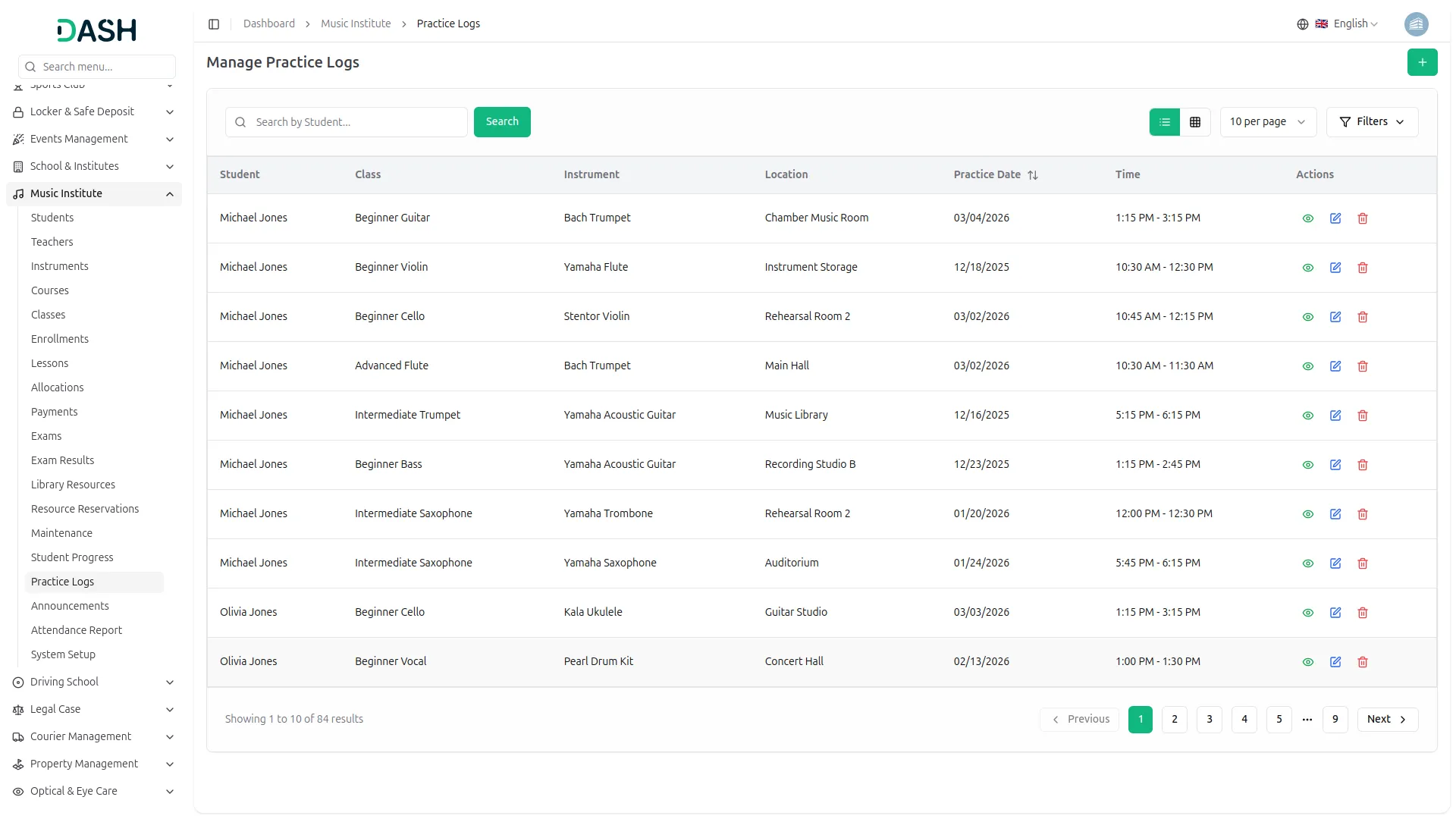
- Use the Search bar to find specific logs by student name, and apply filters using the Student dropdown (Filter by Student), Practice Date picker (Select practice date), Class dropdown (Filter by Class), Instrument dropdown (Filter by Instrument), and Location dropdown (Filter by Location). Click Apply to activate the selected filters or Clear to remove them. The page also allows you to toggle between list view and grid view.
- Using the Actions column, select View to see full practice log details, Edit to modify an existing log’s information, and Delete to permanently remove the practice log from the system.
Manage Announcements
- To add a new announcement, click the ”Create” button which is located on the Manage Announcements page. In the form that opens, enter the Title of the announcement and select the Type from the dropdown to categorise it, such as General, Event, Policy, Holiday, or Urgent.
- Select the Priority level to indicate the urgency of the announcement and set the Announcement Date using the date picker. Enter the Content to provide the full details of the announcement.
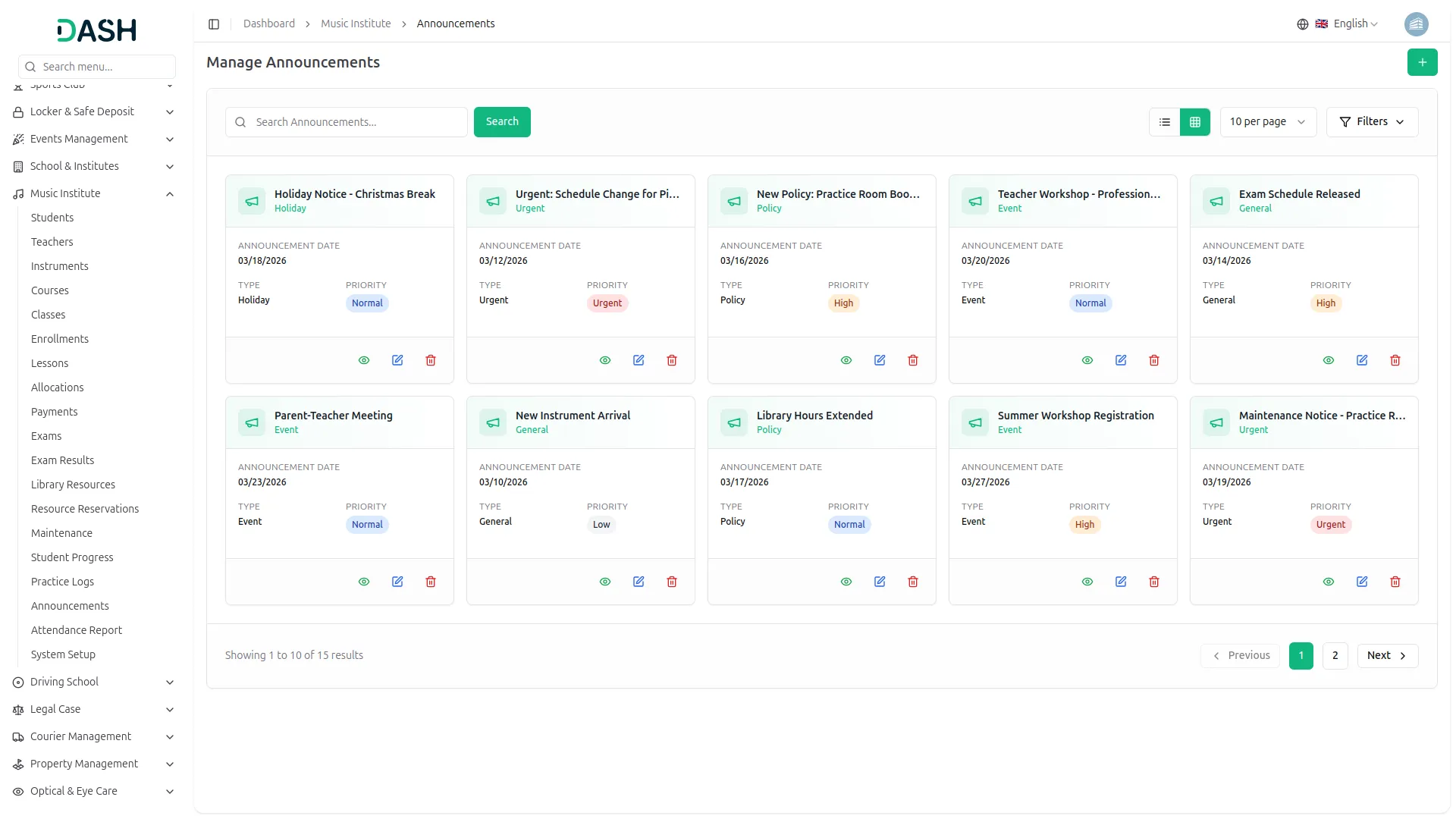
- The list page shows all announcements in a table with columns for Title, Type, Priority, Announcement Date, and Actions.
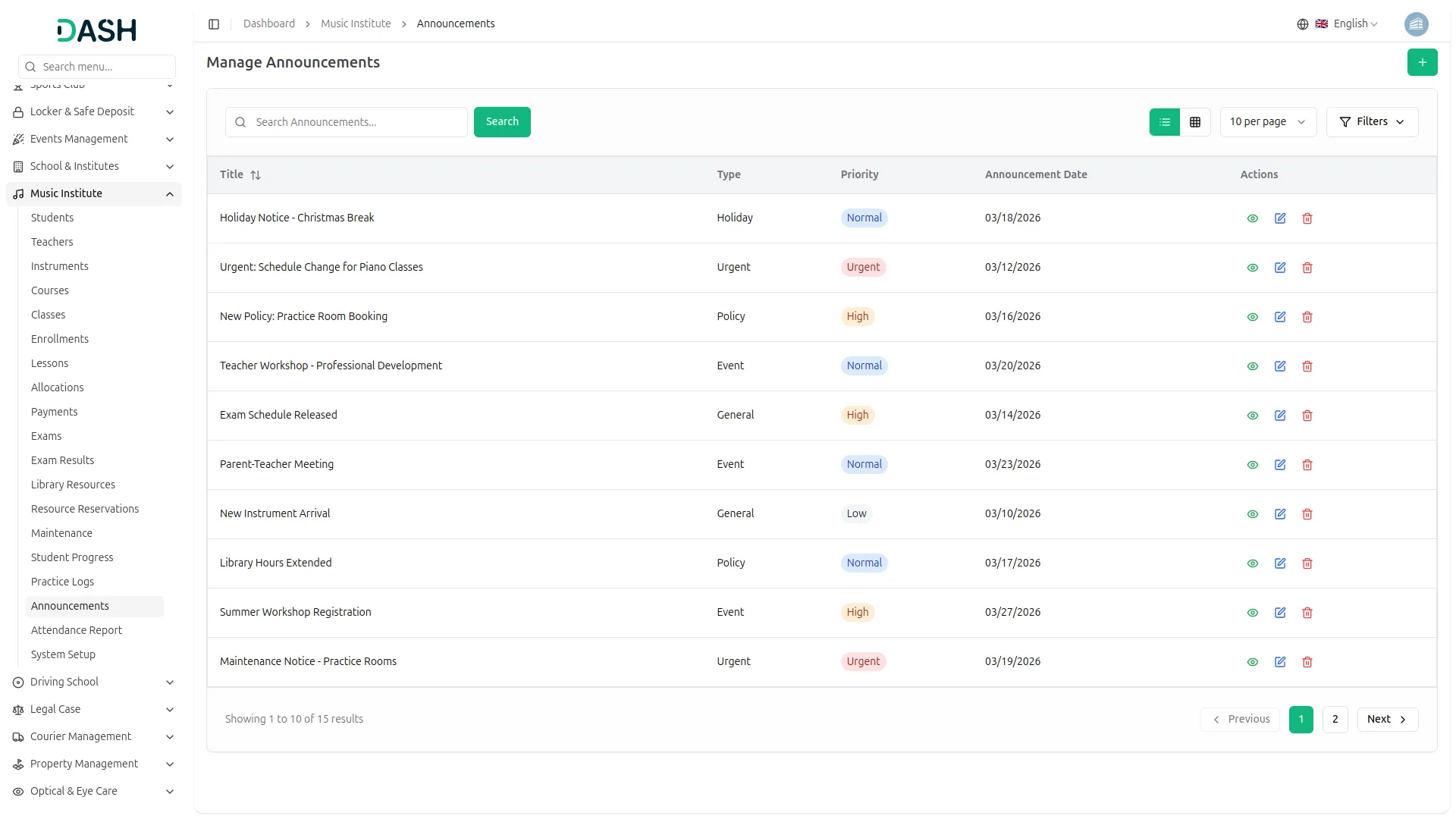
- Use the Search bar to find specific announcements by title, and apply filters using the Type dropdown (Filter by Type) and Priority dropdown (Filter by Priority). Click Apply to activate the selected filters or Clear to remove them. The page also allows you to toggle between list view and grid view.
- Using the Actions column, select View to see the full announcement details, Edit to modify an existing announcement’s information, and Delete to permanently remove the announcement from the system.
Attendance Report
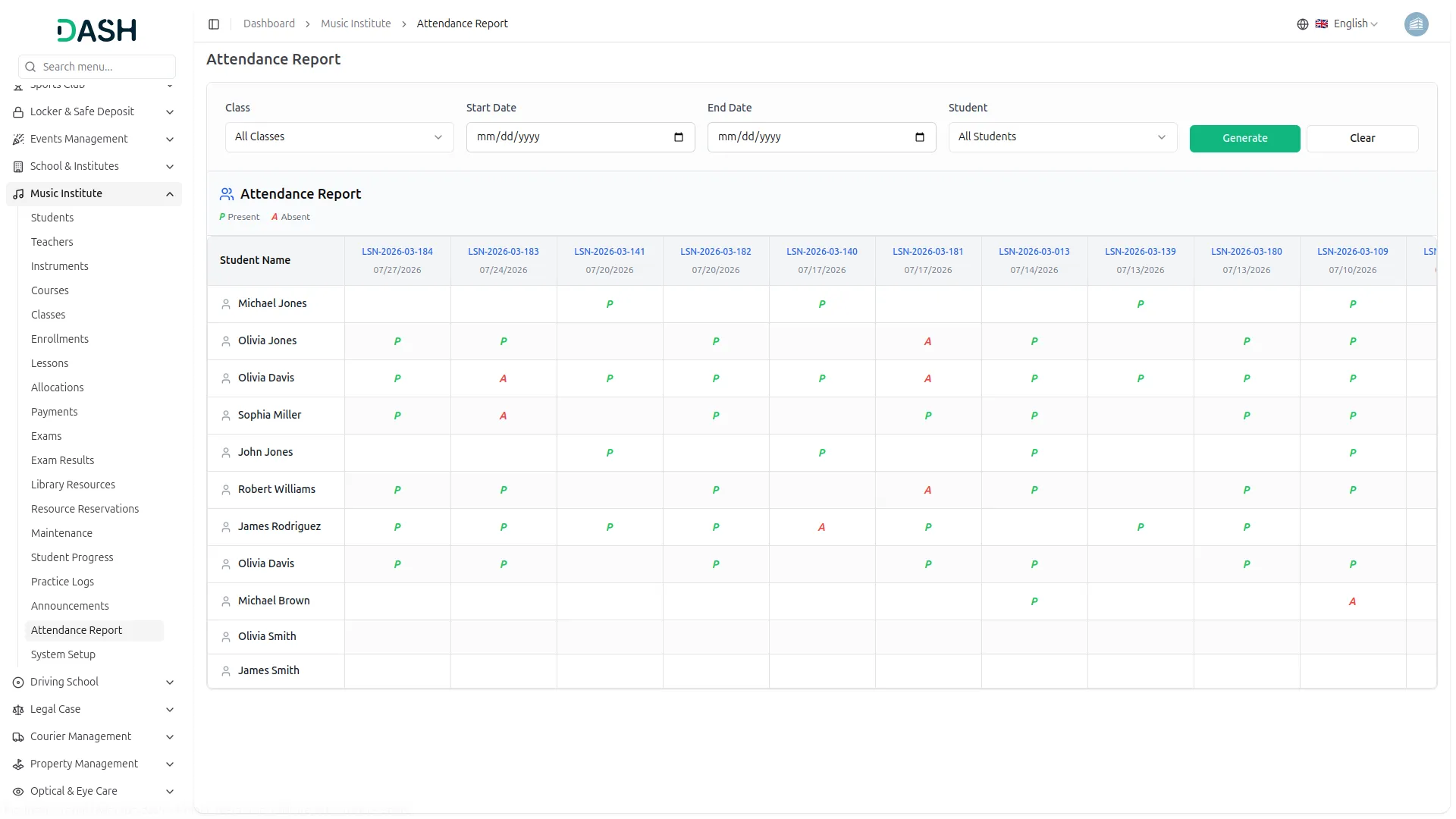
- The Manage Attendance Report page provides a comprehensive overview of student attendance across lessons within a specified date range.
- To generate an attendance report, select the Class from the dropdown to filter by a specific class or leave it set to All Classes for a broader view. Set the Start Date and End Date to define the reporting period and optionally select a specific Student from the dropdown to narrow the results. Click Generate to produce the report or Clear to reset all filters.
- The generated Attendance Report displays student attendance in a matrix format. Student names are listed in rows along the left side, while lesson codes and their corresponding dates are displayed as columns across the top.
- Each cell indicates the attendance status for a student in a particular lesson, marked as “P” in green for Present or “A” in red for Absent. Empty cells indicate that the student was not enrolled in or associated with that particular lesson.
- This report provides a quick visual overview of attendance patterns, making it easy to identify students with frequent absences or to review attendance records across a specific time period.
Categories
Related articles
- Whereby Meeting Integration in Dash SaaS
- Social Media Analytics Detailed Documentation
- Bulk SMS Detailed Documentation
- Vehicle Booking Management Integration in Dash SaaS
- AI Assistant Integration in Dash SaaS
- Finding Email Credentials for the EMailbox Module in Dash SaaS
- Facebook Post Integration in Dash SaaS
- Custom Field Integration in Dash SaaS
- Goto Meeting Integration in Dash SaaS
- Water Park Management
- Google Captcha Integration in Dash SaaS
- Google Docs Integration Detailed Documentation
Reach Out to Us
Have questions or need assistance? We're here to help! Reach out to our team for support, inquiries, or feedback. Your needs are important to us, and we’re ready to assist you!


Need more help?
If you’re still uncertain or need professional guidance, don’t hesitate to contact us. You can contact us via email or submit a ticket with a description of your issue. Our team of experts is always available to help you with any questions. Rest assured that we’ll respond to your inquiry promptly.
Love what you see?
Do you like the quality of our products, themes, and applications, or perhaps the design of our website caught your eye? You can have similarly outstanding designs for your website or apps. Contact us, and we’ll bring your ideas to life.