
Waste Management Integration in Dash SaaS
The Waste Management Add-On can be extremely helpful for industries, businesses, or any other sectors where any type of waste is produced.
Introduction
The Waste Management Add-On is a complete end-to-end solution designed to help organizations efficiently manage waste collection, recycling, inspections, scheduling, and customer interactions from a single dashboard. It provides powerful system setup tools for branding, pages, banners, FAQs, locations, categories, and time slots, along with operational modules for handling collection requests, trips, inspections, recycling processes, disposal facilities, blogs, contacts, and customer questions. With real-time dashboards, detailed reports, flexible scheduling, and seamless frontend-to-backend integration, the add-on streamlines daily operations, improves visibility, and enhances customer engagement across the entire waste management workflow.
How to Install the Add-On?
To Set Up the Waste Management Add-On, you can follow this link: Setup Add-On
How To Use The Waste Management Add-On?
Once you purchase and install the Add-On, go to the sidebar and search for the Waste Management Add-On. You will get to see many pages over there. Which are discussed below.
Dashboard
- After completing the purchase process, go to the sidebar and find the Waste Management Add-On.
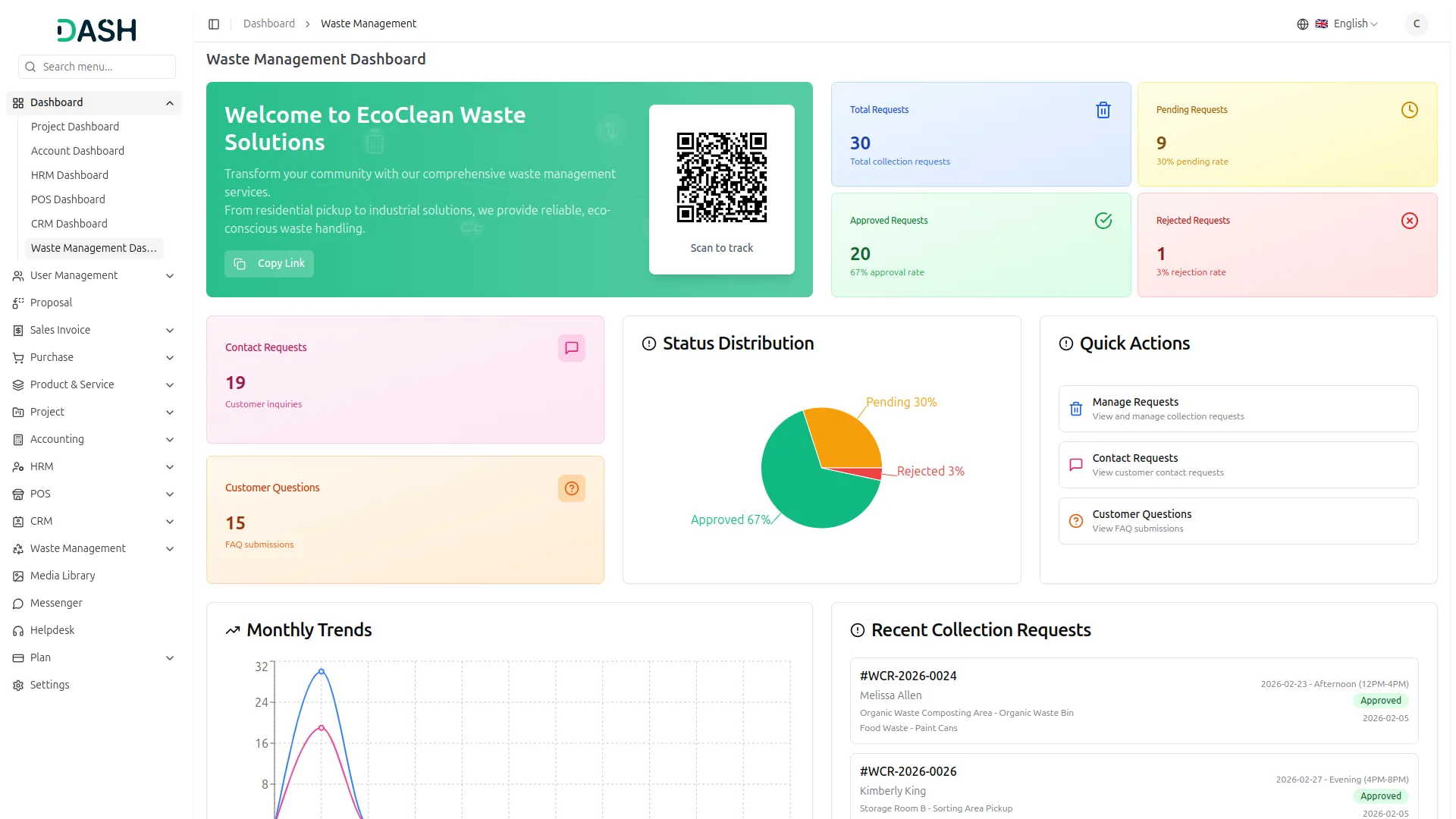
- After accessing the Waste Management Dashboard, you will see the welcome section at the top with a QR code that users can scan to track their waste collection requests.
- At the top, you’ll find the “Copy Link” button to begin using the waste management services.
- The dashboard gives you a clear overview with summary cards showing live counts of Total Requests, Pending Requests, Approved Requests, and Rejected Requests.
- Below the summary cards, you will find additional cards for Contact Requests and Customer Questions.
- In the center, the Status Distribution Overview shows a pie chart breaking down your requests into different status categories, giving you instant visibility of how requests are being processed.
- On the right side, the Quick Actions section provides shortcuts to Manage Requests, Contact Requests, and Customer Questions.
- At the bottom left, the Monthly Trends section displays a line graph showing the volume of requests over the year, allowing you to identify peak seasons and plan resources accordingly.
- On the bottom right, the Recent Collection Requests section shows your latest waste collection requests with details including request ID, customer name, location, waste type, status, and date.
System Setup
Brand Settings
- In the Brand Settings section, click the Browse button next to Logo, Footer Logo, or Favicon to select images from your device. Enter the Site Title and Footer Copyright Text in their respective fields. Write the Footer Description explaining your waste management service.
- In the Dashboard Welcome Card Settings section, enter the Card Title and write the Card Description. Enter the Button Text and click the Button Icon search field to browse and select an icon from the available icon library. Click Save Changes to update.
-
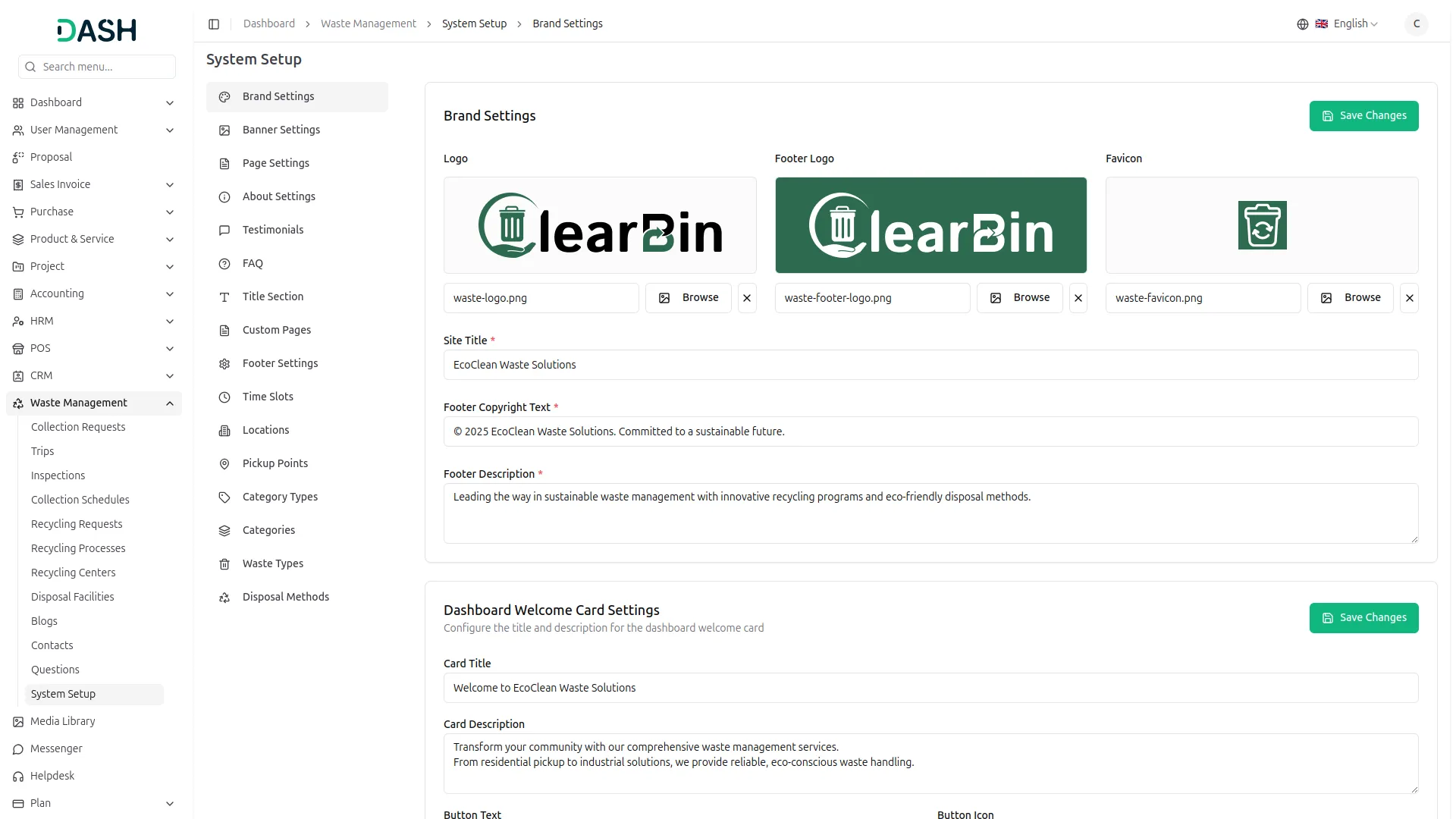
- Once saved, the Logo and Favicon will appear across your waste management website, while the Footer Logo, Site Title, Footer Copyright Text, and Footer Description will display in the footer section on the frontend.
Banner Settings
- In the Banner Settings section, click the Browse button next to Banner Background Image to upload the background image. Enter the Banner Badge Text and click the Banner Badge Icon search field to browse and select an icon from the available icon library.
- In the Banner Titles section, each item includes a Title Text field. Enter the Title Text for each banner headline. Click the delete icon to remove a title item. Click Add Title to add more banner titles.
- Enter the Banner Description in the text area to provide information about your waste management services.
- In the Feature Badges section, enter Feature Badge 1 Text, Feature Badge 2 Text, and Feature Badge 3 Text. Click each icon search field (Feature Badge 1 Icon, Feature Badge 2 Icon, Feature Badge 3 Icon) to browse and select icons from the available icon library.
- In the Slogan Settings section, each item includes Slogan Text and Icon fields. Enter the Slogan Text and click the Icon search field to browse and select an icon. Click the delete icon to remove a slogan item. Click Add Slogan to add more slogans. Click Save Changes to update.
-
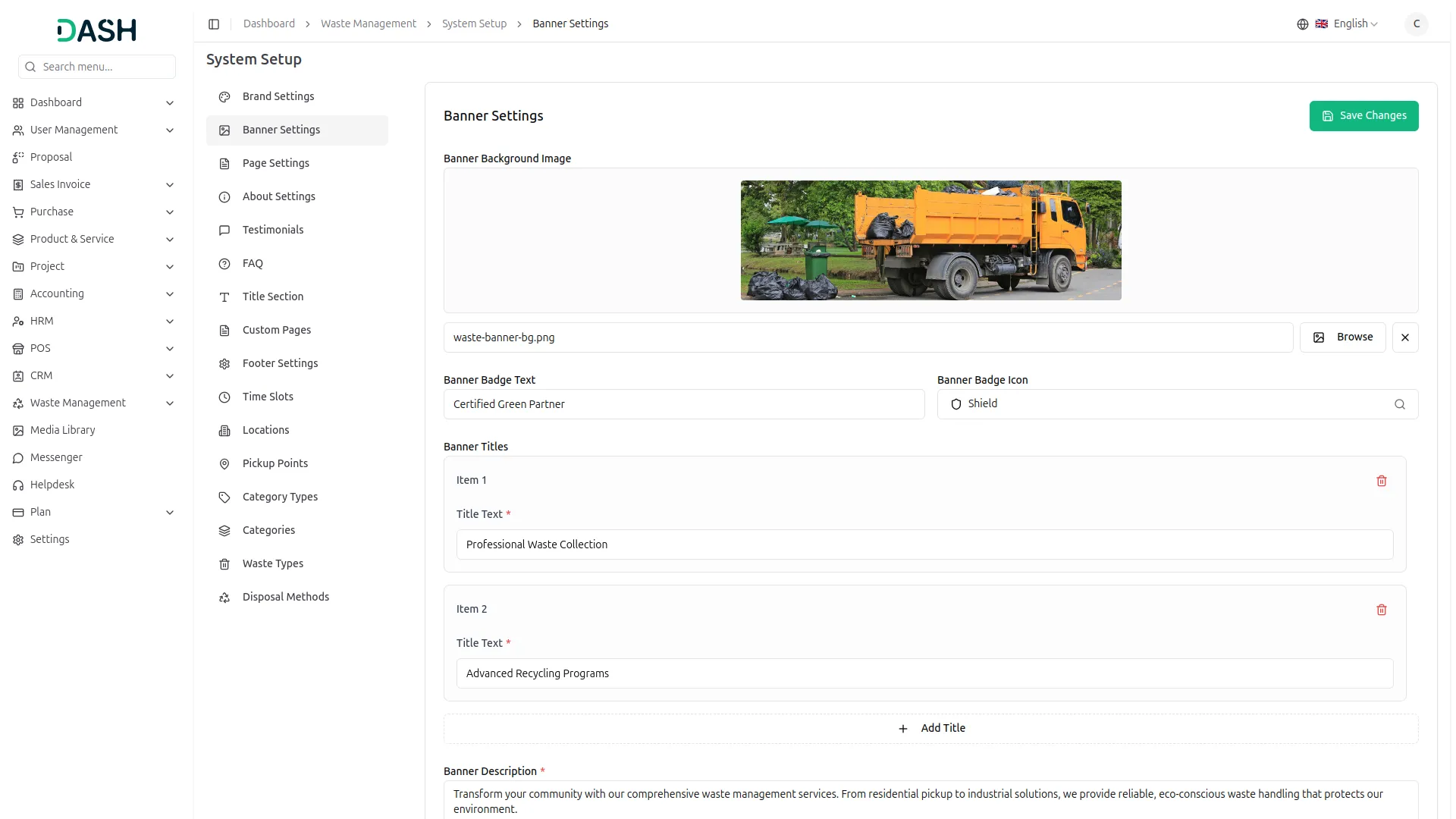
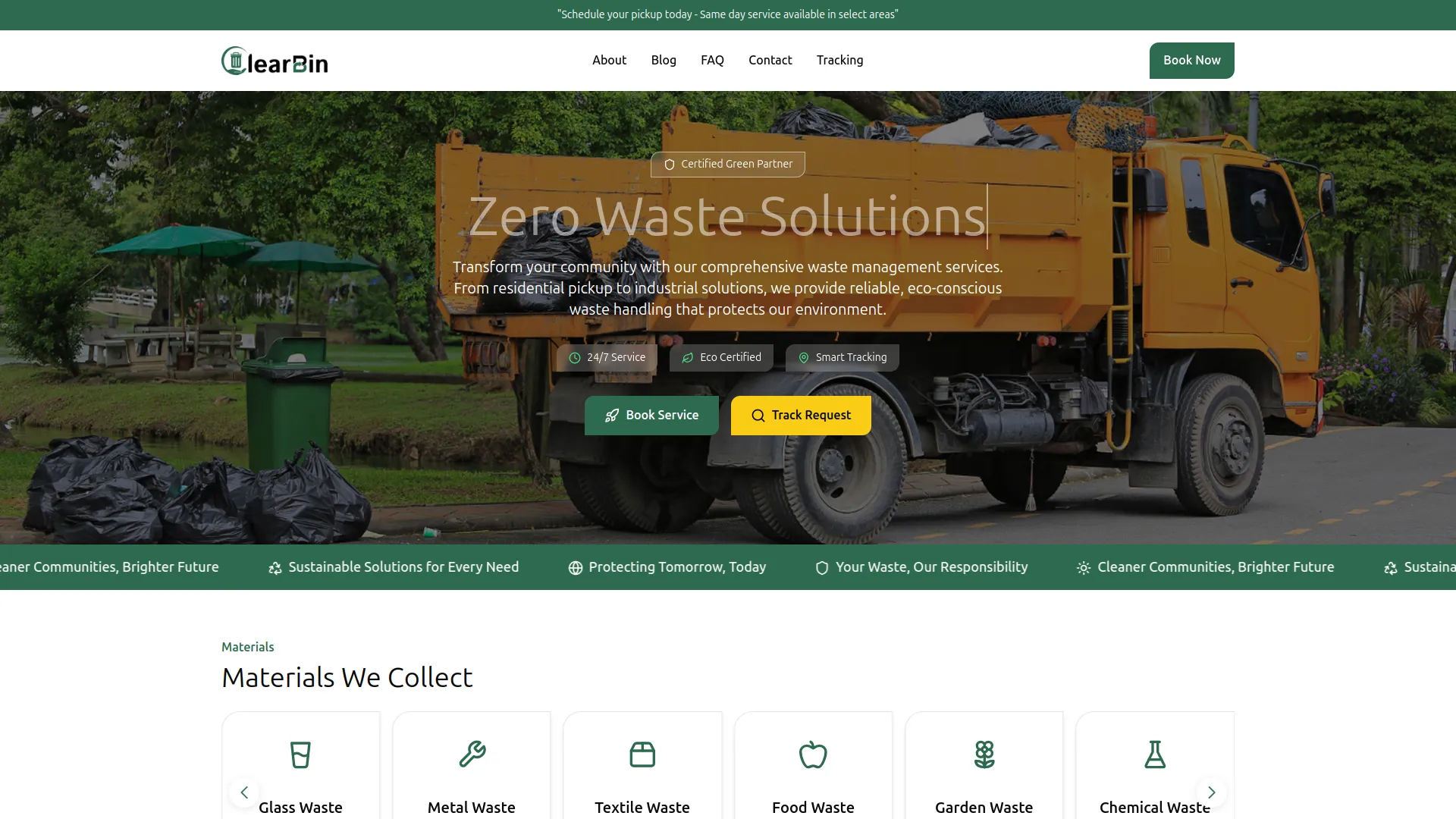
- Once saved, the Banner Background Image, Banner Badge, Banner Titles, Banner Description, Feature Badges, and Slogans will automatically appear in the banner area of your website’s homepage.
Page Settings
- In the Page Settings section under Top Bar Message, enter the Message Text that will display as an announcement bar at the top of your website.
- In the Page Background Image section, click the Browse button next to Background Image (for all pages except the homepage) to upload a background image that will appear across all interior pages. Click Save Changes to update.
-
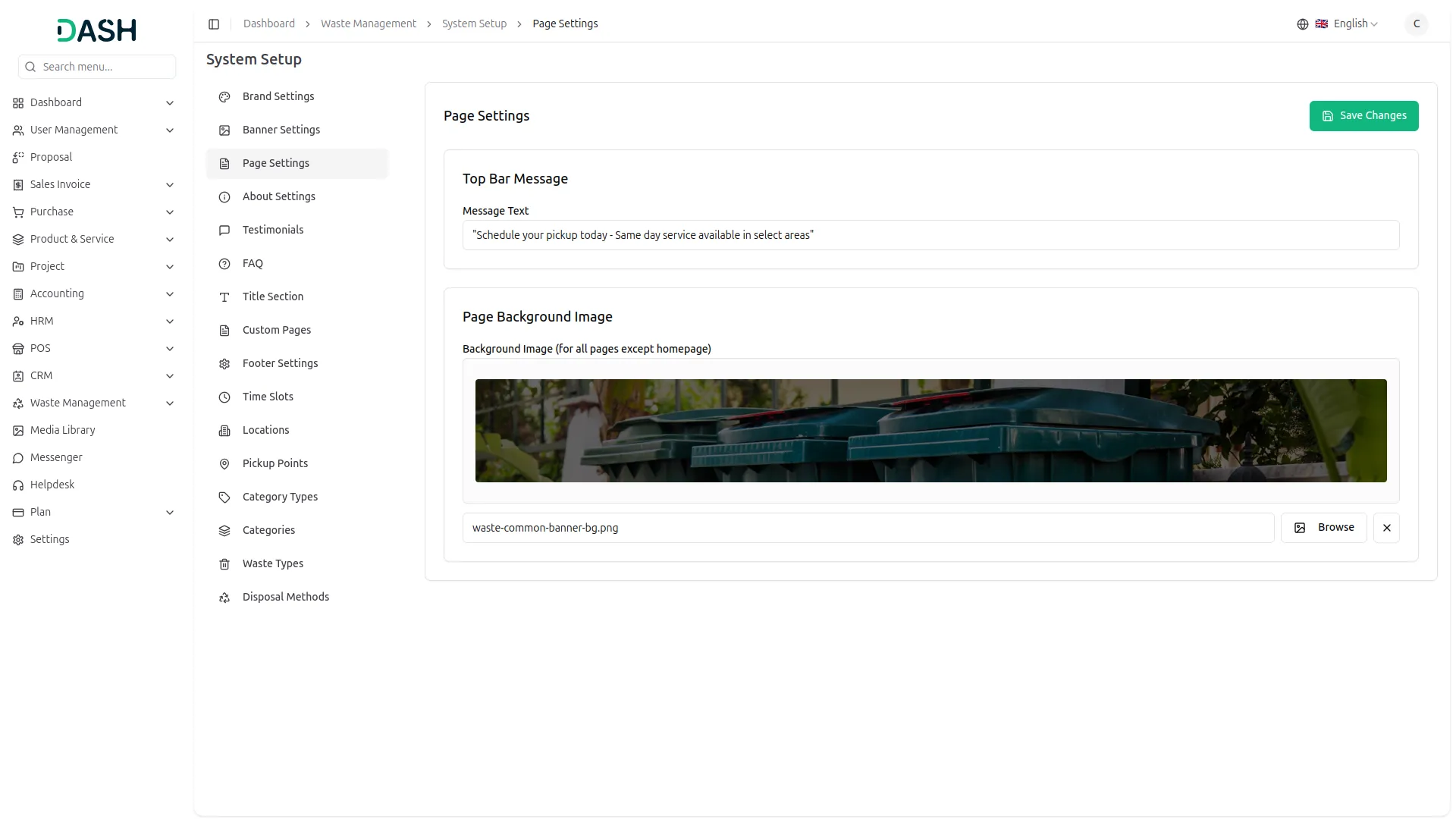
- Once saved, the Message Text will display at the top of your website, and the Background Image will appear on all pages except the homepage, creating a consistent visual experience.
About Settings
- In the About Settings section under About Section, click the Browse button next to About Image to upload an image representing your waste management business. Enter the About Subtitle to provide a tagline or brief description.
- Use the rich text editor to write the About Description, explaining your company’s story, mission, and services. Use the formatting toolbar to apply bold, italic, underline, strikethrough, alignment, lists, quotes, links, and other text formatting as needed.
- In the Features Section, configure four features. For each feature (Feature 1, Feature 2, Feature 3, Feature 4), click the Icon search field to browse and select an icon from the available icon library. Enter the Title for the feature heading and write the Description explaining the benefit or service feature.
- In the Team Members section, each item includes a Team Member dropdown. Select the Team Member from the available team members list. Click the delete icon to remove a team member. Click Add Team Member to add more team members to display. Click Save Changes to update.
-
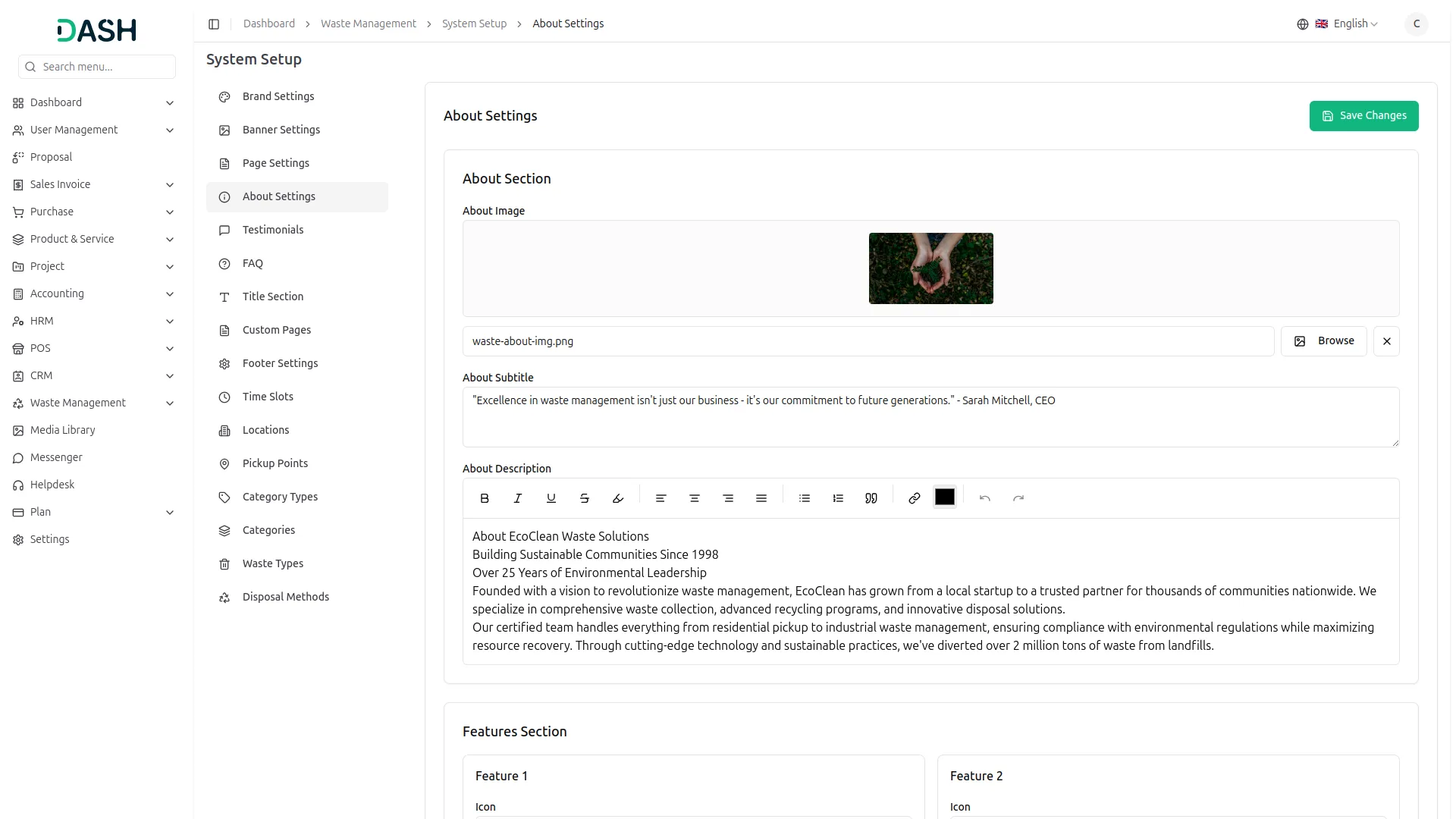
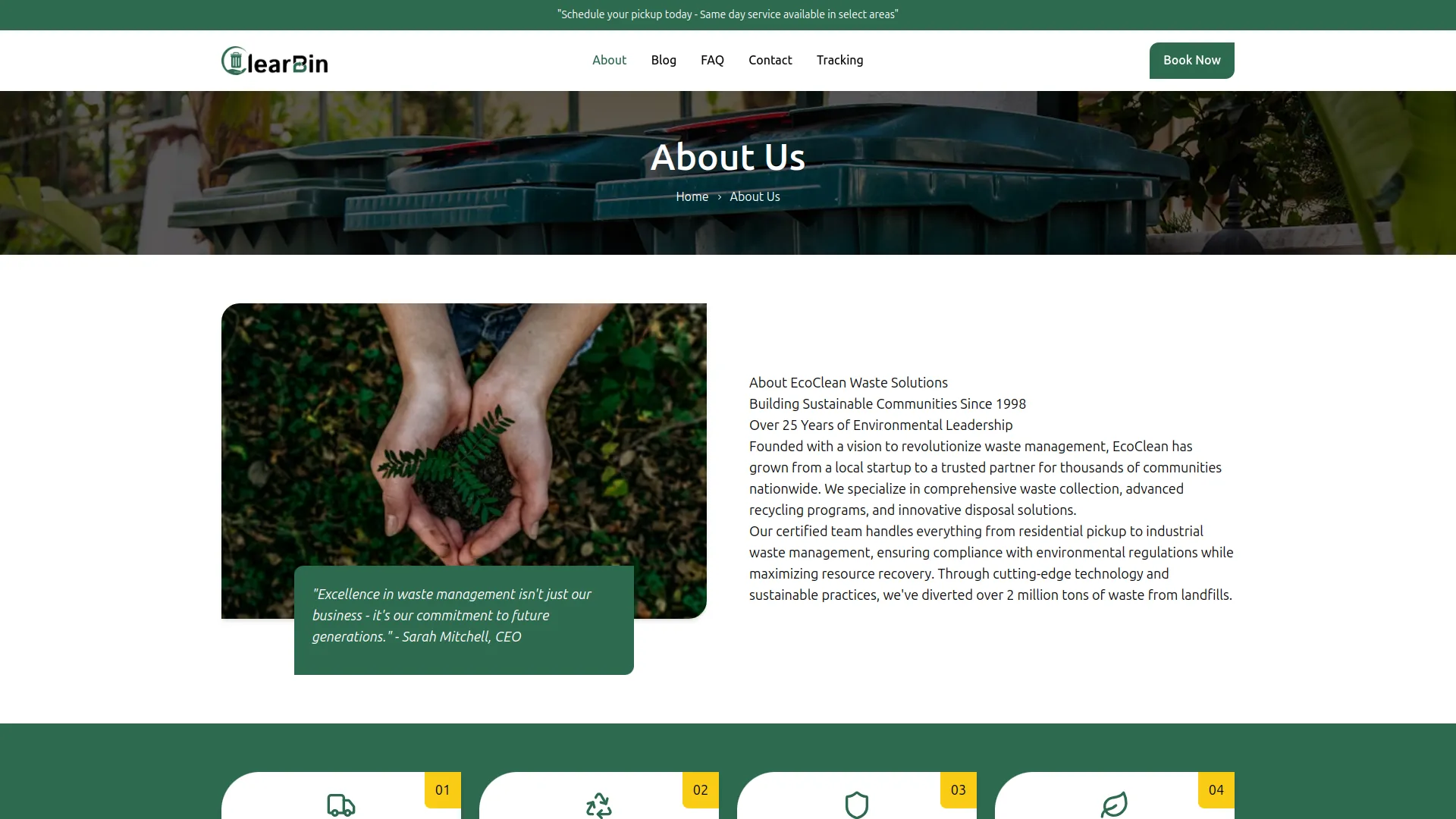
- Once saved, the About Section will display on the frontend About page with your company image, subtitle, description, key features, and team members showcasing your organization.
Testimonials
- In the Testimonials section, each item includes Customer Name, Designation, Rating, Comment, and Profile Image fields. Enter the Customer Name and Designation to identify the customer and their role or location.
- Select the Rating by clicking the star icons to display the customer’s satisfaction level (1 to 5 stars). Write the Comment containing the customer’s review or feedback in the text area.
- Click the Browse button to upload a Profile Image for the customer testimonial. Click the delete icon to remove a testimonial. Click Add Testimonial to add more customer reviews. Click Save Changes to update.
-
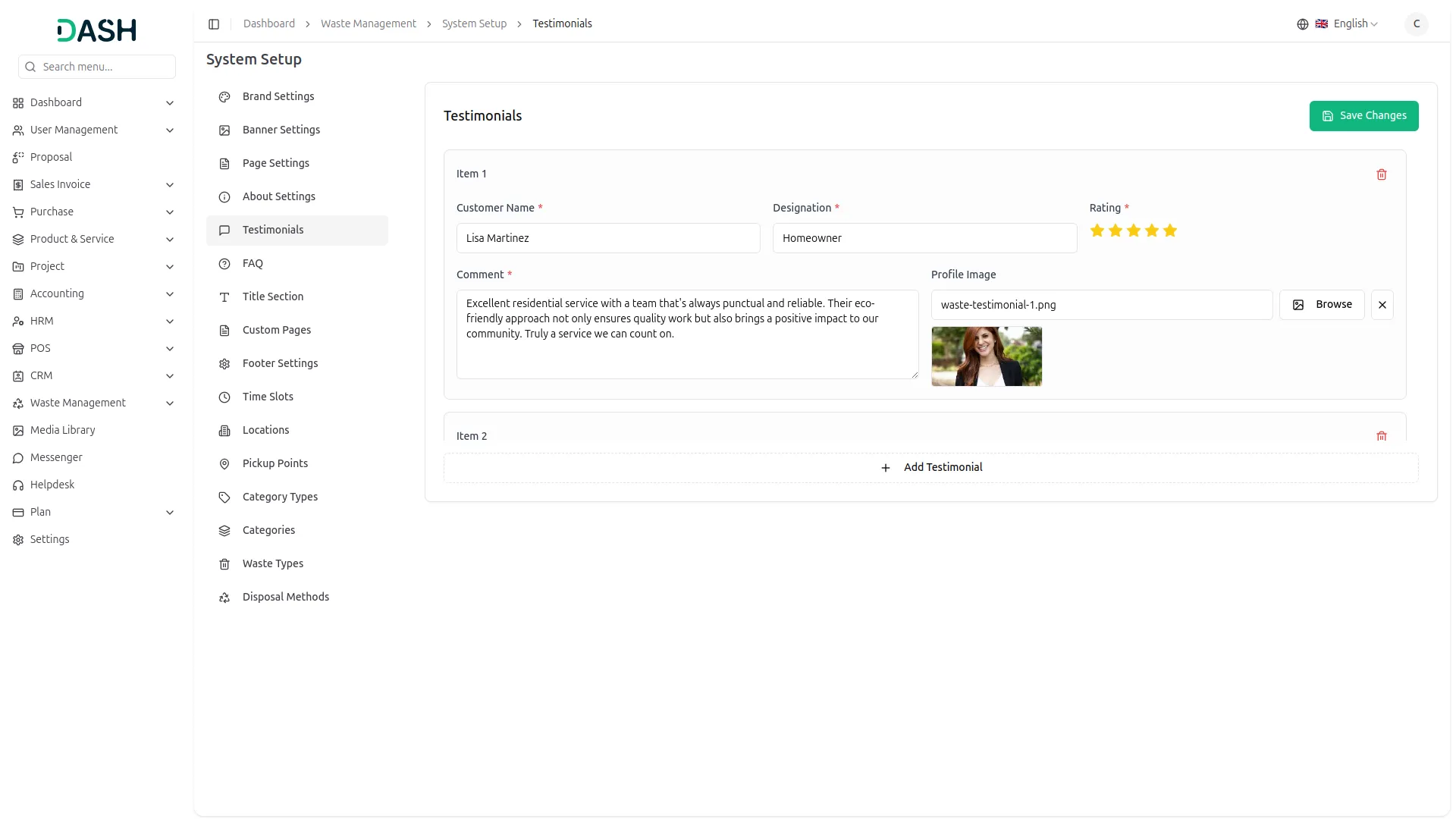
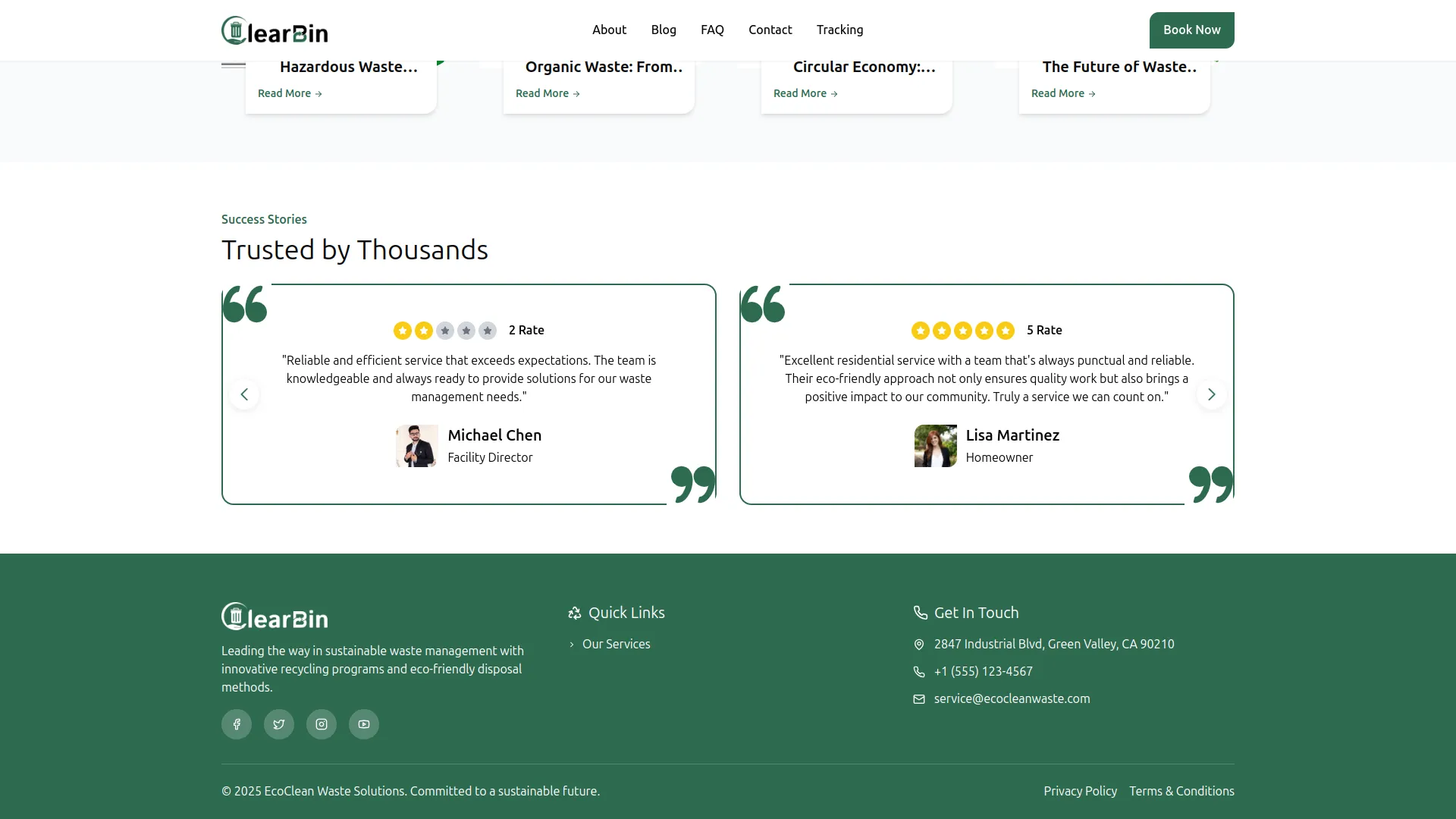
- Once saved, the Testimonials section will display on the frontend with customer reviews, ratings, profile images, names, and designations, showcasing positive experiences from your clients.
FAQ
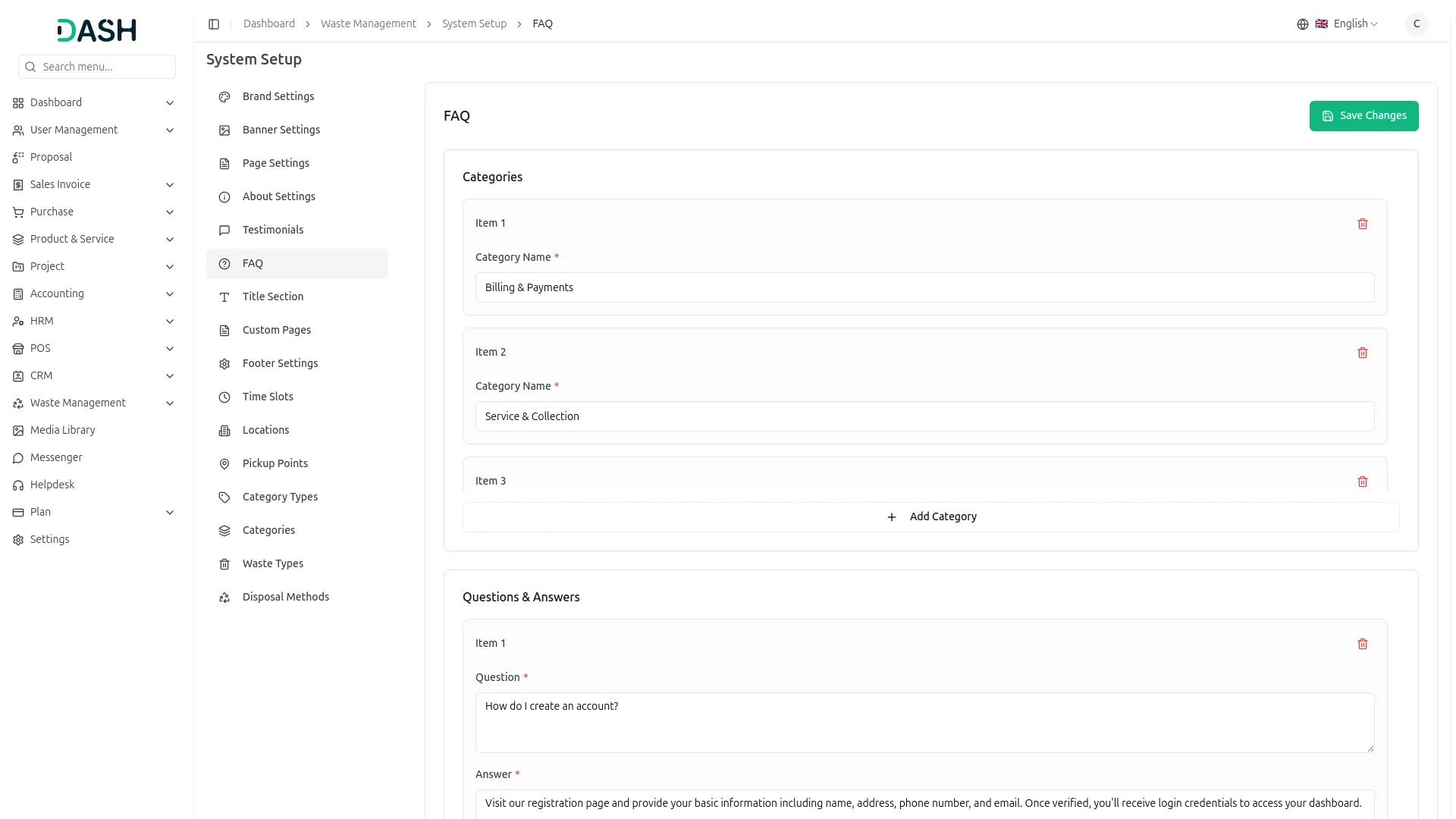
- In the FAQ section under Categories, each item includes a Category Name field. Enter the Category Name to group related questions together (such as Billing & Payments, Technical Support, Service & Collection, or Account Management). Click the delete icon to remove a category. Click Add Category to add more question categories.
- In the Questions & Answers section, each item includes Question and Answer fields. Enter the Question that customers frequently ask about your waste management service. Write the Answer in the text area, providing clear and helpful information to address the question.
- Click the delete icon to remove an FAQ item. Click Add FAQ to add more frequently asked questions. Click Save Changes to update.
-
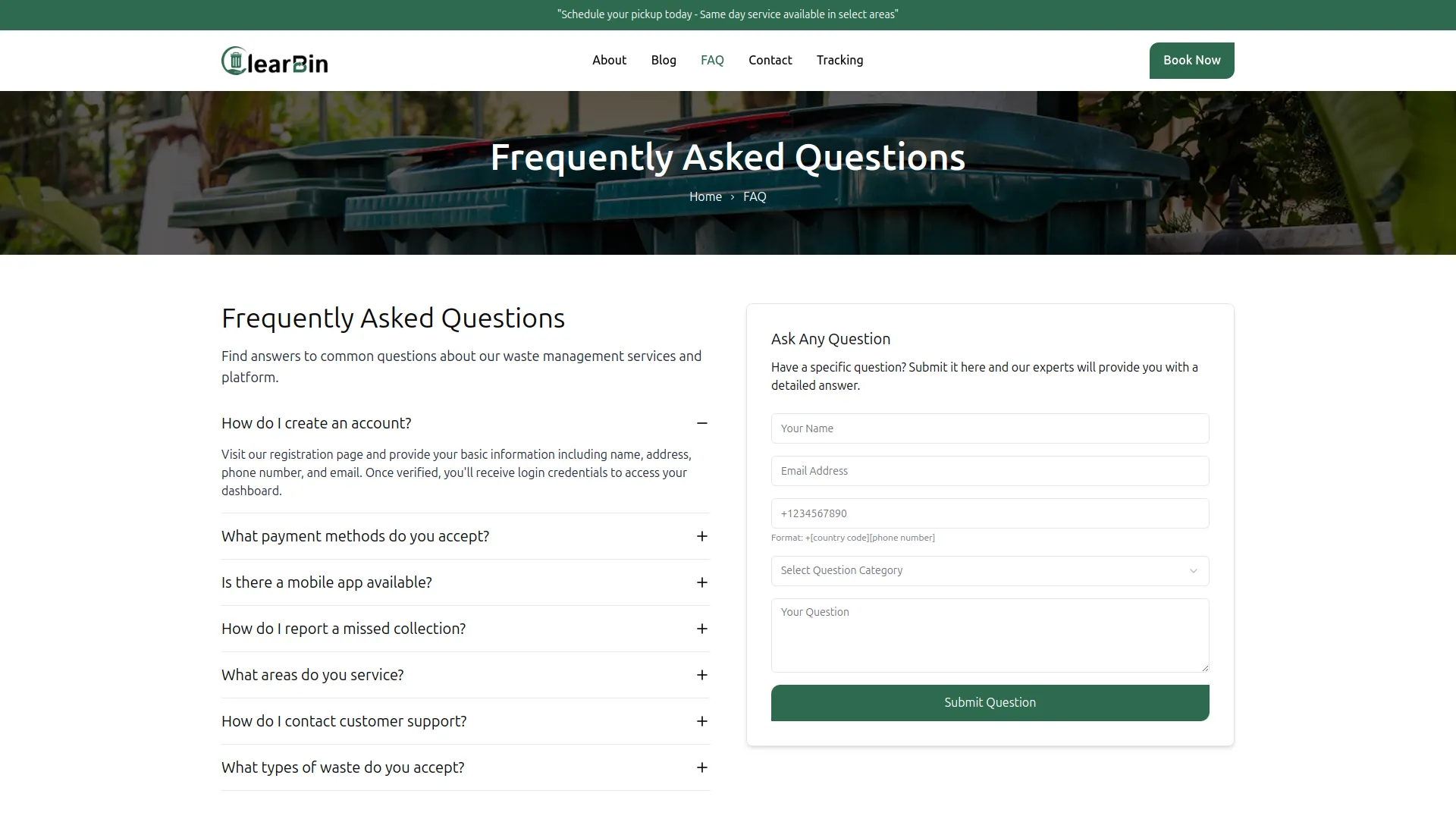
- Once saved, the FAQ section will display on the frontend website with organized categories and questions with expandable answers, helping customers find answers to common questions about your waste management services.
Title Section
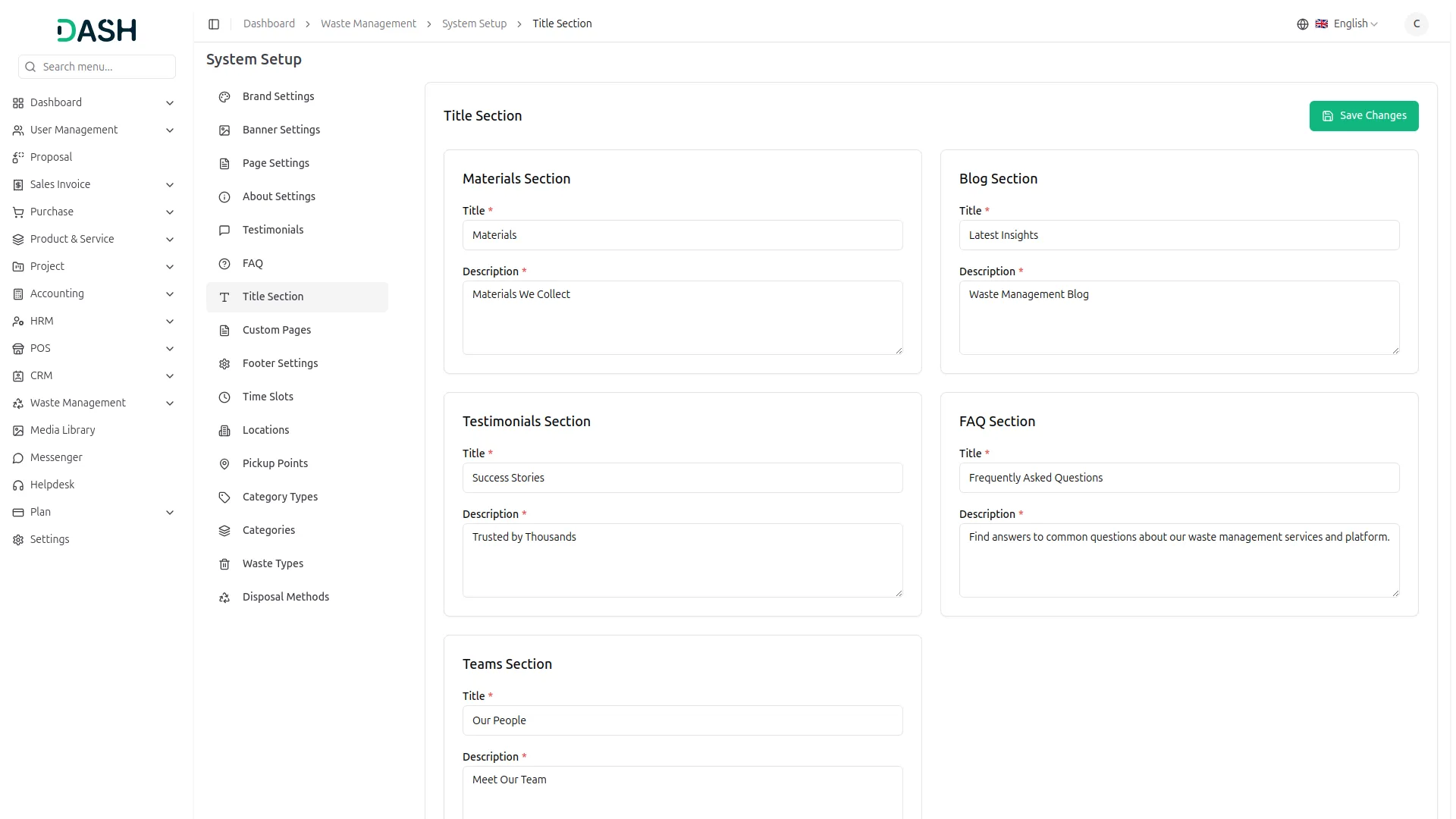
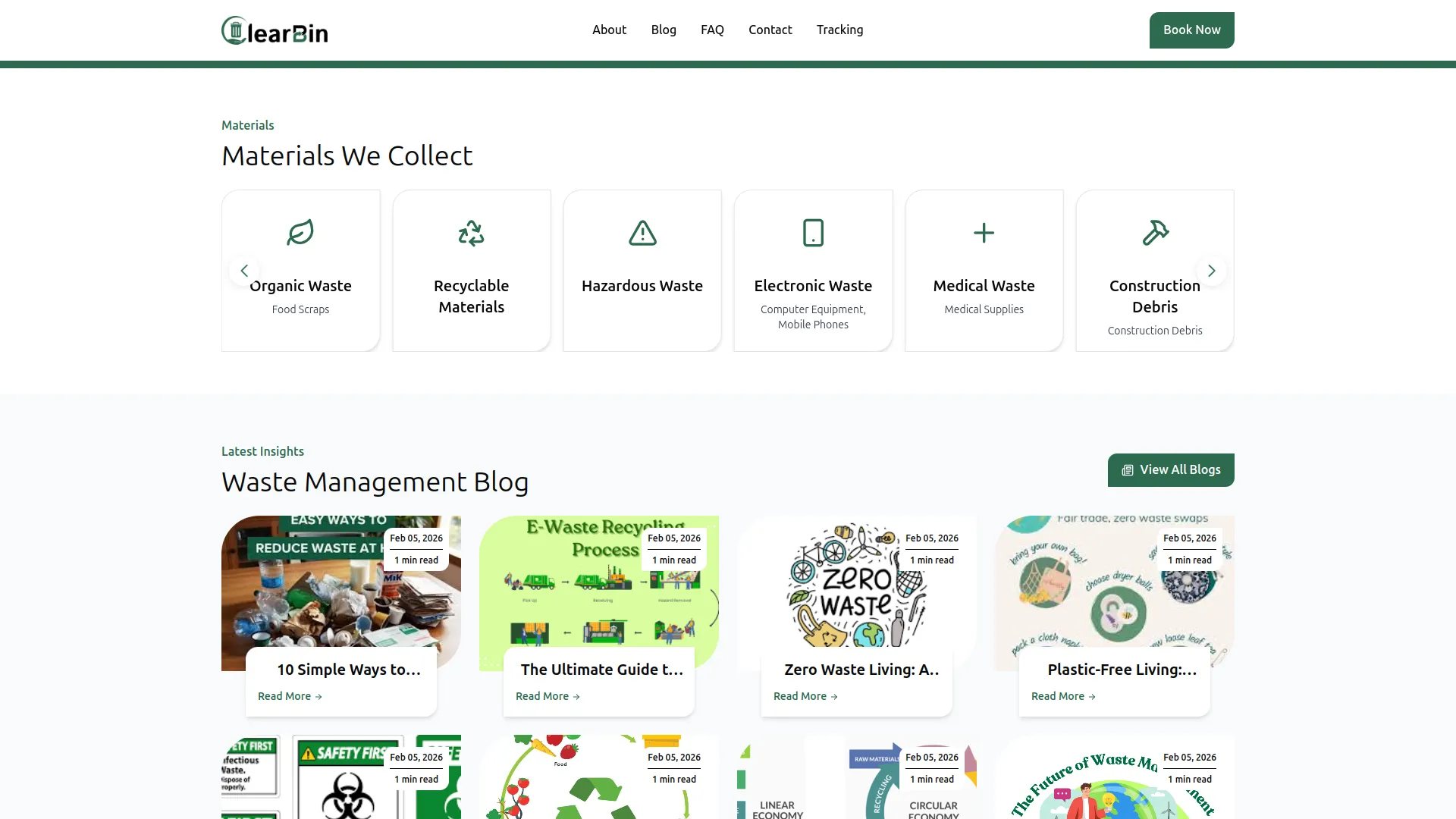
- In the Title Section, configure titles and descriptions for different sections of your website. Under the Materials Section, enter the Title and write the Description for the materials collection section.
- Under the Blog Section, enter the Title and write the Description for the blog or the latest insights section.
- Under the Testimonials Section, enter the Title and write the Description for the customer testimonials section.
- Under the FAQ Section, enter the Title and write the Description for the frequently asked questions section.
- Under the Teams Section, enter the Title and write the Description for the team members section. Click Save Changes to update.
-
- Once saved, these titles and descriptions will display as section headings across different pages of your frontend website, providing clear context for each section.
Custom Pages
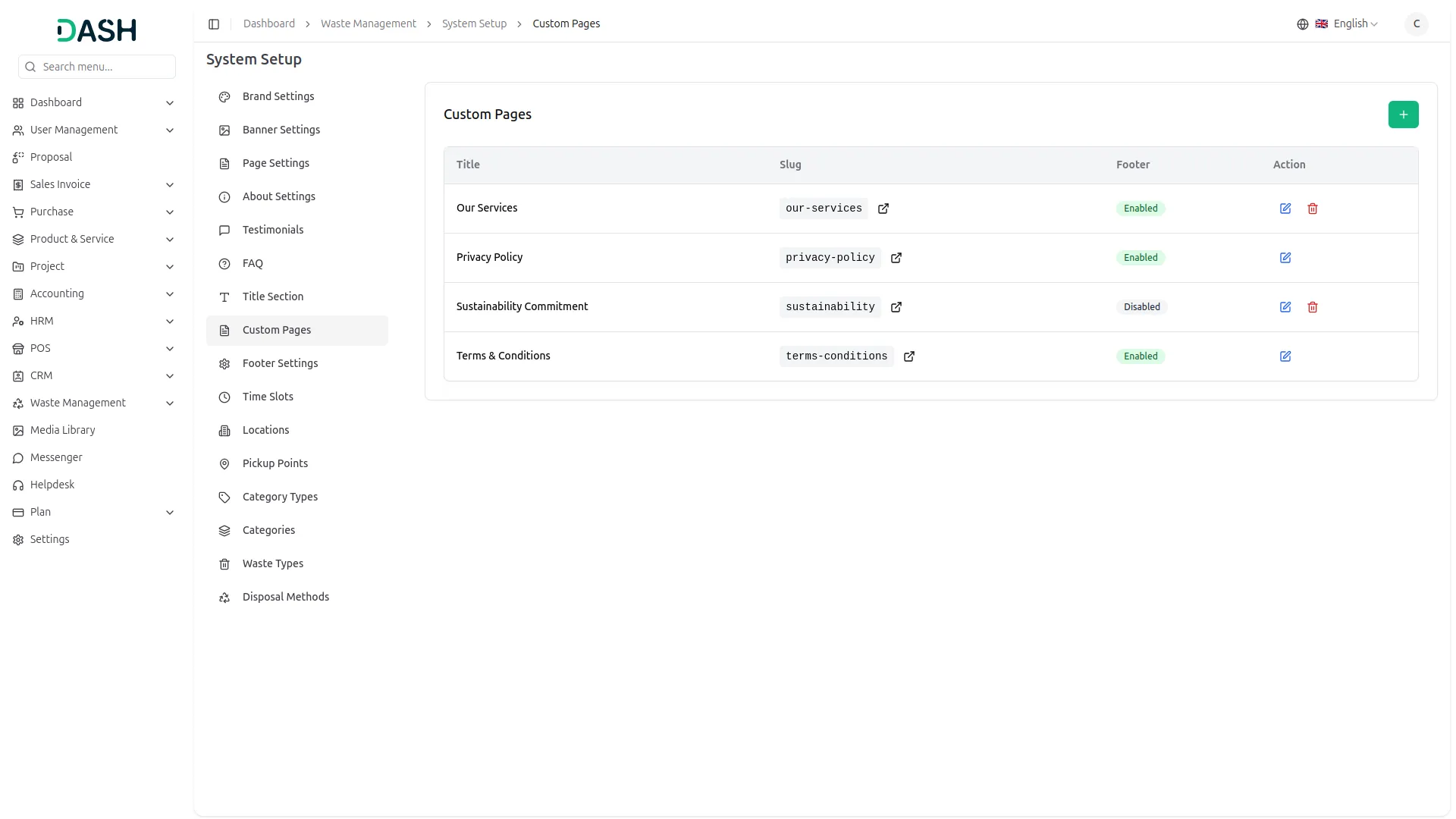
- The Custom Pages section displays all created custom pages in a table with columns for Title, Slug, Footer, and Action. The Slug column shows the URL path for each page. The Footer column indicates whether the page is enabled or Disabled in the footer menu.
- To create a new custom page, click the “Create” button at the top right. Enter the Title for the page heading. Write the page content.
- Toggle Enable Page Footer to include this page link in the website footer menu. When enabled, the page will appear in the footer navigation.
- Click Cancel to discard the changes or click Create to save the custom page.
- Available actions include Edit (clicking on this allows you to modify the custom page content) and Delete (clicking on this will remove the custom page from the system).
-
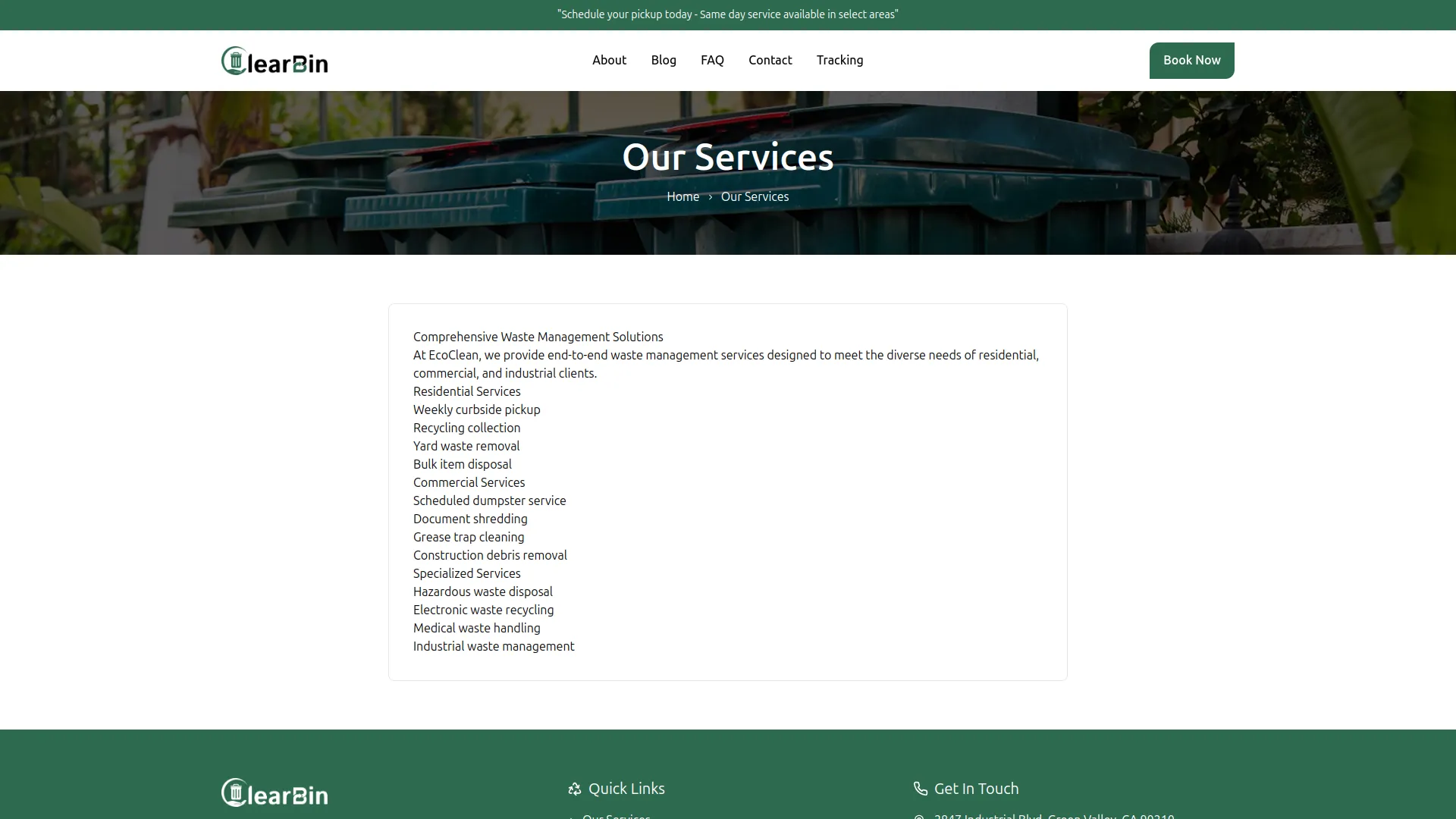
- Once created, the custom page will be accessible on the frontend website through its generated URL slug, and if enabled, it will appear in the footer navigation menu.
Footer Settings
- In the Footer Settings section, enter the get In touch & map iframe details.
- In the Social Links section, each item includes Social Media Icon and URL fields. Click the Social Media Icon search field to browse and select an icon from the available social media platforms. Enter the complete URL for your social media profile in the URL field. Click the delete icon to remove a social link. Click Add Social Link to add more social media profiles. Click Save Changes to update.
-
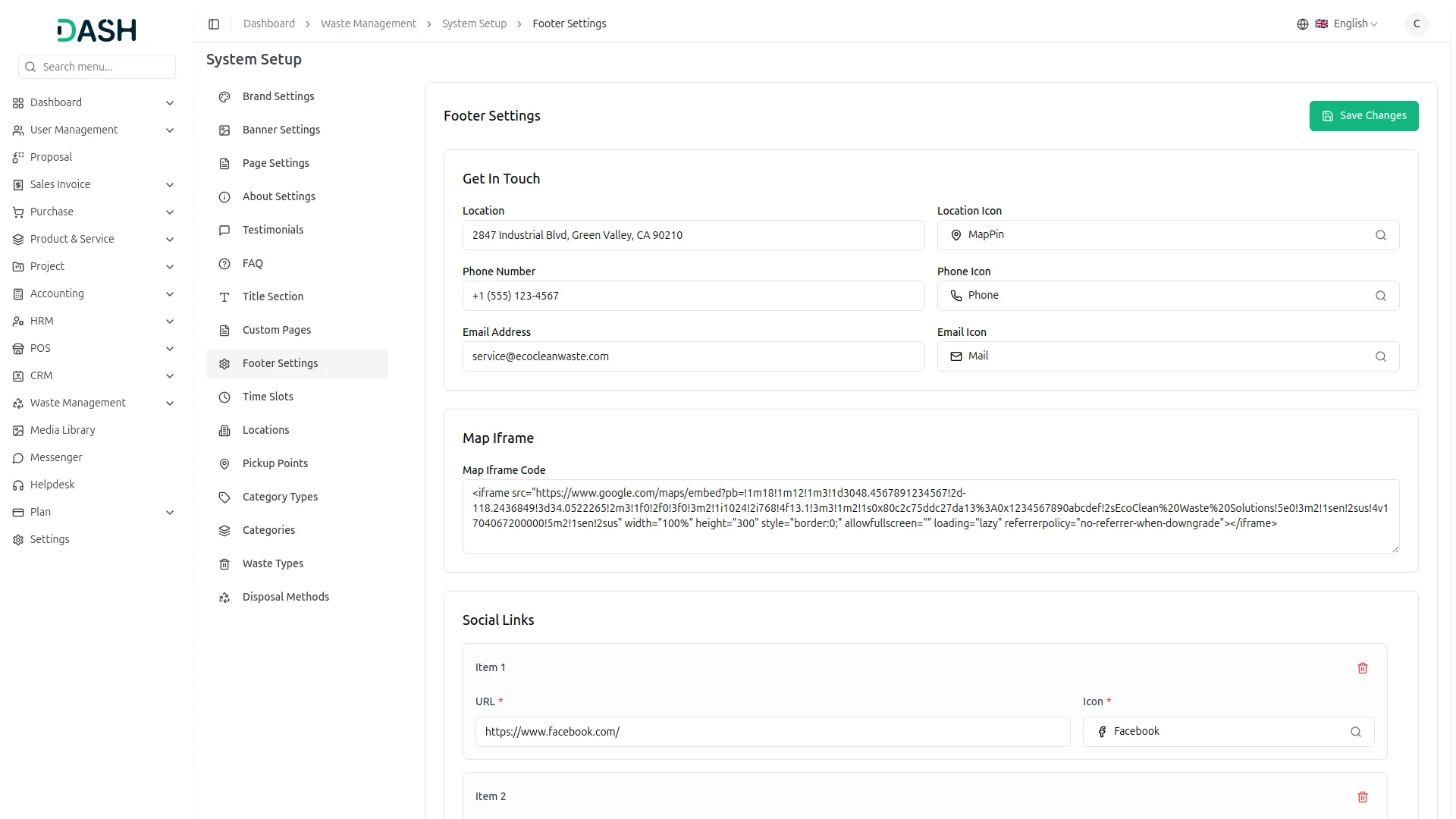
- Once saved, Get In Touch & Social Media Links will display in the footer section and map will display in the contact page of your frontend website, providing visitors with important information and navigation options.
Time Slots
- In the Time Slots section, each item includes Slot Name, Start Time, and End Time fields. Enter the Slot Name to identify the time period (such as Morning, Afternoon, Evening, or Night). Click the Start Time field to select the beginning time for the slot. Click the End Time field to select the ending time for the slot.
- Click the delete icon to remove a time slot. Click Add Time Slot to add more time slots. Click Save Changes to update.
-
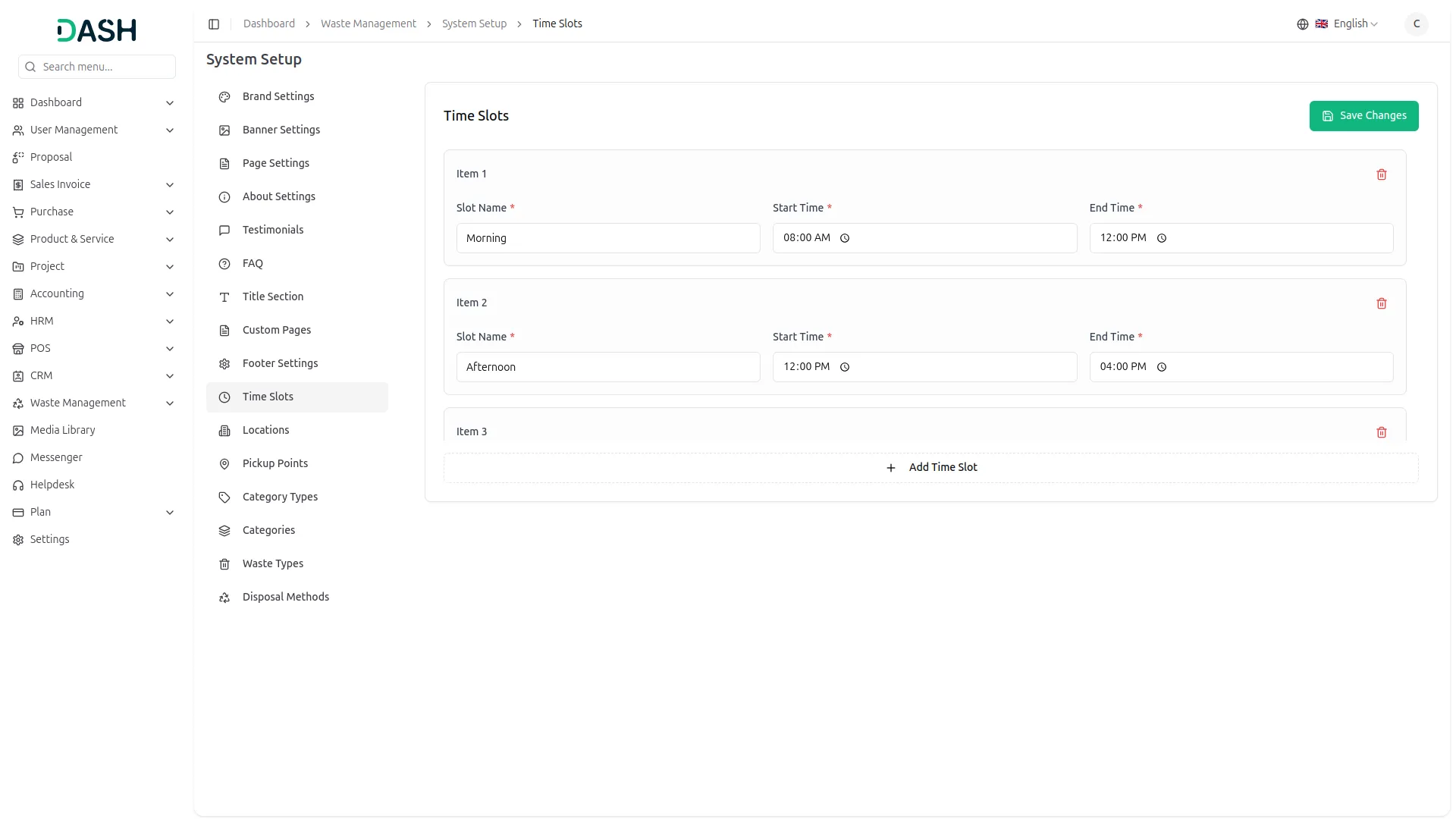
- Once saved, these time slots will be available as time preference options throughout the system, including in collection requests features on the frontend website.
Locations
- The Locations section displays all created locations in a table with columns for Name and Action.
- To create a new location, click the “Create” button at the top right. Enter the Name for the location. Click Cancel to discard the changes or click Create to save the location.
- Available actions include Edit (clicking on this allows you to modify the location name) and Delete (clicking on this will remove the location from the system).
-
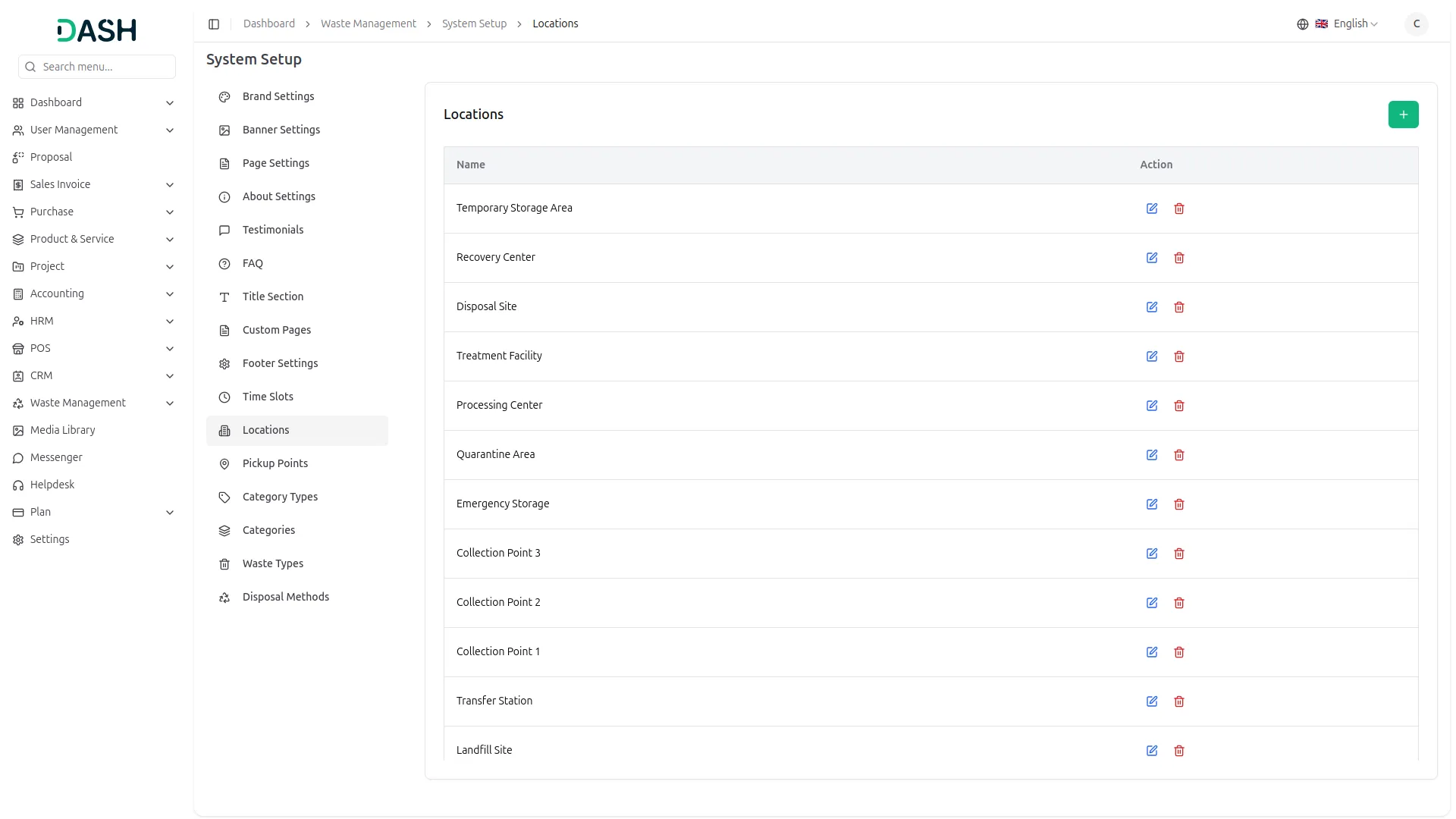
- Once saved, these locations will be available as dropdown options in collection requests and pickup points throughout the system.
Pickup Points
- The Pickup Points section displays all created pickup points in a table with columns for Name, Location, and Action.
- To create a new pickup point, click the “Create” button at the top right. Enter the Name for the pickup point. Select the Location from the dropdown menu (this comes from the locations created in the Locations section). Click Cancel to discard the changes or click Create to save the pickup point.
- Available actions include Edit (clicking on this allows you to modify the pickup point details) and Delete (clicking on this will remove the pickup point from the system).
-
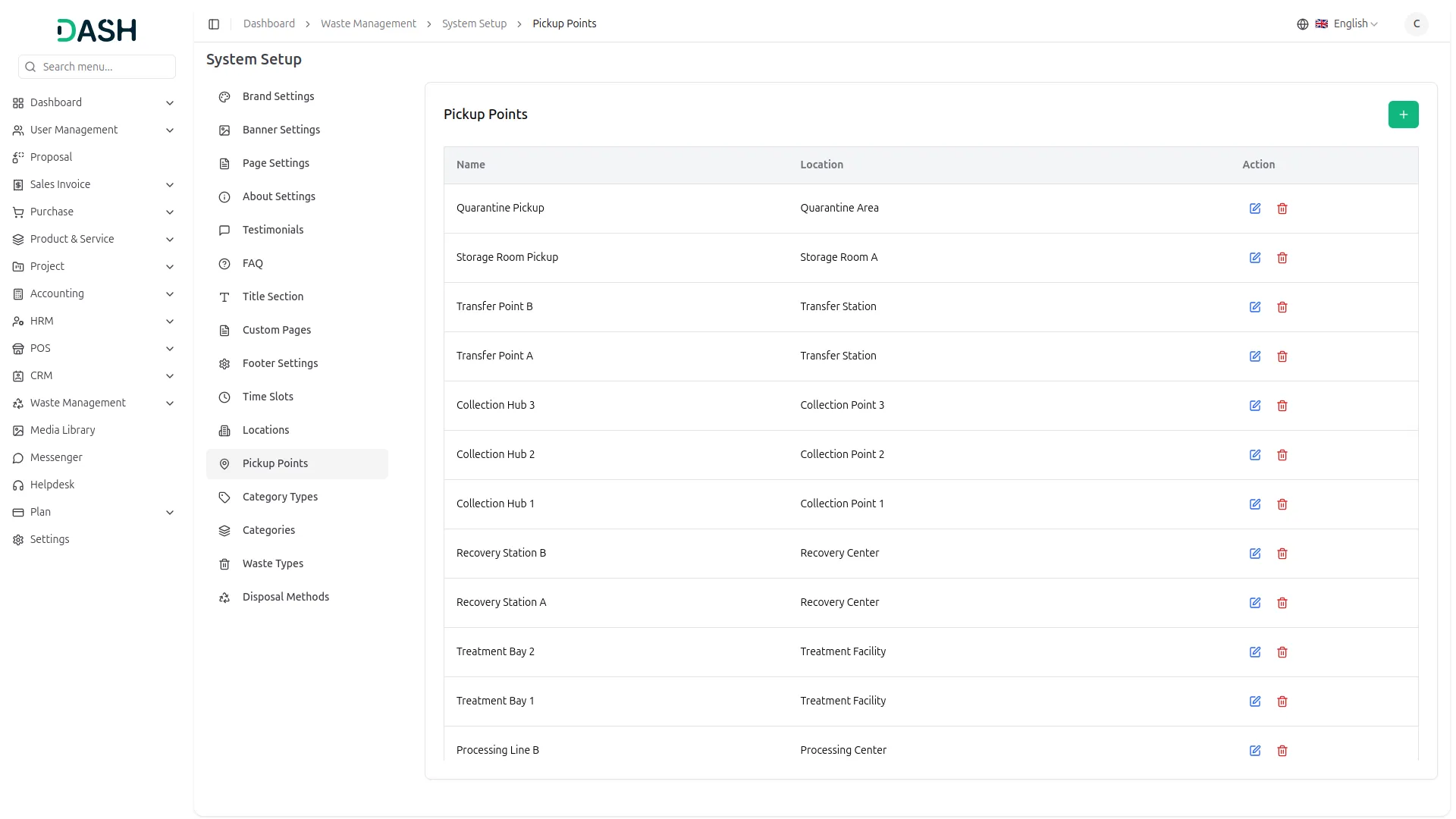
- Once saved, these pickup points will be available as dropdown options in collection requests throughout the system, automatically populating based on the selected location.
Category Types
- The Category Types section displays all created category types in a table with columns for Icon, Name, and Action.
- To create a new category type, click the “Create” button at the top right. Enter the Name for the category type. Click the Icon search field to browse and select an icon from the available icon library. Click Cancel to discard the changes or click Create to save the category type.
- Available actions include Edit (clicking on this allows you to modify the category type details) and Delete (clicking on this will remove the category type from the system).
-
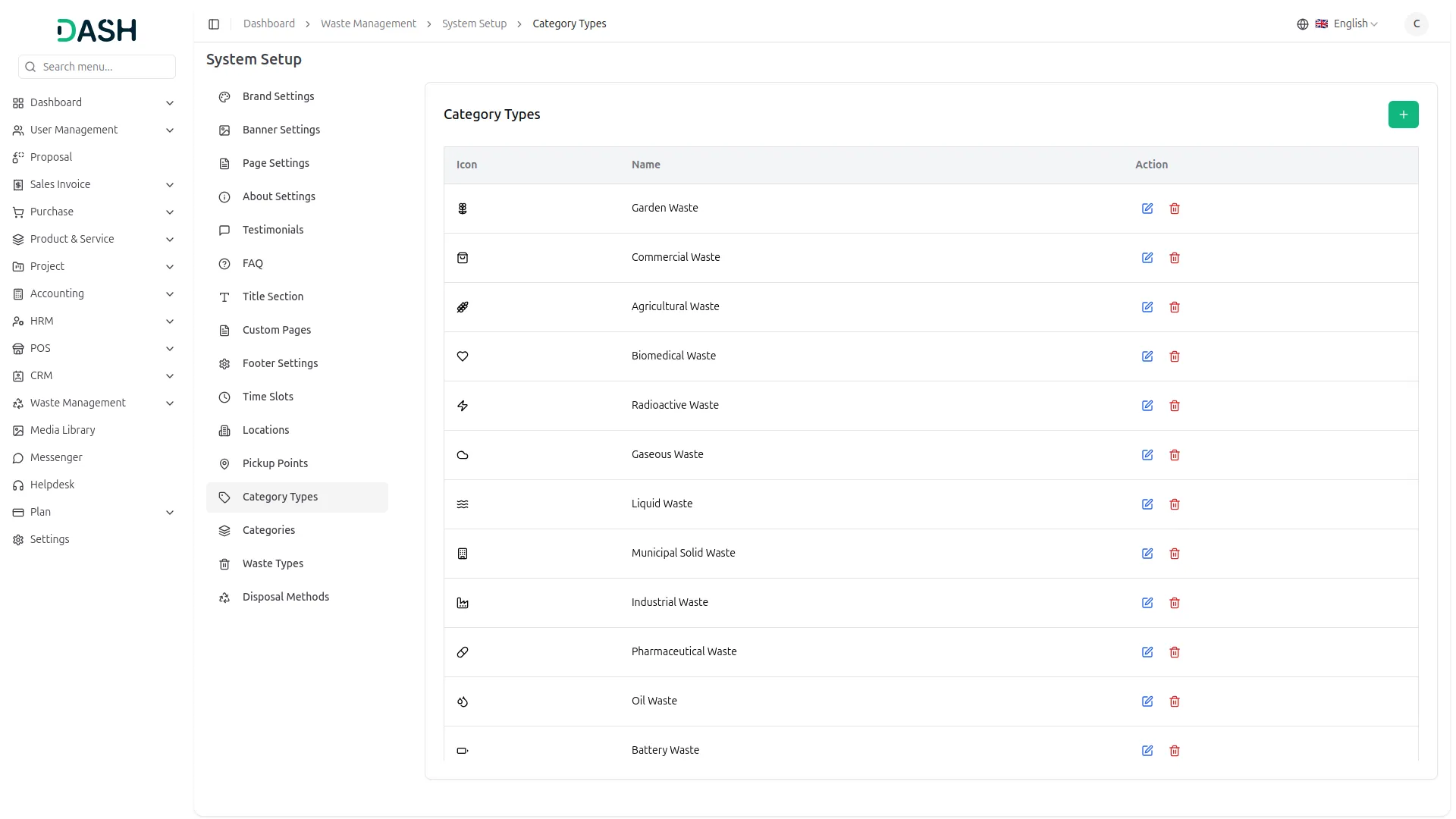
- Once saved, these category types will be available as dropdown options when creating categories throughout the system, helping to organize waste materials into broader classifications.
Categories
- The Categories section displays all created categories in a table with columns for Name, Description, Category Type, and Action.
- To create a new category, click the “Create” button at the top right. Enter the Name for the category. Select the Category Type from the dropdown menu (this comes from the category types created in the Category Types section). Write the Description in the text area, explaining what materials or items belong to this category.
- Click Cancel to discard the changes or click Create to save the category.
- Available actions include Edit (clicking on this allows you to modify the category details) and Delete (clicking on this will remove the category from the system).
-
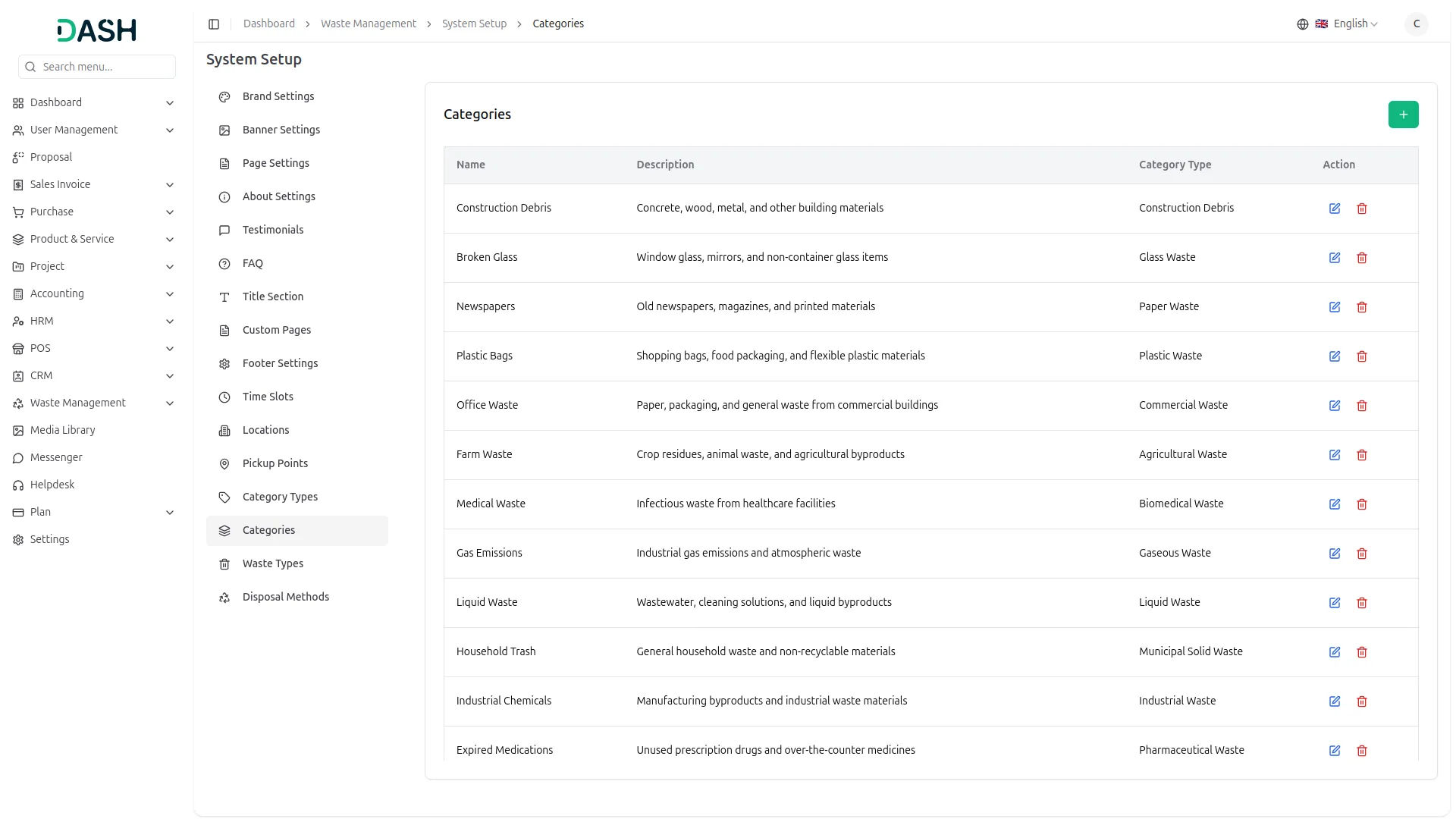
- Once saved, these categories will be available as dropdown options in collection requests, inspections, and other modules throughout the system, automatically populating based on the selected category type.
Waste Types
- The Waste Types section displays all created waste types in a table with columns for Name and Action.
- To create a new waste type, click the “Create” button at the top right. Enter the Name for the waste type. Click Cancel to discard the changes or click Create to save the waste type.
- Available actions include Edit (clicking on this allows you to modify the waste type name) and Delete (clicking on this will remove the waste type from the system).
-
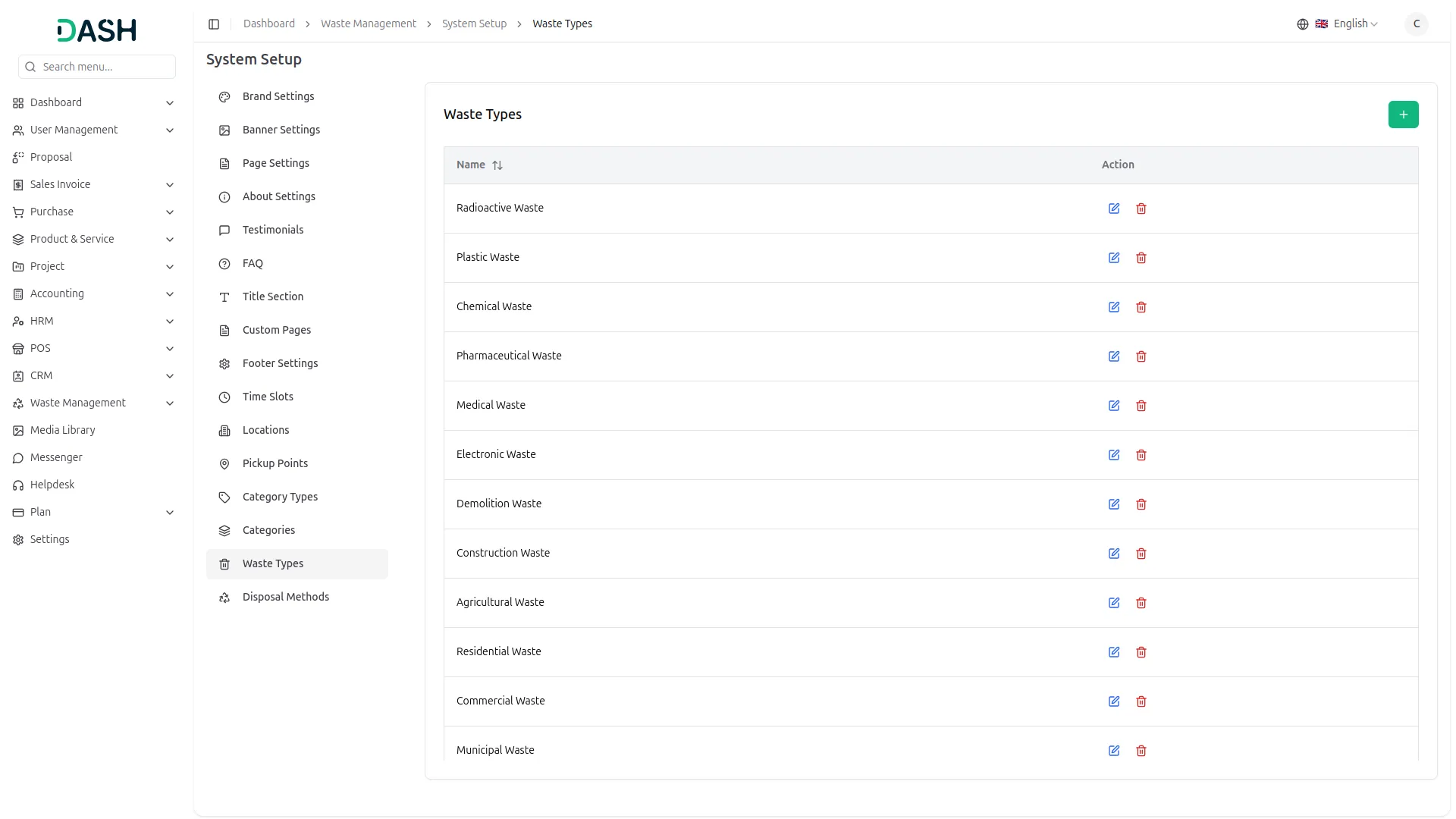
- Once saved, these waste types will be available as dropdown options in recycling requests throughout the system.
Disposal Methods
- The Disposal Methods section displays all created disposal methods in a table with columns for Name and Action.
- To create a new disposal method, click the “Create” button at the top right. Enter the Name for the disposal method (such as Landfill Disposal, Incineration, Chemical Treatment, Biological Treatment, Recycling, or Composting). Click Cancel to discard the changes or click Create to save the disposal method.
- Available actions include Edit (clicking on this allows you to modify the disposal method name) and Delete (clicking on this will remove the disposal method from the system).
-
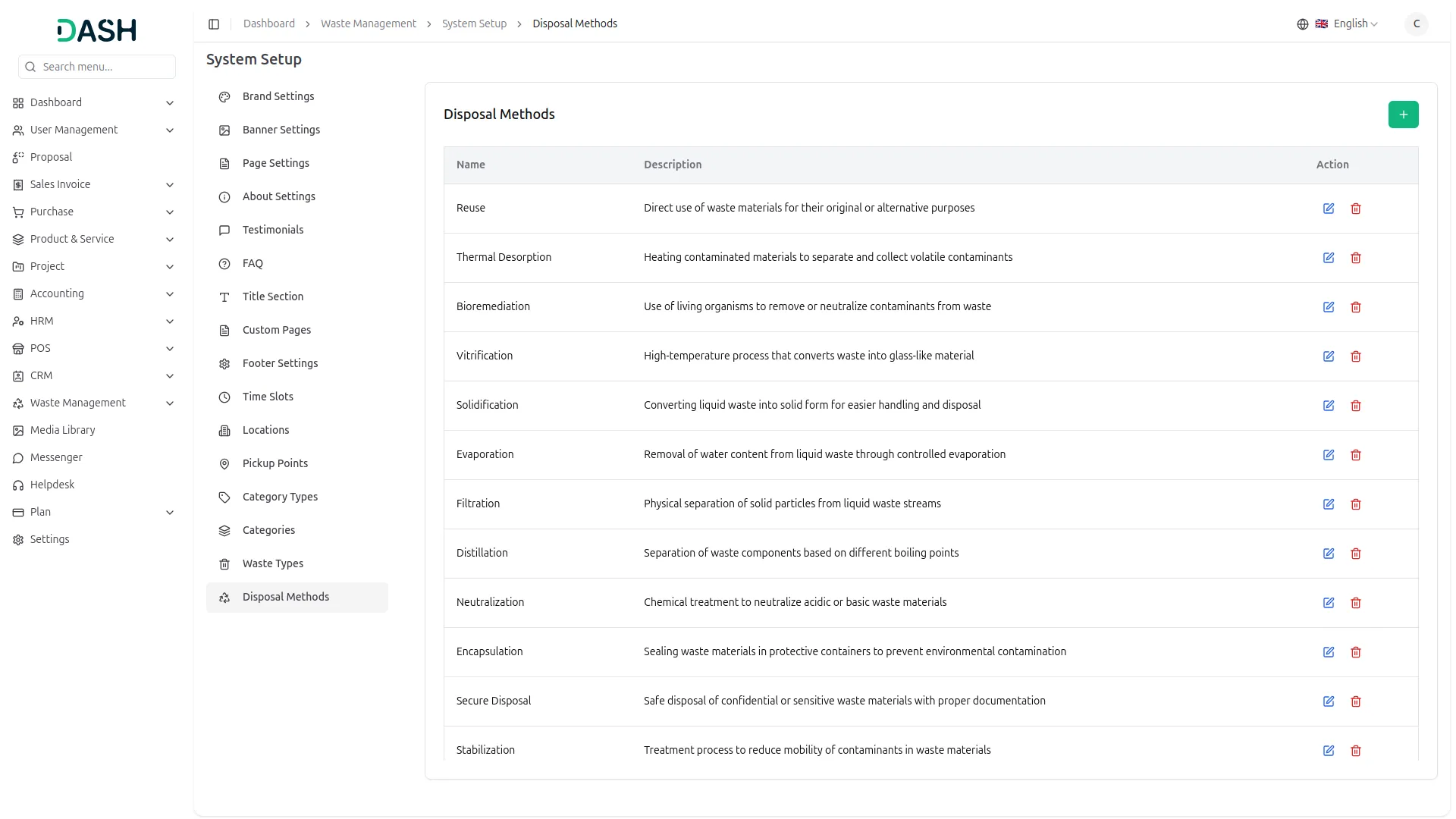
- Once saved, these disposal methods will be available as dropdown options in disposal facilities and other modules throughout the system, helping to categorize different waste processing approaches.
Collection Request
- On the Manage Collection Requests page, you can easily add a new collection request by clicking the “Create” button given at the top right of the page.
- Fill in the customer information by entering the Name, Email, and Phone number.
- Select the Date from the date. Choose the Time Preference from the dropdown menu (afternoon, evening, morning).
- Select the Location from the dropdown menu (comes from the system set-up), and auto generate Pickup Point.
- Select the Category Type from the dropdown menu(comes from the system set-up), then auto-generate the specific Category. Add any Special Instructions in the text area if needed.
- After filling in all the required details, click the Create button to submit the collection request.
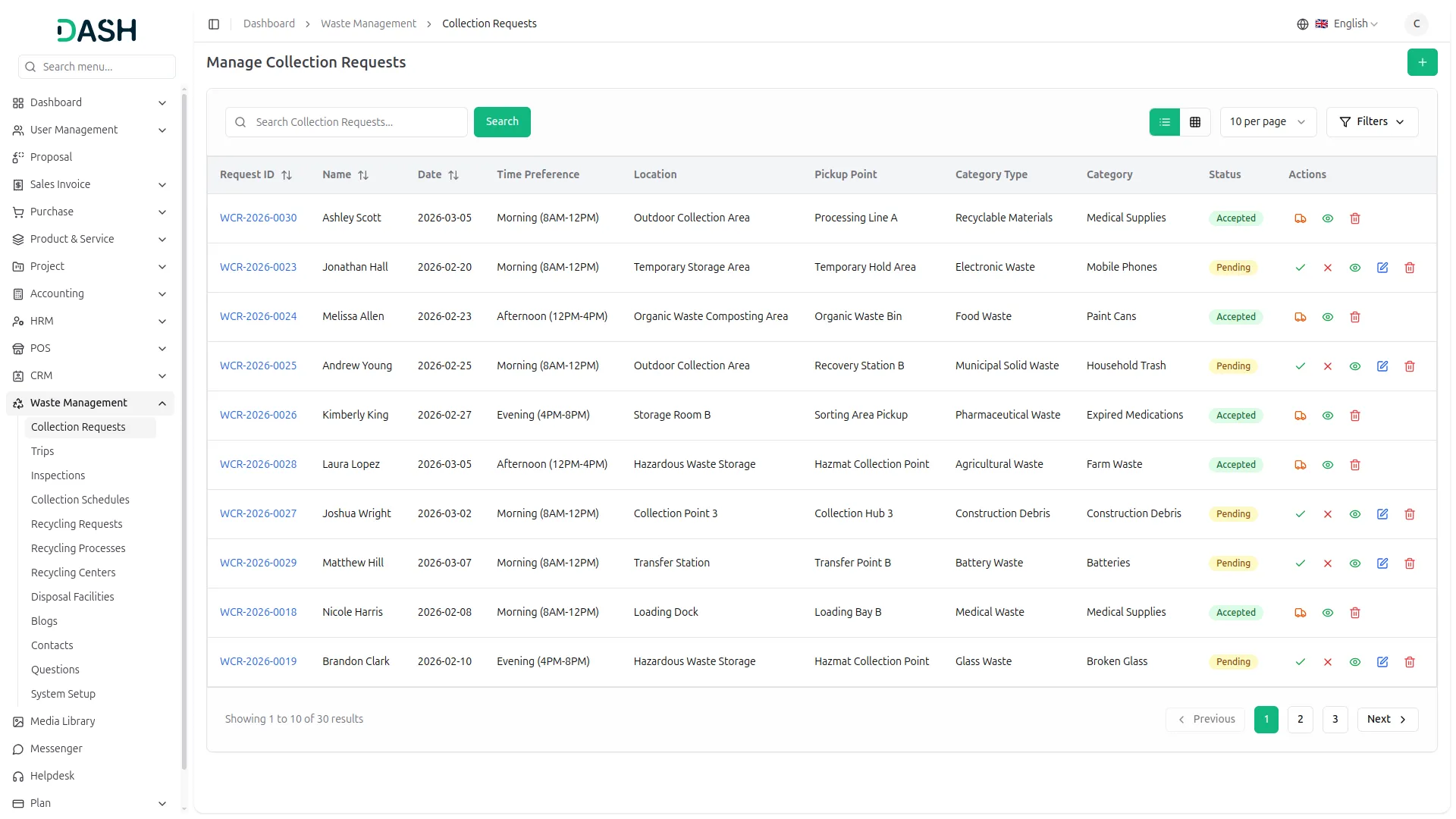
- The list page displays all collection requests in a table with columns for Request ID, Name, Date, Time Preference, Location, Pickup Point, Category Type, Category, Status, and Actions.
- Use the search bar to find specific collection request records. Click the Filters button to access filtering options. Select the status from the dropdown (pending, accepted, rejected), set the date, and choose the time preference dropdown (afternoon, evening, morning). Click the Apply button to filter the data or the Clear button to reset the filters.
- Available actions you can use several options such as edit to modify the data, delete to the delete the existing data, accept ( clicking on accept will change the request status to accepted ), reject ( clicking on this will make the request status rejected ), and after accept request convert to a trip action show ( where you select the user to assign the trip from the dropdown).
Manage Trip
- A trip is automatically created when a collection request is converted into a trip.
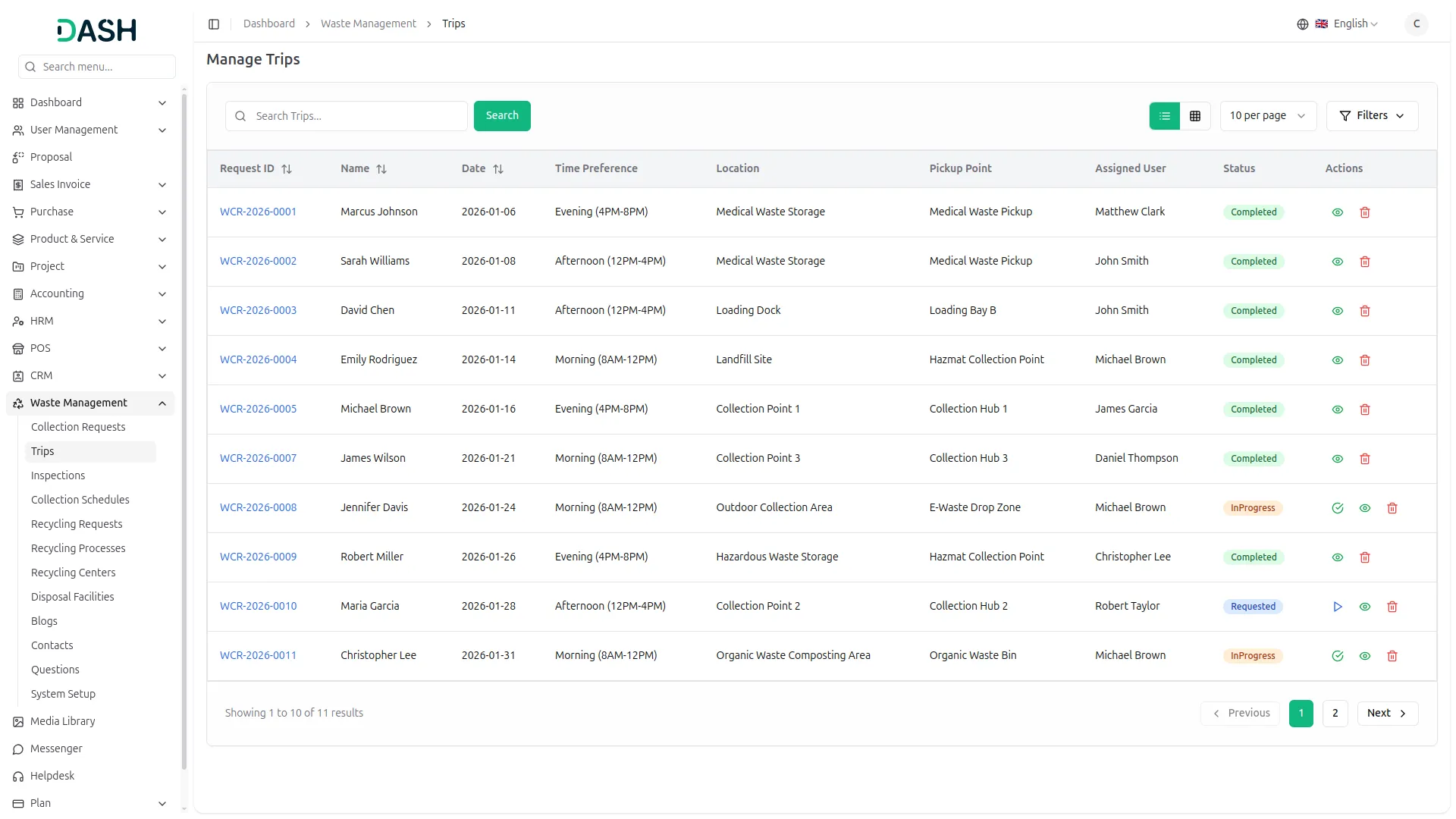
- Trip information is displayed in a table with columns, including details such as the Request ID, Name, Date, Time Preference, Location, Pickup Point, Assigned User, Status, and Actions.
- Use the search bar to find specific trips. Click the Filters button to access filtering options, including selecting Status from the dropdown ( Requested, InProgress, and Completed), choosing a Date from the date, and selecting Time Preference from the dropdown ( Morning 8 AM-12 PM, Afternoon 12 PM-4 PM, and Evening 4 PM-8 PM). Click the Apply button to filter the data or the Clear button to reset the filters.
- On this page, with the help of the actions column you can use the view option to see the trip details, the delete option to remove the trip, and start the trip. Request (clicking on this will make the status in progress), complete (clicking on this will make the status completed)
Manage Inspection
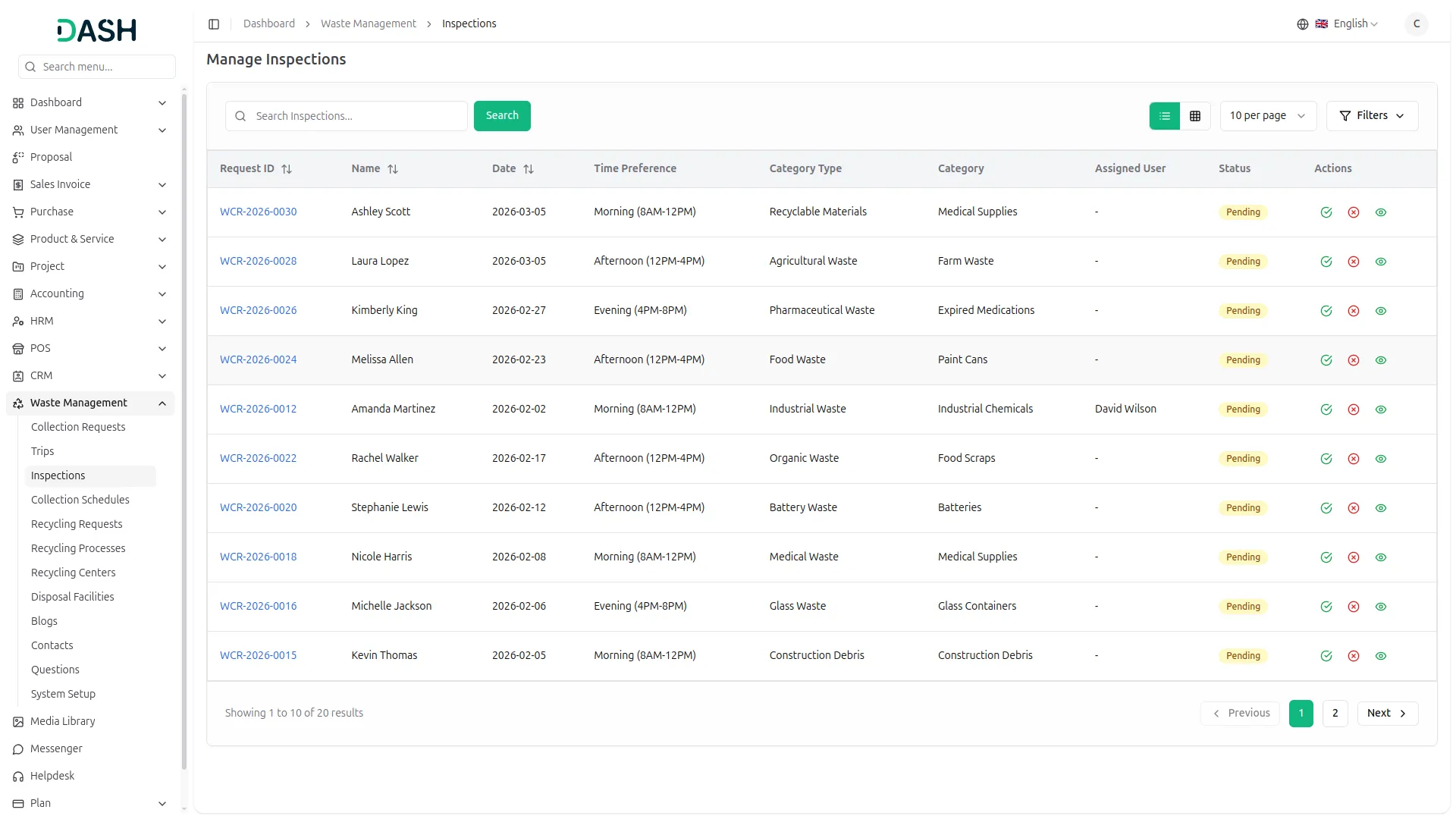
- The list page displays all accept requests in a table with columns for Request ID, Name, Date, Time Preference, Category Type, Category, Assigned User, Status, and Actions.
- Use the search bar to find specific inspection records. Click the Filters button to access filtering options. Select the Status from the dropdown (Pending, Passed, Failed), set the Date from the date, and choose the Time Preference from the dropdown (Morning 8 AM-12 PM, Afternoon 12 PM-4 PM, Evening 4 PM-8 PM). Click the Apply button to filter the data or the Clear button to reset the filters.
- Available actions include Pass (clicking on this will change the inspection status to Passed), Fail (clicking on this will change the inspection status to Failed), and View (clicking on this will display the complete inspection details).
Collection Schedule
- To create a new collection schedule, click on the”Create” button at the top of the page. Select the Collection Request from the dropdown menu (this comes from existing accept requests in collection requests the system), enter the Name, and set the date.
- Choose the Recurrence option by selecting one of the radio buttons (Daily, Weekly, or Monthly). Select the Status by choosing one of the radio buttons (Pending or Completed).
- After filling in all the required details, click the Create button to submit the collection schedule. Click Cancel to discard the changes.
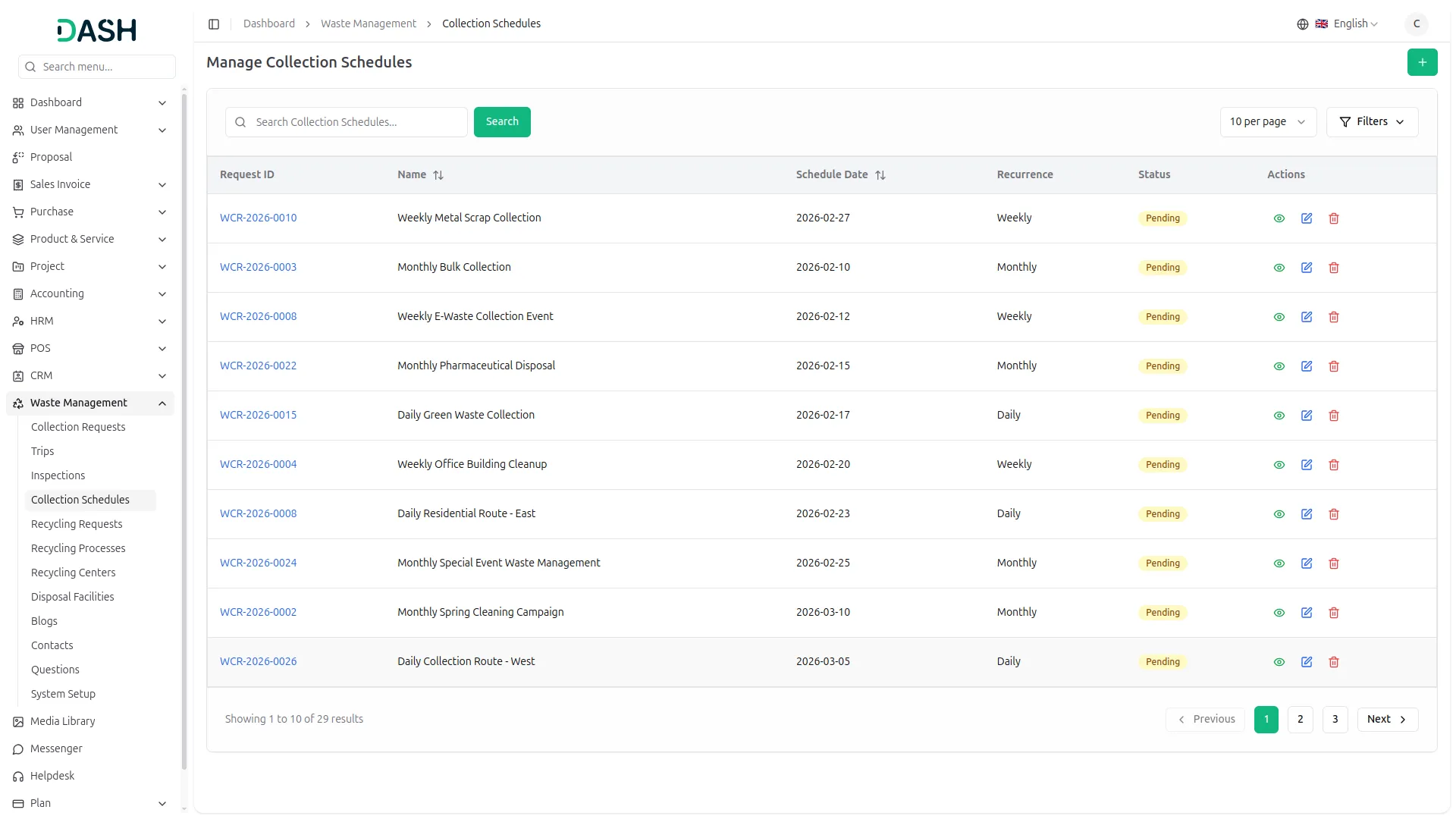
- The list page displays all collection schedules in a table with columns for Request ID, Name, Schedule Date, Recurrence, Status, and Actions. Use the search bar to find specific collection schedule records.
- Click the Filters button to access filtering options. Select the Status from the dropdown (Pending, Completed), set the Date from the date, and choose the Recurrence from the dropdown (Daily, Weekly, Monthly). Click the Apply button to filter the data or the Clear button to reset the filters.
- Available actions include View (clicking on this will display the complete schedule details), Edit (clicking on this allows you to modify the schedule data), and Delete (clicking on this will remove the schedule from the system).
Recycling Requests
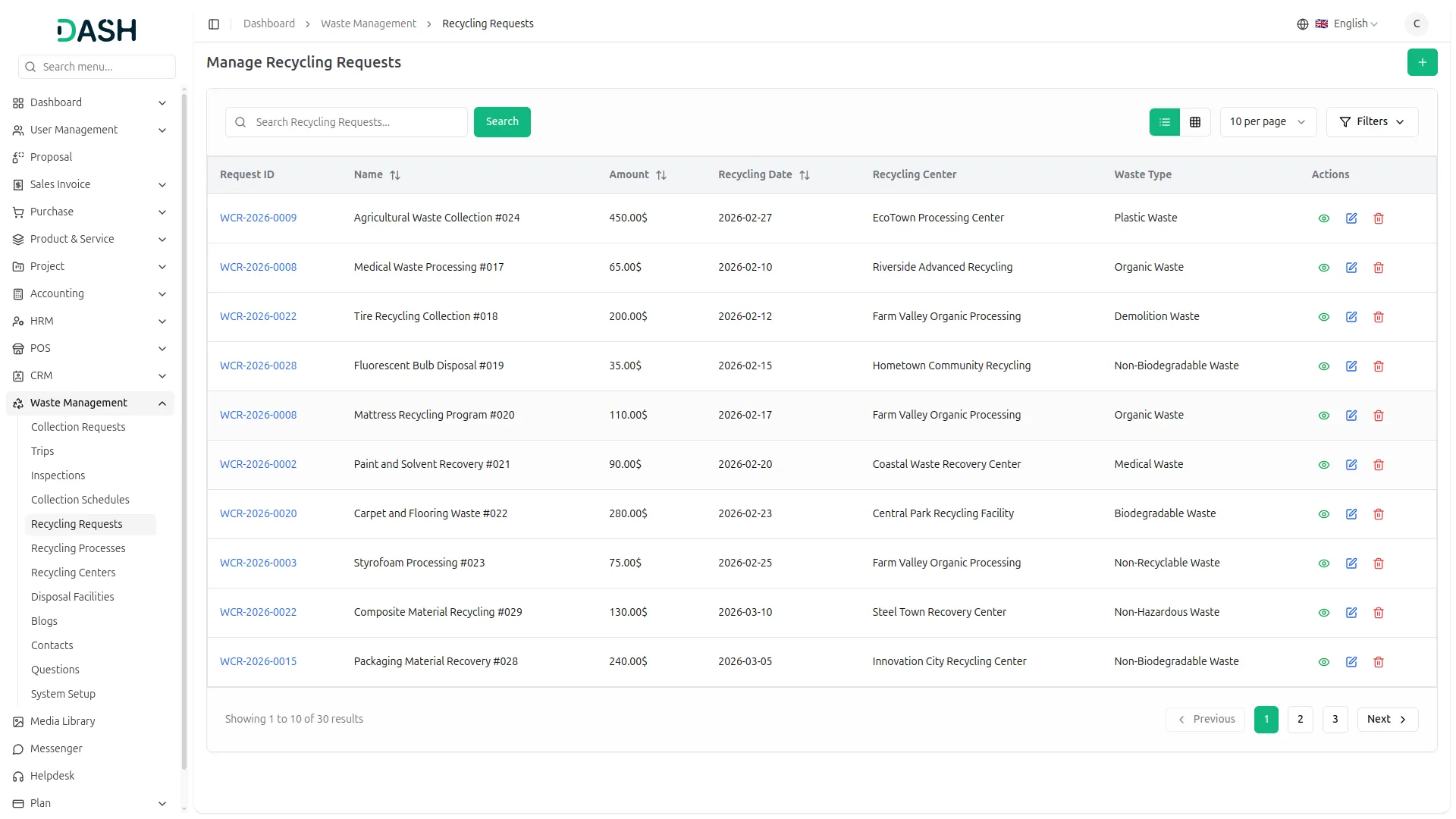
- On the Manage Recycling Requests page, you can easily add a new recycling request by clicking the “Create” button given at the top right of the page.
- Select the Collection Request from the dropdown menu (this comes from existing accept requests in collection requests the system). Enter the Name, Amount, and set the Recycling Date.
- Select the Recycling Center from the dropdown menu (this comes from the Recycling Center section). Select the Waste Type from the dropdown menu (this comes from the system setup). Add any Description
- After filling in all the required details, click the Create button to submit the recycling request. Click Cancel to discard the changes.
- The list page displays all recycling requests in a table with columns for Request ID, Name, Amount, Recycling Date, Recycling Center, Waste Type, and Actions. Use the search bar to find specific recycling request data.
- Click the Filters button to access filtering options. Set the Date from the date, select the Recycling Center from the dropdown, and choose the Waste Type from the dropdown. Click the Apply button to filter the data or the Clear button to reset the filters.
- Available actions include View (clicking on this will display the complete recycling request details), Edit (clicking on this allows you to modify the request data), and Delete (clicking on this will remove the recycling request from the system).
Recycling Processes
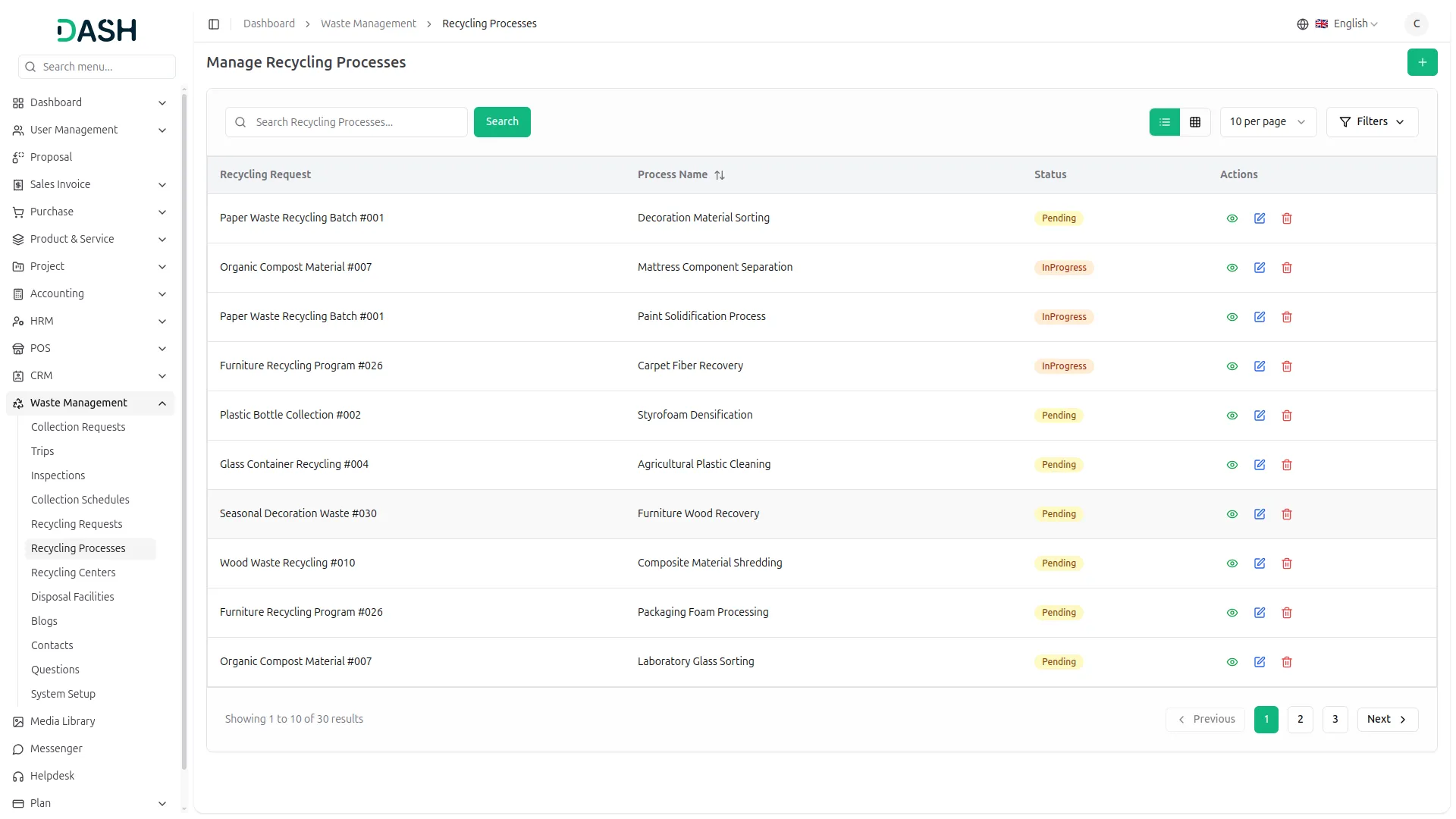
- To add a new recycling process, click the “Create” button at the top right of the recycling process page. Select the Recycling Request from the dropdown menu (this comes from the recycling requests section). Enter the Process Name.
- Select the Status by choosing one of the radio buttons (Pending, InProgress, or Completed). Write the Description.
- After filling in all the required details, click the Create button to submit the recycling process. Click Cancel to discard the changes.
- The list page displays all recycling processes in a table with columns for Recycling Request, Process Name, Status, and Actions. Use the search bar to find specific recycling process data.
- Click the Filters button to access filtering options. Select the Status from the dropdown (Pending, InProgress, Completed). Click the Apply button to filter the data or the Clear button to reset the filters.
- In the actions column, you can use options that include View (clicking on this will display the complete recycling process details), Edit (clicking on this allows you to modify the process data), and Delete (clicking on this will remove the recycling process from the system).
Recycling Centers
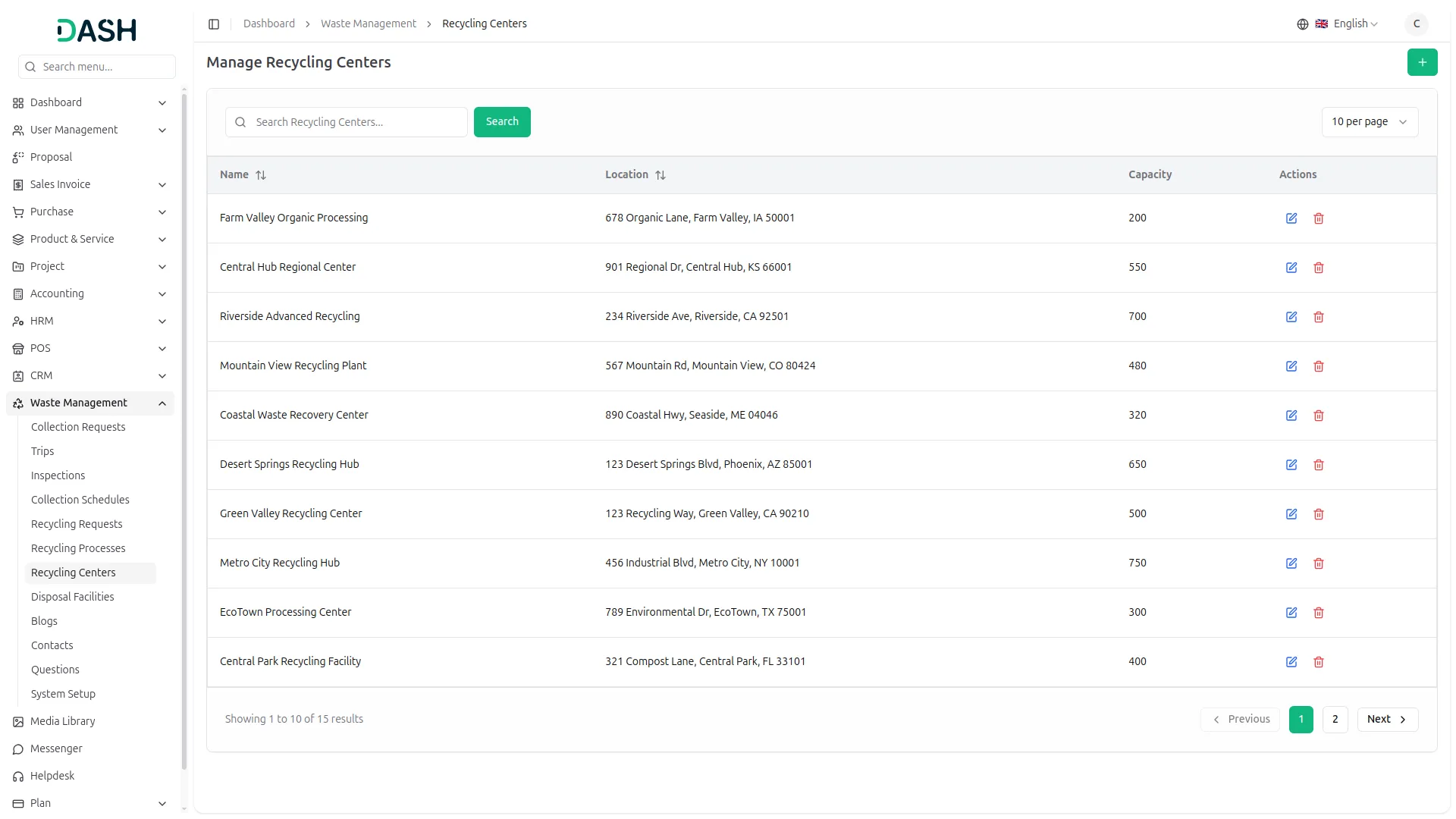
- On the Manage Recycling Centers page, you can easily add a new recycling center by clicking the “Create” button given at the top right of the page.
- Fill in the required details, such as the Name, Location, and Capacity. After filling in all the required details, click the Create button to submit the recycling center. Click Cancel to discard the changes.
- The list page displays all recycling centers in a table with columns for Name, Location, Capacity, and Actions. Use the search bar to find specific recycling center records.
- Available actions include Edit (clicking on this allows you to modify the recycling center data) and Delete (clicking on this will remove the recycling center from the system).
Disposal Facilities
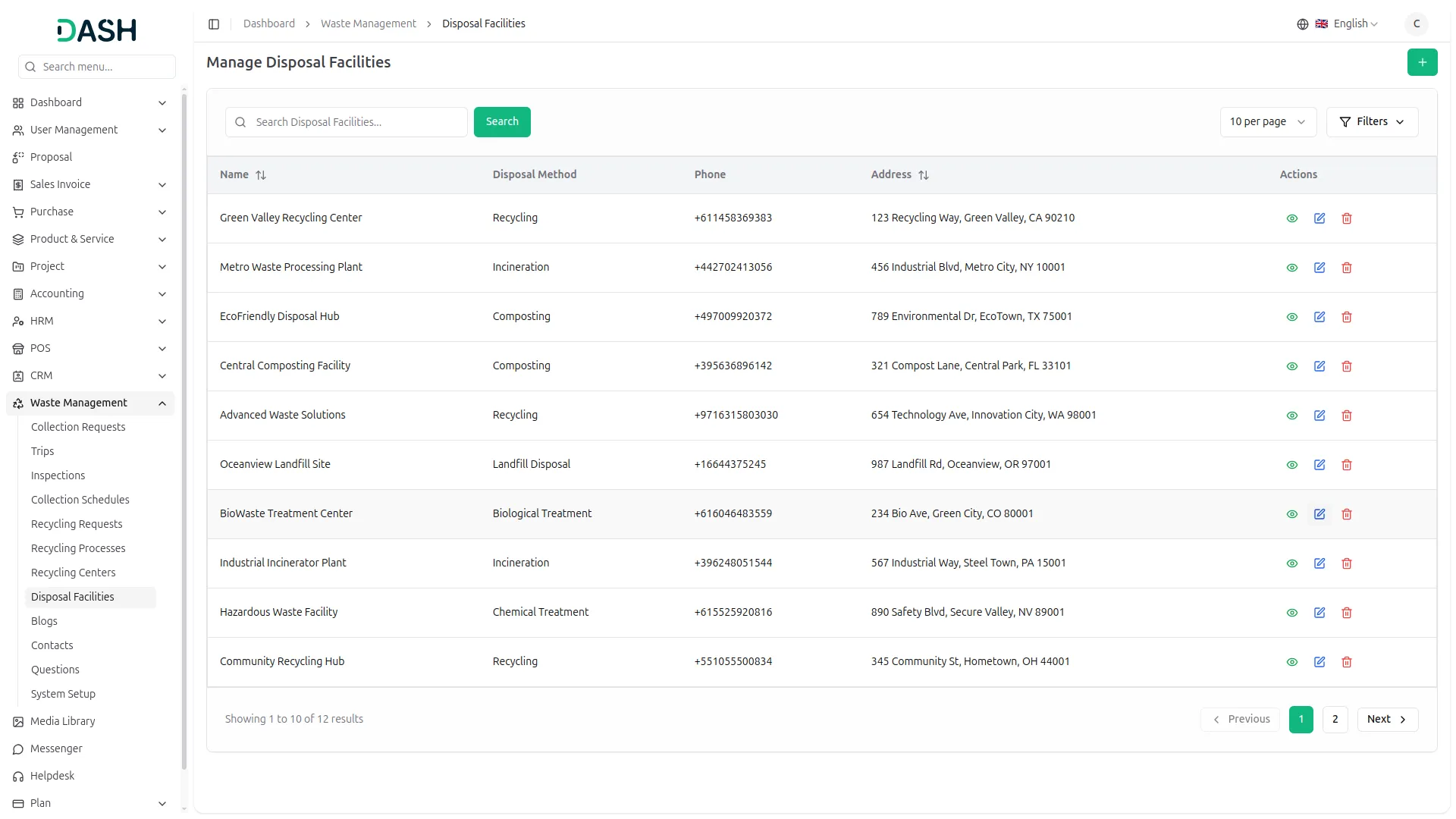
- To add a new Disposal Facility, click the “Create” button at the top right of the recycling process Disposal Facilities page. Select the Disposal Method from the dropdown menu (this comes from the system setup). Enter the Name, Phone number, and Address.
- After filling in all the required details, click the Create button to submit the disposal facility. Click Cancel to discard the changes.
- The list page displays all disposal facilities in a table with columns for Name, Disposal Method, Phone, Address, and Actions. Use the search bar to find specific disposal facility records.
- Click the Filters button to access filtering options. Select the Disposal Method from the dropdown (comes from the system set-up). Click the Apply button to filter the data or the Clear button to reset the filters.
- Available actions include View (clicking on this will display the complete disposal facility details), Edit (clicking on this allows you to modify the facility data), and Delete (clicking on this will remove the disposal facility from the system).
Manage Blogs
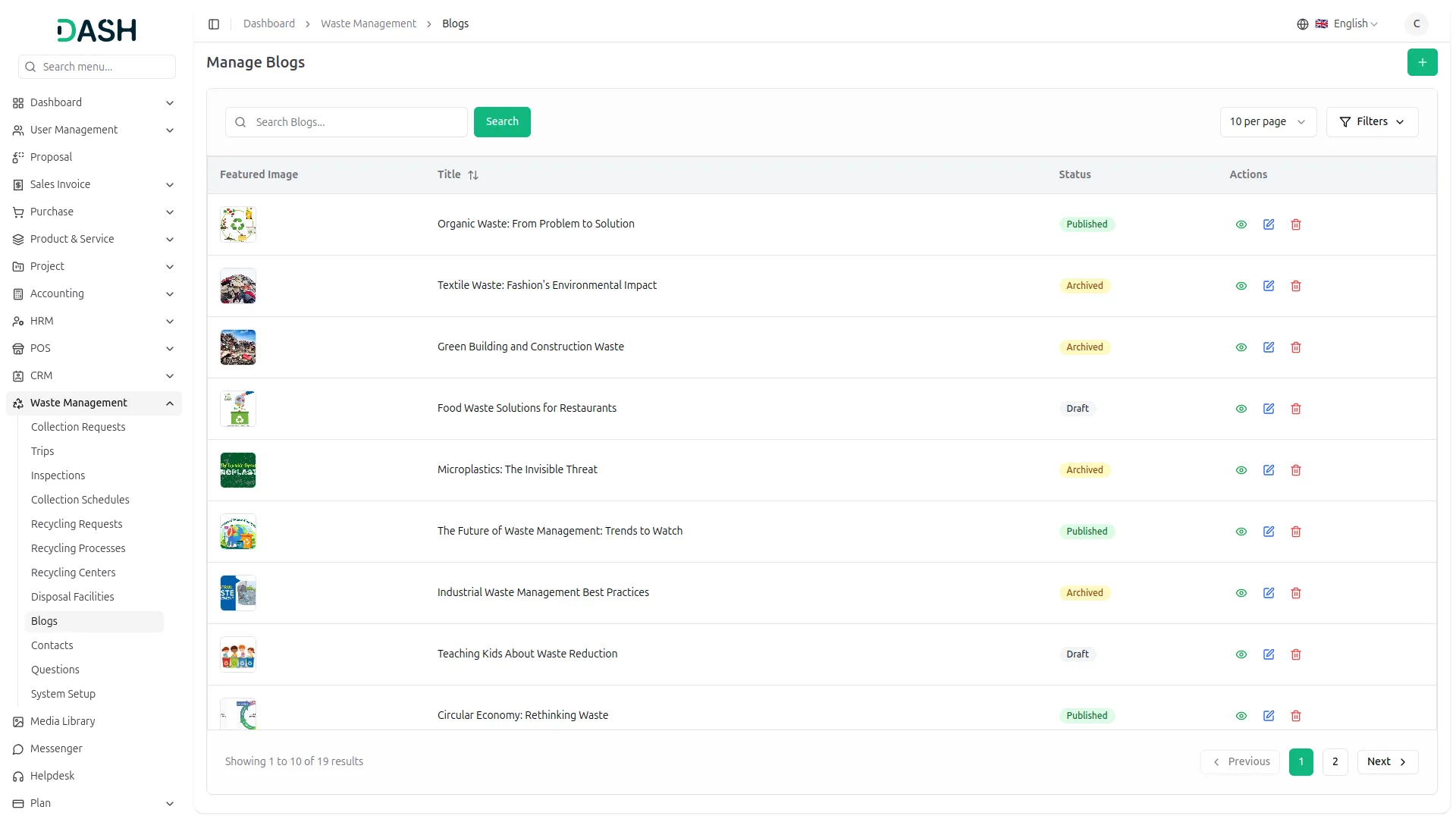
- To add a new blog, click the “Create” button at the top of the Manage Blogs page. Start by entering the Title, and select the Status by choosing one of the radio buttons (Draft, Published, or Archived).
- Upload a Featured Image by clicking the Browse button next to the Select featured image field to choose an image from your device. Write the blog Content.
- In the Quick Facts section, click the Add Quick Fact button to include additional information or key points related to the blog post.
- After filling in all the required details, click the Create button to submit the blog. Click Cancel to discard the changes.
- The list page displays all blog posts in a table with columns for Featured Image, Title, Status, and Actions.
- Use the search bar to find specific blog records. Click the Filters button to access filtering options. Select the Status from the dropdown (Draft, Published, Archived). Click the Apply button to filter the data or the Clear button to reset the filters.
- Available actions include View (clicking on this will display the complete blog details), Edit (clicking on this allows you to modify the blog data), and Delete (clicking on this will remove the blog from the system).
-
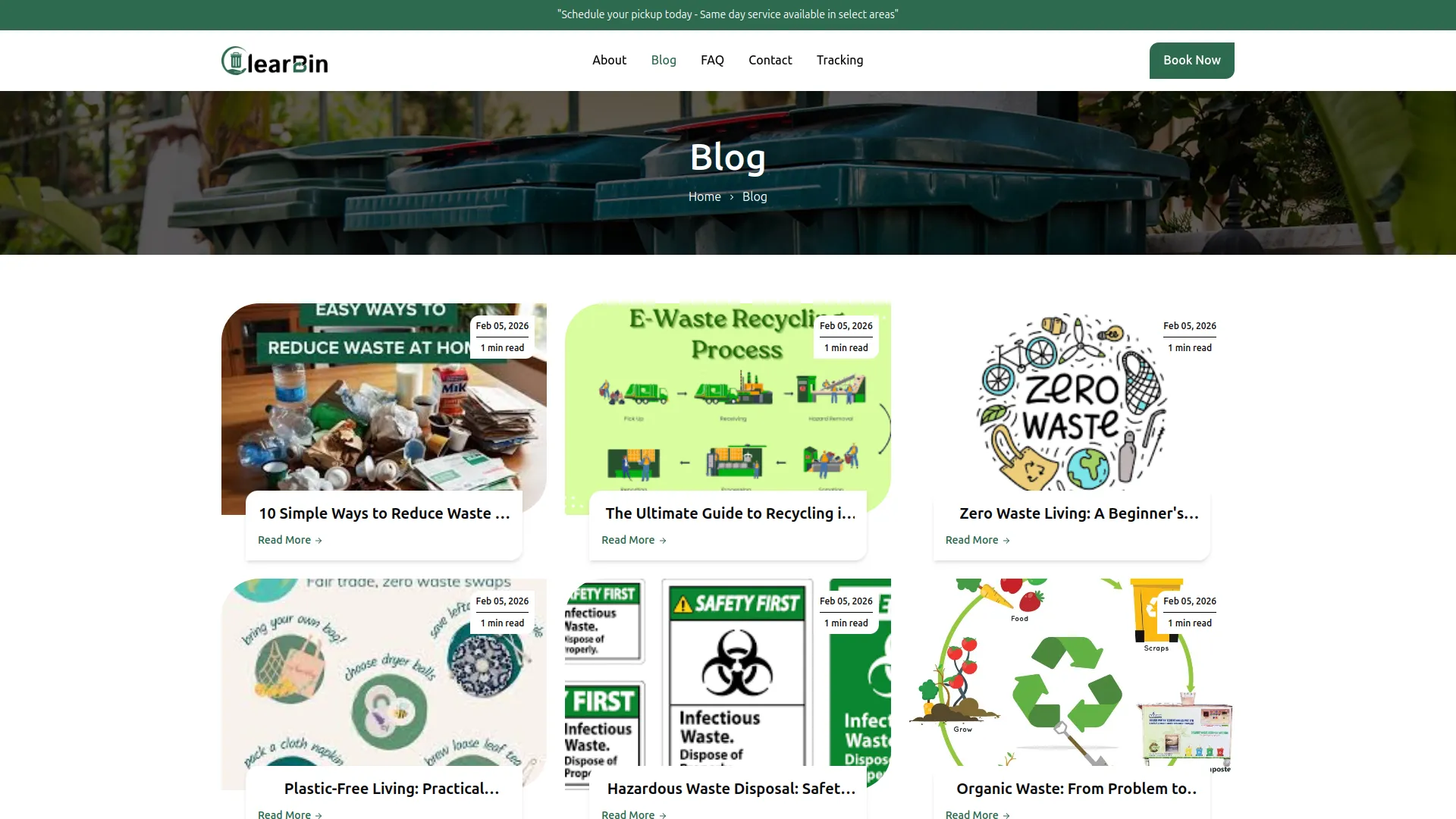
- Once published, the blog will automatically appear on your website’s blog page. The blog page displays articles in a grid layout with each blog card showing the featured image, publication date, author name, article title, excerpt, and a Read More button to open the full article.
Manage Contacts
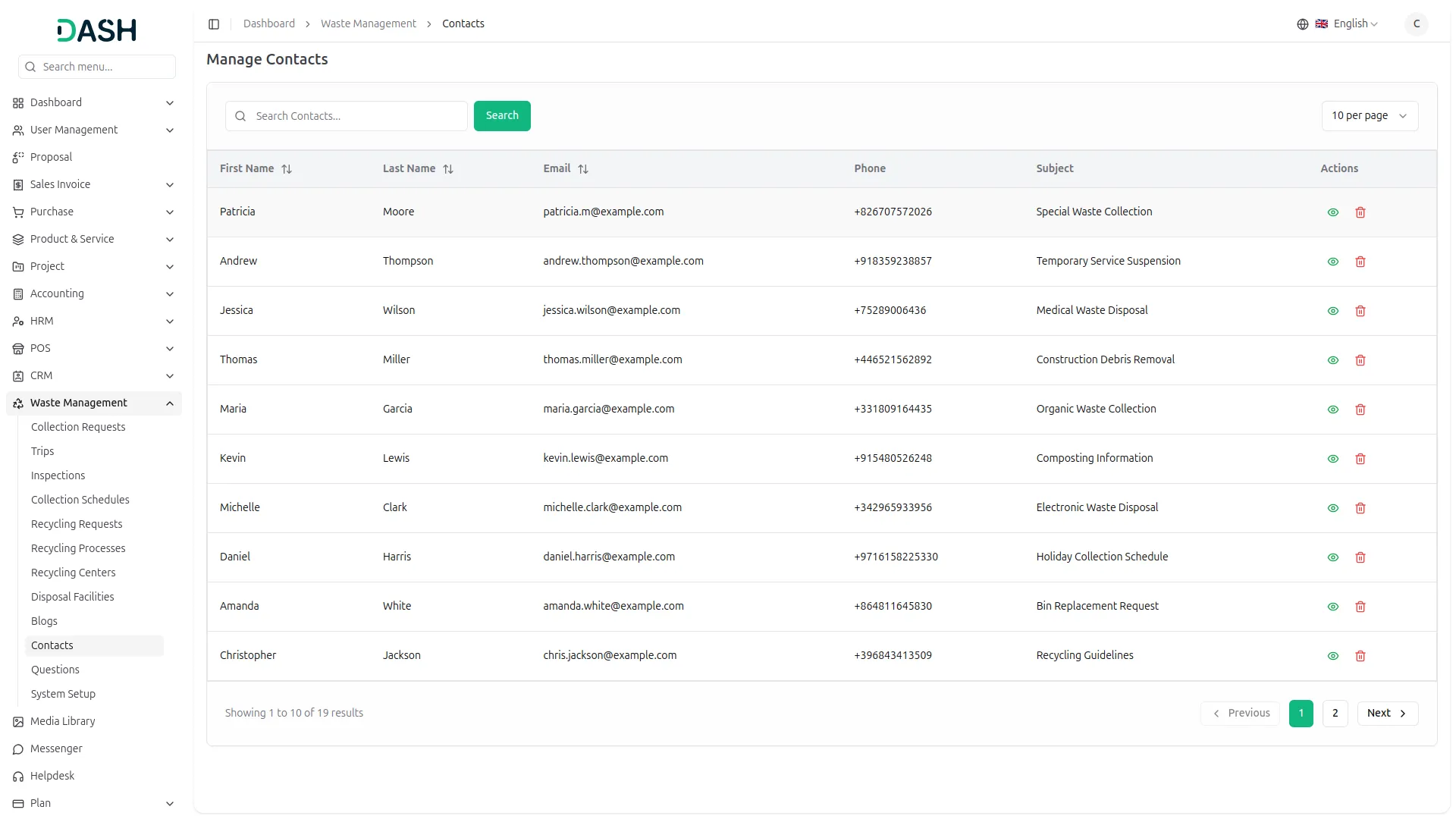
- The Manage Contacts page displays all contact submissions in a table with columns for First Name, Last Name, Email, Phone, Subject, and Actions. Use the search bar to find specific contact records easily.
- Available actions include View (clicking on this will display the complete contact message details) and Delete (clicking on this will remove the contact entry from the system).
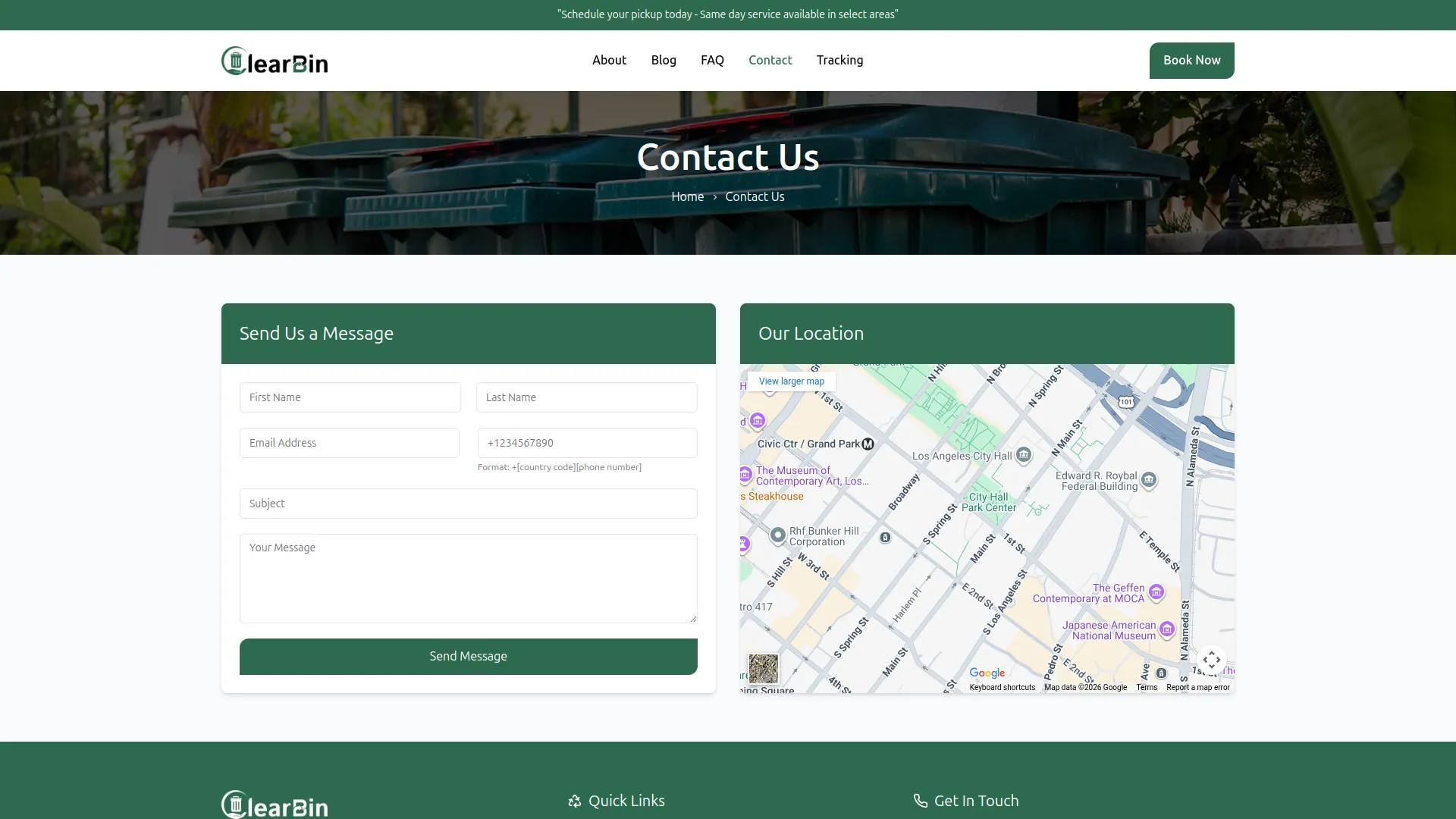
- On the website’s Contact Us page, visitors can submit inquiries through the “Send Us a Message” form. They need to fill in First Name, Last Name, Email Address, Phone Number, Subject, and Message, then click “Send Message” to submit.
- The right side shows “Our Location” with a Google Map of the business location. Visitors can click “View larger map” for detailed directions.
- All contact submissions from the website automatically appear in the backend Manage Contacts page for easy management.
Manage Questions
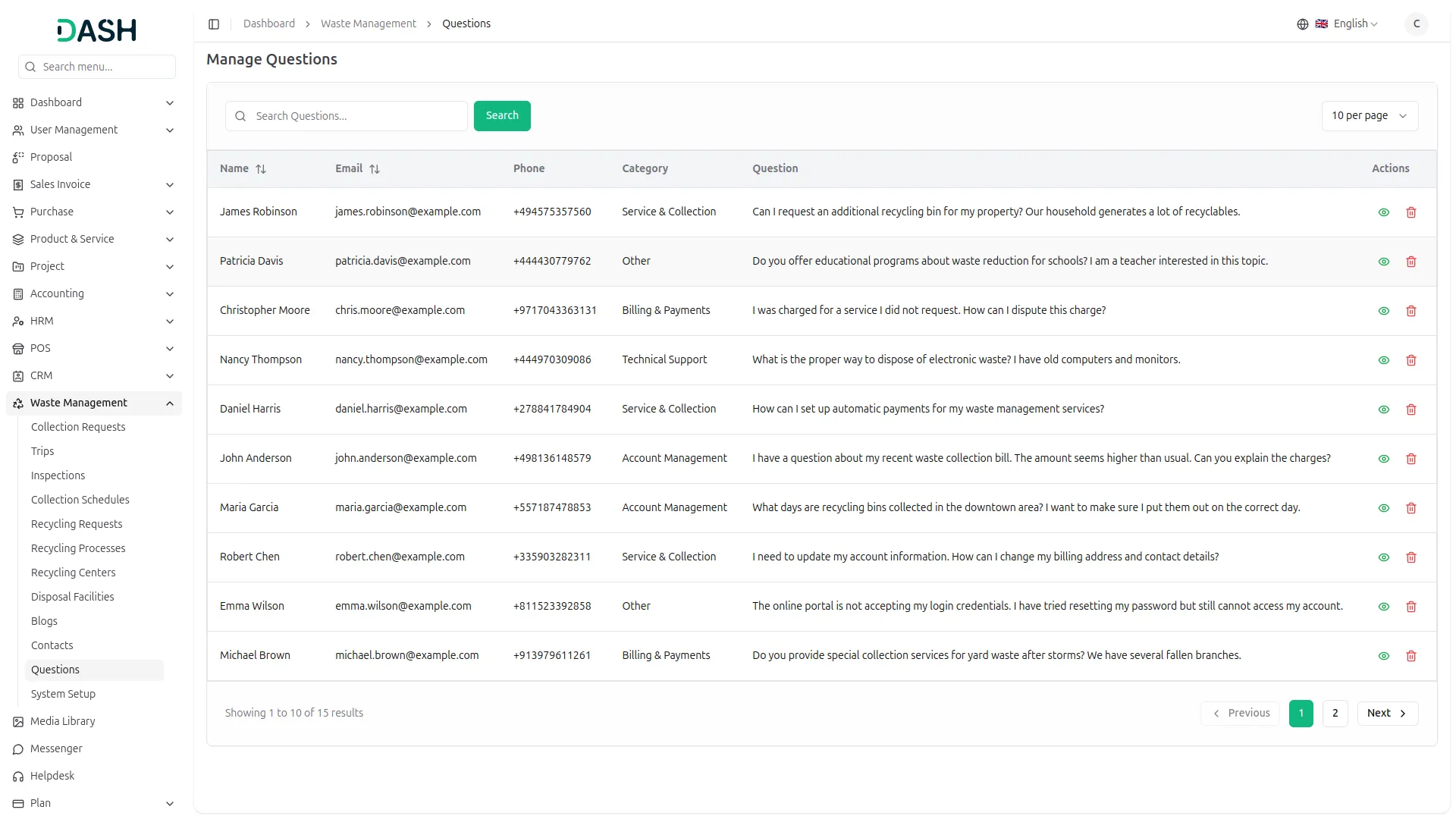
- The Manage Questions page displays all customer question submissions in a table with columns for Name, Email, Phone, Category, Question, and Actions. Use the search bar to find specific question records easily.
- Available actions include View (clicking on this will display the complete question details) and Delete (clicking on this will remove the question entry from the system).
- On the website’s FAQ page, visitors can see a list of common questions on the left side with expandable answers. Each question has a plus icon to view the detailed answer.
- The right side features an “Ask Any Question” form where customers can submit specific questions by filling in their name, Email Address, Phone Number, selecting a Question Category from the dropdown, and entering their question in the text area, then clicking “Submit Question”.
- All question submissions from the website automatically appear in the backend Manage Questions page for review and management.
Categories
Related articles
- Trello Integration Detailed Documentation
- Medical Lab Management Integration in Dash SaaS
- Feedback Integration in Dash SaaS
- Queue Management Integration in Dash SaaS
- Jitsi Meet Detailed Documentation
- Optical & Eyecare Center Detailed Documentation
- To Do Integration in Dash SaaS
- Grant Management Detailed Documentation
- ZitaSMS Integration in Dash SaaS
- Webhook – WorkDo Dash SaaS Add-on
- Vehicle Booking Management Integration in Dash SaaS
- Procurement Integration in Dash SaaS
Reach Out to Us
Have questions or need assistance? We're here to help! Reach out to our team for support, inquiries, or feedback. Your needs are important to us, and we’re ready to assist you!


Need more help?
If you’re still uncertain or need professional guidance, don’t hesitate to contact us. You can contact us via email or submit a ticket with a description of your issue. Our team of experts is always available to help you with any questions. Rest assured that we’ll respond to your inquiry promptly.
Love what you see?
Do you like the quality of our products, themes, and applications, or perhaps the design of our website caught your eye? You can have similarly outstanding designs for your website or apps. Contact us, and we’ll bring your ideas to life.