

HR Reporting Software: HR Analytics & Human Resources Insights
HR reporting software that delivers custom, real‑time HR reports and analytics for smarter workforce decisions.
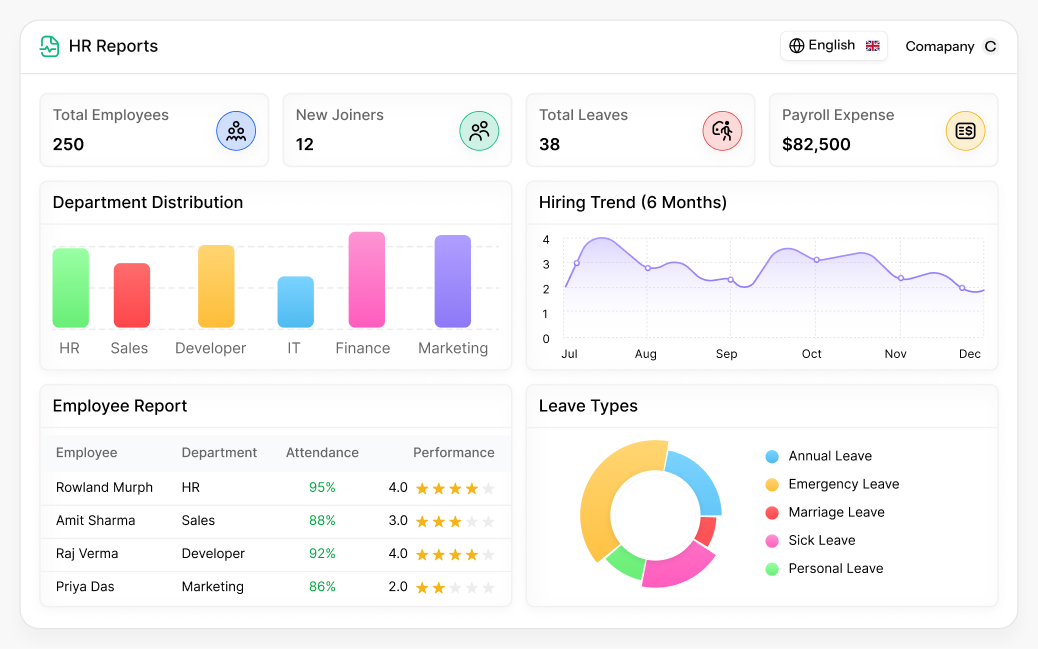
Introduction to HR Reporting
HR reporting is the process of collecting and organizing workforce data into an HR report to track employee trends, compliance, and efficiency, while HR analytics reports analyze this data to support strategic decisions.
Key Types of HR Reports for Management
Modern HR reporting gives management real-time insights into workforce performance, productivity, and compliance. With the right HR software, you can access reports that make data-driven decisions simple and effective:
Employee Demographics
Understand workforce distribution, diversity, and tenure to plan recruitment and growth.
Recruitment & Hiring
Review and validate records regularly to ensure information remains correct, complete, and up to date.
Performance & Appraisals
Monitor goals, appraisals, and productivity for promotions, training, and succession planning.
Training & Learning (LMS)
Track course completion, skill development, and ROI from training programs.
Payroll & Compensation
Ensure accurate salaries, bonuses, and benefits, while maintaining compliance.
Employee Turnover & Retention
Analyze attrition, retention trends, and plan succession strategies.
Compliance & HR Audits
Stay aligned with labor laws, policies, and statutory requirements to reduce risks.
With these reports, your HR team can turn raw data into actionable insights, streamline HR processes, and drive smarter workforce decisions.
Key Metrics Included in HR Reports
HR reports focus on a few core metrics that help organizations quickly understand workforce performance and HR effectiveness. Common metrics included in hr reports are:
Importance of HR Reports for Businesses
HR reports are essential for turning employee data into actionable insights that drive business success.
Strategic Decision-Making
Workforce data offers visibility into employee performance, turnover, recruitment, and training. This allows management to:
- Identify trends and patterns.
- Align HR strategies with business goals.
- Make informed workforce planning decisions.
If information shows high turnover in a department, management can investigate causes and implement retention strategies.
Performance Management
HR track employee performance metrics, including productivity, goal completion, and appraisal outcomes. They help:
- Recognize high performers.
- Identify underperforming employees.
- Plan promotions, bonuses, or additional training.
A monthly performance report can highlight top-performing teams and areas needing improvement.
Cost Management
By analyzing workforce data, companies can control labor costs. Key areas include:
- Overtime expenses.
- Recruitment and hiring costs.
- Training and development expenditures.
A cost-per-hire analysis helps optimize recruitment spending.
Compliance and Risk Management
HR reports help ensure the organization complies with labor laws, workplace safety standards, and diversity regulations. They track:
- Attendance and leave.
- Employee grievances.
- Diversity and inclusion metrics.
Regular compliance reviews prevent penalties from labor law violations.
Talent Acquisition and Retention
Recruitment and turnover insights provide insights into hiring effectiveness and employee satisfaction. They help:
- Identify the most effective recruitment channels.
- Understand reasons for attrition.
- Improve retention strategies.
If exit data show that salary dissatisfaction is a major reason for leaving, HR can adjust compensation packages.
Enhancing Employee Engagement
HR reports track engagement metrics like training participation, internal survey results, and feedback. This enables:
- Better employee experience initiatives.
- Higher morale and productivity.
- Reduced absenteeism and turnover.
Forecasting and Planning
HR reports allow predictive analytics for future workforce needs, such as:
- Anticipating hiring requirements.
- Planning succession for key positions.
- Preparing for seasonal or project-based workforce fluctuations.
A predictive staffing overview helps ensure the company is never short-staffed during peak periods.
Choosing the Best HR Reporting Software
Selecting the right HR reporting software is crucial for turning HR data into actionable insights. When evaluating options, consider:
Customizable Reports
Tailor outputs to track the metrics that matter most.
HRIS Integration
Seamlessly connect with your existing HR systems for unified visibility.
Data Security
Protect sensitive employee information with robust security measures.
Role-Based Access
Control who can view or edit specific data sets.
Analytics Dashboards
Visualize trends and performance for faster, data-driven decisions.
Ideal Solution
Supports operational HR needs and leadership visibility for smarter, data-driven decisions.
Why Workdo’s HRM Is a Smart Choice for HR Reporting
Workdo.io is an all-in-one SaaS platform designed to help growing businesses streamline their human resource functions and operational workflows from a centralized dashboard.
Workdo’s HRMS suite covers key human resource workflows—such as employee records, attendance, leave, payroll, performance, and HR admin tasks—while also making it easy to generate insights across these areas. Its system consolidates workforce data so HR teams can access critical metrics without juggling spreadsheets or disconnected systems.
At the core of Workdo’s value is its ability to turn operational HR data into reportable insights. The platform gives HR managers a dashboard view of key statistics, including staff counts, payroll summaries, and performance analytics, helping teams monitor trends and make faster decisions.
Whether you are a small startup or an expanding enterprise, Workdo’s customizable modules adapt to your business size and reporting complexity. You can shape your HR modules to match your internal workflows and reporting requirements without heavy custom development.
Workdo’s HRMS reduces administrative workload by automating routine tasks: attendance capture, leave approvals, payroll processing, and performance tracking.. These processes feed into the broader HR system, improving data accuracy and giving HR teams more time to focus on strategy.
With Workdo.io, HR data isn’t siloed — it’s unified. This makes generating human resources reports and exporting them for compliance or management review much faster and more accurate than traditional manual methods.
What Our Clients Say! About HRM
Our clients are at the heart of everything we do. Here's what they have to say about their experience with our solutions.
I recently purchased products from WorkDo on CodeCanyon, and I am beyond impressed.

from codecanyon
Best products with the best features on envato! I highly recommend what is good has to grow. And incredible support!
from codecanyon
I really love WorkDo's support. WorkDo offers excellent support with quick and enthusiastic responses.
from codecanyon
Their customer service is outstanding, always ready to assist with any concerns you may have.
from codecanyon
Upgrade to Advanced HR Reporting Software Today
Create accurate, real-time human resources reports using an intelligent system designed to simplify HR operations and management insights.