

HR Record Keeping Software: Employee Database Management
HR record keeping software to centrally manage employee data, streamline records, and simplify HR database tasks.
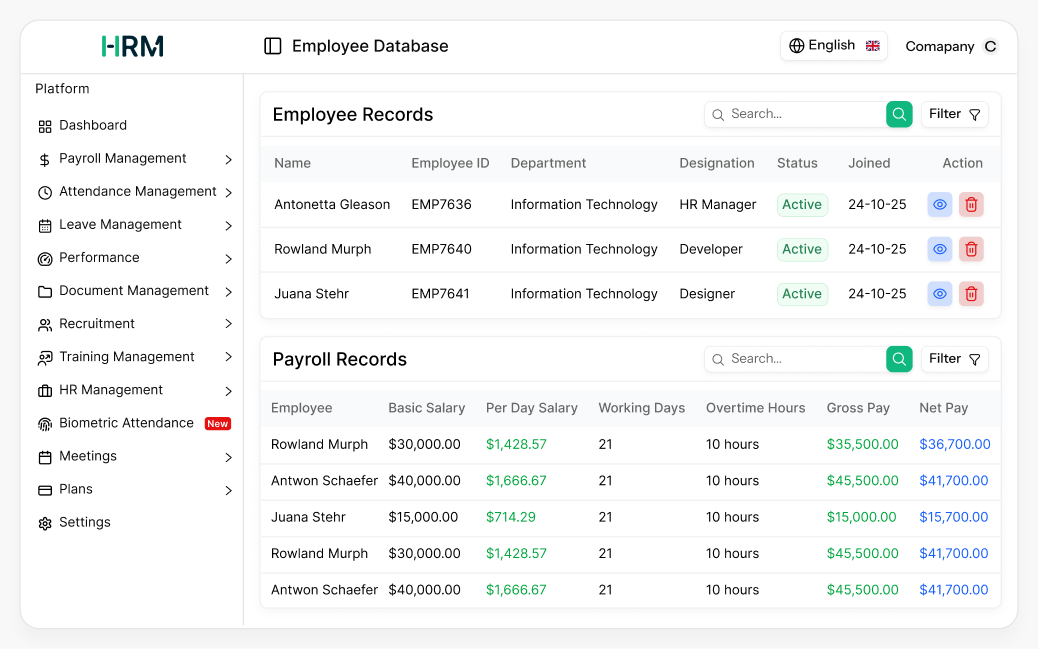
What Is Employee Data Management?
Employee data management is the process of organizing, storing, and maintaining workforce information in a centralized human resources database to ensure accuracy, security, and efficient HR operations.
Centralized Records
Centralizes employee records in one secure system
Accurate Data Management
Improves record management and data accuracy
Payroll & Compliance Support
Supports payroll, compliance, and HR reporting
Data Security & Access Control
Enhances data security and role-based access control
Workforce Planning
Enables better workforce planning and decision-making
Efficient HR Processes
Streamlines HR processes and improves overall operational efficiency
Employee Data Management Process
A structured employee data management process ensures workforce information remains accurate, secure, and useful throughout the employment lifecycle.
Data Collection & Organization
Collect employee data during hiring and organize it into categories like attendance, performance, payroll, and compliance.
Centralized Storage
Store all workforce data in a secure, centralized HR database to enable quick access and reduce data duplication.
Data Verification & Accuracy
Review and validate records regularly to ensure information remains correct, complete, and up to date.
Controlled Access Management
Assign role-based permissions so only authorized personnel can view or modify sensitive records.
Reporting & Insights Generation
Analyze stored data to create HR reports, identify workforce trends, support planning, and improve decision-making.
Security, Backup & Compliance
Protect information using encryption, system backups, audit trails, and legal compliance measures to prevent data loss or misuse.
Key Features of Employee Database Management Software
Manage your workforce efficiently with a centralized system that streamlines employee data, attendance, payroll, and performance all in one place.
Employee Information Management
Easily maintain a centralized database of all employee details including personal information, job roles, and employment history. Quick access and updates save time and reduce errors.
Centralized storage of employee records, including:
- Personal details: name, contact info, date of birth
- Job-related info: designation, department, reporting manager
- Employment history and educational background
- Quick search and retrieval of employee data
Streamline your HR operations and manage employee data effortlessly.
Attendance and Leave Management
Track attendance, shifts, and work hours seamlessly. Manage leave requests, approvals, and balances automatically to ensure smooth workforce management.
Features to efficiently manage attendance and leave:
- Daily attendance tracking for all employees
- Shift management for flexible work schedules
- Leave request, approval, and balance tracking
- Integration with biometric or time-tracking devices
Simplify attendance tracking and leave management for a more organized workforce.
Payroll and Compensation Management
Automate salary calculations, deductions, bonuses, and tax withholdings. Generate payslips and maintain accurate payroll records without manual effort.
Payroll management capabilities include:
- Salary computation: basic pay, allowances, bonuses, deductions
- Tax and statutory compliance automatically applied
- Payslip generation and history tracking
- Customizable payroll reports for analysis
Ensure accurate and timely payroll processing every time.
Performance Management
Monitor employee performance, appraisals, and goal tracking. Identify training needs and reward high performers to boost productivity.
Performance tracking features include:
- Employee evaluations and appraisals
- Goal setting and progress monitoring
- Performance scorecards and feedback records
- Identification of training and development needs
Enhance team performance and motivate employees effectively.
Recruitment and Onboarding
Maintain applicant records and streamline hiring processes. Facilitate smooth employee onboarding with document management and task assignments.
Recruitment and onboarding features include:
- Applicant tracking and management
- Hiring workflow automation
- Onboarding task assignments and document collection
- Tracking recruitment metrics like time-to-hire
Make recruitment and onboarding faster, easier, and more efficient.
Document Management
Store contracts, certifications, and other important employee documents securely. Ensure easy access, version control, and compliance.
Document management capabilities include:
- Secure storage for all employee documents
- Version control for updated records
- Easy search and retrieval
- Compliance with legal and regulatory requirements
Keep all employee documents organized, secure, and easily accessible.
Reporting and Analytics
Generate comprehensive reports on attendance, performance, payroll, and more. Use insights for smarter workforce planning and decision-making.
- Customizable HR reports on attendance, payroll, performance
- Dashboards for quick insights
- Trend analysis for workforce planning
- Data-driven decision-making support
Leverage data-driven insights to make informed HR decisions.
Compliance and Security
Protect sensitive employee data with role-based access and maintain compliance with labor laws and data protection regulations.
Compliance and security features include:
- Role-based access control for secure data management
- Data encryption and backup for sensitive information
- Audit trails to track changes and activity
- Ensures adherence to labor laws and regulations
Maintain high data security and stay compliant with regulations effortlessly.
Self-Service Portals
Allow employees to update personal info, request leaves, and access payslips. Managers can approve requests and track performance efficiently.
Self-service features include:
- Employee self-service: update info, request leave, access payslips
- Manager self-service: approve requests, monitor team performance
- Task automation for routine HR functions
- Enhanced employee engagement and empowerment
Empower employees and managers to handle tasks independently.
Scalability and Customization
Adapt to businesses of any size with customizable fields, workflows, and reports. Scale effortlessly as your organization grows.
Scalability and customization features include:
- Customizable workflows and fields to fit business processes
- Flexible reporting templates
- Adaptable for organizations of all sizes
- Easily scale with business growth
Easily scale and customize the system to match your business needs.
Employee Data Management vs HRIS vs HRM
Organizations often get confused about the differences between Employee Data Management, HRIS, and HRMS. While all three systems are used to manage workforce information, they differ in scope, functionality, and level of usage.
Employee Data Management
Employee Data Management focuses on collecting, storing, updating, and securing employee information in a centralized system.
- Centralized employee records
- Storage of personal, job-related, attendance, and compliance data
- Role-based access control
- Basic reporting and data accuracy management
Small to mid-sized organizations that want to keep employee records organized, accurate, and secure without complex HR automation.
HRIS (Human Resource Information System)
An HRIS is a structured system designed to manage core HR operations along with employee data.
- Employee data management combined with payroll and benefits administration
- Leave and attendance tracking
- Compliance and statutory management
- Standard HR reporting
Growing businesses that need to automate core HR processes while maintaining accurate and compliant employee records.
Explore HRIS SoftwareHRMS (Human Resource Management System)
An HRMS is the most advanced solution, covering end-to-end employee lifecycle management.
- All Employee Data Management and HRIS features
- Performance management
- Recruitment and onboarding workflows
- Learning, training, and appraisal management
- Advanced analytics and workforce planning
Medium to large organizations seeking complete HR automation, data-driven insights, and strategic workforce planning.
Explore HRM SoftwareBenefits of Employee Data Management
Effective employee data management helps organizations maintain accurate workforce records, improve HR efficiency, enhance data security, and support smarter business decisions.
The Importance of Employee Database Management in HR Operations
Effective database management plays a vital role in achieving multiple HR and organizational objectives by maintaining a structured human resources database and accurate workforce records.
A well-maintained database minimizes redundant data entry, reduces administrative workload, and streamlines daily HR operations. Using employee database software and data management software, HR teams can automate workflows such as onboarding documentation, payroll processing, and benefits enrollment. This reduces manual effort, boosts productivity, and improves service delivery.
A centralized human resource management database acts as a secure repository for compliance-related documents, certifications, and employee acknowledgments. With robust hr database management, organizations can track regulatory requirements, manage expiration deadlines, and generate audit-ready reports. This proactive record keeping software approach minimizes legal risks and ensures regulatory adherence.
A comprehensive database of employees supports strategic decisions related to hiring, compensation planning, training initiatives, and workforce optimization. Insights from HR databases and human resources records help organizations identify trends, forecast staffing needs, and make informed, data-backed decisions.
Modern database management software includes self-service portal capabilities, allowing staff to update personal details, access payroll information, and manage HR requests independently. These tools improve satisfaction, boost engagement, and reduce dependency on HR teams for routine tasks.
Detailed HRMS employee details provide a strong foundation for workforce analytics and long-term planning. By analyzing skills inventory, performance metrics, and turnover trends stored in the HR software database, organizations can align talent strategies with business goals.
Secure HR database software protects sensitive information through access controls, encryption, and audit trails. Proper file management software safeguards confidential data, reduces breach risks, and ensures compliance with data protection standards.
A well-structured human resources database software preserves institutional knowledge by maintaining role histories, reporting structures, and workforce documentation. This continuity supports smooth transitions, reduces disruptions, and strengthens long-term organizational resilience.
What Our Clients Say! About HRM
Our clients are at the heart of everything we do. Here's what they have to say about their experience with our solutions.
I recently purchased products from WorkDo on CodeCanyon, and I am beyond impressed.

from codecanyon
Best products with the best features on envato! I highly recommend what is good has to grow. And incredible support!
from codecanyon
I really love WorkDo's support. WorkDo offers excellent support with quick and enthusiastic responses.
from codecanyon
Their customer service is outstanding, always ready to assist with any concerns you may have.
from codecanyon
Centralized Employee Records System
Store, organize, and manage workforce records in one secure system for faster HR operations and better decision-making.