
What is Ecommerce Management? Meaning, Process & Systems for Online Success
Learn what ecommerce management Meaning, how the Ecommerce process works, and which systems are used to manage online businesses. This guide covers the full scope – operations, tools, and workflows—to help you manage ecommerce efficiently.
Complete guide to eCommerce management for your online store
In the ever expanding world of online retail success is a thing of the past which is simply about putting a product out there. What you need is to run the full gamut of the customer journey, operations and backend systems efficiently. That’s what ecommerce management is for. Whether you are putting up a small shop on Shopify or you‘re running a global multi vendor marketplace, ecommerce management sees to it that each element of your business from product listing and inventory to marketing and customer care works as a unit.
In this comprehensive guide, we’ll break down:
- What ecommerce management actually means
- The core processes it involves
- Who is responsible for managing ecommerce
- The systems and tools used
- How to manage marketplaces vs owned stores
- And why good management can make or break your business
What is the Meaning & Definition of Ecommerce Management?
Ecommerce management is a framework which we put in place for our online businesses which includes the organization, execution and optimization of all elements of the business. We look at product delivery, order fulfillment, customer care, digital marketing, inventory management, analytics and much more. At the end of the day what we are after is that all of these elements play well together to give the best experience for the customer and at the same time grow the business.
Meaning
At its core, ecommerce management refers to managing digital commerce operations — everything needed to run a successful online store or marketplace. It blends technology, workflows, and people into a streamlined ecosystem.
Definition
Ecommerce management is a continuous effort which covers all technical, operational, and customer facing elements of an online retail business from catalog management to performance optimization. We may be talking here of a single store ecommerce site or a multi vendor marketplace but in either case ecommerce management is what keeps business processes in sync and the customer experience the same.
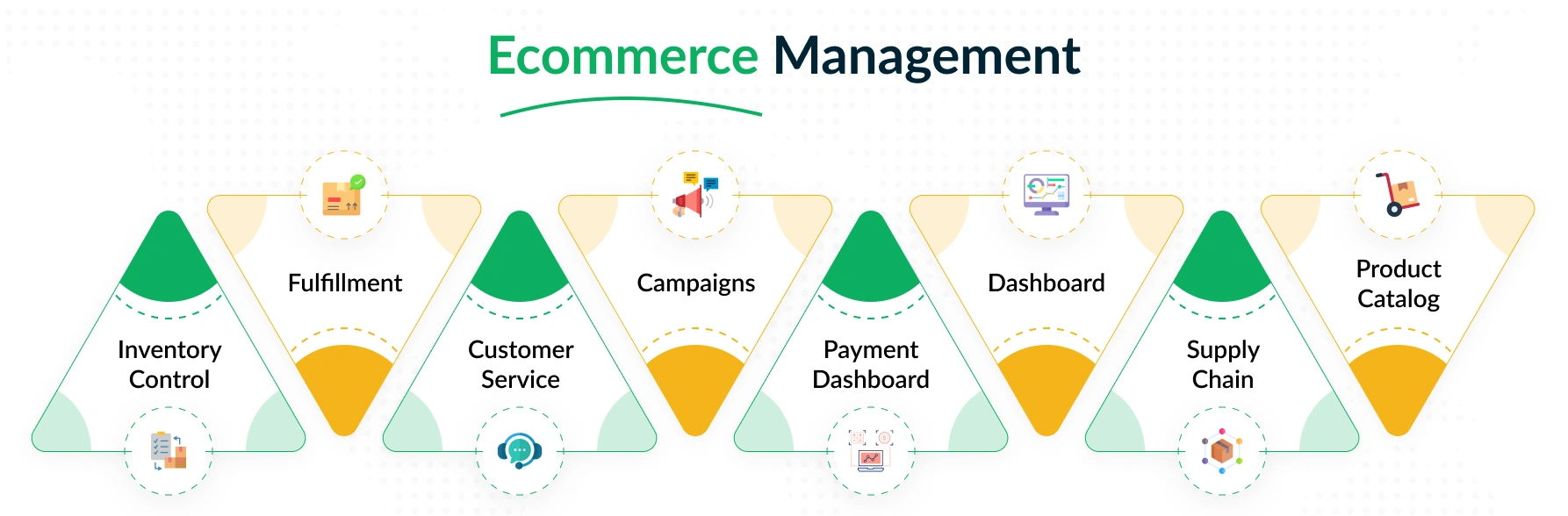
What is Ecommerce Management?
Ecommerce management is the process of planning, organizing, and controlling every aspect of an online business.Ecommerce management entails supervising every aspect related to operating an online store. It covers website administration. Ecommerce management entails an array of tasks such as product listing, setting prices, managing stock, ensuring website functionality, digital marketing, providing customer support, and processing orders.
Order fulfillment and customer support are also critical elements. Smooth ecommerce oversight helps the business to operate efficiently, provide an uninterrupted customer journey, retain shoppers, drive sales, and maximize revenue.
The business stays profitable and relevant in the online marketplace by benchmarking against competitors and using relevant tools and data to enhance automated processes, navigate through digital channels, improve automated processes, and enhance the conversion funnels. The same can be said of ecommerce platforms Amazon, Shopify, or WooCommerce. One of the most critical elements in the emerging digital economy is coherent ecommerce management.
Why Ecommerce Management is Critical
Ecommerce management isn’t something to consider as an option. Every business should have a structured framework, which can help solve complications like overselling, neglecting to fulfill orders on time, inefficient customer care, and unorganized advertising.
Having a defined strategy for ecommerce management goes a long way—lessening the chances for chaos gives the ability to smoothen workflows, automate non-core tasks, and provide a uniform experience across all customer touchpoints. Streamlined management helps improve operational efficiency, lower operational costs, and enhance customer lifetime value. Most importantly, it helps a business remain flexible and responsive to changes in the marketplace and customers.
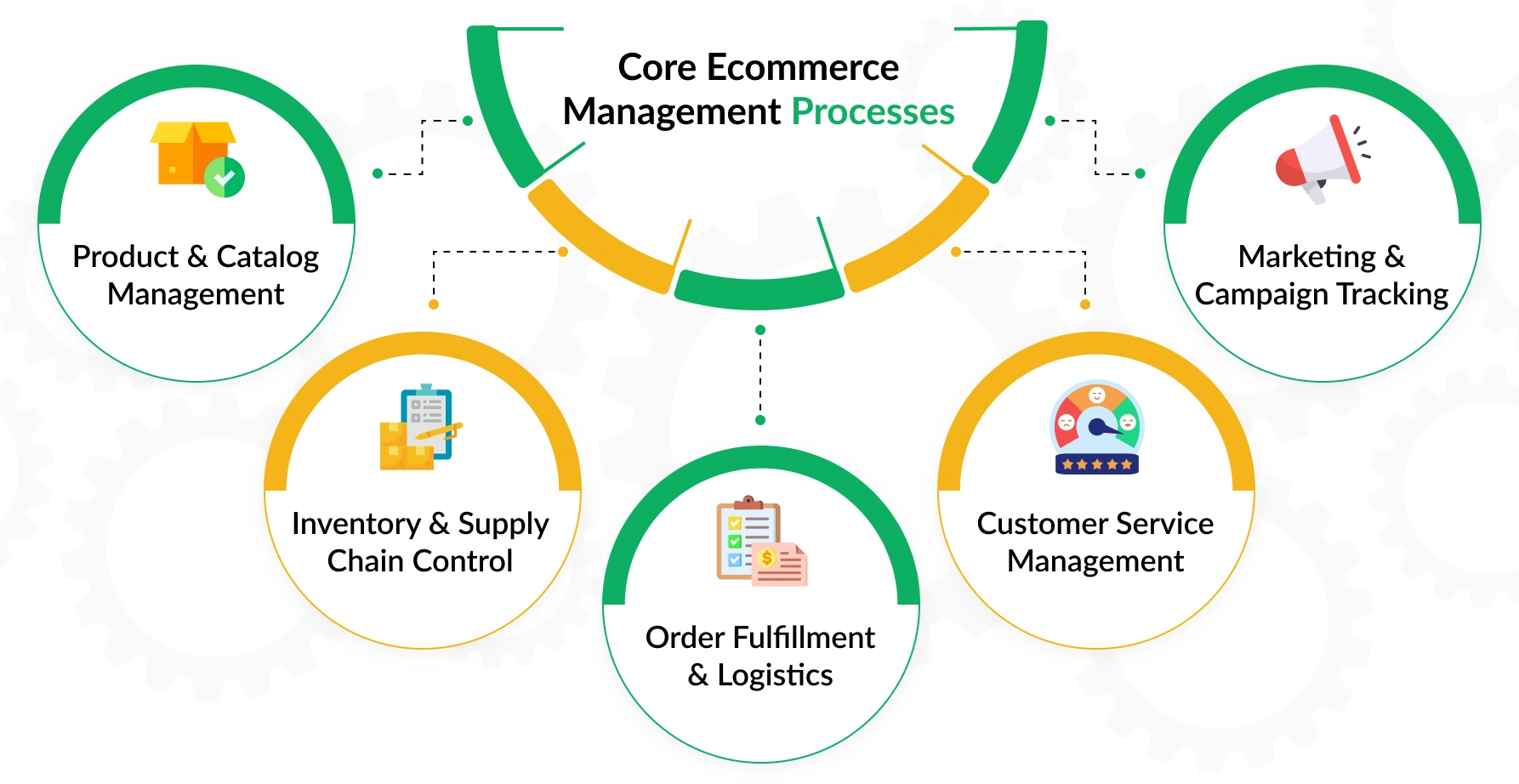
Core Ecommerce Management Processes
Ecommerce involves various interconnected workflows, all of which must be managed properly. From inventory and product updates to post-purchase communication, each element plays a role in user satisfaction and profitability. Core processes include:
🔘 Product & Catalog Management
This involves listing new products. As an example, it consists of SKU assignment, product categorization, writing item descriptions, uploading related images, and adjusting stock numbers. Product data that are confusing, erroneous, multinational and multilingual results in poor data governance. Effective catalog management enhances discoverability, good catalog management ensures better SEO rankings and higher conversion rates.
🔘 Inventory & Supply Chain Control
Inventory updates are critical on a number of fronts including data accuracy and real-time updates across platforms. This encompasses syncing of warehouse data, supplier tracking, future demand forecasting. An inventory system that is not efficient results in poor cash flow, excessive waste, poor delivery. Inventory Management results in operational bottlenecks and poor customer service.
🔘 Order Fulfillment & Logistics
Managing orders is a process which includes what we do in terms of processing, packaging, shipping out and tracking deliveries. We must do this well, do it fast and make it transparent to the customer in order to build trust. Today’s ecommerce players integrate shipping carriers, fulfillment centers, and notification systems into a seamless pipeline which they use to that effect. Smooth logistics improve reviews and we also see it play a large role in reducing return rates.
🔘 Customer Service Management
Effective at building long term loyalty. Ecommerce managers put out issues, returns, feedback, and reviews on email, chat, and social media in their stride. We see value in helpdesk software, chatbots, and support workflows which in turn improves response time. Timely resolution and personal touch leads to better customer retention and word of mouth promotion.
🔘 Marketing, Promotions & Campaign Tracking
Ecommerce marketing includes paid ads and organic content. In terms of execution we see them run campaigns, do performance tracking, and improve spend. We also note that they use CRM tools and analytics to create audience segments, put in place automated email campaigns, and study buyer behavior. This is what turns marketing actions into growth.
Who Manages Ecommerce Operations?
The ecom manager is mainly responsible for operations in ecom, though the organizational structure will vary with the size of the business. A small business might have one person or a small group doing a variety of roles, whereas larger companies often have dedicated organization into specific divisions. To ensure the systems in place work properly, eCommerce managers integrate different functions. An eCommerce manager needs to have extensive knowledge in ecommerce systems, advertising, stock control, and even business intelligence. Putting in place the right people with the correct skills greatly improves business and operational effectiveness.
Marketplace vs Owned Ecommerce Management
Running a Marketplace Managing a marketplace presence is very different from managing your own DTC (direct-to-consumer) store. Marketplaces like Amazon or Flipkart come with pre-set rules, minimal branding, as well as centralized logistics. DTC stores offer full control over branding, pricing, and customer relations. Marketplace management centers on seller performance, listings, compliance, and reviews. Store management has end-to-end control over: UX, sales funnels, SEO, customer data, and loyalty programs. Both models need different strategies, tools, and resource allocation.
Why is Ecommerce Management Important?
Ecommerce management is very important for the health, growth, and financial success of online companies. Also without proper structure which may be brought on by managed systems even what appear to be very good ecommerce businesses may have issues with delays, errors, customer care problems, and also will see resources used in the wrong ways.
Here’s why ecommerce management is essential:
- Operational Control: It allows visibility across all departments such as fulfillment, marketing, and inventory, ensuring nothing is overlooked.
- Scalability: Ecommerce management enables business growth without sacrificing efficiency or quality.
- Customer Satisfaction: Smooth processes, real-time inventory, and fast shipping enhance user experience, leading to loyalty and repeat purchases.
- Data-Driven Decisions: By leveraging analytics, ecommerce managers can improve product sourcing, promotions, and overall performance.
- Consistency Across Channels: Ecommerce management ensures consistent branding, pricing, and support across owned stores and marketplaces.
In short, ecommerce management builds a foundation for automation, growth, and profitability — making it one of the most critical areas for any digital business.
How to Manage an Ecommerce Website with an Ecommerce Manager?
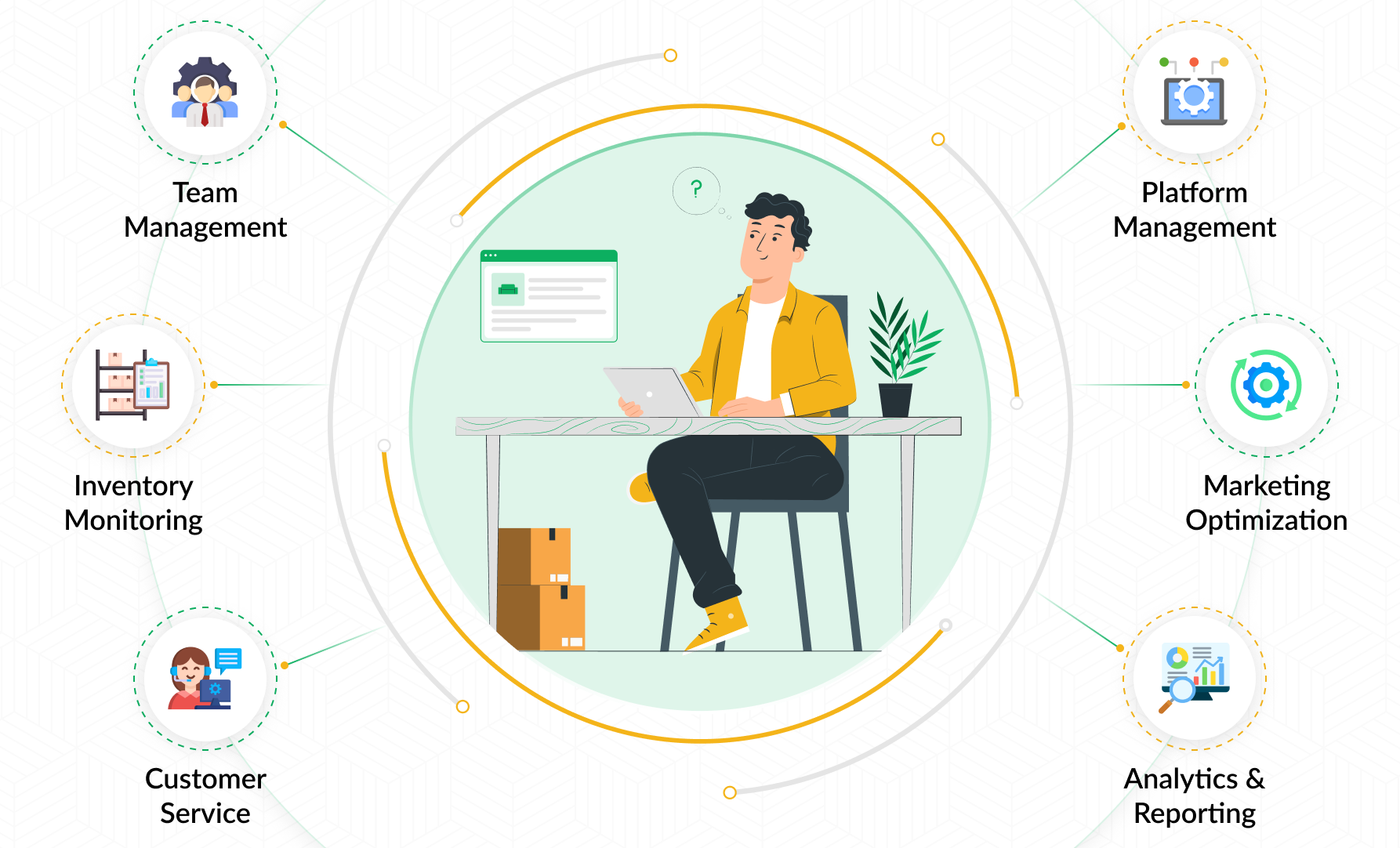
The Ecommerce Manager usually manages an ecommerce website, covering collaboration, strategizing, and employing certain tools. It is this person’s job to make certain that the whole system functions without hitches, is efficiently driven, and can be maintained operationally into the future.
Here’s how ecommerce managers manage websites effectively:
- Platform & Catalog Oversight: The ecommerce manager meticulously manages the product catalog for organization, updates, and improved SEO. They also ensure the site is user-friendly, mobile-optimized, and technically sound.
- Team Coordination: Whether a single manager or a full team, coordination across marketing, logistics, tech, and support ensures everyone works toward shared goals.
- Inventory & Fulfillment Monitoring: Real-time inventory is tracked through software integrations. Managers set reorder points, prevent overstock or stockouts, and oversee fulfillment processes.
- Marketing & Conversion Optimization: Ecommerce managers run promotional campaigns, design email flows, and perform A/B testing on landing pages to boost conversion rates. They analyze outcomes and adjust strategies accordingly.
- Customer Service Management: They oversee support channels, including live chat and help desks, ensuring quick resolution of customer issues and complaints.
- Analytics & Reporting: Performance metrics—such as product sales, cart abandonment, traffic sources, and user behavior—are continuously monitored to guide ongoing improvements.
Ecommerce Management Process – Summary Table & Tool Comparison
Understanding the essential components of ecommerce management is crucial for running a successful online store. Below is a detailed comparison of core processes, commonly used tools, and how WorkDo’s Ecommerce Management System simplifies everything under one roof.
| Ecommerce Process | What It Covers | Common Tools Used | Where WorkDo Stands Out |
|---|---|---|---|
| 🛍️ Product & Catalog Management | Add/edit products, manage categories, descriptions, variants. | WooCommerce, Shopify, WorkDo | Offers intuitive catalog control with support for multiple storefront themes. |
| 📦 Inventory Management | Stock tracking, low stock alerts, and inventory syncing. | Zoho Inventory, Katana, WorkDo | Built-in inventory dashboard with auto alerts, no need for separate tool. |
| 🚚 Order & Fulfillment | Processing orders, managing shipping, and delivery tracking. | ShipStation, EasyPost, WorkDo | Unified order workflow with real-time status updates directly from admin panel. |
| 🎧 Customer Support | Handling inquiries, support tickets, and returns. | Freshdesk, HelpScout, WorkDo | Includes native support tools to manage tickets and customer communication. |
| 📈 Marketing & Promotions | Launching discounts, coupons, email campaigns. | Mailchimp, Omnisend, WorkDo | Create and track promotions without leaving the dashboard. |
| 💳 Payments & Checkout | Payment gateways, cart customization, multi-currency support. | Stripe, Razorpay, WorkDo | 10+ payment integrations with localized checkout and tax settings. |
| 📊 Reports & Analytics | Sales tracking, performance KPIs, traffic, user behavior. | Google Analytics, Glew.io, WorkDo | Pre-built business reports — no manual setup required. |
| 🎨 Theme & UI Customization | Changing storefront look and layout. | ThemeForest (paid), Webflow, WorkDo | Comes with free built-in themes and visual editor, no coding needed. |
| 🏬 Multi-store Management | Managing multiple storefronts or sales channels from one dashboard. | Magento (Enterprise), WorkDo | Easily handle B2B/B2C stores, languages, and currencies in one place. |
📌 Frequently Asked Questions (FAQs)
Reach Out to Us
Have questions or need assistance? We're here to help! Reach out to our team for support, inquiries, or feedback. Your needs are important to us, and we’re ready to assist you!


Need more help?
If you’re still uncertain or need professional guidance, don’t hesitate to contact us. You can contact us via email or submit a ticket with a description of your issue. Our team of experts is always available to help you with any questions. Rest assured that we’ll respond to your inquiry promptly.
Love what you see?
Do you like the quality of our products, themes, and applications, or perhaps the design of our website caught your eye? You can have similarly outstanding designs for your website or apps. Contact us, and we’ll bring your ideas to life.