
Photo Studio Management – WorkDo Dash SaaS Add-On Guide
Learn how to manage photo shoots, bookings, projects, and clients in WorkDo Dash SaaS.
Introduction
The Photo & Studio Management Add-On is a comprehensive solution designed to help photography studios manage every aspect of their business from a single, intuitive admin panel. With this Add-On, you can build and customize a fully functional photography studio website, manage your team, showcase your services and equipment, handle client appointments, and track payments, all in one place. The Add-On includes a System Setup module to configure your website’s branding and content, along with dedicated management modules for Camera Kits, Services, Appointments, Payments, Contacts, and Newsletter Subscribers, giving you complete control over your studio’s operations and online presence.
How To Install The Add-On?
To Set Up the Photo & Studio Management Add-On, you can follow this link: Setup Add-On.
How To Use The Photo & Studio Management Add-On?
Photo & Studio Dashboard
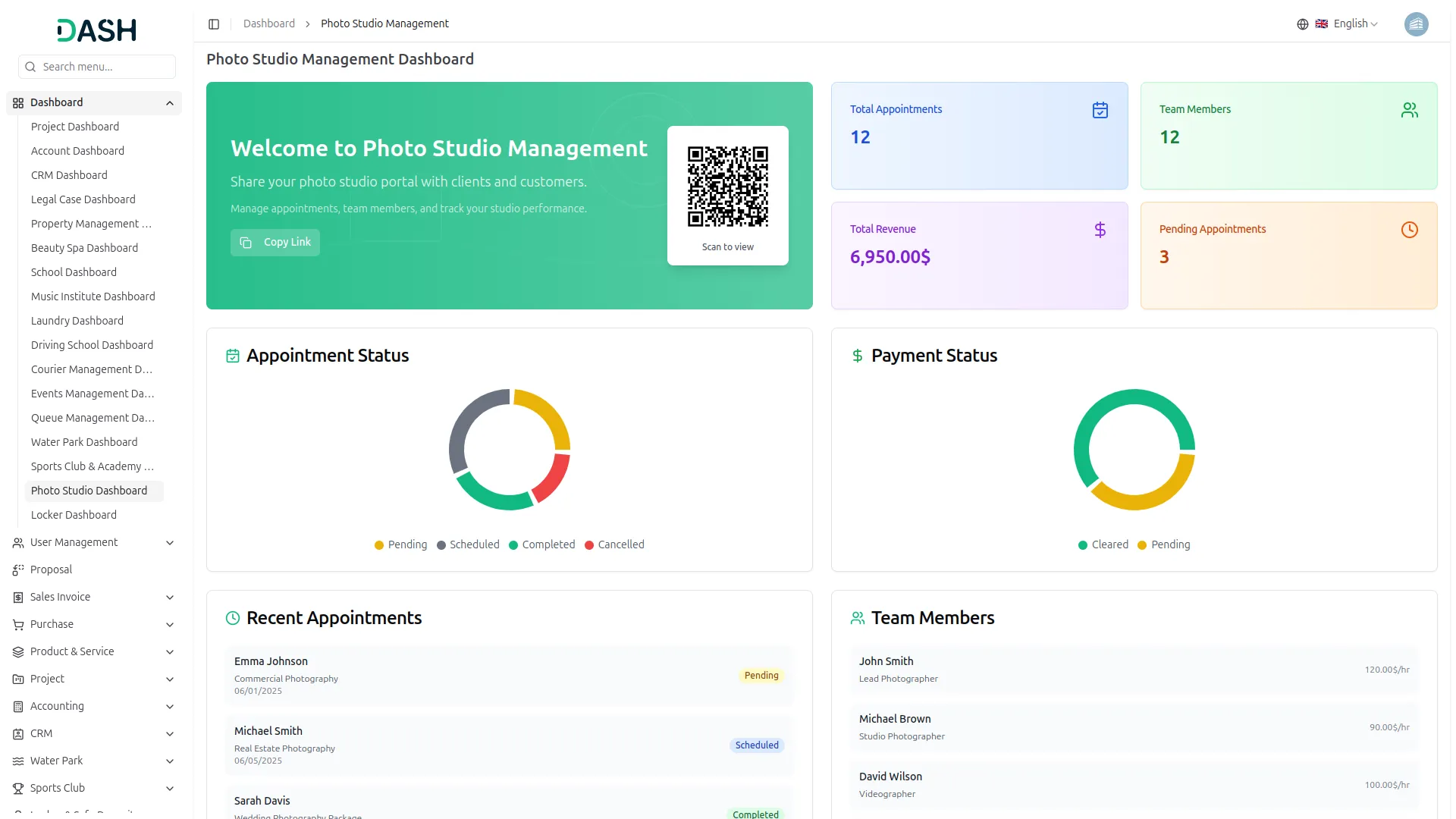
- The dashboard provides a complete overview of your photo studio’s operations and performance through various visual elements and quick access features.
- At the top, you will find a QR Code that clients can scan to directly access your studio’s booking portal, along with a Copy Link button to easily share the booking website link with customers.
- The dashboard displays important summary cards showing Total Appointments, Total Revenue, Team Members, and Pending Appointments, giving you instant insights into your studio’s key metrics at a glance.
- The Appointment Status donut chart displays a visual breakdown of all appointments by their current status (Pending, Scheduled, Completed, and Cancelled), allowing you to quickly monitor the overall health of your appointment pipeline.
- The Payment Status donut chart gives you a clear visual split between Cleared and Pending payments, helping you stay on top of your studio’s financial activity at a glance.
- The Recent Appointments section at the bottom left displays the latest client bookings with details including the client’s name, selected photography service, booking date, and current status, allowing you to monitor and track the most recent appointments directly from the dashboard.
- The Team Members section at the bottom right lists all active studio staff along with their roles and hourly rates, giving you a quick snapshot of your team’s composition and pricing structure.
Team Member Dashboard
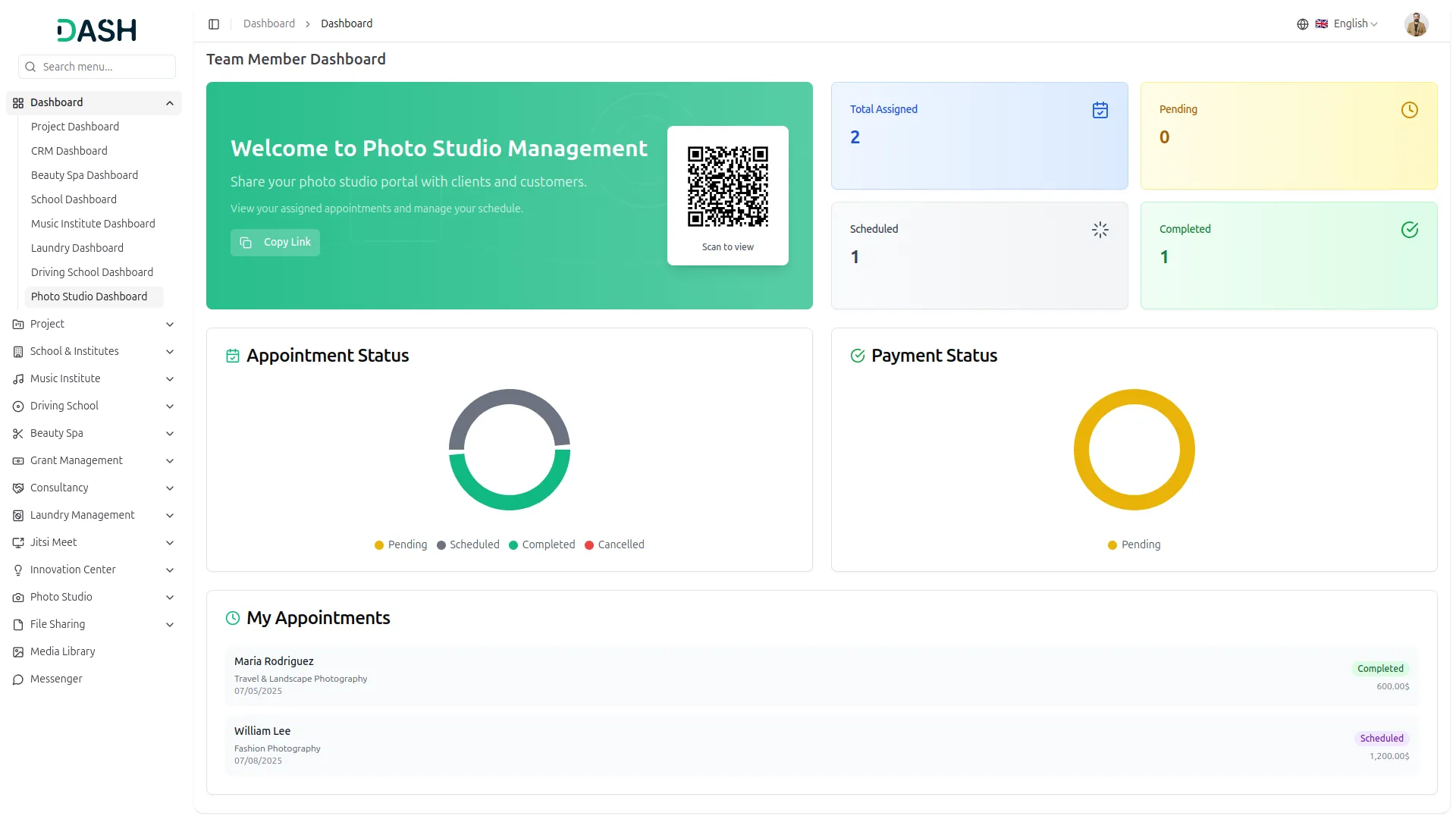
- The Team Member Dashboard provides a focused overview of your individual assignments and appointment activity within the photo studio management system, giving you instant visibility into your personal workload and schedule.
- At the top, you will find a QR Code that clients and customers can scan to directly access your studio’s booking portal, along with a Copy Link button to easily share the booking website link with anyone who needs it.
- The dashboard displays important summary cards showing Total Assigned, Pending, Scheduled, and Completed appointments, giving you a quick snapshot of your current workload and task progress at a glance.
- The Appointment Status donut chart displays a visual breakdown of all your assigned appointments by their current status (Pending, Scheduled, Completed, and Cancelled), allowing you to quickly monitor the overall health of your personal appointment pipeline.
- The Payment Status donut chart gives you a clear visual indicator of outstanding payment activity linked to your appointments, helping you stay informed about the financial status of your bookings at a glance.
- The My Appointments section at the bottom displays your latest client bookings with details including the client’s name, selected photography service, booking date, assigned value, and current status, allowing you to monitor and track your most recent appointments directly from the dashboard.
System Setup
Brand Settings
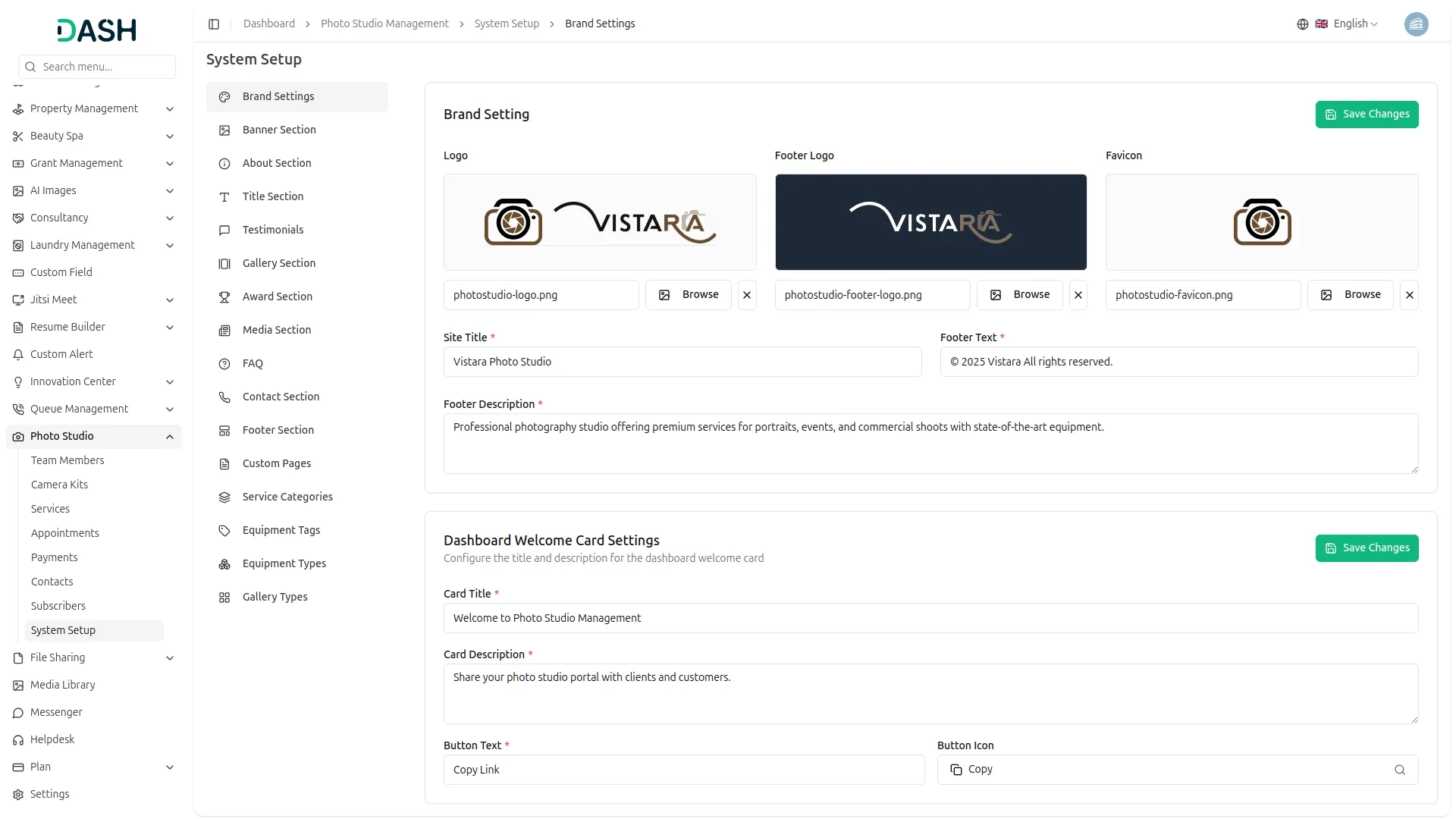
- In the Brand Settings section, you will find fields for Logo, Footer Logo, Favicon, Site Title, Footer Text, and Footer Description. You can upload the logo, footer logo, and favicon using the Browse button. Enter all the required details and click Save Changes.
- In the Dashboard Welcome Card Settings, you will find fields for Card Title, Card Description, Button Text, and Button Icon. Enter all the details and click Save Changes.
- Once saved, the Logo will appear in the header of your website, the Footer Logo will display in the footer area, and the Favicon will appear as the small icon in the browser tab. The Site Title will represent your studio’s name across the site, the Footer Text will display as the copyright tagline at the bottom of your website, and the Footer Description will appear as the short introductory text in the footer section. The Dashboard Welcome Card title and description will reflect on the welcome banner inside your admin dashboard, along with the configured button label.
Banner Section
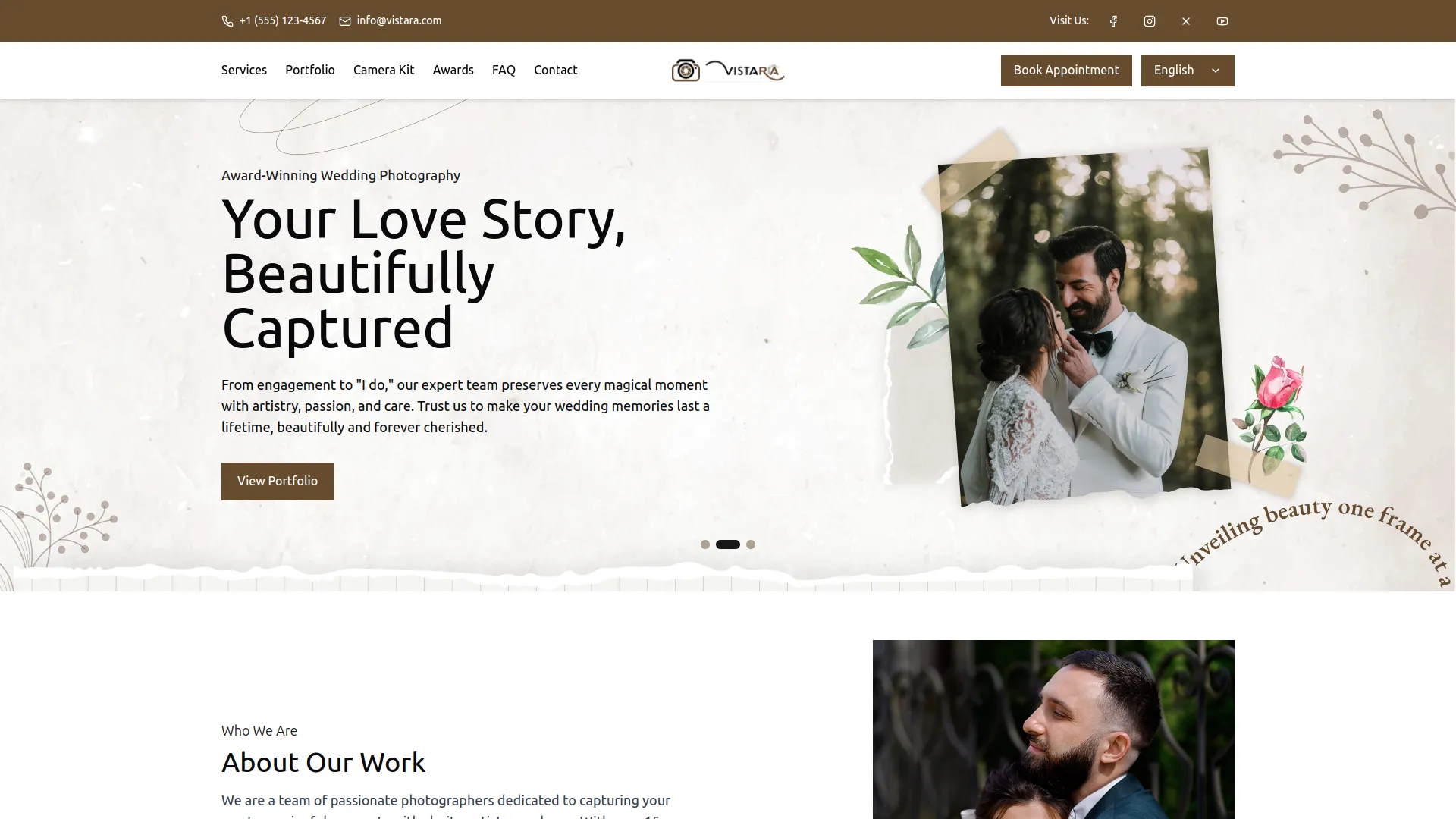
- In the Banner Section, you will find fields for Banner Title, Banner Sub Title, Banner Image, and Description for each banner item. Upload your hero image using the Browse button and enter all the required details. You can add multiple banner slides using the “Add Banner” button. Click Save Changes when done.
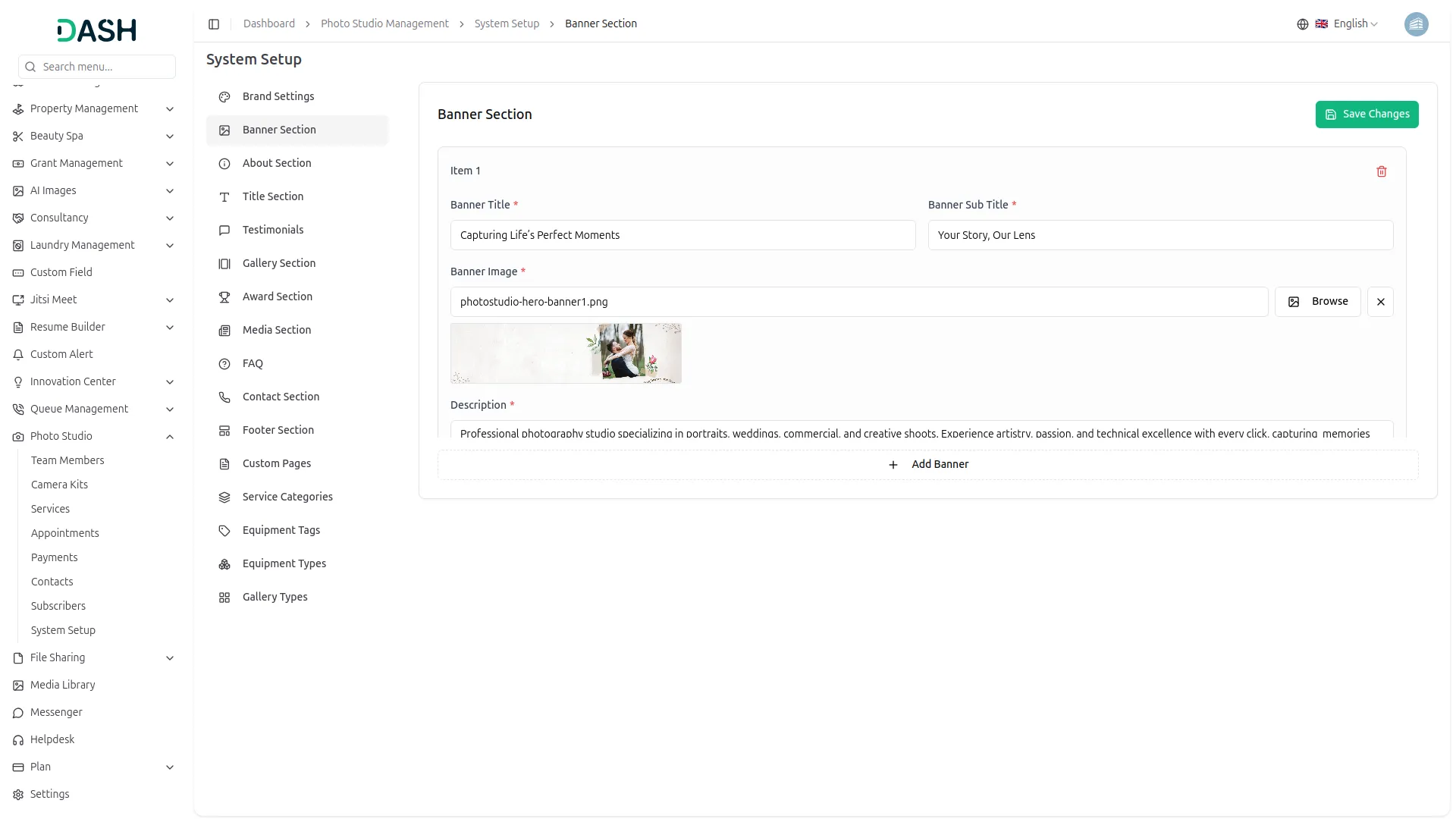
- Once saved, the Banner Title and Sub Title will appear as the headline text in the hero slider on your homepage. The uploaded Banner Image will display as the background visual for each slide, and the Description will appear as the supporting text beneath the title, giving visitors an engaging first impression of your photography studio.
About Section
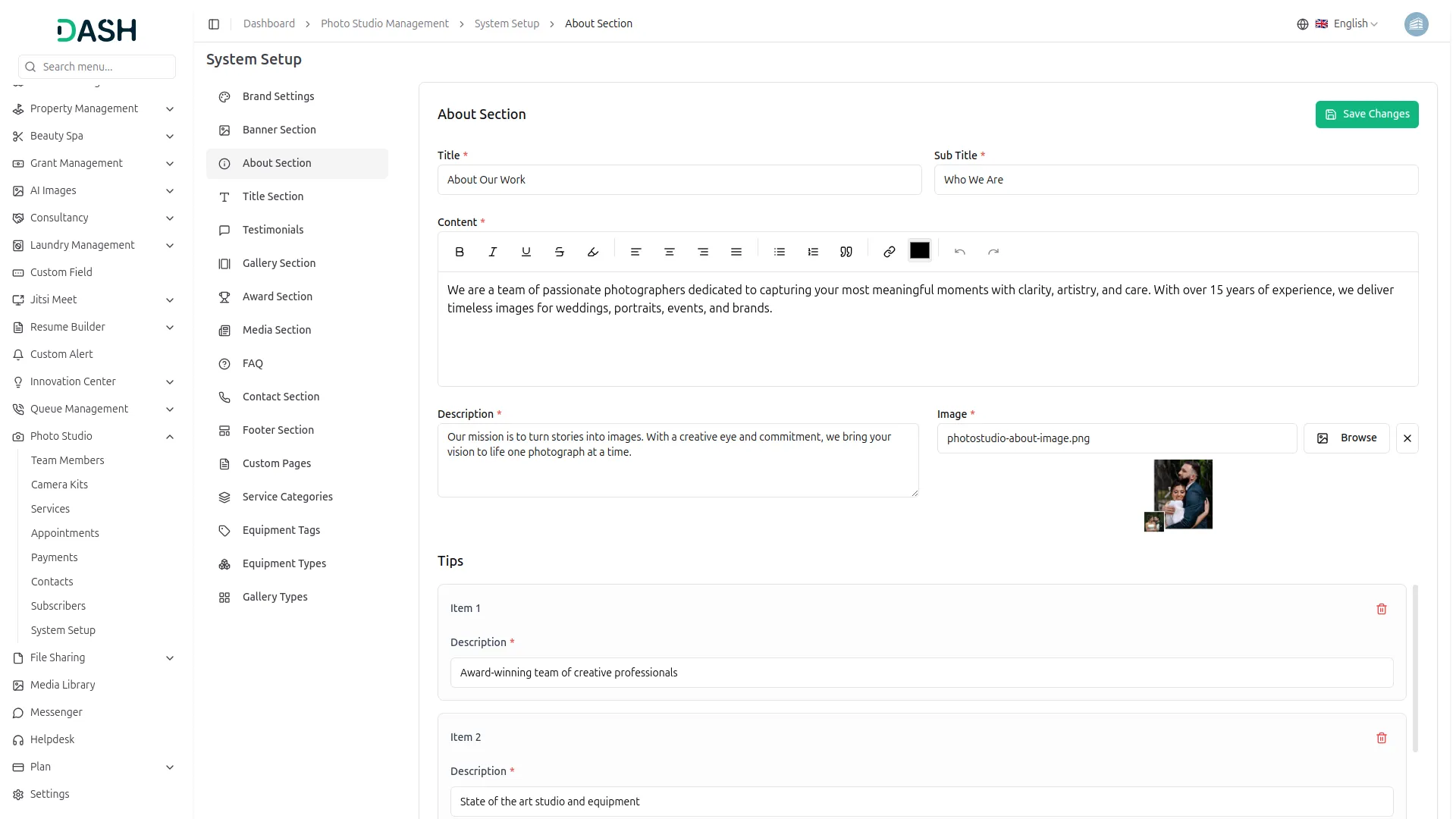
- In the About Section, you will find fields for Title, Sub Title, Content, Description, and Image. Use the rich text editor in the Content field to write your studio’s main introduction.
- Enter a short Description for the mission statement and upload your image using the Browse button. You can also add multiple Tips items, each with its own Description, using the “Add Tip” button. Click Save Changes when done.
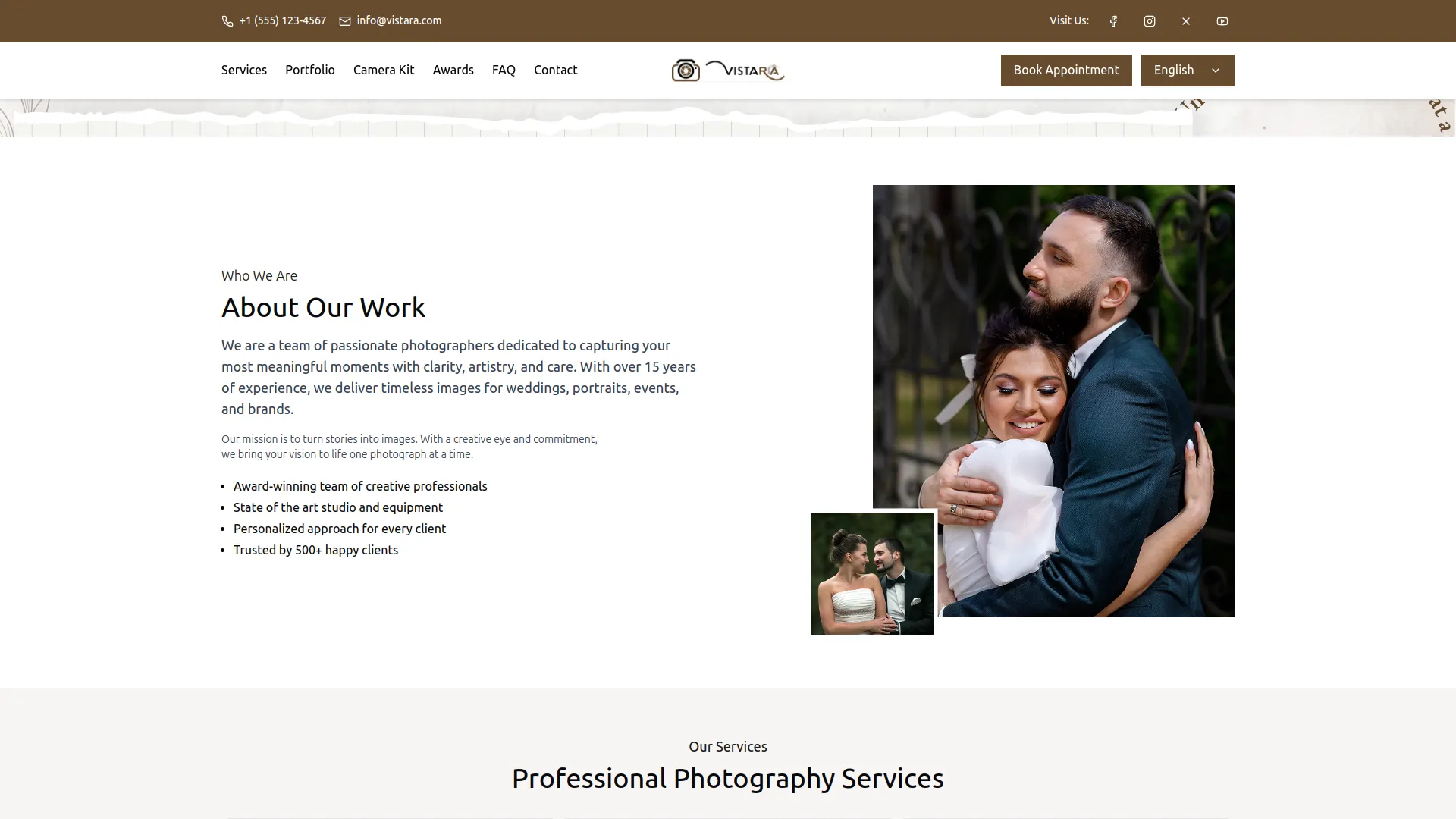
- Once saved, the Sub Title and Title will appear as the section heading in the About area on your homepage. The Content will display as the main introductory paragraph describing your studio, and the Description will appear as the mission statement text. The uploaded Image will display alongside the content. Each Tip item will appear as a bullet point highlight, showcasing your studio’s key strengths to visitors.
Title Section
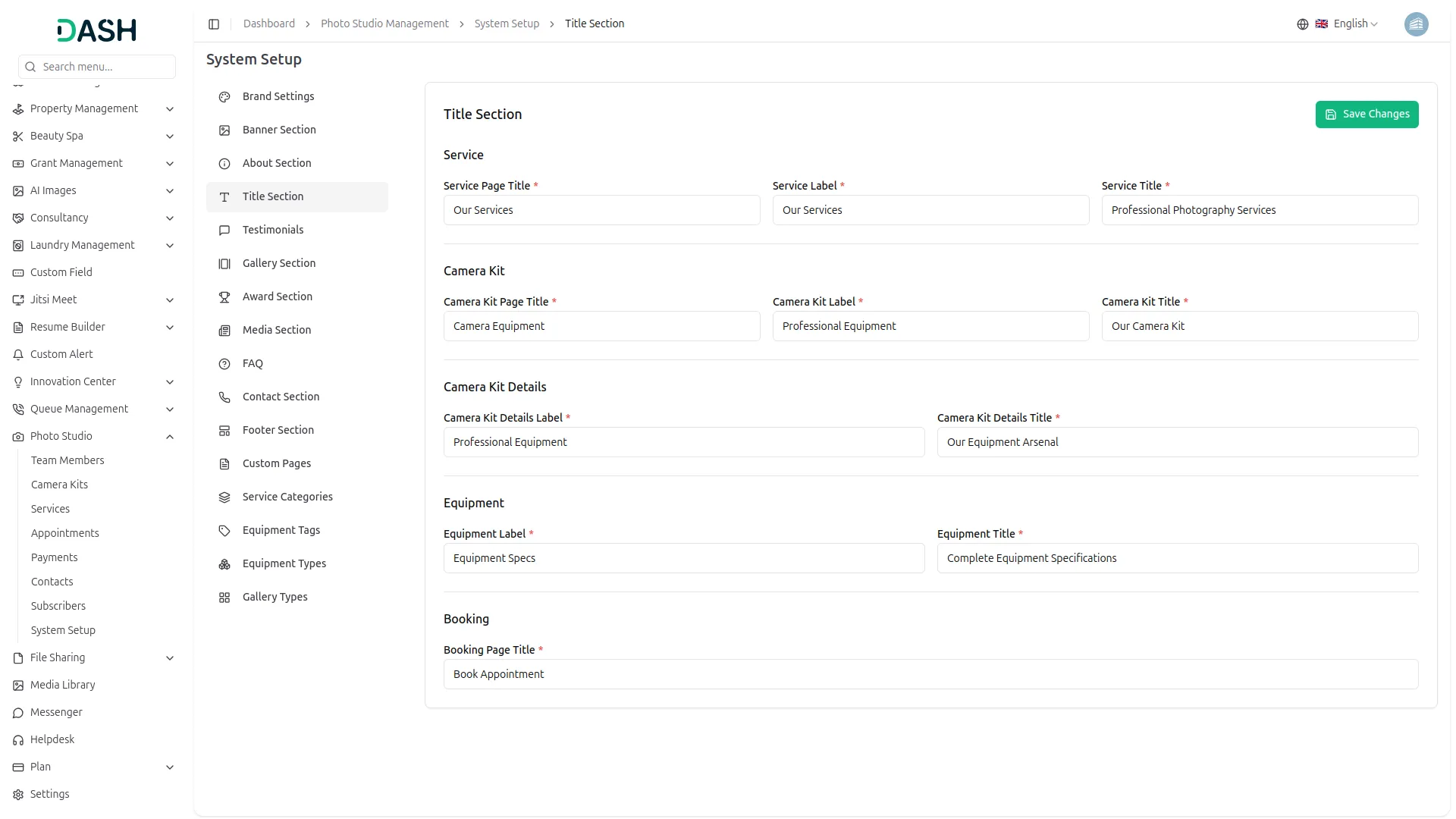
- In the Title Section, you will find dedicated title fields for multiple pages and sections of your website. For Service, enter the Service Page Title, Service Label, and Service Title. For Camera Kit, enter the Camera Kit Page Title, Camera Kit Label, and Camera Kit Title.
- For Camera Kit Details, enter the Camera Kit Details Label and Camera Kit Details Title. For Equipment, enter the Equipment Label and Equipment Title. For Booking, enter the Booking Page Title. Click Save Changes when done.
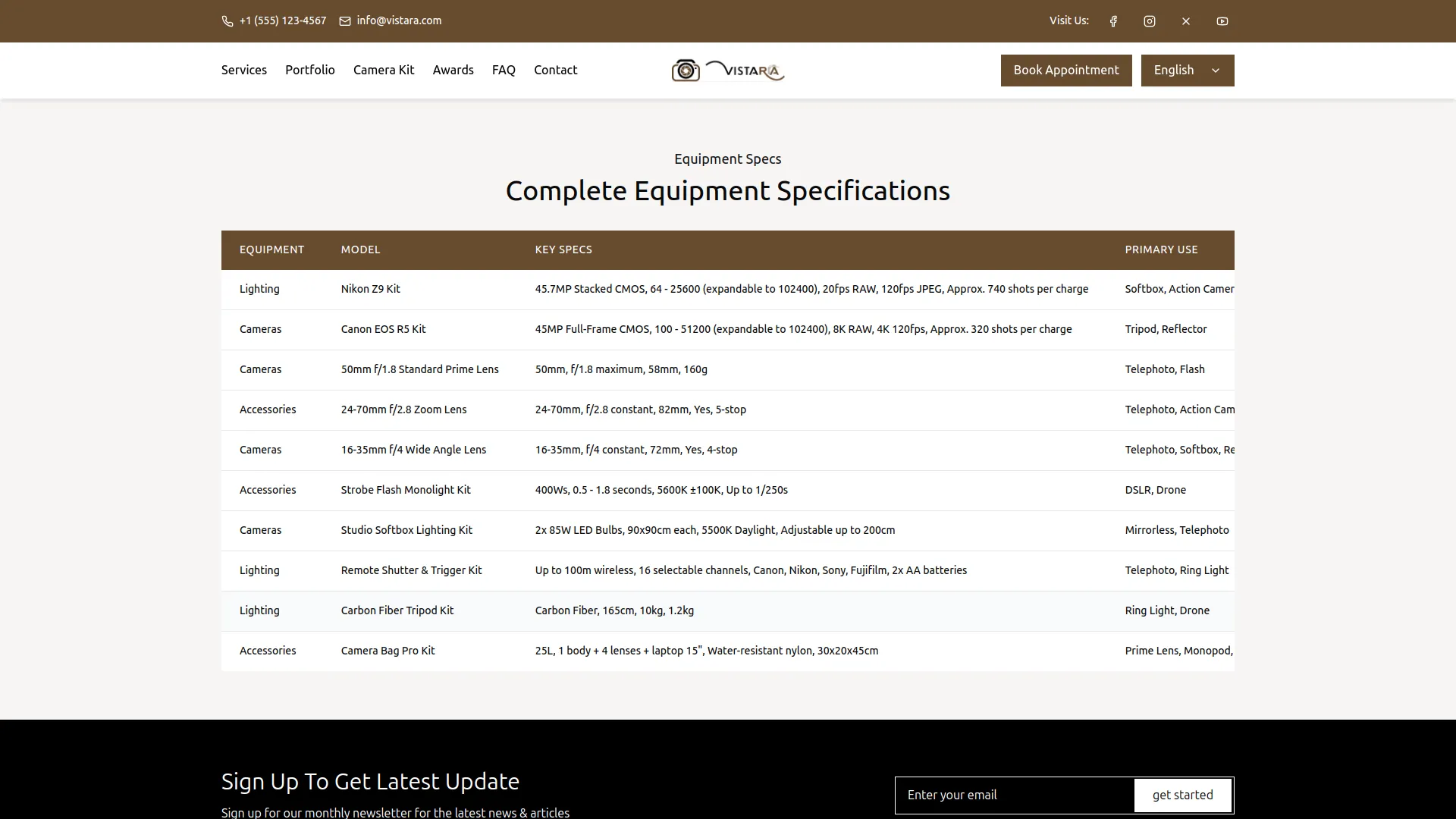
- Once saved, all the titles and labels entered here will reflect directly on their respective pages and sections of the frontend website. The Service titles will appear on the Services page, the Camera Kit titles will display on the Camera Equipment page, the Equipment label and title will appear in the specifications table section, and the Booking Page Title will display as the heading on the appointment booking page.
Testimonials
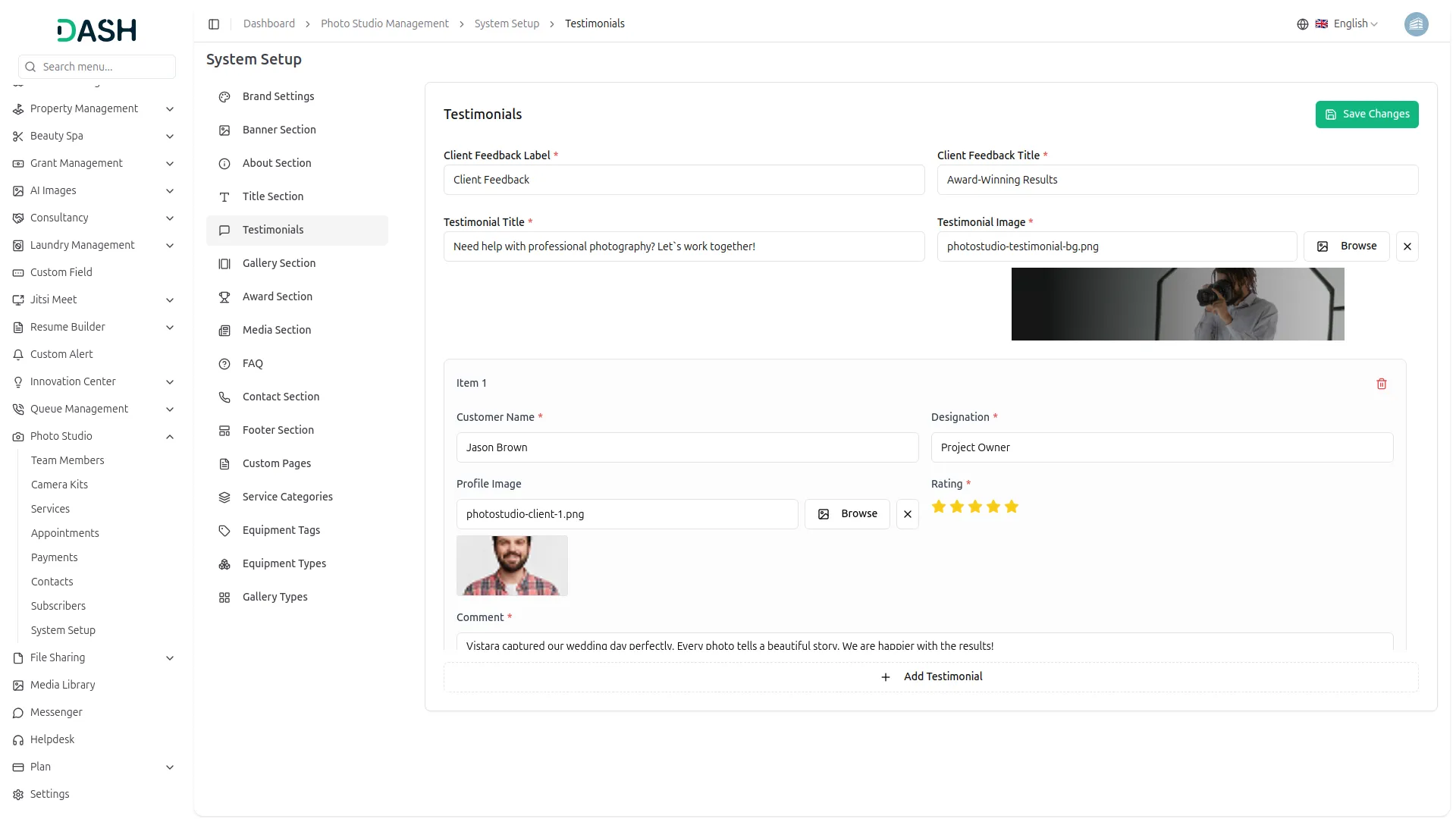
- In the Testimonials section, you will find fields for Client Feedback Label, Client Feedback Title, Testimonial Title, and Testimonial Image. Upload a background image for the testimonial section using the Browse button.
- For each testimonial item, enter the Customer Name, Designation, Profile Image, Rating, and Comment. You can add multiple testimonials using the “Add Item” button. Click Save Changes when done.
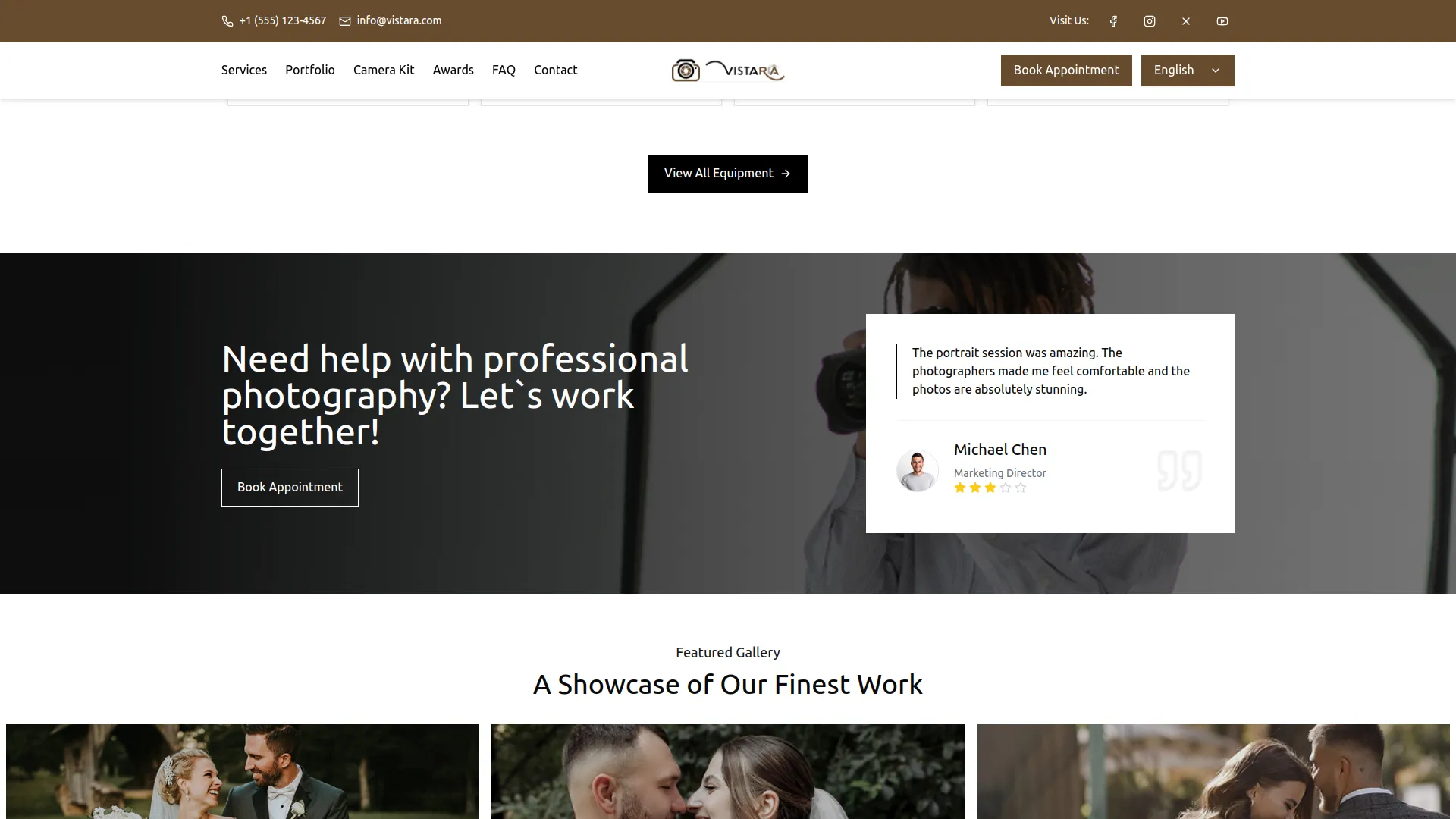
- Once saved, the Client Feedback Label and Client Feedback Title will appear as the section heading on the Awards page. The Testimonial Title will display as the call-to-action heading in the testimonial banner section, and the uploaded Testimonial Image will appear as its background visual. Each client’s Name, Designation, Profile Image, Star Rating, and Comment will be displayed as individual testimonial cards in a slider on both the homepage and the Awards page.
Gallery Section
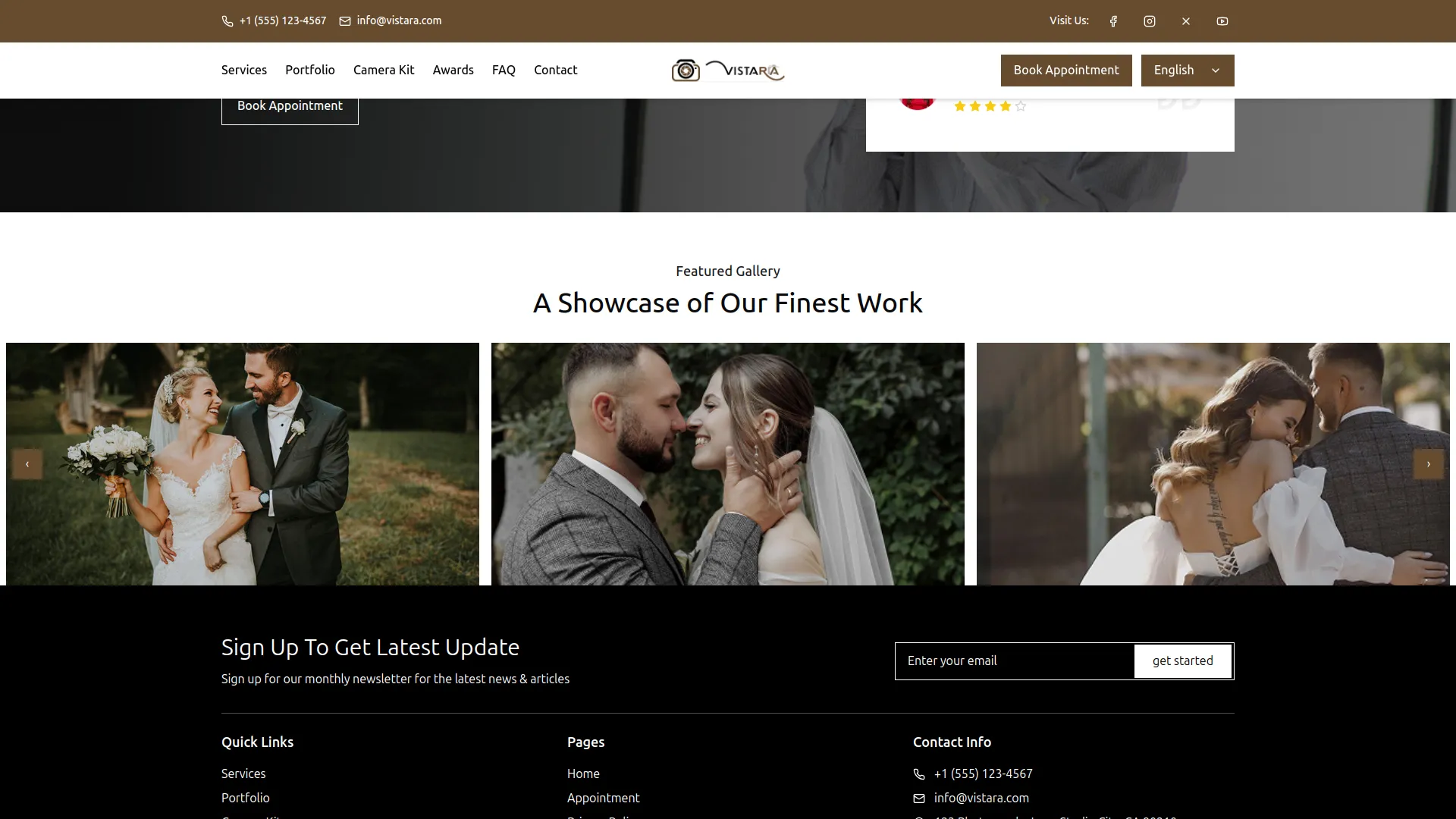
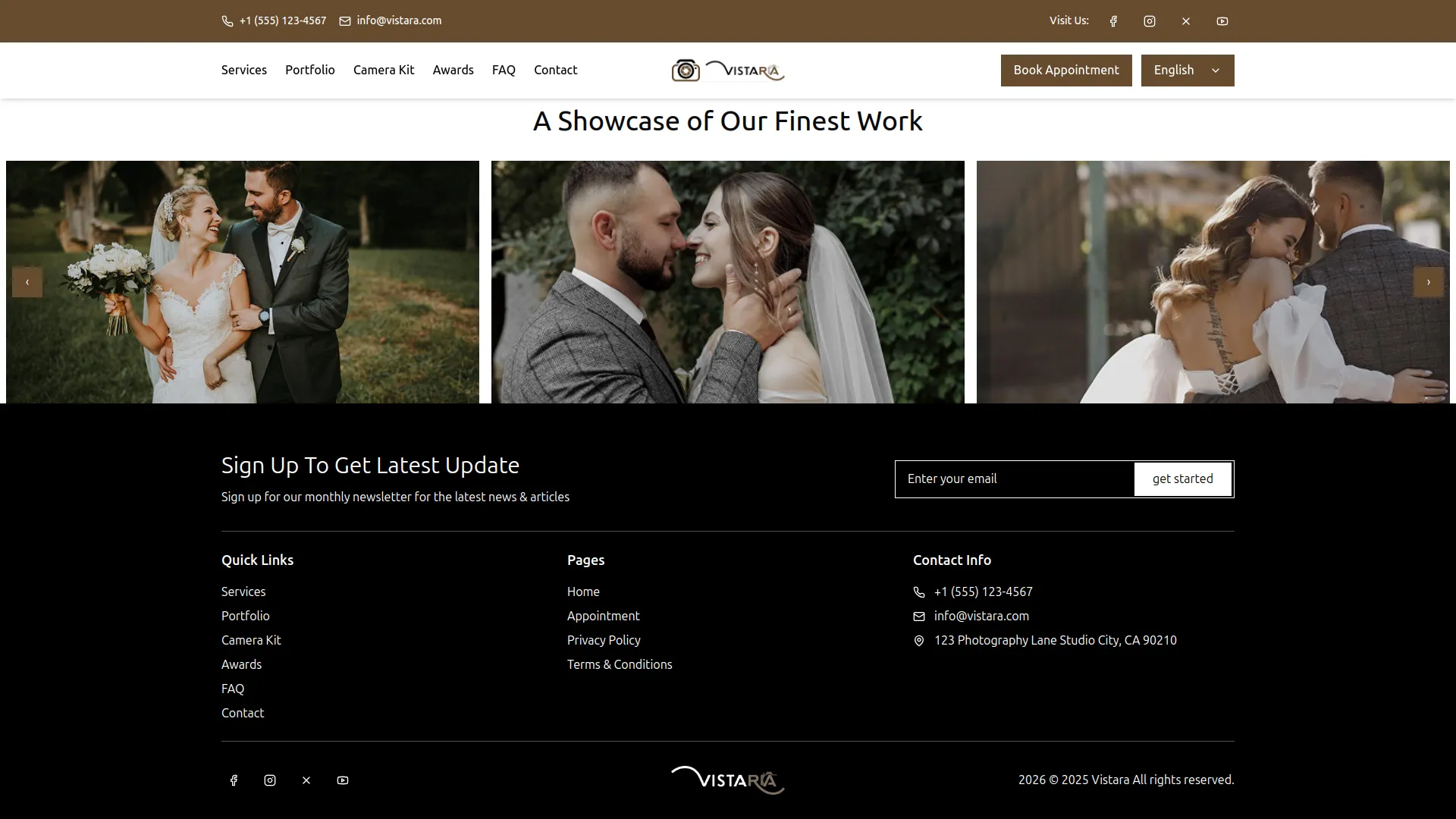
- In the Gallery Section, you will find fields for Gallery Page Title, Gallery Label, Gallery Title, Gallery Category Label, and Gallery Category Title. For each gallery image item, select the Gallery Type from the dropdown and upload the Gallery Image using the Browse button. You can add more images using the “Add Image” button. Click Save Changes when done.
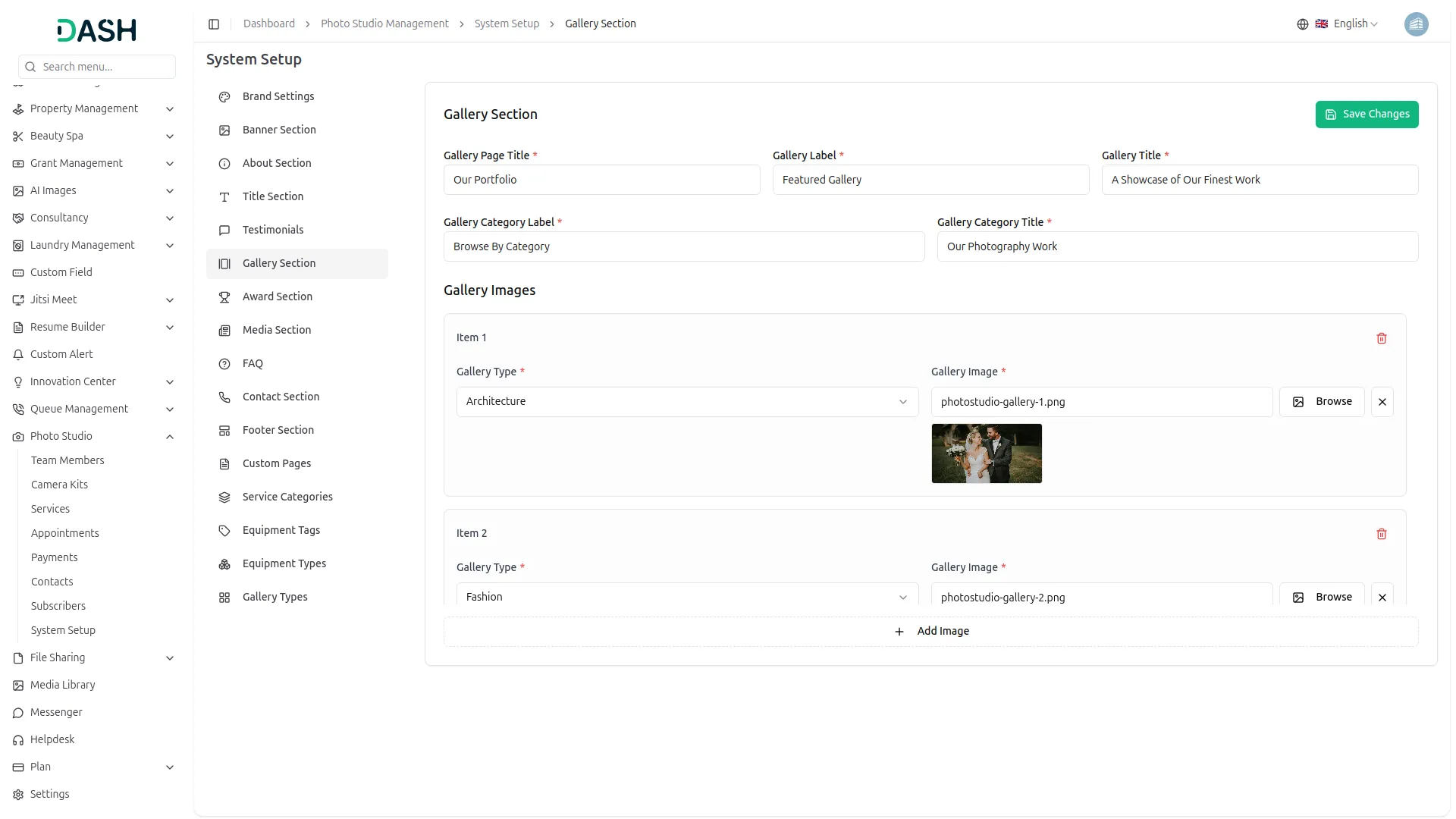
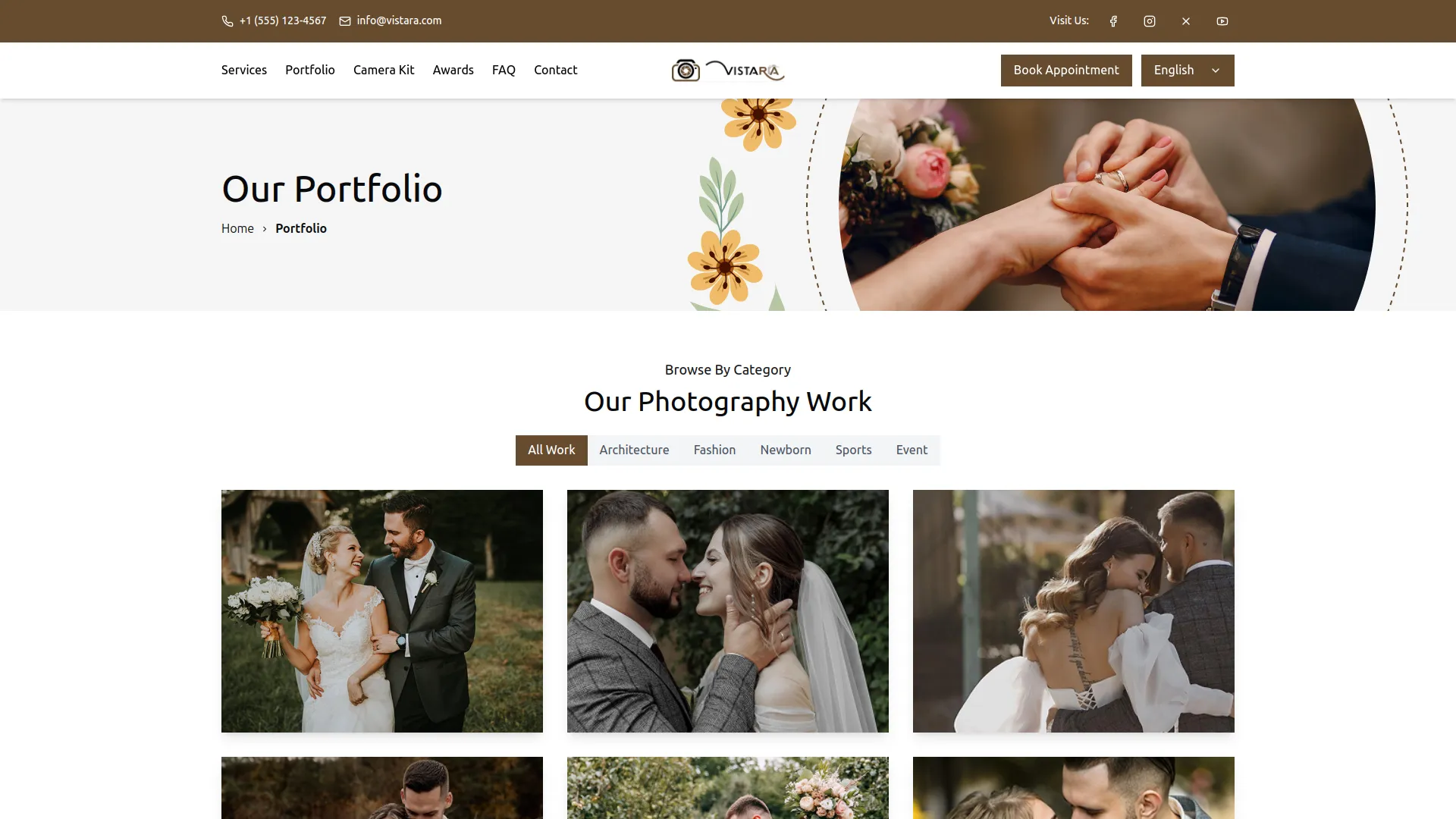
- Once saved, the Gallery Page Title will appear as the heading on the Portfolio page. The Gallery Label and Gallery Title will display in the featured gallery section on your homepage. The Gallery Category Label and Gallery Category Title will appear as the section heading above the filter tabs on the Portfolio page. Each uploaded gallery image will appear in the photo grid, organized under its assigned gallery type, allowing visitors to browse your work by category.
Award Section
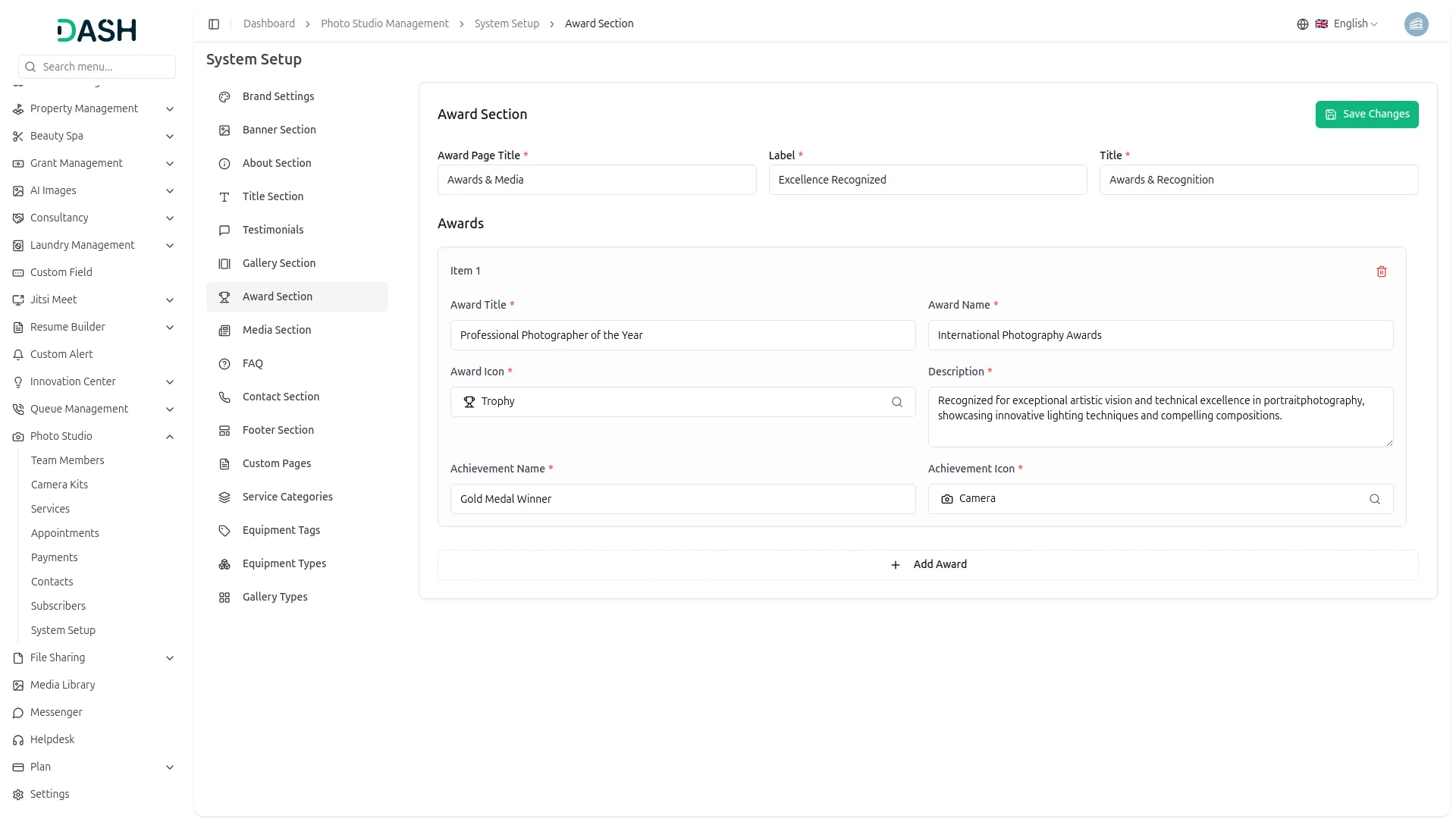
- In the Award Section, you will find fields for Award Page Title, Label, and Title. For each award item, enter the Award Title, Award Name, Award Icon, Description, Achievement Name, and Achievement Icon. You can add multiple awards using the “Add Award” button. Click Save Changes when done.
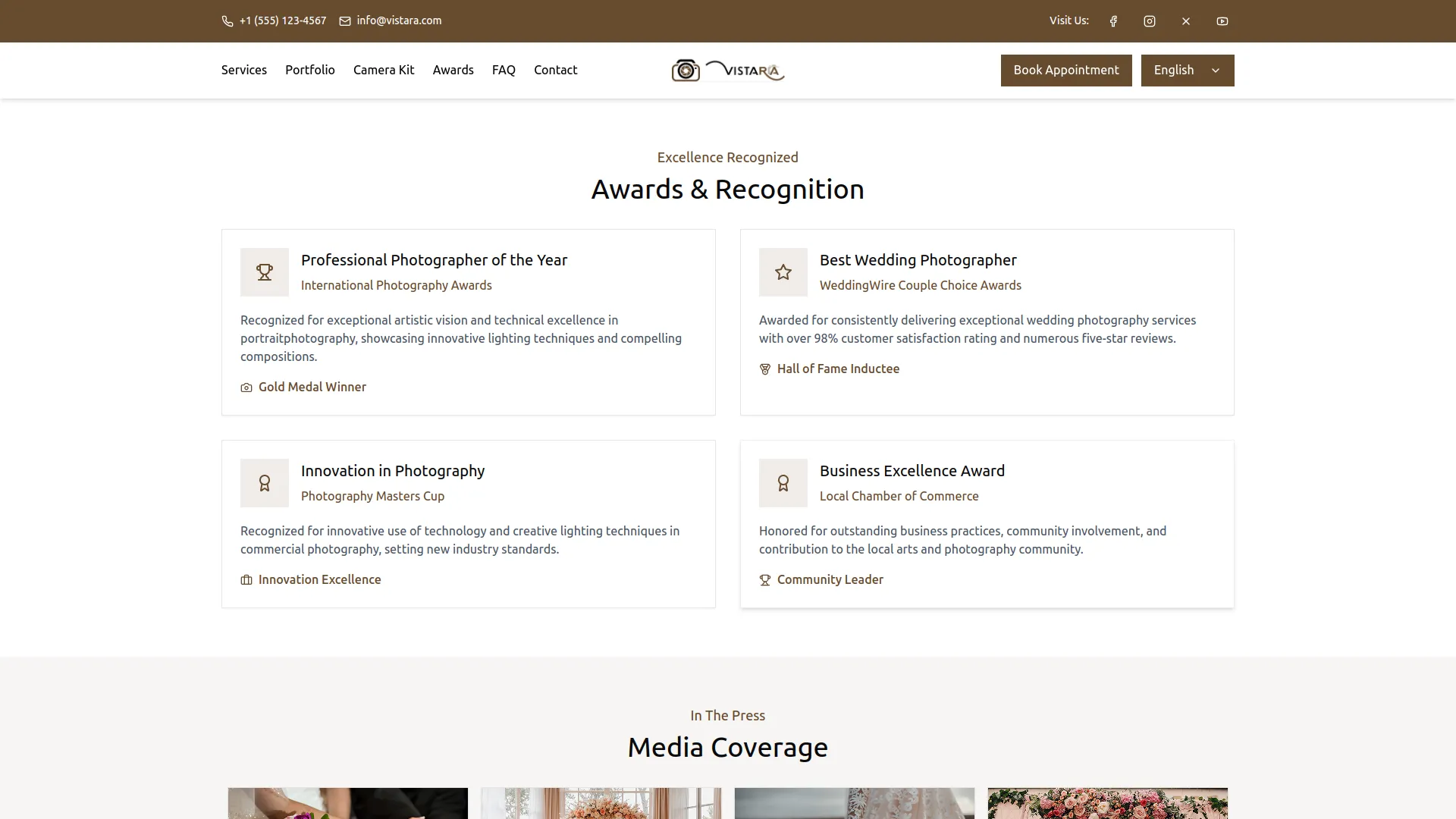
- Once saved, the Award Page Title will appear as the heading on the Awards & Media page. The Label and Title will display as the section heading above the award cards. Each award card will show the Award Icon, Award Title, Award Name, Description, and the Achievement Name with its corresponding icon, giving visitors a clear view of your studio’s professional recognition and accomplishments.
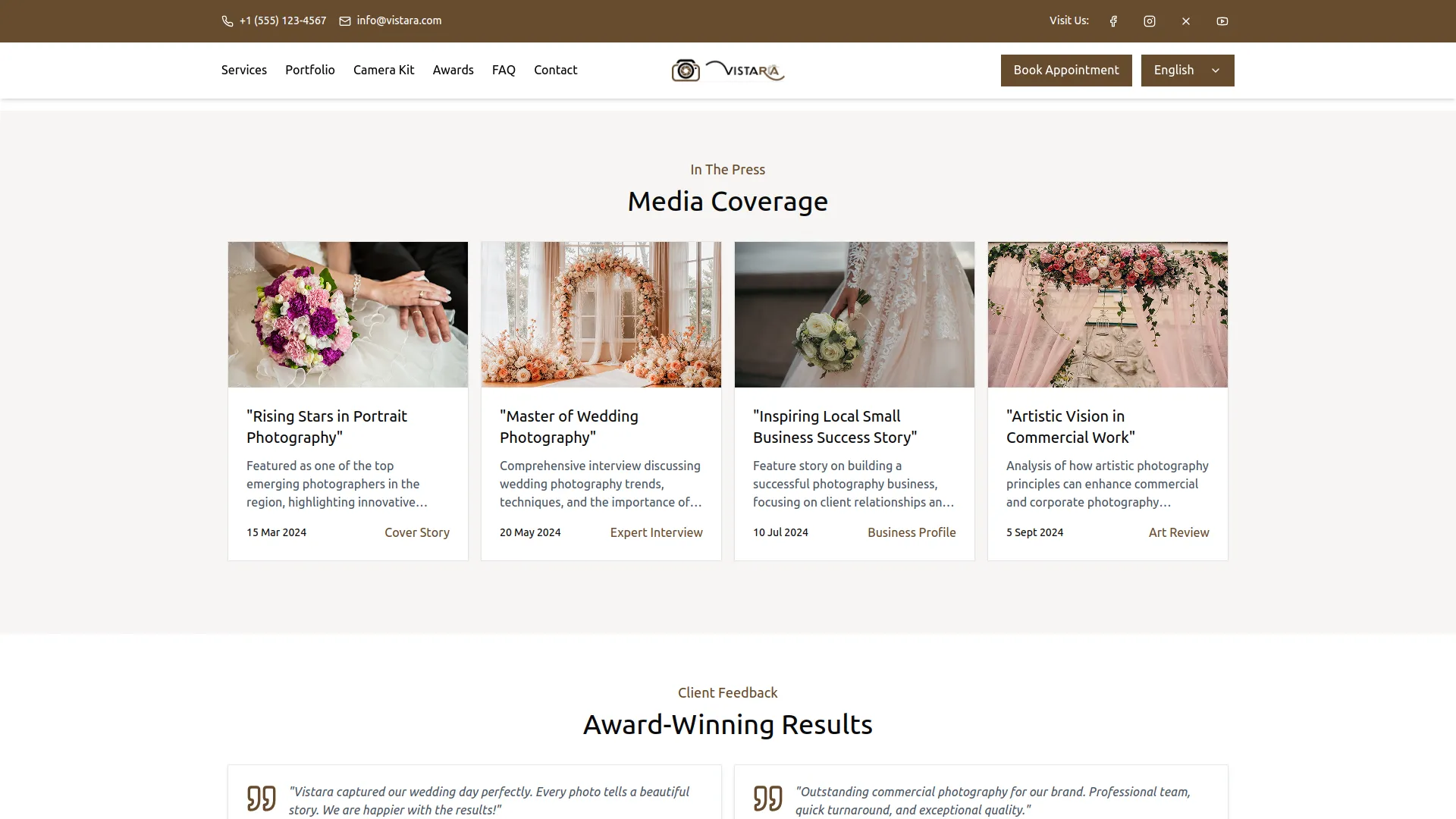
Media Section
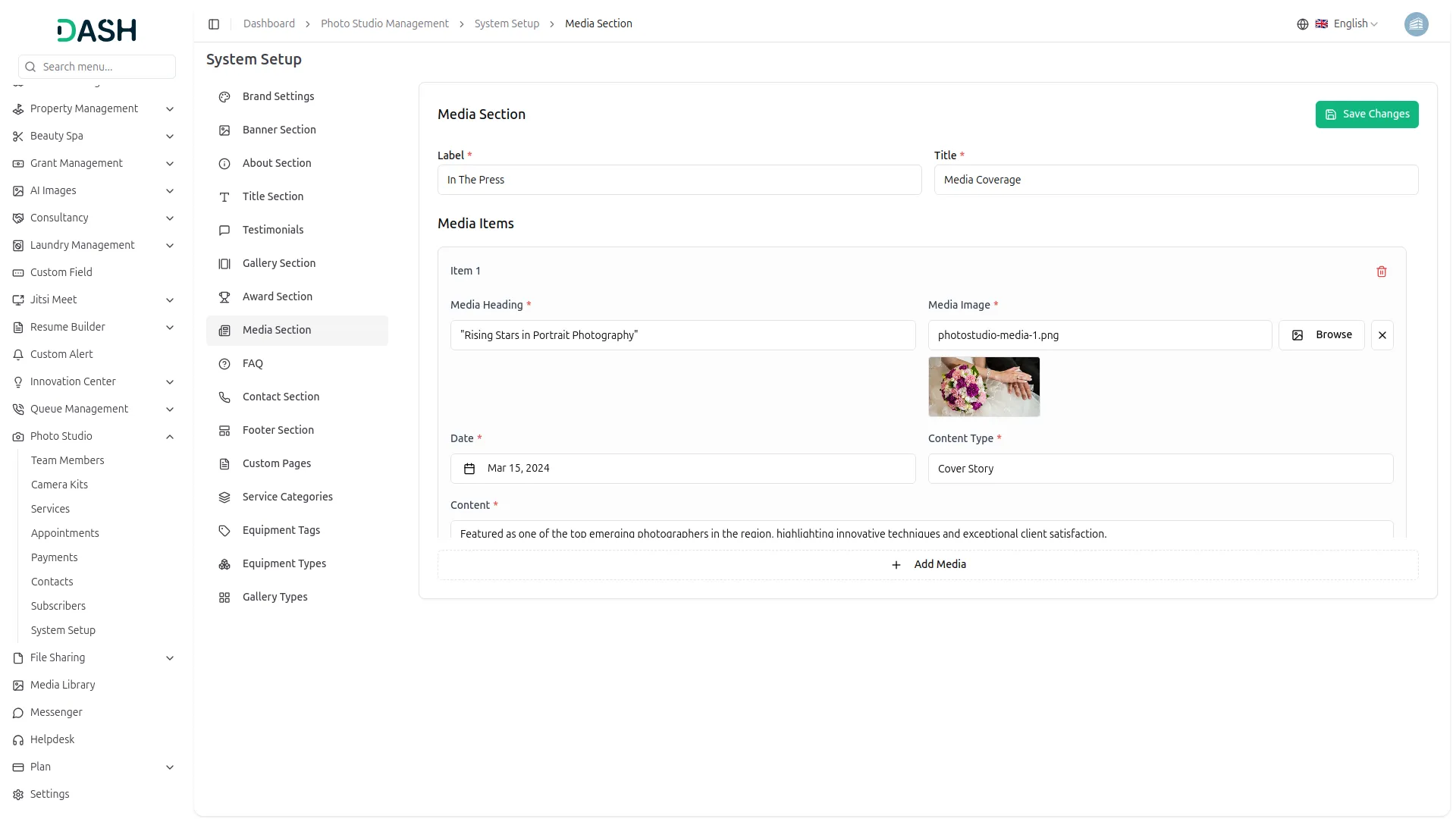
- In the Media Section, you will find fields for Label and Title for the section heading. For each media item, enter the Media Heading, upload the Media Image using the Browse button, select the Date, enter the Content Type, and add the Content description. You can add more media entries using the “Add Media” button. Click Save Changes when done.
- Once saved, the Label and Title will appear as the section heading in the Media Coverage area on the Awards & Media page. Each media item will display as a press card showing the Media Image, Media Heading, Date, Content Type, and a short Content preview, showcasing your studio’s press features and media appearances to visitors.
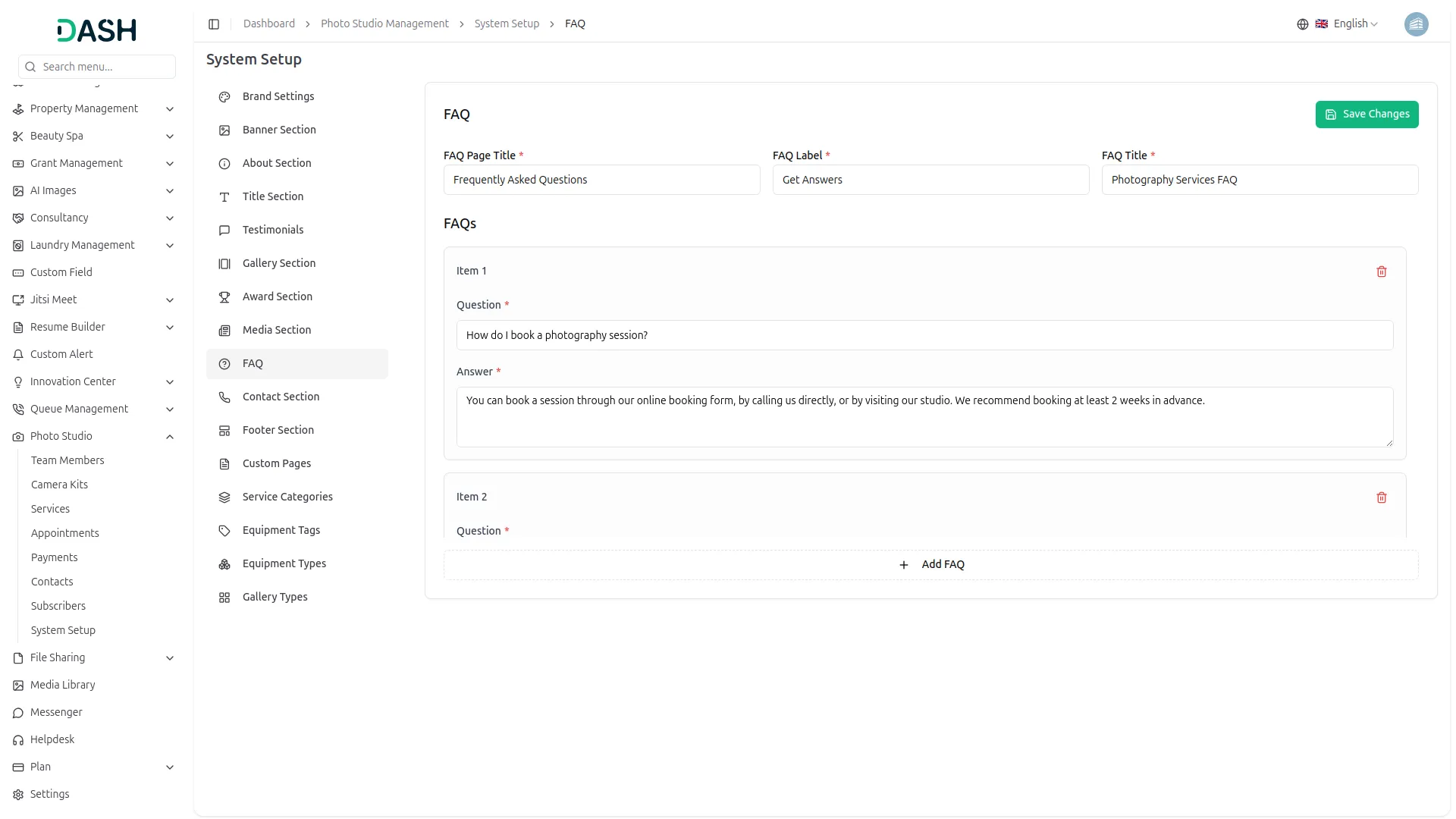
FAQ
- In the FAQ section, you will find fields for FAQ Page Title, FAQ Label, and FAQ Title. For each FAQ item, enter the Question and its corresponding Answer. You can add more questions using the “Add FAQ” button. Click Save Changes when done.
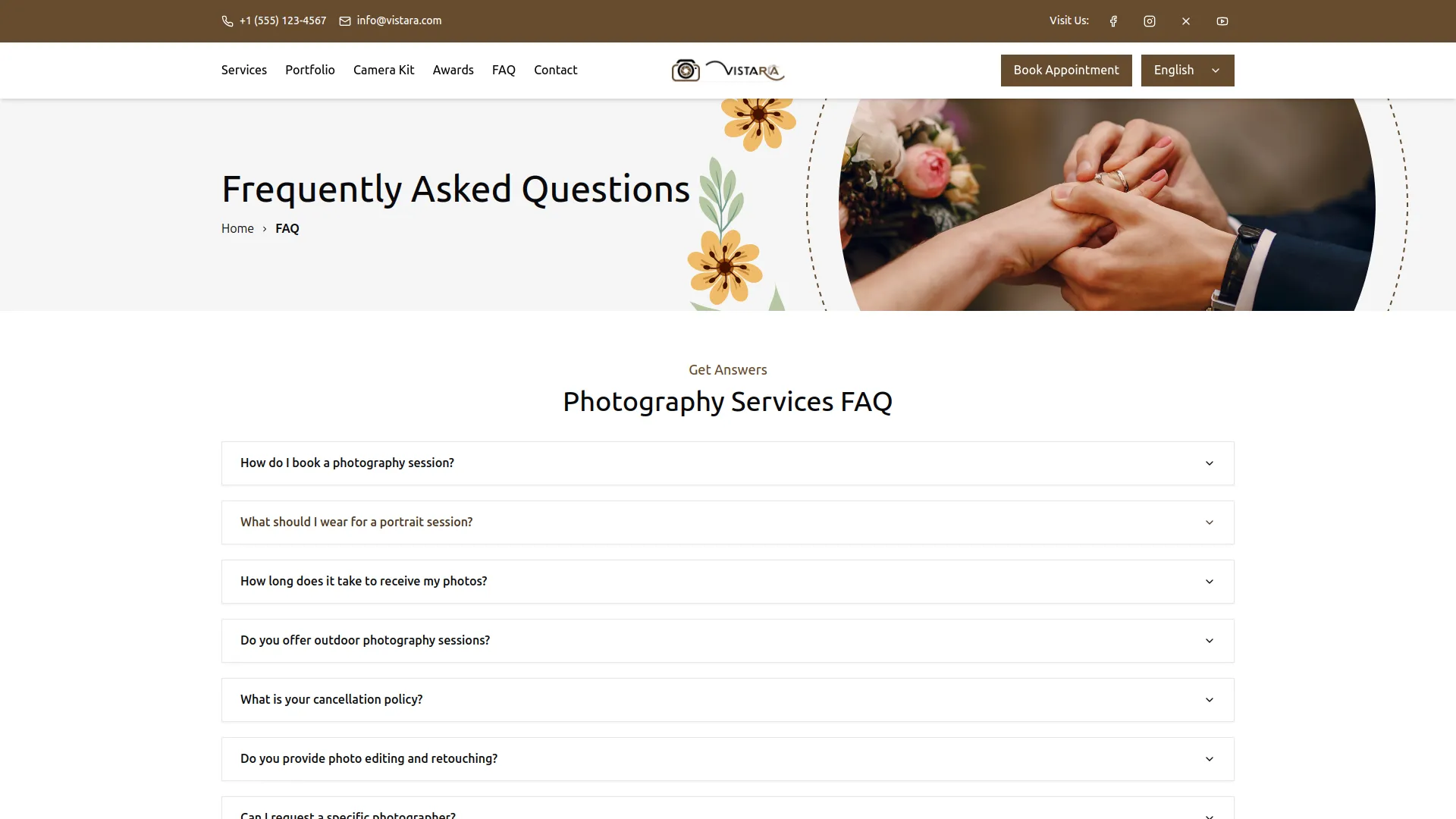
- Once saved, the FAQ Page Title will appear as the heading on the FAQ page. The FAQ Label and FAQ Title will display as the section heading above the questions. Each Question and Answer pair will appear as an expandable accordion item on the FAQ page, allowing visitors to click on a question to reveal its answer.
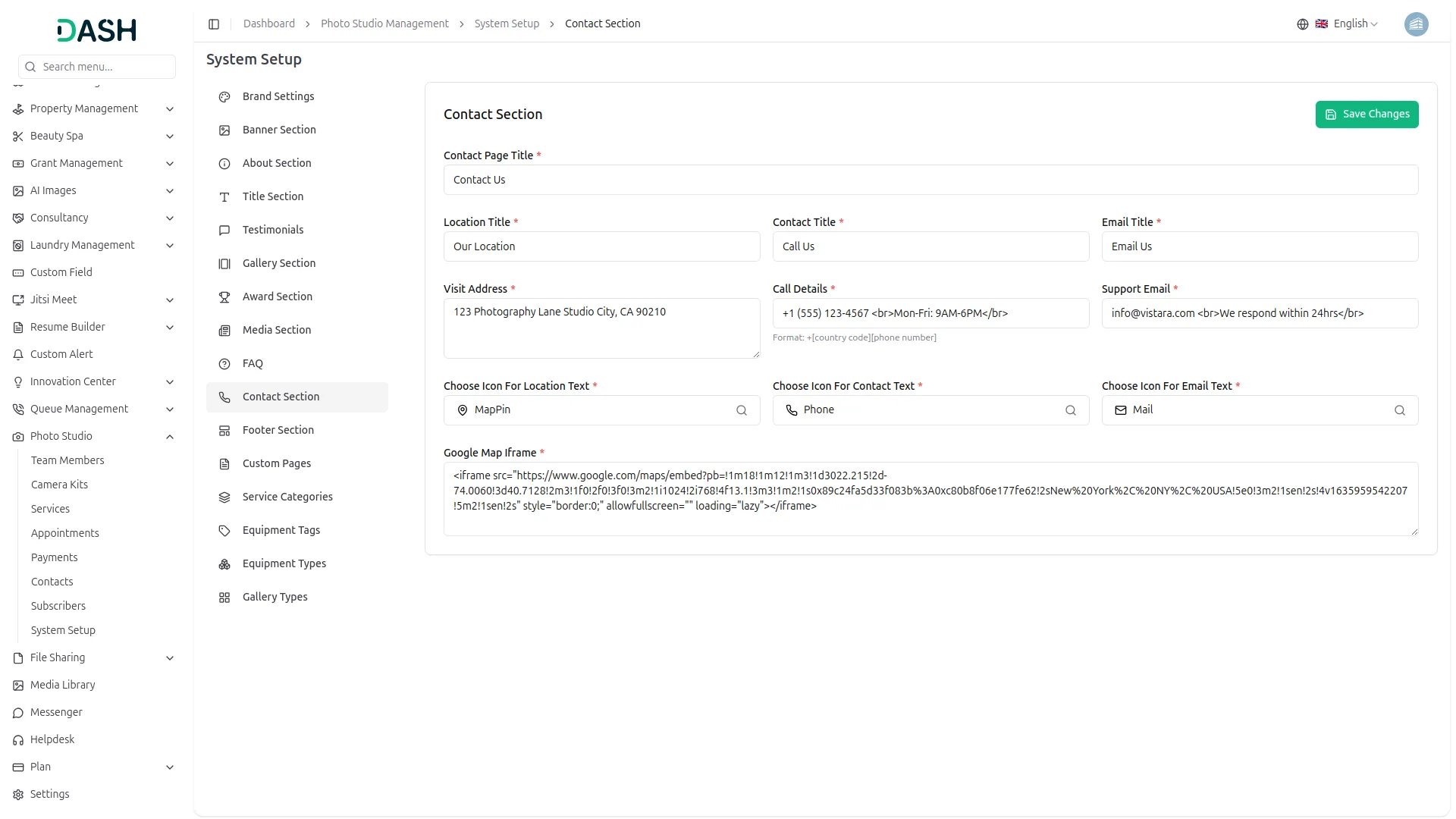
Contact Section
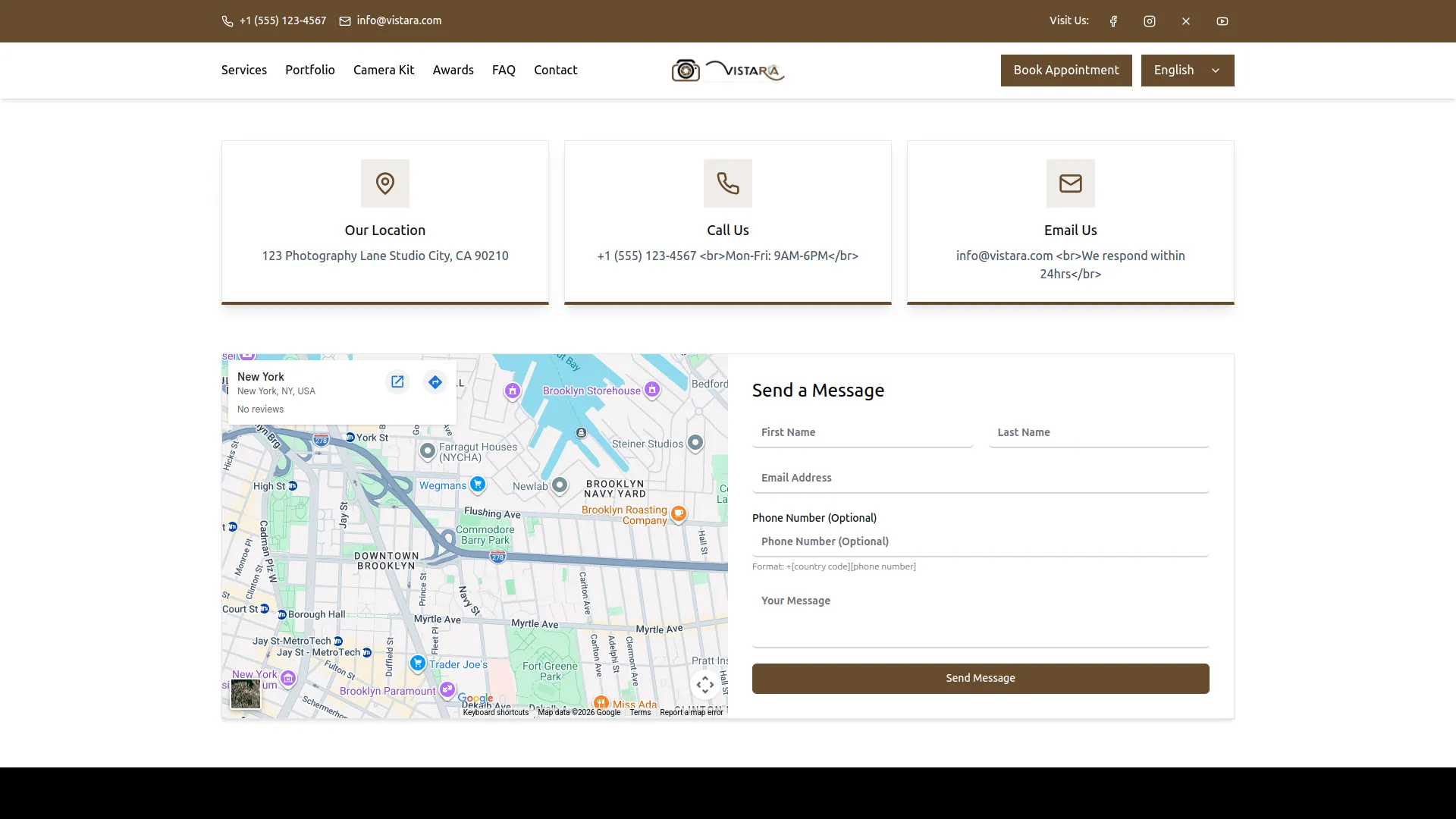
- In the Contact Section, you will find fields for Contact Page Title, Location Title, Contact Title, and Email Title as the card headings. Enter the Visit Address, Call Details, and Support Email in their respective fields. Select the appropriate icon for each contact type using the icon chooser for Location, Contact, and Email. Finally, paste your Google Map Iframe embed code in the map field. Click Save Changes when done.
- Once saved, the Contact Page Title will appear as the heading on the Contact Us page. The three contact cards will display with their configured titles and icons, showing your studio’s Address, Phone number with working hours, and Email address with response time. The Google Map will render as an interactive map on the contact page, helping clients easily locate your studio.
Footer Section
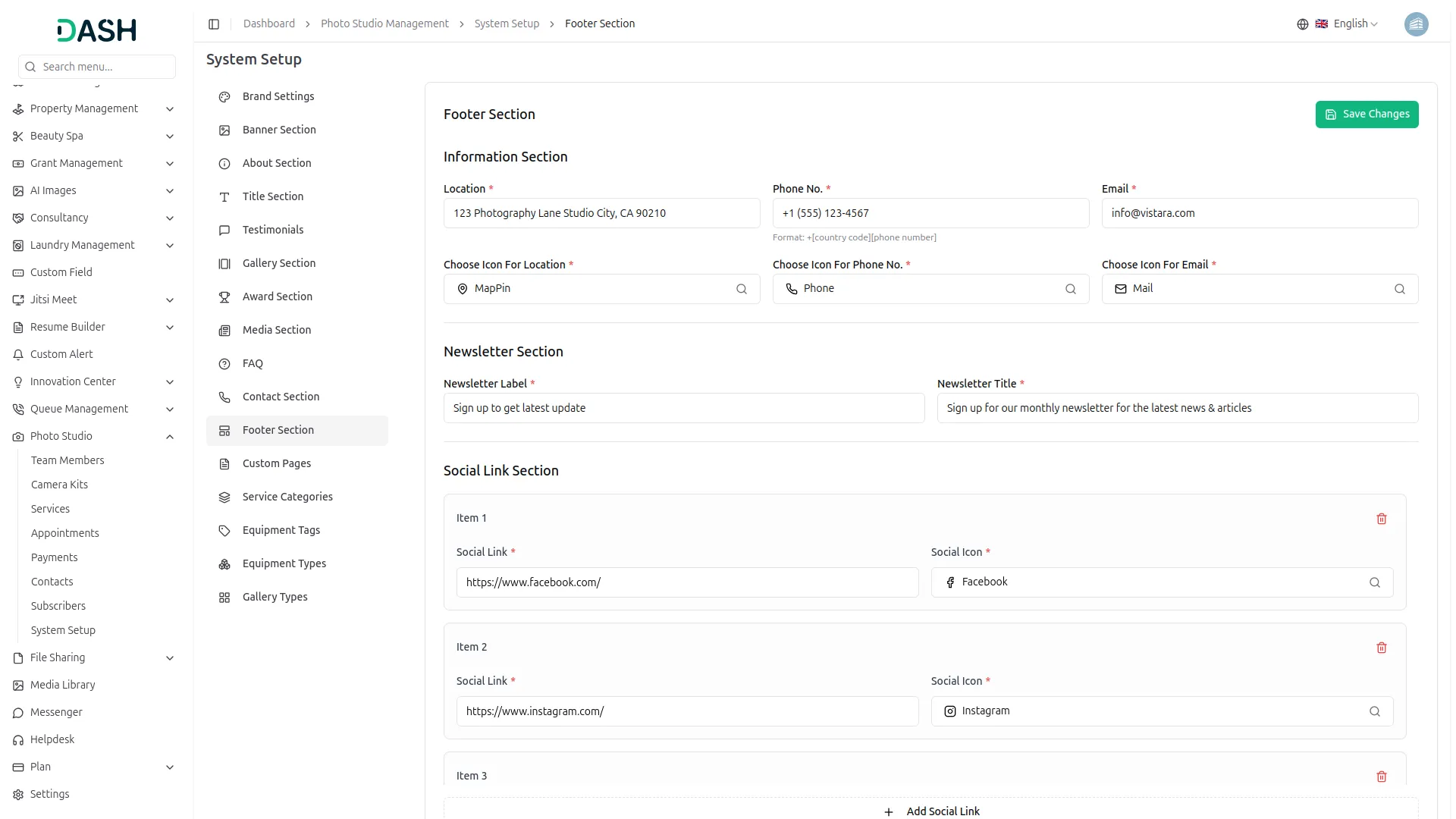
- In the Footer Section, you will find three sub-sections. In the Information Section, enter the Location, Phone Number, and Email, and select the corresponding icon for each using the icon chooser. In the Newsletter Section, enter the Newsletter Label and Newsletter Title.
- In the Social Link Section, enter the Social Link URL and select the corresponding Social Icon for each platform. You can add more social links using the “Add Social Link” button. Click Save Changes when done.
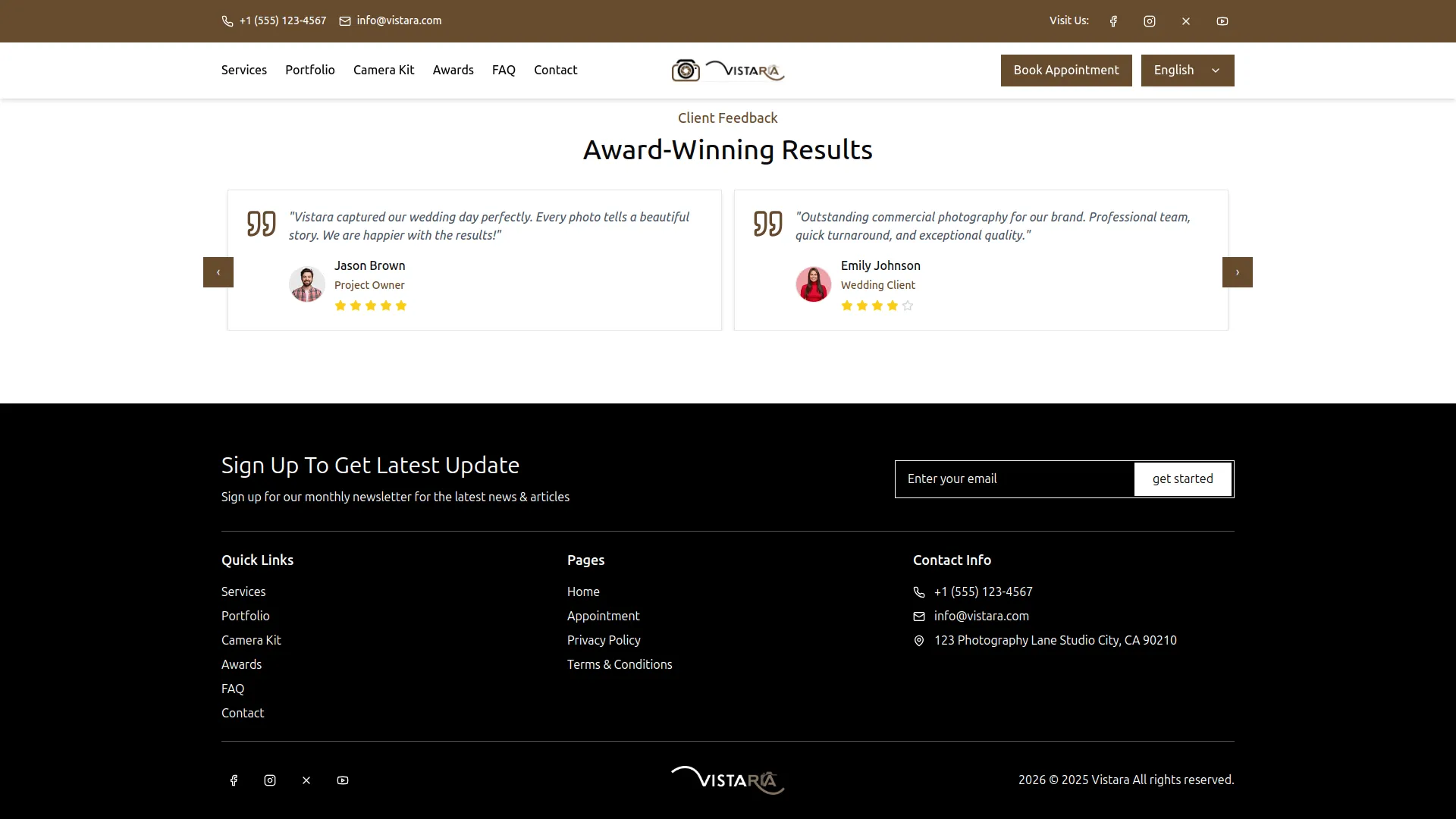
- Once saved, the studio’s Location, Phone Number, and Email with their icons will appear in the Contact Info block at the bottom of every page. The Newsletter Label and Title will display in the email subscription area in the footer. Each social media link and icon will appear as a clickable social icon in the footer, allowing visitors to follow your studio across platforms.
Custom Pages
- To create a new page, click the “Create” button at the top right. In the Create Custom Page modal, enter the Title, set the URL Slug using lowercase letters and hyphens only (e.g., privacy-policy), add an optional Description, and write the full page Contents using the rich text editor. You can also toggle Enable Page Footer to show or hide the footer on that page. Click Create to save.
- In the Custom Pages section, you will find a list of all created custom pages displaying their Title, Slug, Footer status, and Action options. In the action column, you can use the Edit to update the details or Delete to remove that detail.
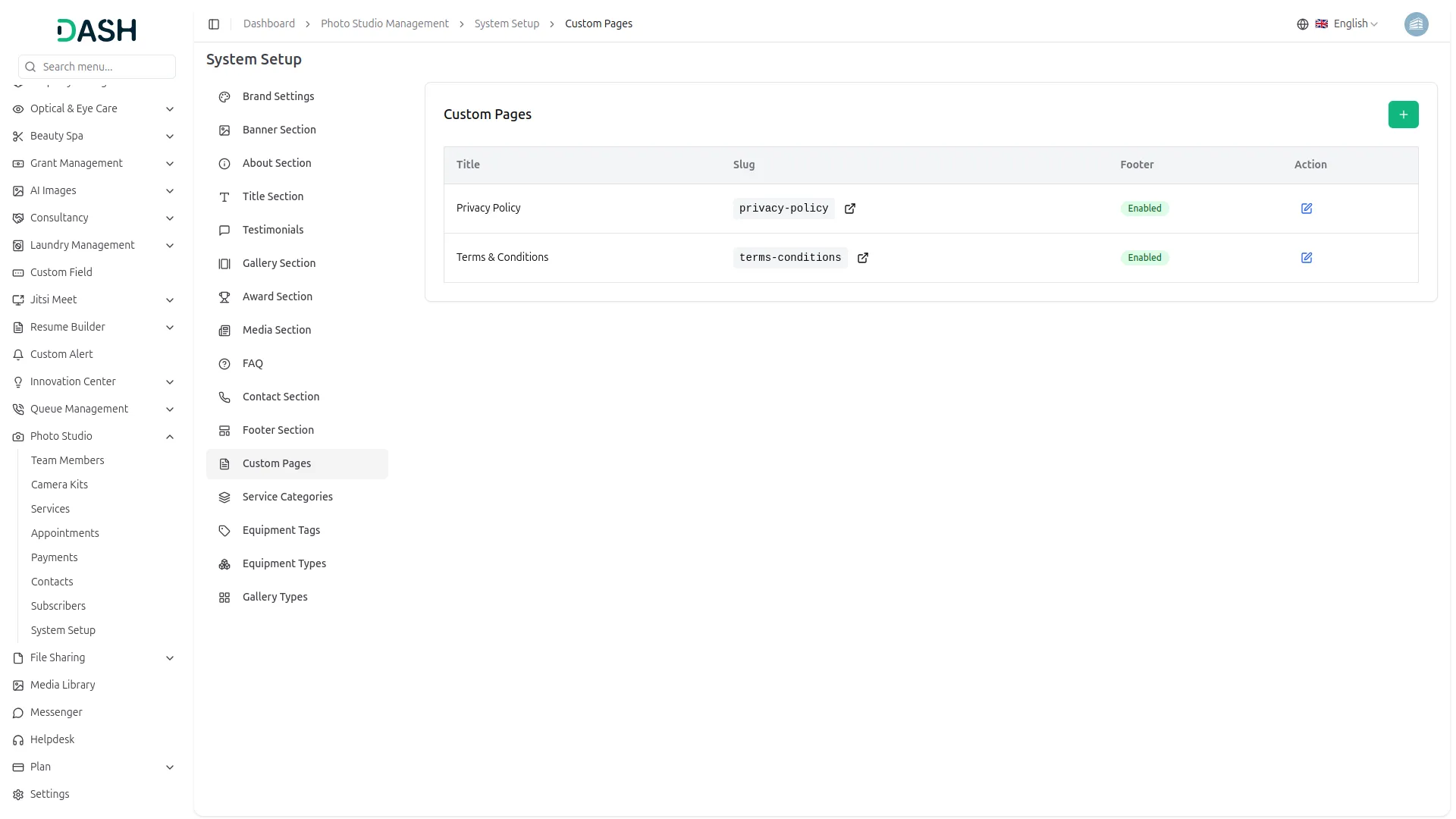
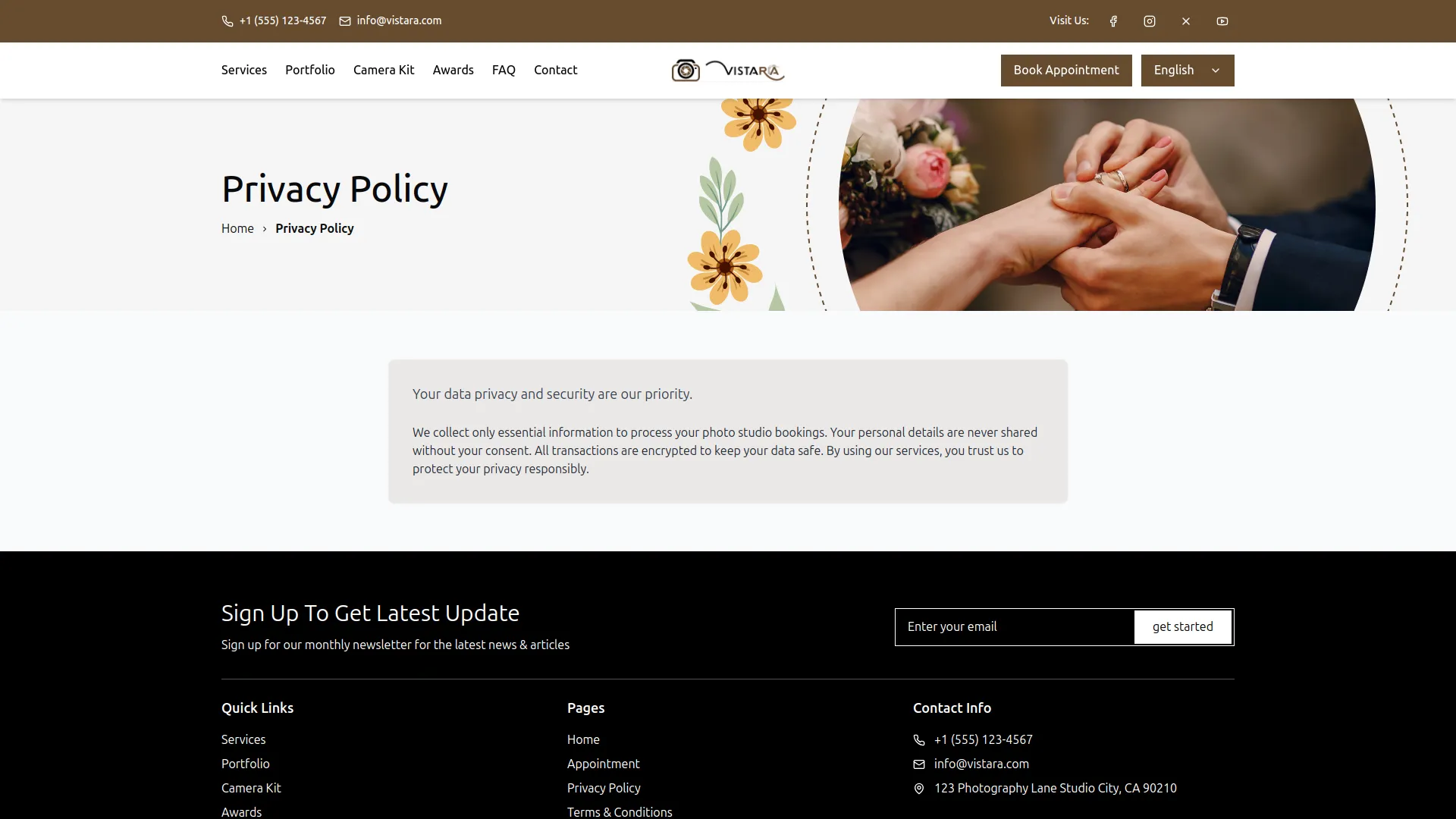
- Once created, each custom page will be accessible on your website through its configured URL slug. The Page Title will display as the heading, and the Contents will appear as the body of the page. If the footer is enabled, the standard site footer will be shown at the bottom of the page, keeping the custom page consistent with the rest of your website.
Service Categories
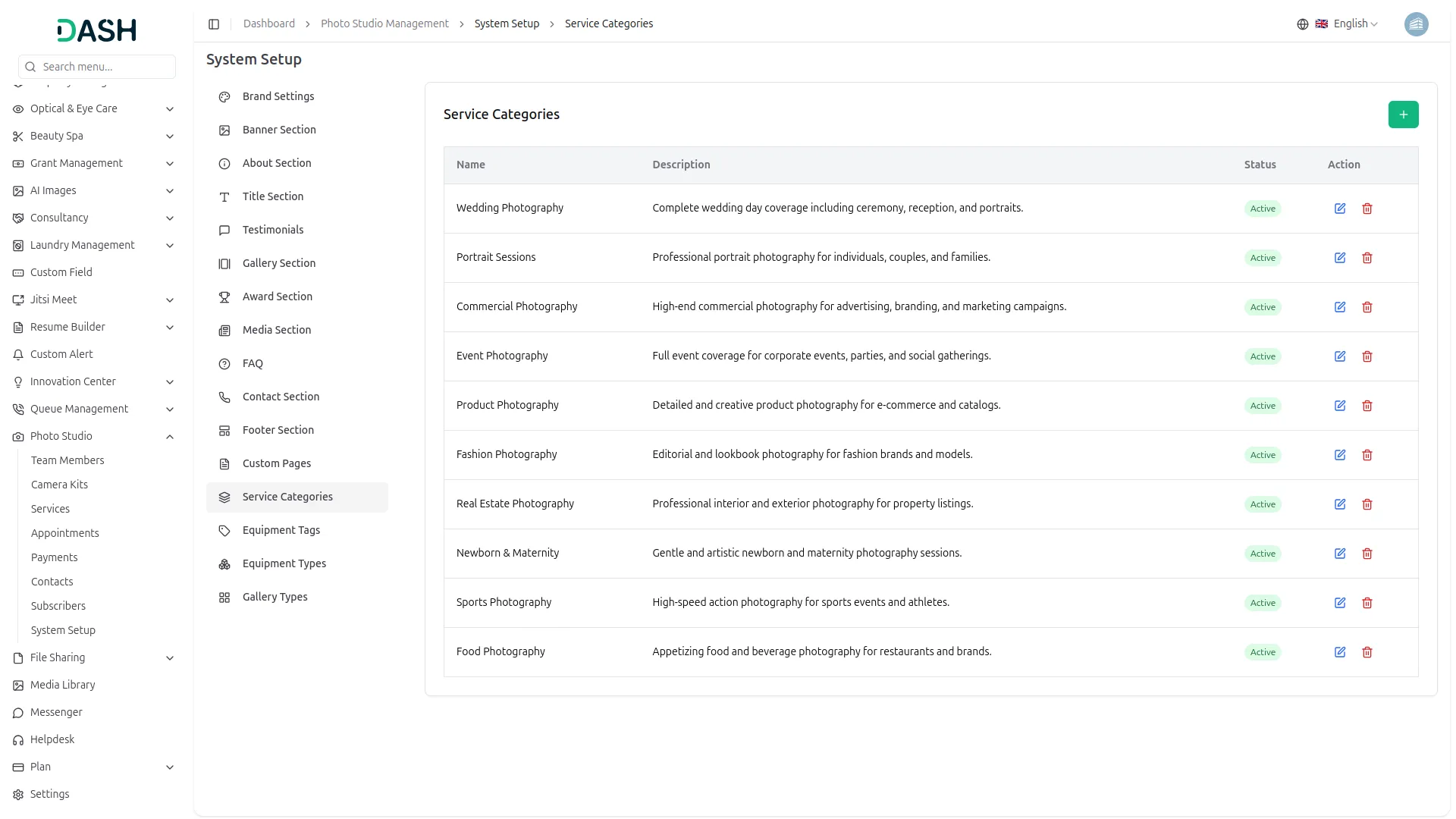
- To add a new category, click the “Create” button at the top right. In the Create Service Category modal, enter the Name, add a Description, and set the Status to Active or Inactive.
- In the Service Categories section, you will find a list of all existing categories displaying their Name, Description, Status, and Action options. Available Actions: You can use the edit to update an existing category or the delete to remove it.
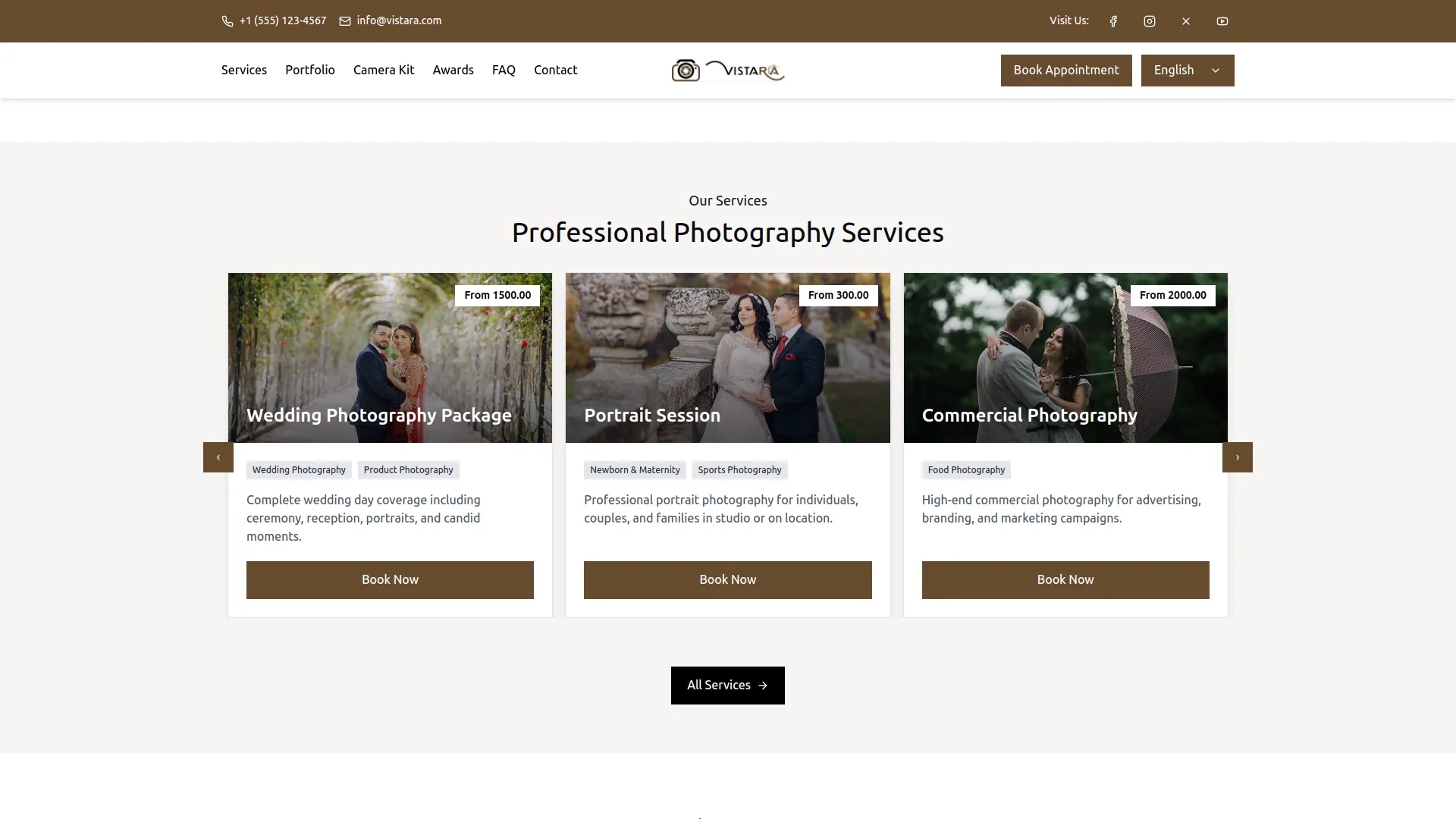
- Once saved, all Active service categories will appear as tags displayed on each service card on the Services page, allowing visitors to quickly identify the type of photography service being offered.
Equipment Tags
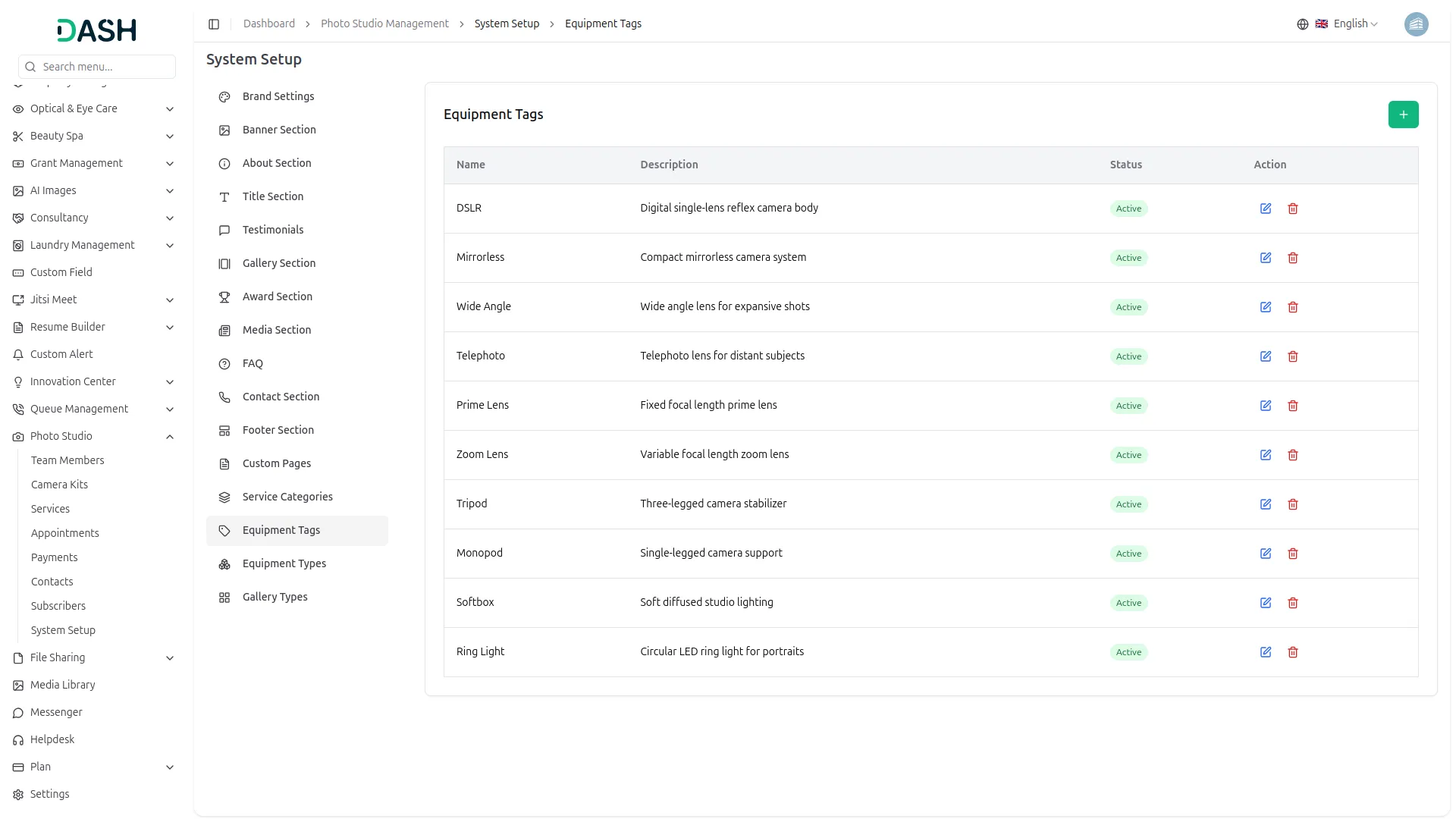
- To add a new tag, click the “Create” button at the top right. In the Create Equipment Tag modal, enter the Name, add a Description, set the Status to Active or Inactive, and click Create.
- In the Equipment Tags section, you will find a list of all existing tags displaying their Name, Description, Status, and Action options. In the action column, you can use the edit icon to update an existing tag or the delete icon to remove it.
- Once saved, all Active equipment tags will appear on each equipment card on the Camera Kit page, indicating the specific use or compatibility of the equipment piece to visitors browsing your studio’s gear.
Equipment Types
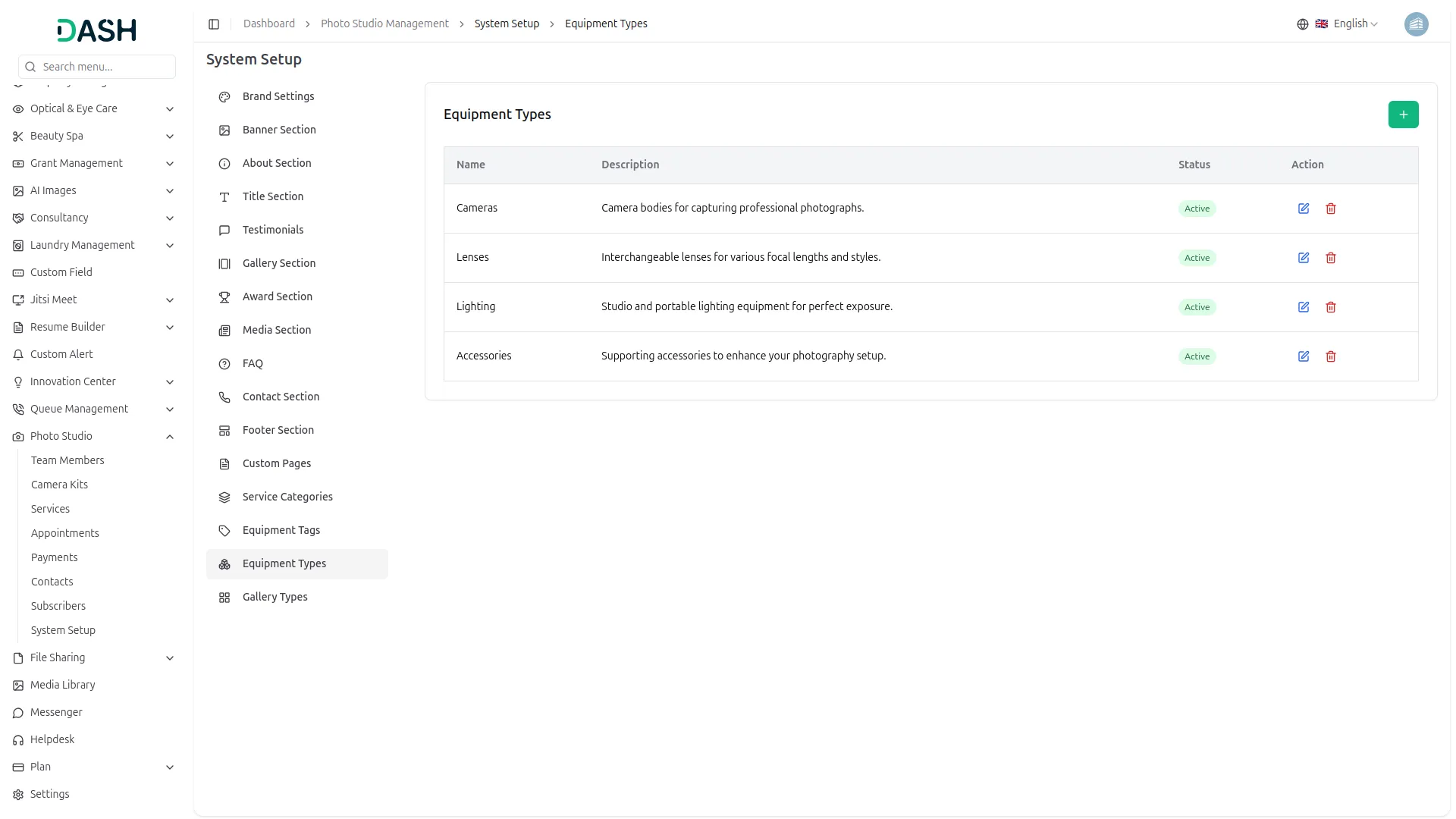
- To add a new type, click the “Create” button at the top right. In the Create Equipment Type modal, enter the Name, add a Description, set the Status to Active or Inactive, and click Create.
- In the Equipment Types section, you will find a list of all existing types displaying their Name, Description, Status, and Action options. Available actions: You can use the edit icon to update an existing type or the delete icon to remove it.
- Once saved, all Active equipment types will appear as filter tabs on the Camera Kit page (e.g., Cameras, Lenses, Lighting, Accessories), allowing visitors to browse your studio’s equipment by category and quickly find the specific type of gear they are interested in.
Gallery Types
- To add a new gallery type, click the “Create” button at the top right. In the Create Gallery Type modal, enter the Name, add a Description, set the Status to Active or Inactive, and click Create.
- In the Gallery Types section, you will find a list of all existing gallery types displaying their Name, Description, Status, and Action options. Available actions: You can use the edit icon to update an existing gallery type or the delete icon to remove it.
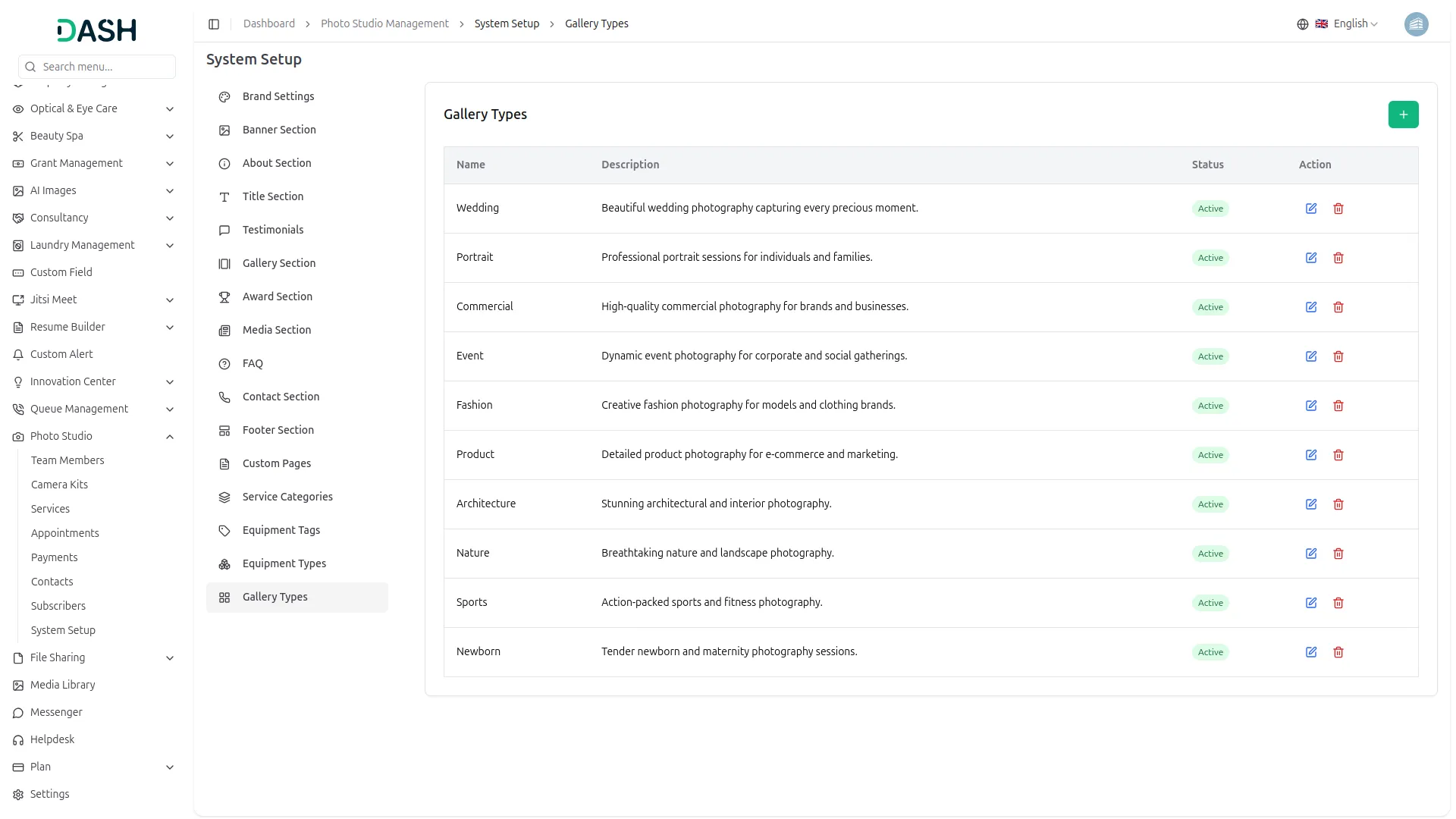
- Once saved, all Active gallery types will appear as filter tabs on the Portfolio page (e.g., Wedding, Portrait, Sports, Nature), allowing visitors to browse your studio’s photography work by category and quickly find the specific type of photography they are interested in.
Team Members
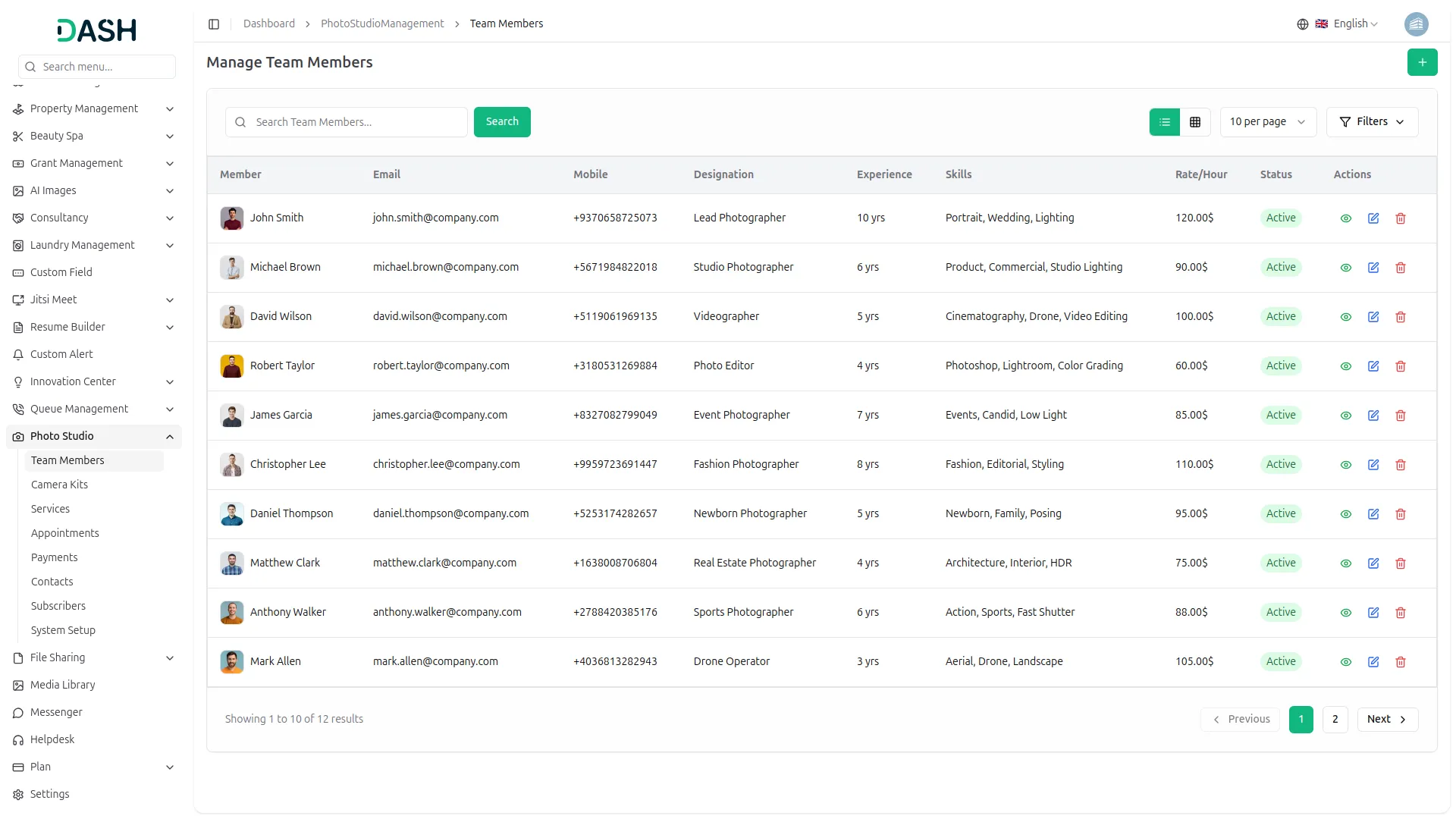
- To add a new team member, click the “Create” button on the Manage Team Members page. In the Create Team Member modal, select the User from the dropdown (comes from the User Management), enter the Designation, Experience Year, Skills, and Rate Per Hour, set the Status to Active or Inactive, and write a short Bio.
- The list page displays a table with columns including the member’s Profile Photo, Member Name, Email, Mobile, Designation, Experience, Skills, Rate/Hour, Status, and Actions.
- Use the search bar to find a specific team member by name. You can also use the Filters button to filter members by Status, then click Apply to filter the results or Clear to reset them.
- In the Actions column, you can use the view to preview the full member details, the edit to update their information, or the delete to permanently remove the team member from the system.
Camera Kits
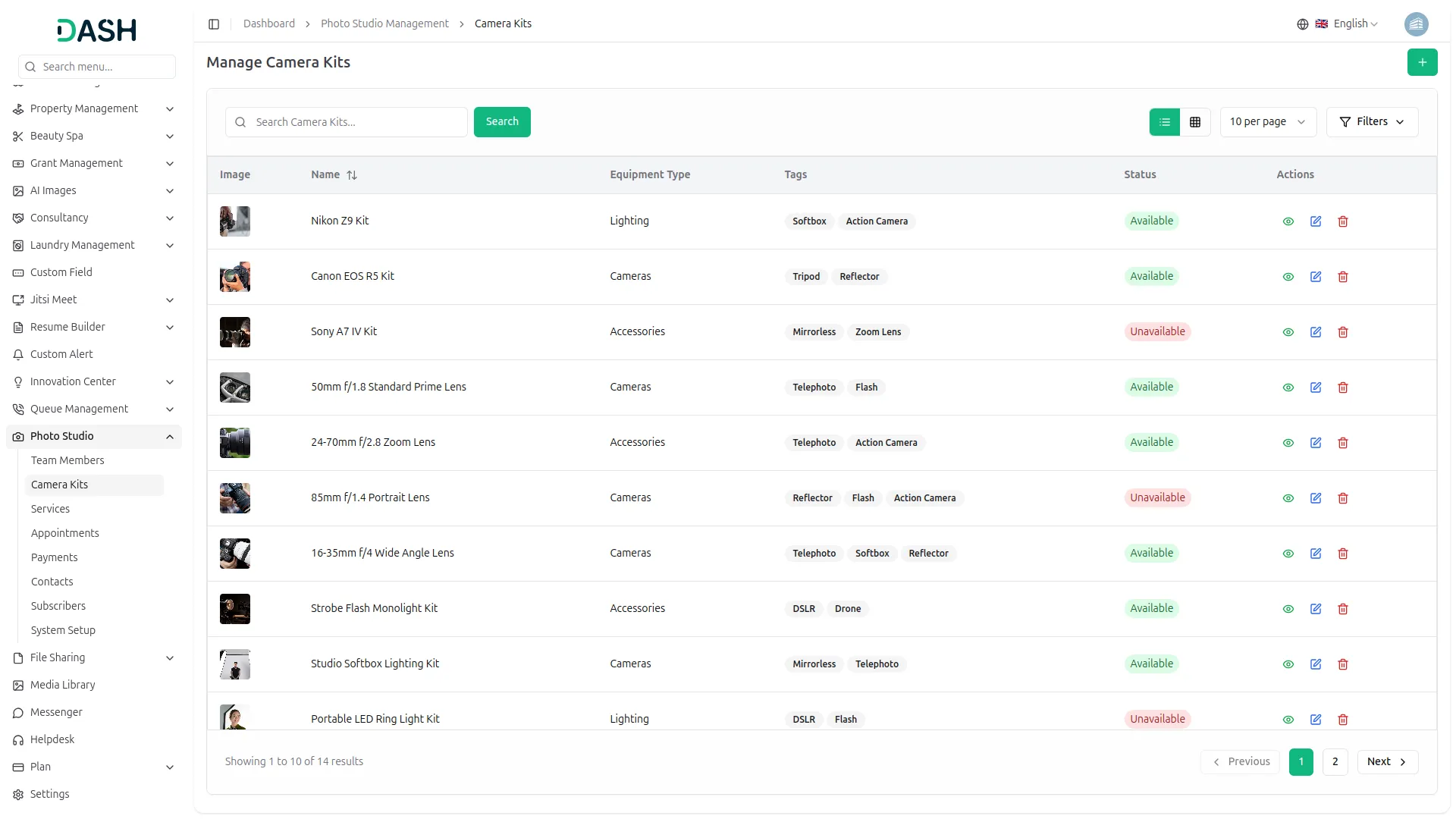
- To add a new camera kit, click the “Create” button on the Manage Camera Kits page. In the Create Camera Kit modal, enter the Name, select the Equipment Type and Tags from their respective dropdowns (which are configured from the System setup).
- Set the Status to Available or Unavailable, add a Description, and upload an Image using the Browse button. In the Specifications section, enter the Field Name and Description for each specification item. You can add more specification rows using the “Add Specification” button.
- The list page displays a table with columns including the equipment Image, Name, Equipment Type, Tags, Specifications, Status, and Actions. Use the search bar to find a specific camera kit by name. You can also use the Filters button to filter equipment by Status or Equipment Type, then click Apply to filter the results or Clear to reset them.
- In the Actions column, you can use the view to preview the full equipment details, the edit to update the information, or the delete to permanently remove the camera kit from the system.
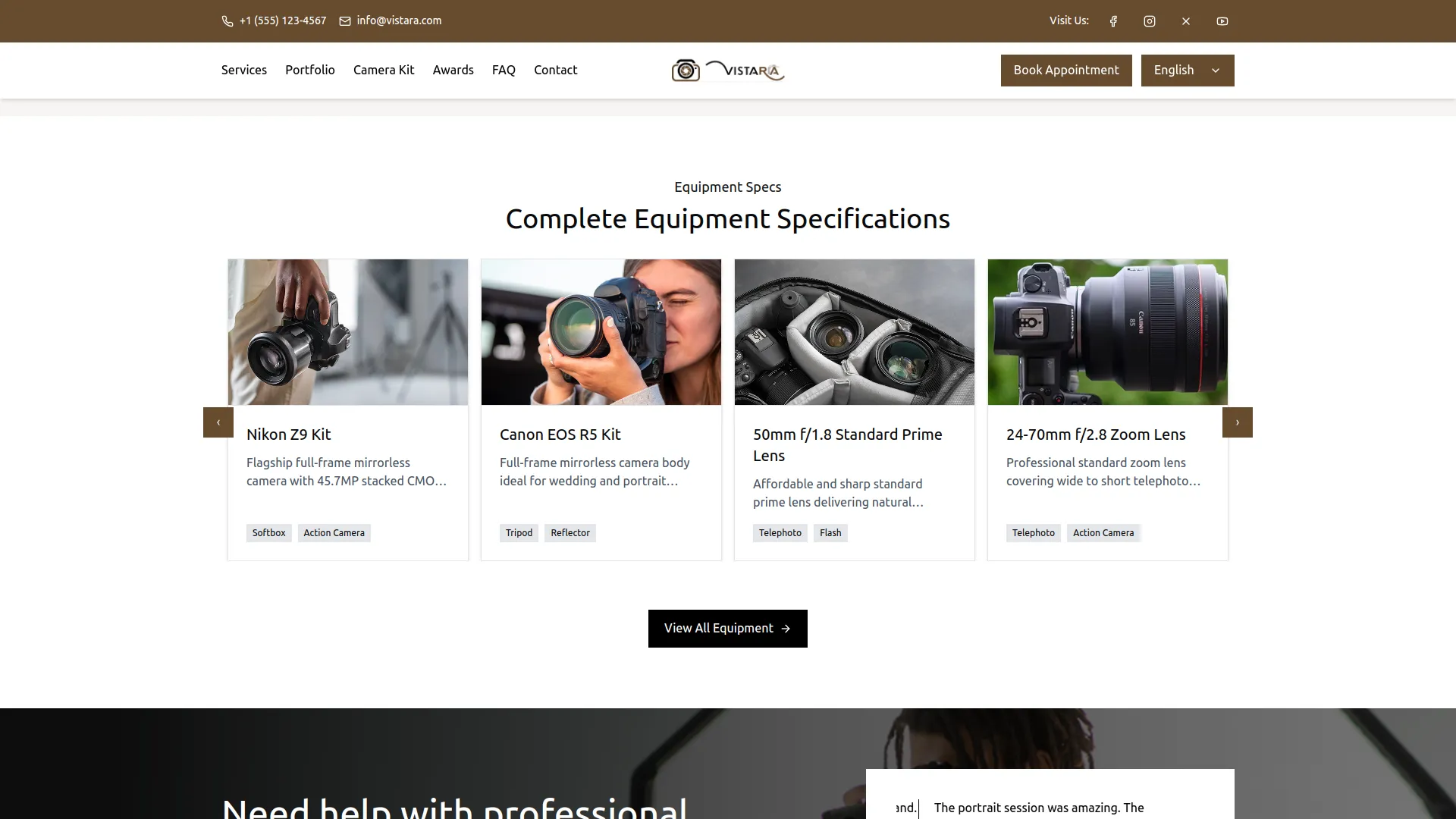
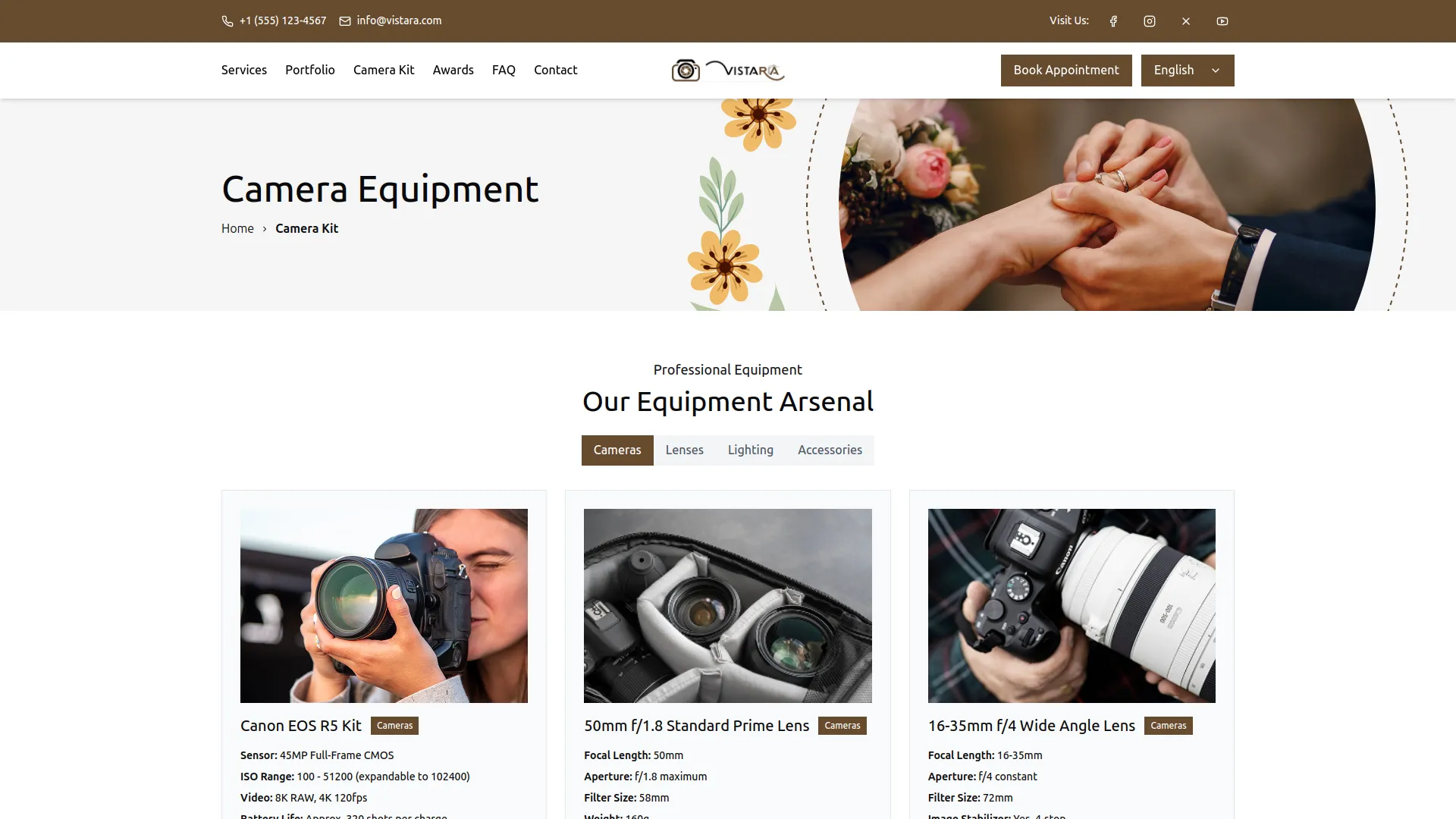
- Once saved, all camera kits will appear on the Camera Kit page of your website. Each equipment card will display the kit’s Image, Name, Equipment Type as a badge, and key Specifications such as sensor details, ISO range, video capability, and battery life.
- The assigned Tags will appear at the bottom of each card under the Use label (e.g., Flash, Drone). Equipment cards will be organized under their assigned Equipment Type filter tabs (e.g., Cameras, Lenses, Lighting, Accessories), allowing visitors to browse by category.
- All camera kits will also appear in the Complete Equipment Specifications table further down the page, displaying each kit’s Equipment Type, Model Name, Key Specs, and Primary Use in a structured table format, giving visitors a detailed and organized view of your studio’s full equipment arsenal.
Manage Services
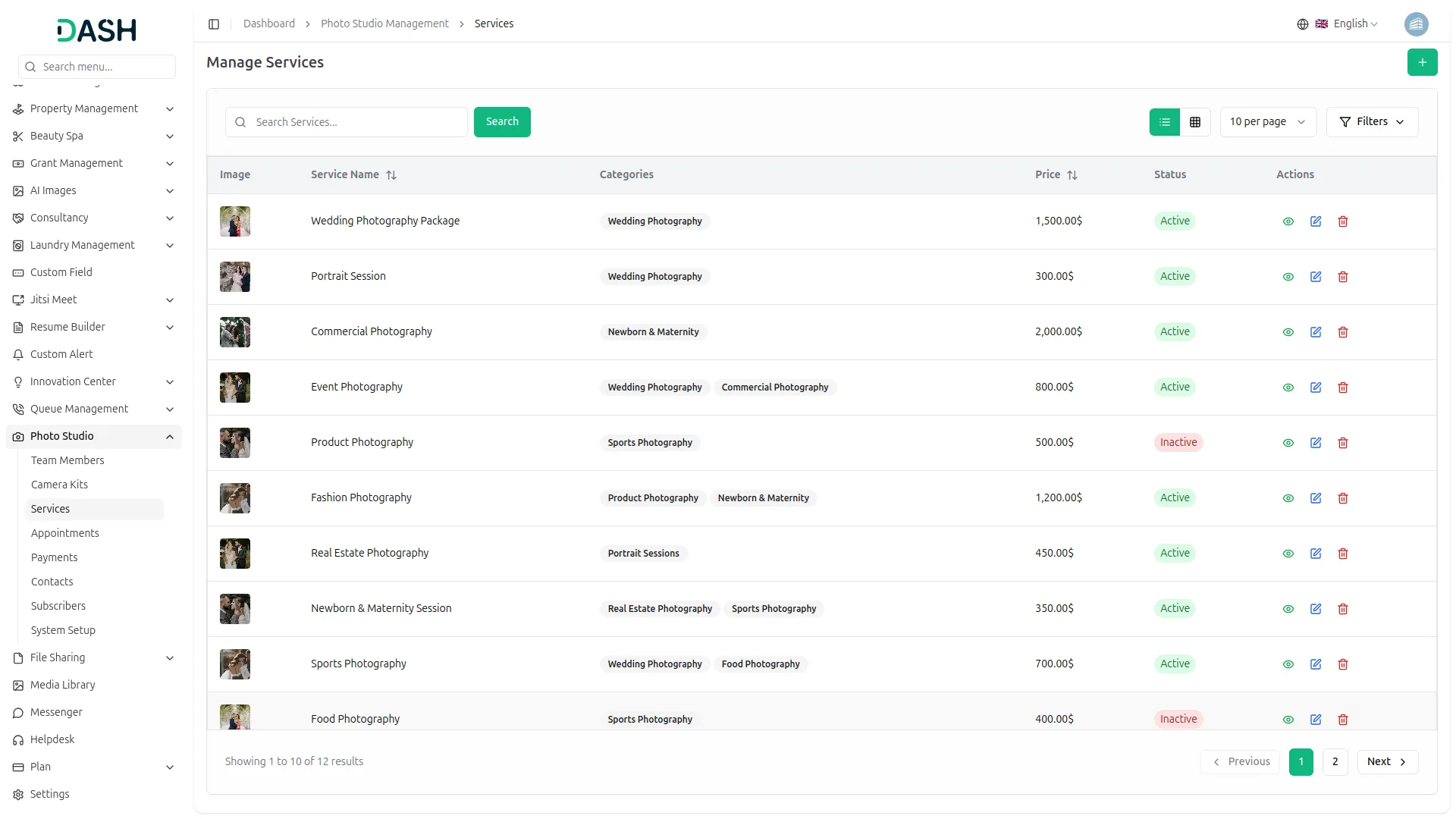
- To add a new service, click the “Create” button on the Manage Services page. In the Create Service modal, enter the Service Name, Price, select the Service Category and Camera Kits from their respective dropdowns, set the Status to Active or Inactive, upload an Image using the Browse button, and add a Description. Click Create to save.
- The list page displays a table with columns including the service Image, Service Name, Categories, Camera Kits, Price, Status, and Actions. Use the search bar to find a specific service by name. You can also use the Filters button to filter services by Status or Category, then click Apply to filter the results or Clear to reset them.
- In the Actions column, you can use the view icon to preview the full service details, the edit icon to update the service information, or the delete icon to permanently remove the service from the system.
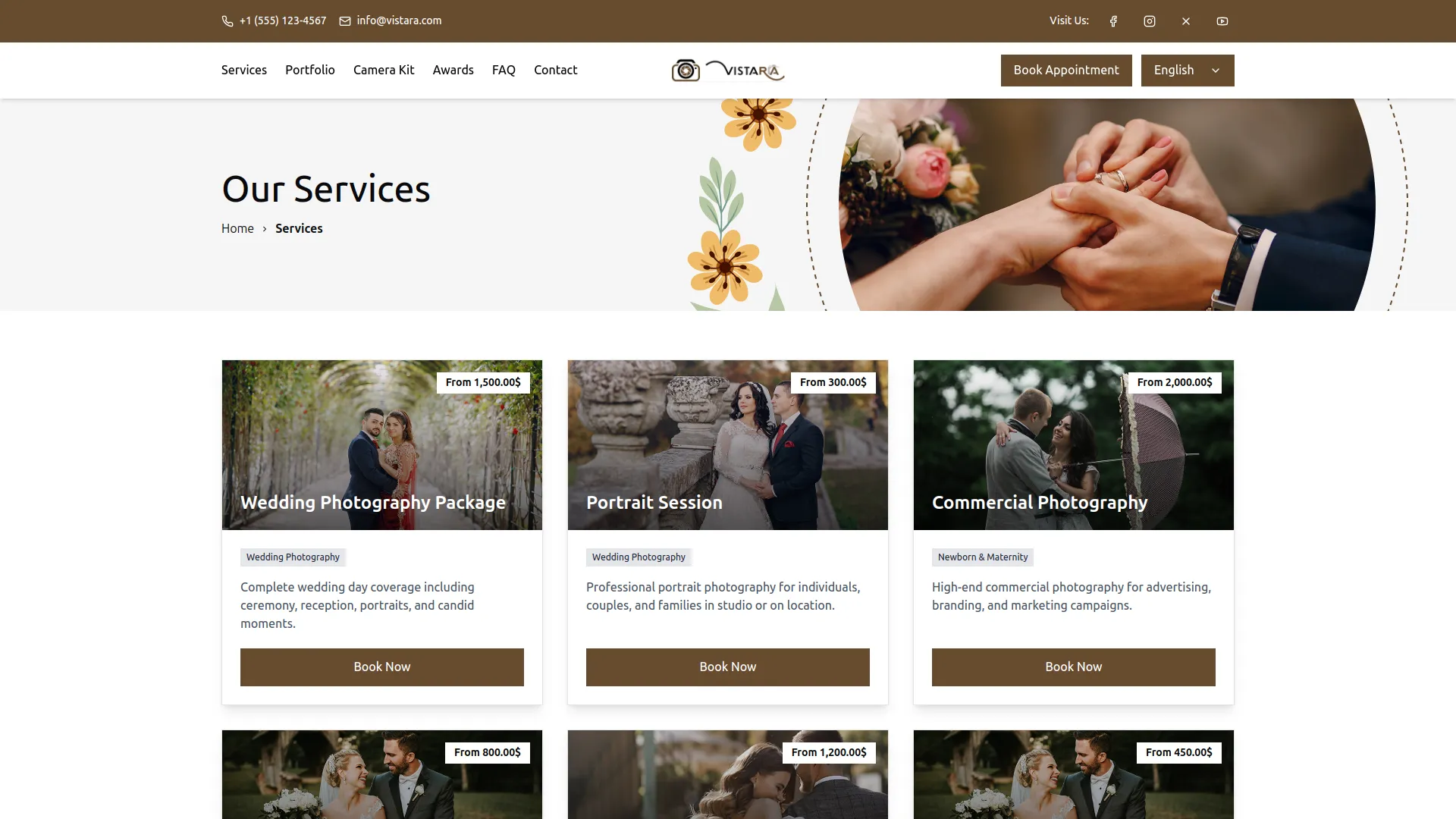
- Once saved, all Active services will appear as individual service cards on the Services page of your website. Each card will display the service Image, Service Name, assigned Category tags, a short Description, the starting Price in the top right corner of the image, and a Book Now button.
- Active services will also appear in the Professional Photography Services section on the homepage as a preview carousel, allowing visitors to quickly browse your offerings and book directly from there.
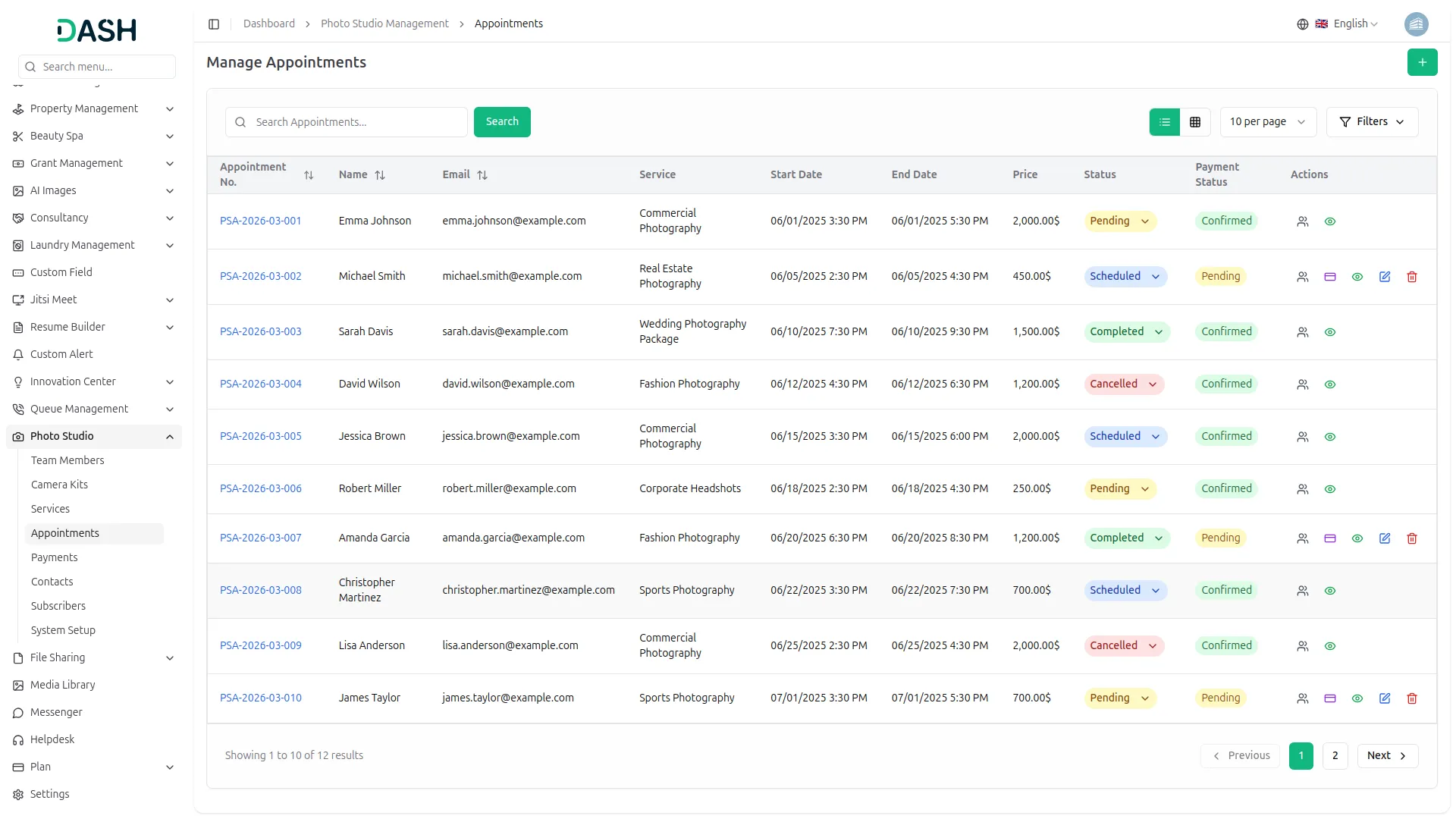
Manage Appointments
- To add a new appointment manually, click the “Create” button on the Manage Appointments page. In the Create Appointment modal, enter the client’s Name, Email, Mobile No., select the Booking Start Date and Booking End Date with time, select the Service from the dropdown, and the Price will be populated automatically. Click Create to save.
- The list page displays a table with columns including Appointment No., Name, Email, Service, Start Date, Team Members, Price, Status, Payment Status, and Actions. Use the search bar to find a specific appointment by name. You can also use the Filters button to filter appointments by Status, Payment Status, or Service, then click Apply to filter the results or Clear to reset them.
- You can update the Appointment Status directly from the list by clicking the status dropdown on any appointment row and selecting from Pending, Scheduled, Completed, or Cancelled, without needing to open the full edit form.
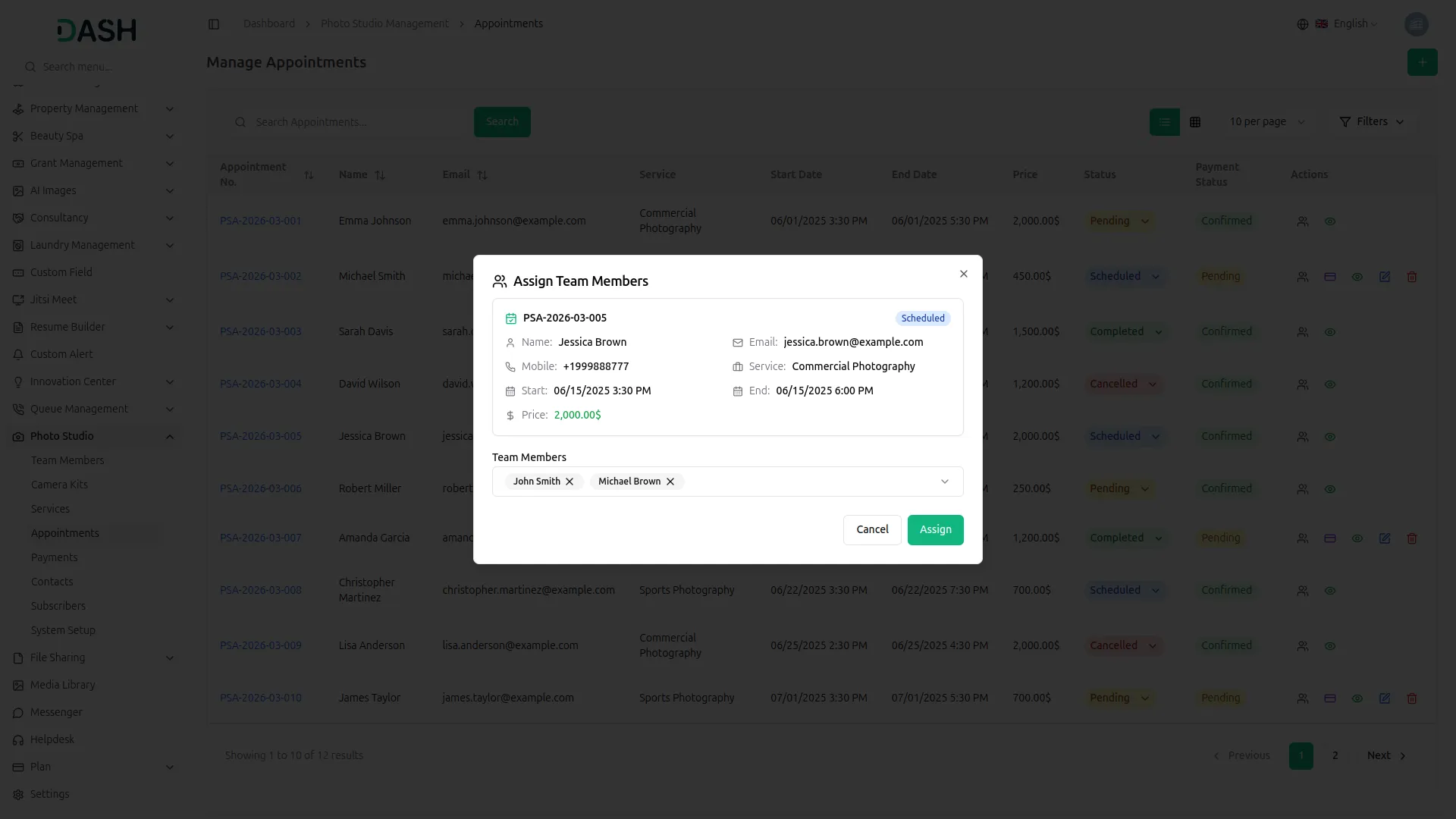
- In the Actions column, you can use the Assign Team Members icon to open the assignment modal, which displays the full appointment details, including the Appointment No., client Name, Email, Mobile, Service, Start and End time, and Price. From this modal, you can select and assign one or more team members to the appointment and click Assign to save.
- You can use the Payment icon to open the Create Payment modal, which displays the pre-filled Appointment No., Customer Name, Service, Date, and Amount. Select the Bank Account, add an optional Description, and click Create to record the payment.
- You can also use the view to preview the full appointment details, the edit to update the appointment information, or the delete to permanently remove the appointment from the system.
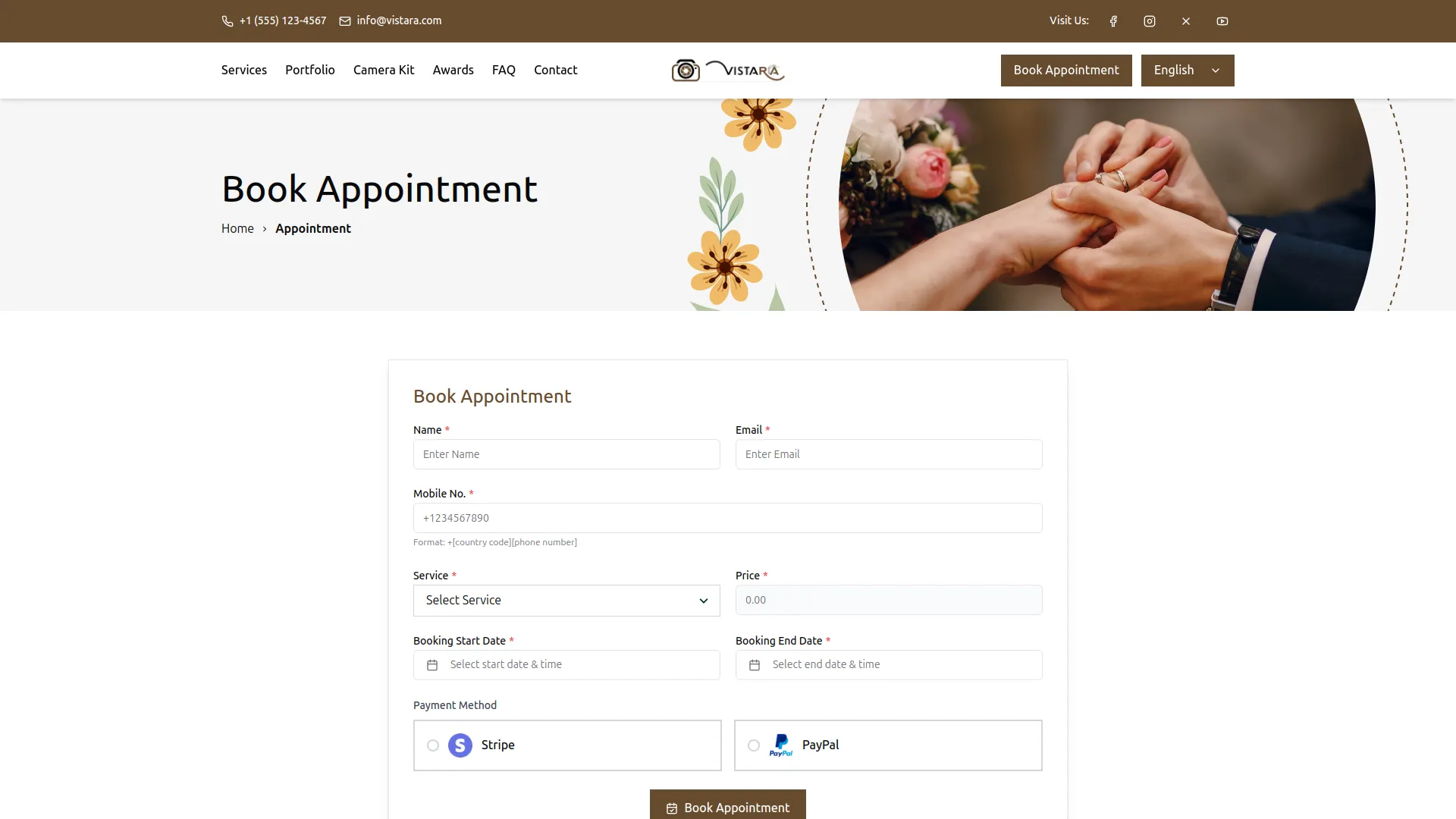
- Once an appointment is created, whether submitted by a client through the website’s Book Appointment page or added manually by the admin, it will appear in the Recent Appointments section on the admin dashboard, showing the client name, service, booking date, and current status, giving you a real-time overview of your studio’s latest bookings.
Manage Payments
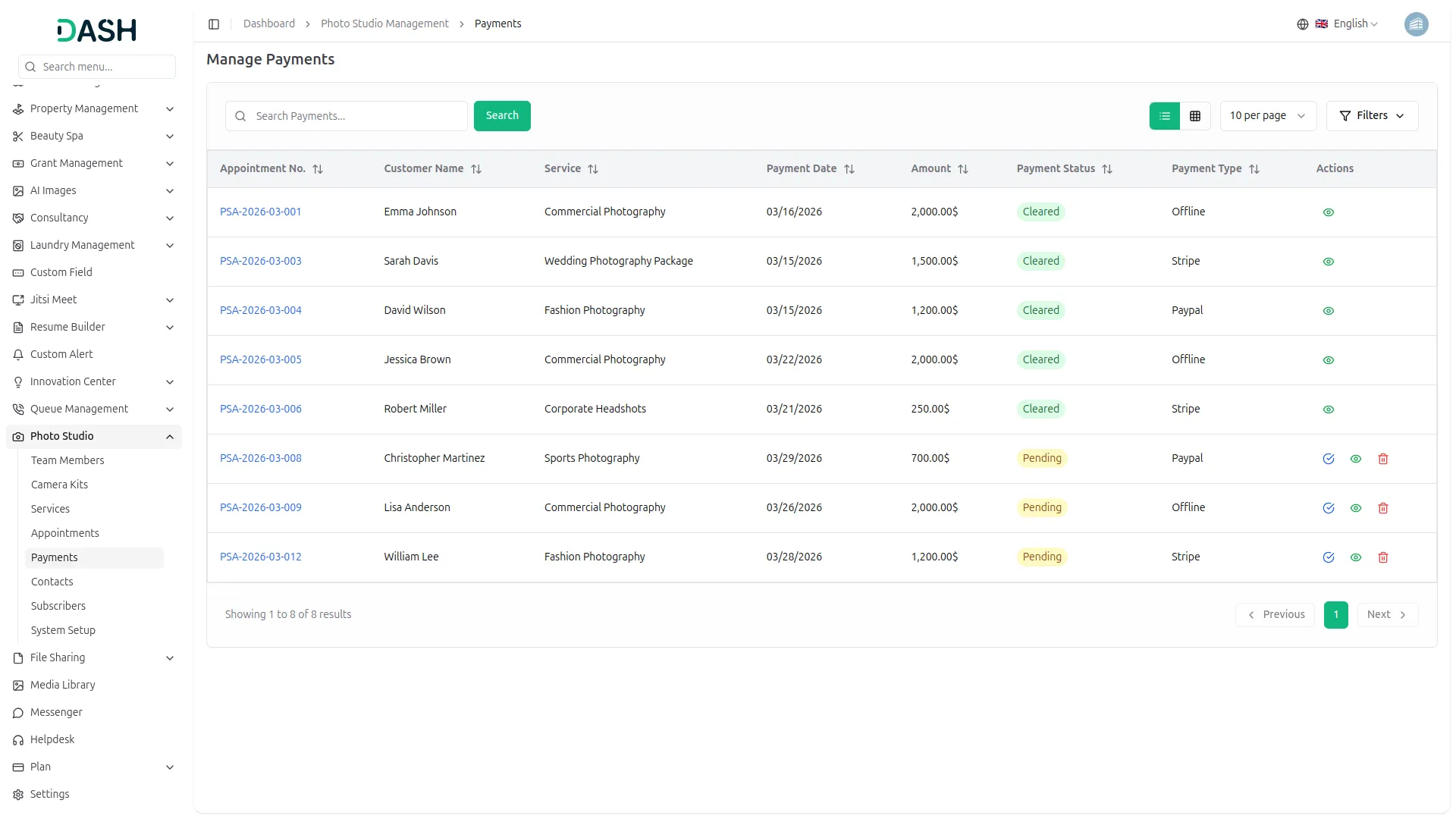
- The list page displays a table with columns including Appointment No., Customer Name, Service, Payment Date, Amount, Payment Status, and Payment Type. Use the search bar to find a specific payment by name.
- You can also use the Filters button to filter payments by Payment Status, Service, or Payment Date Range, then click Apply to filter the results or Clear to reset them.
- In the Actions column, for payments with a Pending status, you can use the Mark as Cleared icon to instantly update the payment status to Cleared without opening any form. You can also use the view icon to preview the full payment details. For pending payments, the delete icon is available to permanently remove the payment record from the system.
- Once a payment is marked as Cleared, it will be reflected in the Payment Status donut chart on the admin dashboard, updating the Cleared and Pending segments to give you an accurate real-time view of your studio’s overall payment collection progress. The Total Revenue summary card on the dashboard will also update accordingly.
Manage Contacts
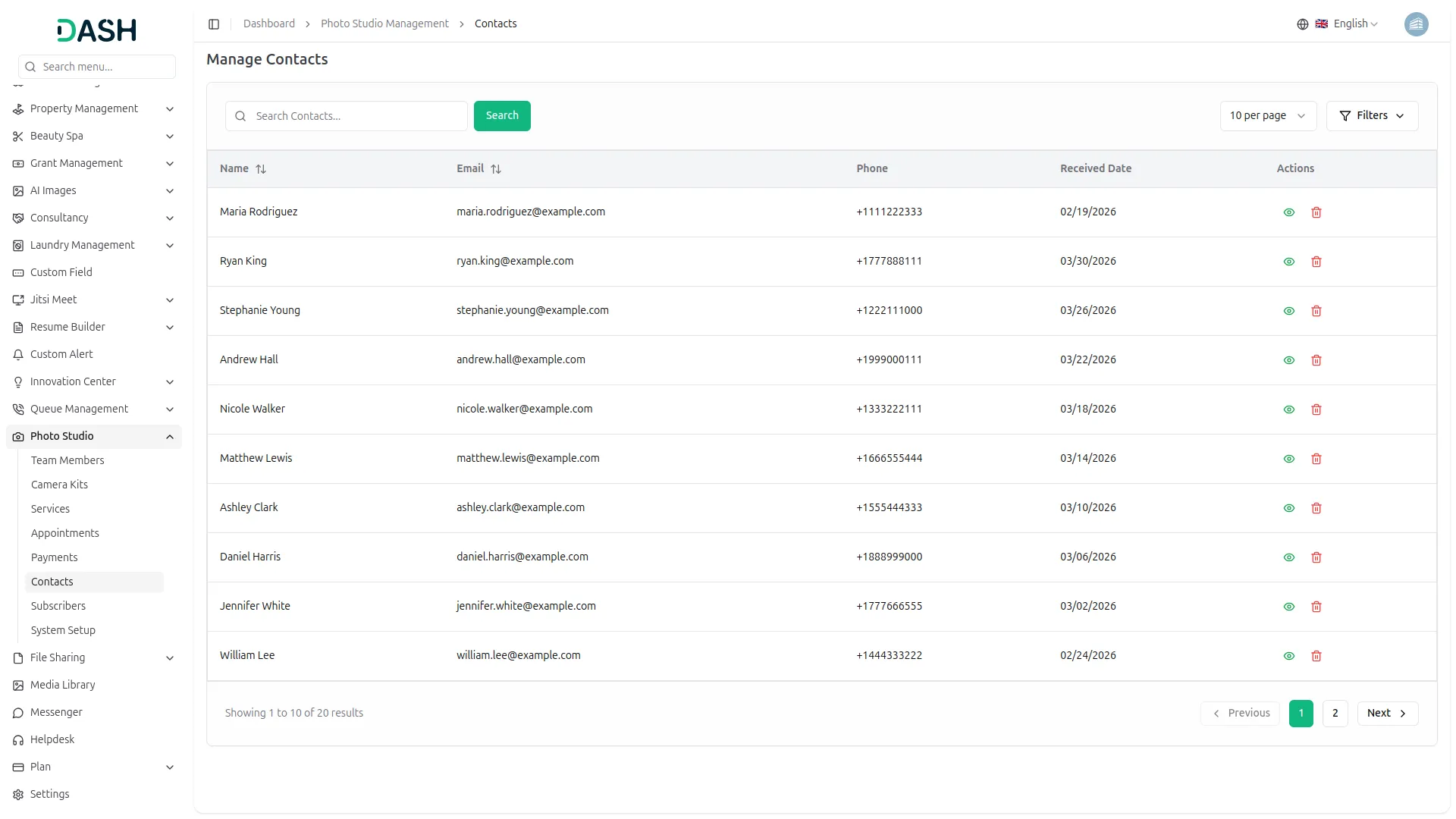
- The list page displays a table with columns including the contact’s Name, Email, Phone, Received Date, and Actions. Use the search bar to find a specific contact by name. You can also use the Filters button to filter contacts by Date Range, then click Apply to filter the results or Clear to reset them.
- In the Actions column, you can use the view icon to preview the full contact message details, or the delete icon to permanently remove the contact entry from the system.
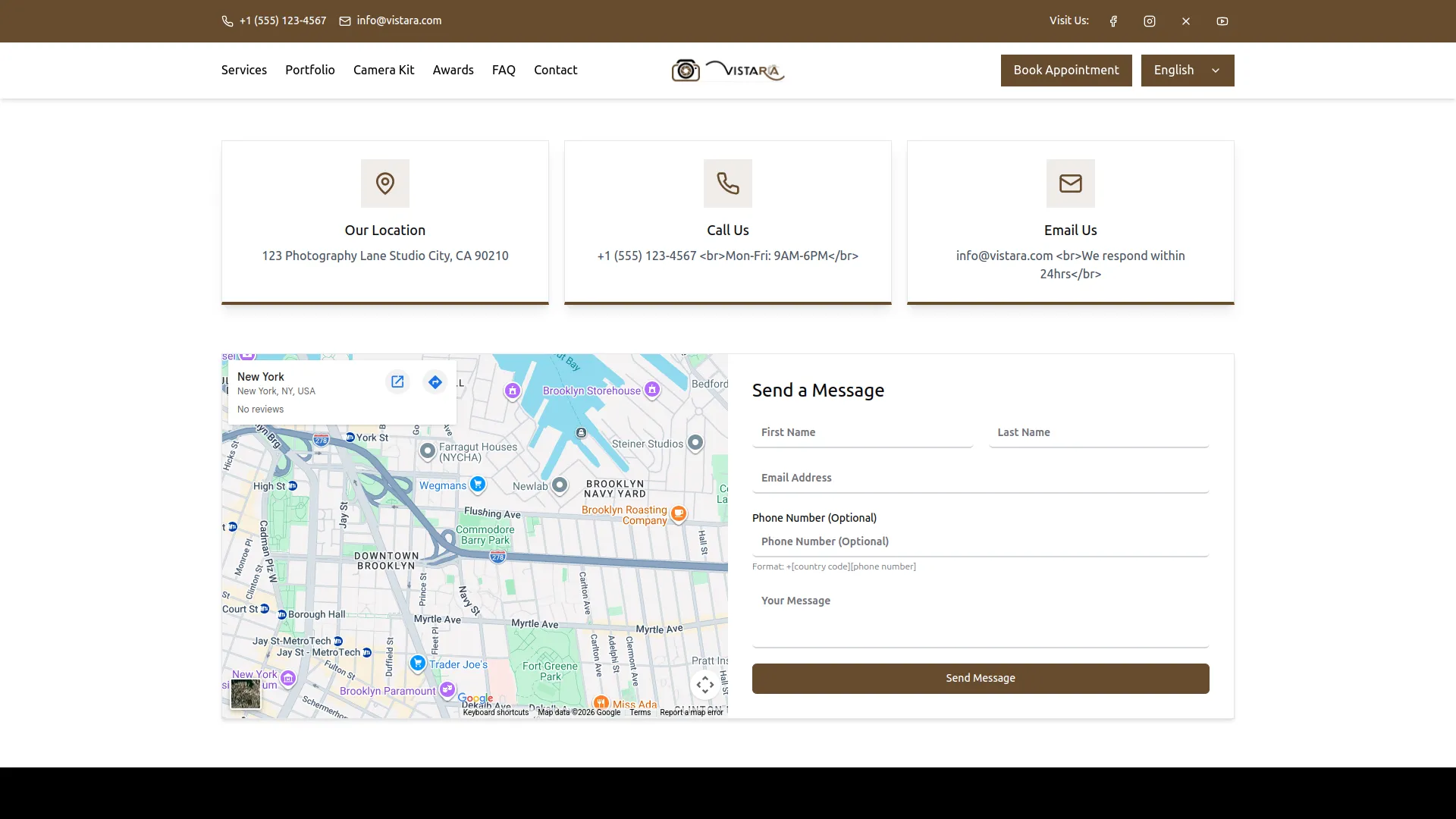
- All contact entries in this section are submitted by visitors through the Send a Message form on the Contact Us page of your website. When a visitor fills in their First Name, Last Name, Email Address, Phone Number, and Message and clicks Send Message, their details are captured and appear here in the Manage Contacts list, allowing you to review and respond to client inquiries directly.
Newsletter Subscribers
- The list page displays a table with columns including the subscriber’s Email and Subscribed Date. Use the search bar to find a specific subscriber by email. You can also use the Filters button to filter subscribers by Date Range, then click Apply to filter the results or Clear to reset them.
- In the Actions column, you can use the delete icon to permanently remove a subscriber from the list.
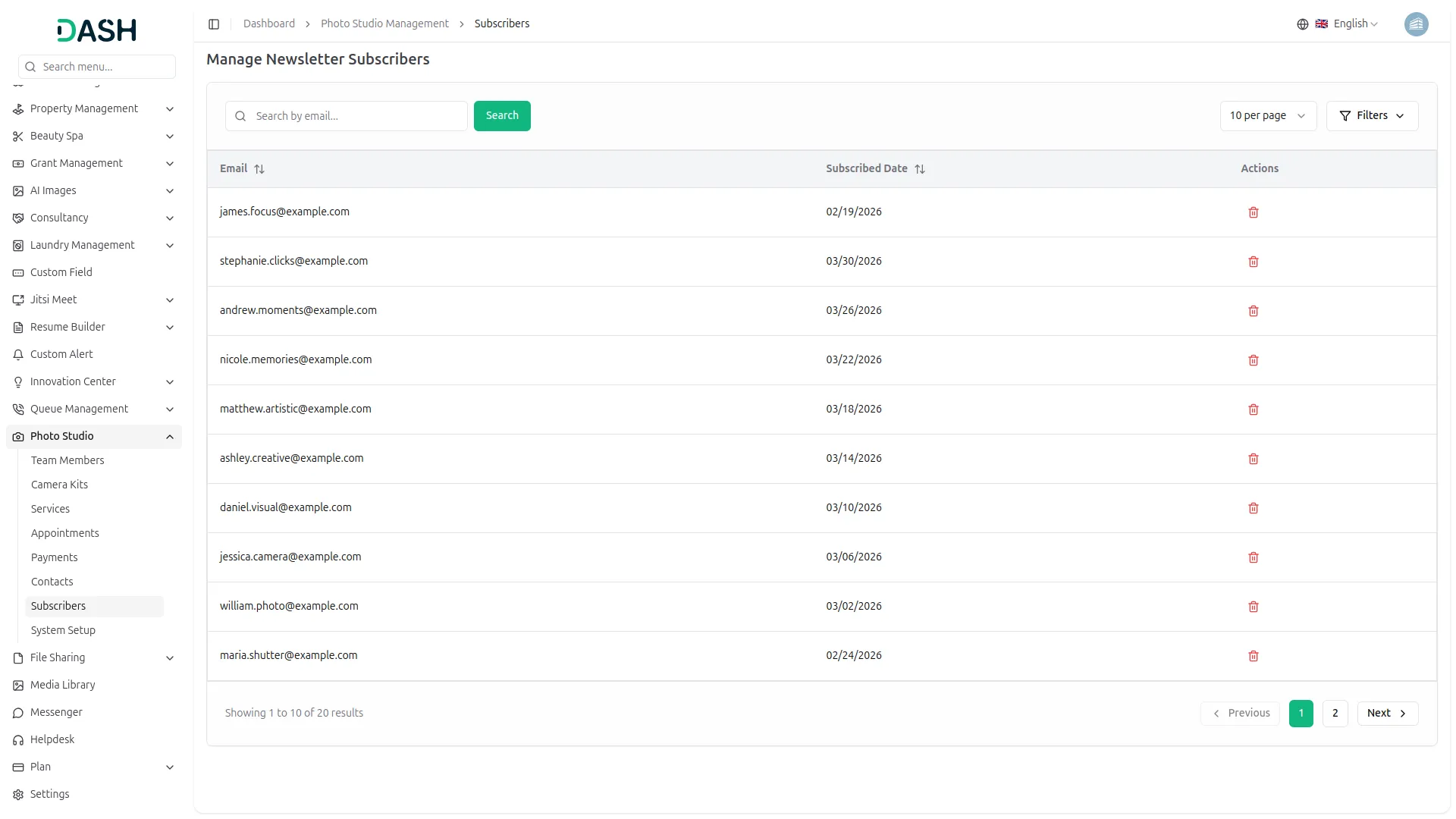
- All subscriber entries in this section are captured when a visitor enters their email address in the Sign Up To Get Latest Update newsletter section available in the footer area across all pages of your website and clicks the Get Started button. Their email and subscription date are then recorded here, allowing you to monitor and manage your growing subscriber base.
Categories
Related articles
- Business Model – WorkDo Dash SaaS Add-On Guide
- Paytm – BookingGo SaaS Add-On Guide
- Report Module Guide – eCommerceGo SaaS
- ToDo – BookingGo SaaS Add-On Guide
- Jitsi Meet – WorkDo Dash SaaS Add-On Guide
- Facilities – WorkDo Dash SaaS Add-On Guide
- PayTR – BookingGo SaaS Add-On Guide
- Meeting Hub – WorkDo Dash SaaS Add-On Guide
- CoinGate – WorkDo Dash SaaS Add-On Guide
- Boutique & Designer Studio – WorkDo Dash SaaS Add-On Guide
- Digital Product – eCommerceGo SaaS Add-On Guide
- Subdomain & Custom Domain Settings Guide
We're Here to Help - Let's Talk
Have questions about our solutions, customization services, or business tools? Our team is here to help you. let's talk.