
ERP Full Form and Meaning: Everything You Need to Know
Learn what ERP stands for and its meaning in business, and see why Enterprise Resource Planning matters.

ERP Full Form and Meaning
The ERP full form in software is Enterprise Resource Planning, a term you’ve probably come across if you’ve ever explored how modern businesses manage their day-to-day operations.
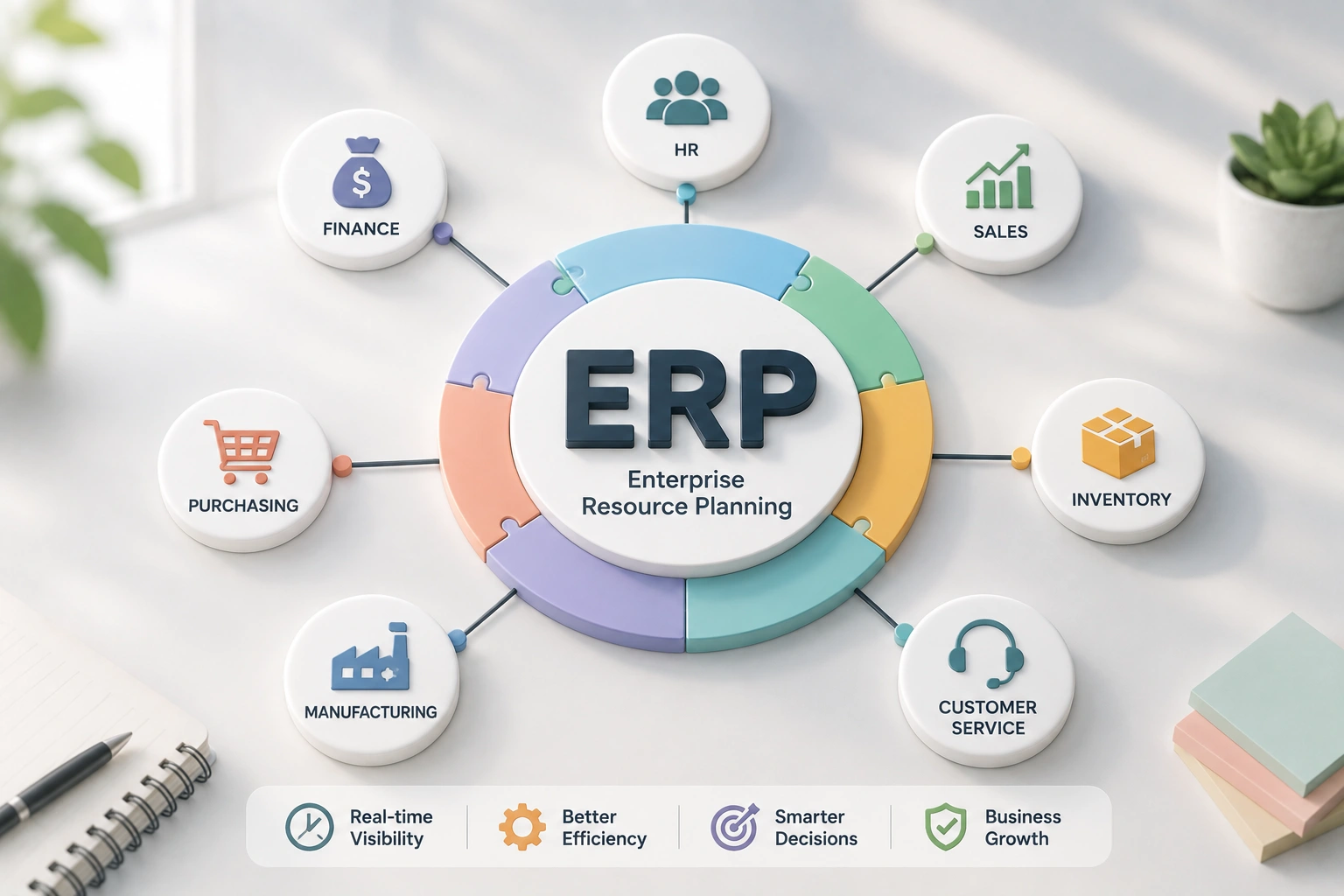
In simple words, ERP is a type of software that helps organizations bring together all their core business functions, like finance, HR, sales, inventory, manufacturing, and procurement, into one single, connected system. Instead of each department working in its own isolated software (which often leads to confusion, duplicate data, and miscommunication), ERP ties everything together so information flows smoothly across the entire organization.
Think of it as the digital backbone of a company, one platform where every department can access accurate, real-time data without having to manually share updates with each other.
Why Businesses Use ERP
Companies adopt ERP systems to:
- Improve overall efficiency and productivity
- Reduce errors caused by manual data entry
- Get real-time visibility into business performance
- Make faster, data-driven decisions
- Automate repetitive processes across departments
What Does ERP Stand For?
ERP stands for Enterprise Resource Planning. It’s a category of business software designed to help organizations manage and integrate their core processes, such as finance, human resources, sales, inventory, procurement, and manufacturing, all within a single, unified system.
ERP Definition:
Here’s a simple ERP definition you can actually remember:
Enterprise Resource Planning (ERP) is a business management approach and the software category built around it that connects a company’s core functions like finance, inventory, sales, HR, and operations into one unified system so every department works from the same real-time information.
ERP = one system that knows everything your business owns, spends, sells, and does, all in one place.
Now, memorizing the ERP abbreviation is easy. Understanding why those three specific words were chosen is where the real insight lives. Let’s break the phrase apart.
Rather than each department relying on separate, disconnected tools, ERP creates one central platform where data is shared and updated in real time. This means better coordination, fewer errors, and faster decision-making across the entire business.
ERP Meaning: Quick Recap Table
Still trying to figure out what ERP stands for, letter by letter? You’re not alone, it’s easy to mix them up. Here’s a simple breakdown to help it finally stick.
| Letter | Word | What It Means |
|---|---|---|
| E | Enterprise | The whole organization, every department, any size |
| R | Resource | People, money, inventory, equipment, data, time |
| P | Planning | Coordinating all resources through one shared system |
So, in short, ERP is just a system that helps a business manage its people, money, and resources in one place. It’s not as complicated as it sounds.
A Quick Note on How People Ask This Question
Not everyone types the same phrase into Google. Some search “what does ERP stand for,” others type “what does ERP stands for ” without worrying about grammar, and some just search “ERP in meaning” when they’ve seen the term used as a verb in a casual conversation online. All of these point to the same answer: Enterprise Resource Planning. However someone phrases the question, the meaning behind ERP stays exactly the same.
What Is ERP and How Does It Work?
ERP is a software solution that enables businesses to manage their daily operations from a single, integrated platform. It connects departments such as finance, sales, inventory, purchasing, manufacturing, human resources, and customer service, allowing them to share accurate, real-time information and work more efficiently.
To better understand the term ‘enterprise resource planning’, it helps to look at each word individually:
- Enterprise → Who is it for?
- Resource → What does it manage?
- Planning → How does it manage it?
Put the three answers together, and the whole concept clicks into place.
Enterprise: The “Who”
An enterprise is any organization viewed as one complete unit, with every department, every branch, and every team working under one name.
Why does this word matter so much? Because it defines the scope.
Think about the tools most businesses already use. Accounting software serves the finance team. A CRM serves the sales team. Payroll software serves HR. Each one is brilliant at its own job and completely blind to everything else.
ERP flips that model. Instead of serving one department, it serves the entire organization at once. That’s the promise packed into the very first word.
Resource: The “What”
Resources are everything your business consumes, owns, or depends on to keep running. In real business terms, that means:
- Employees: their time, skills, salaries, and productivity
- Money: cash flow, budgets, invoices, payables, and receivables
- Inventory: raw materials, stock on shelves, and finished goods
- Equipment: machines, vehicles, tools, and technology
- Data: customer records, orders, contracts, and reports
- Time: production schedules, delivery windows, and project deadlines
Now here’s the problem that gave birth to ERP.
In most growing companies, each of these resources lives in a separate silo. Finance tracks money in Tally or QuickBooks. The warehouse manages stock in Excel. HR keeps employee records in a third tool. Sales updates a CRM that talks to none of them.
Ever seen a sales team promise stock that doesn’t exist? Or does a finance team approve a budget using last month’s numbers? That’s what disconnected resources look like in daily life. Information gets copied by hand, errors creep in, and nobody sees the full picture.
ERP exists to end exactly that chaos by putting every resource into one shared system.
Planning: The “How”
Planning is the word that turns a pile of resources into a working business. It means coordination, every department making decisions from the same real-time information.
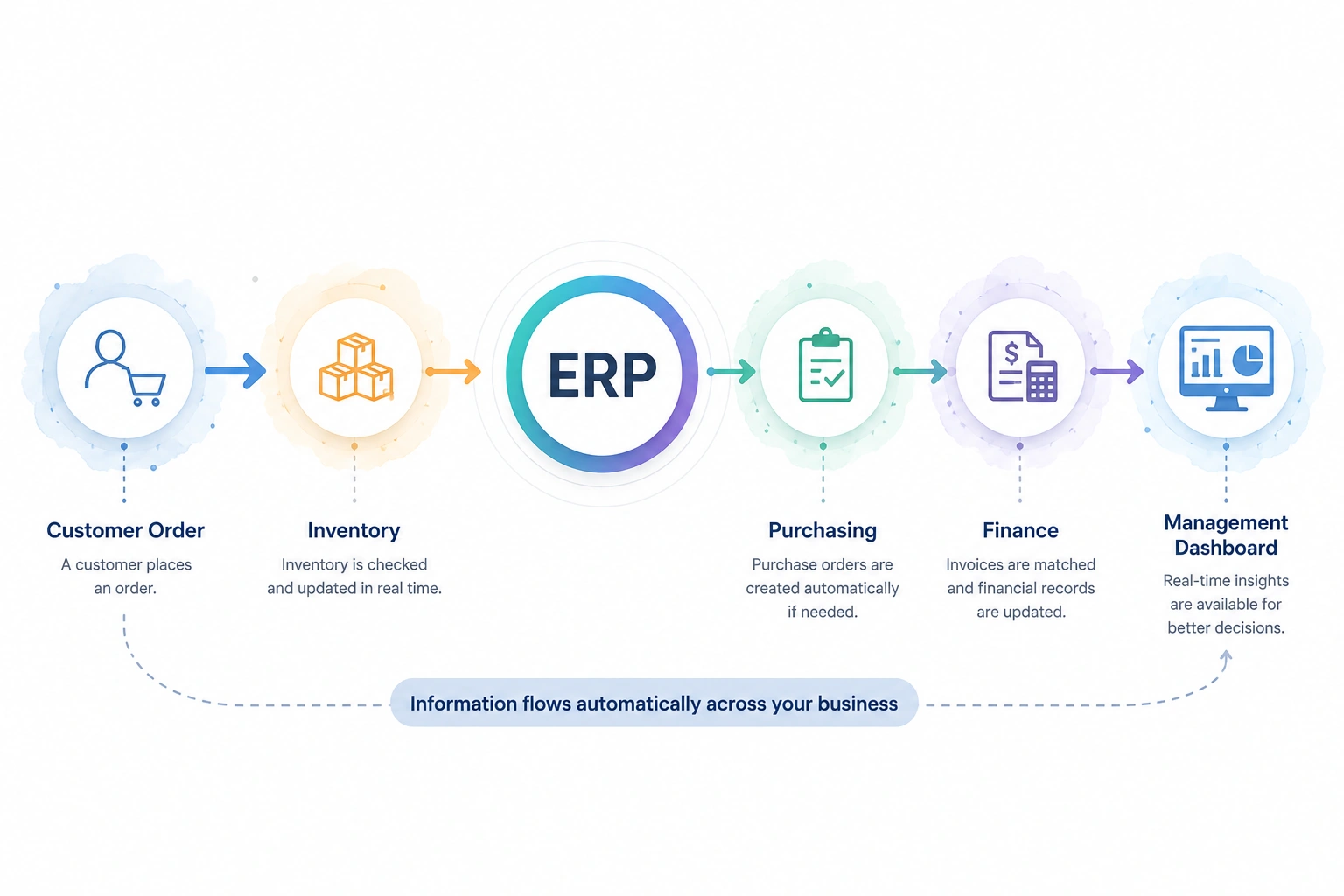
Here’s what that looks like in practice. A customer places an order:
- Sales records the order in the system
- Inventory instantly sees what stock to reserve
- Purchasing knows whether raw materials need reordering
- Finance sees the invoice and expected revenue
- Management watches all of it happen on one dashboard
No emails asking “do we have stock?” No spreadsheets passed around. One event, and every department already knows its next move.
That coordination, with resources planned across the whole enterprise, is the entire idea packed into the ERP abbreviation.
What Is ERP Meaning in Business?
In business, ERP meaning goes beyond software. It’s a management philosophy: run the company on one integrated flow of information instead of a patchwork of disconnected tools.
Think of it like this. A business without ERP is a group of musicians playing from different sheet music. Each one might be talented, but the result is noise. ERP is the shared score; everyone plays from the same page, in the same tempo.
For a business, ERP isn’t just software — it’s a way of working. It means:
- Every department sees the same data, so nobody is working with outdated or incorrect numbers.
- Decisions are made faster because managers don’t have to wait for reports from different teams.
- Processes become more organized, since tasks like billing, stock updates, and payroll happen automatically instead of manually.
- Growth becomes easier to manage because the same system can handle a small business or scale up as the company grows.
Modern ERP software solves this by connecting those business functions into one integrated platform. How it does that, the workflows, the architecture, and the automation, is a deeper topic we cover in How ERP Systems Work.
For now, remember the essence: ERP in business stands for a way of managing the whole company’s resources through one coordinated system.
Common Examples of Where You’ll Hear the Term ERP
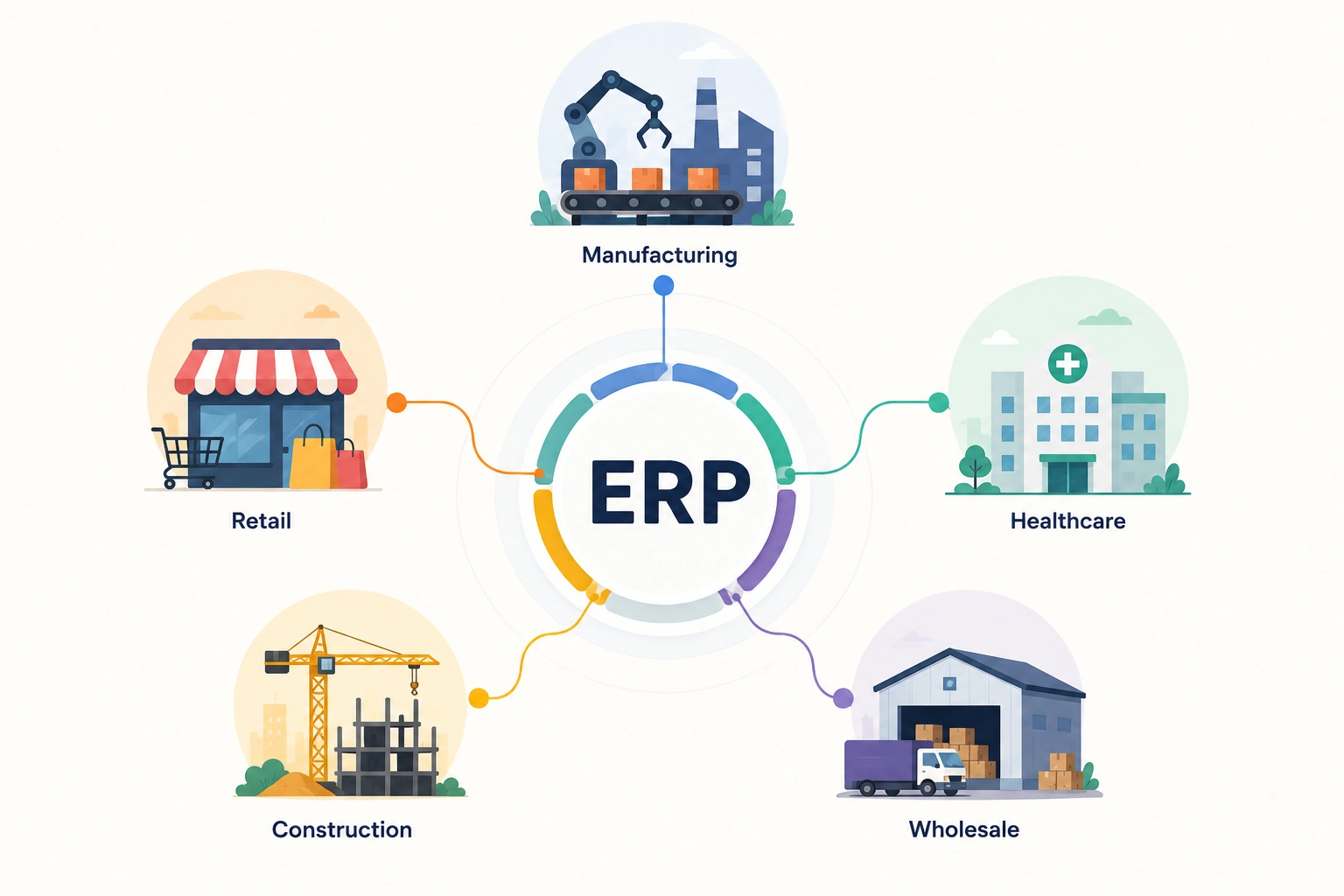
Once you know the ERP meaning in software, you’ll start noticing it everywhere. A few places it comes up constantly:
- Manufacturing: the birthplace of ERP, where production, materials, and schedules must stay in sync
- Retail: connecting what sells at the counter with what sits in the stockroom and what needs reordering from suppliers
- Wholesale & Distribution: juggling bulk inventory, tiered pricing, and multiple warehouse locations at once
- Healthcare: coordinating staff rosters, patient billing, medical supplies, and compliance inside hospitals and clinics
- Construction: tracking project costs, equipment, labor, and contracts spread across multiple job sites
You’ll also hear it in job listings (“ERP Administrator”), consulting (“ERP implementation partner”), and boardrooms (“our ERP migration”).
Each of these industries uses ERP differently, and those differences deserve their own deep dive. We break them down properly so this article stays focused on the terminology itself.
Continue Learning with Workdo’s ERP
Understanding what ERP stands for is the first step toward seeing how modern businesses actually run. Concepts like resources, planning, and integration make far more sense when you watch them work together inside a real platform.
Workdo’s Dash SaaS ERP brings core business functions, finance, inventory, HR, CRM, projects, and daily operations into one integrated system so you can see Enterprise Resource Planning in action rather than just in theory.
Conclusion
Let’s lock it in one last time. ERP stands for “Enterprise Resource Planning”, a term coined by Gartner in the 1990s to describe systems that coordinate an organization’s people, money, inventory, and data through one connected platform.
You now know something most people using the term don’t: what each word actually means, why the name exists, and where it applies. That’s the foundation. The natural next steps in your learning path are:
 Frequently Asked Questions (FAQs)
We're Here to Help - Let's Talk
Have questions about our solutions, customization services, or business tools? Our team is here to help you. let's talk.