

What is HRM? Understanding Human Resource Management
HRM manages recruitment, payroll, performance, and employee growth for stronger results.

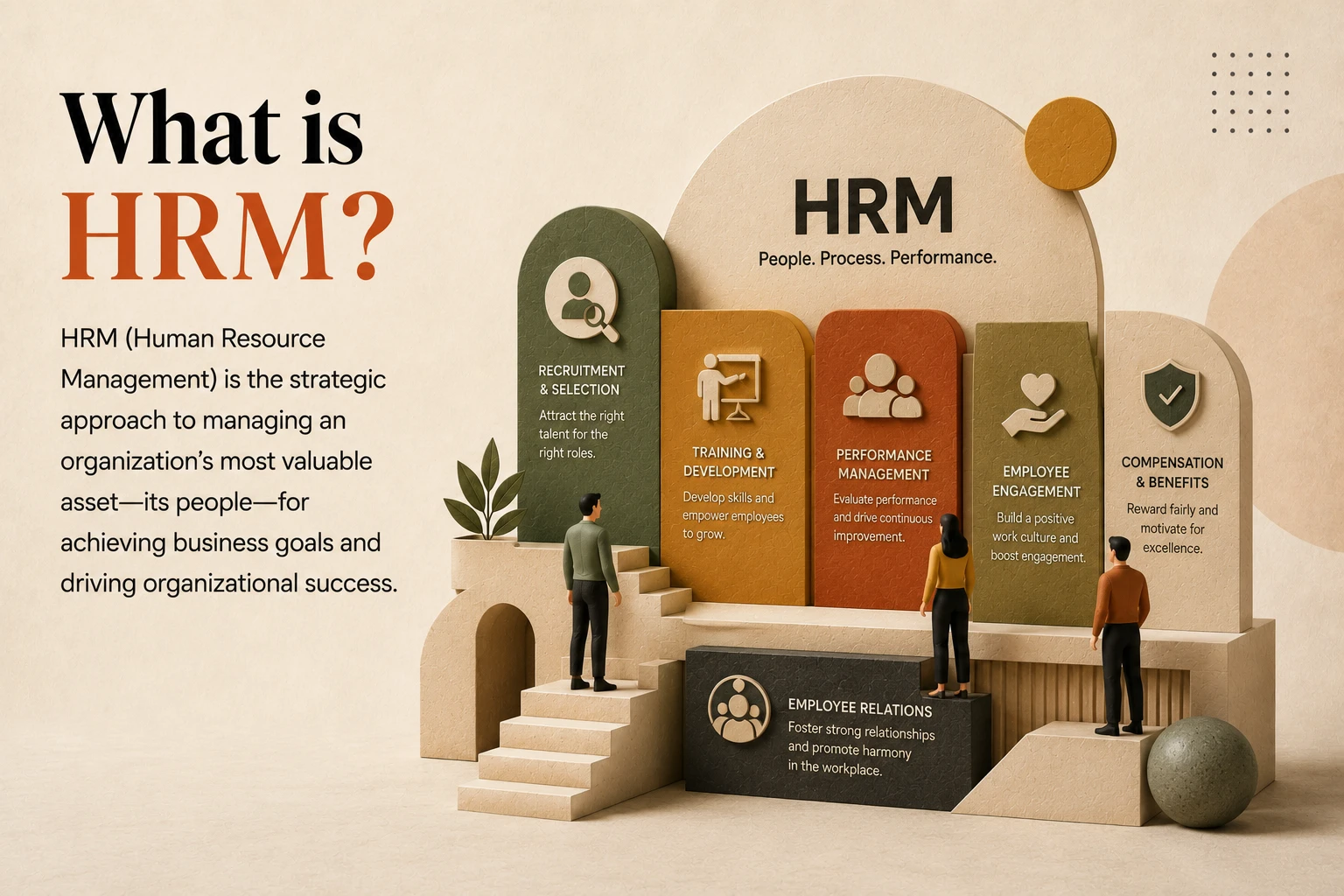
What is HRM? Unlocking the Power of People Management
Human Resource Management, or HRM, stands for the strategic process of recruiting, managing, and developing an organization’s employees to align their efforts with business goals. HRM’s full form is Human Resource Management, a function that coordinates human capital for productivity and growth while ensuring compliance and employee well-being. It proves vital for every organization by bridging employee performance with strategic objectives, reducing turnover, and fostering positive cultures.
Definition of the HRM
HRM’s full form stands for Human Resource Management, the practice of efficiently and strategically managing people at work to maximize organizational performance.
HRM meaning refers to the coherent approach of managing the workforce effectively across employment phases like hiring and development. The definition of HRM emphasizes coordinating human capital to advance business objectives while ensuring fair treatment and growth opportunities. Unlike traditional personnel management, HRM strategic planning treats employees as partners in success.
How Strategic HRM Drives Organizational Success
The strategic goal of Human Resource Management (HRM) is to align people and business so both can grow together.
In simple terms, HRM aims to build a skilled, motivated, and engaged workforce that helps the organization achieve its long-term goals. It does this by hiring the right people, developing their skills, managing performance fairly, and creating a positive work environment where employees want to stay and contribute.
Strategic HRM also focuses on future needs: planning for upcoming skills, supporting organizational change, and using data to make better decisions about talent. The ultimate goal is to turn human capital into a real competitive advantage for the business.
Key Functions of Human Resource Management
HRM functions are divided into managerial and operative categories to ensure effective workforce management.
Workdo’s HRM Software: A Smart All-in-One HR Management System
Workdo’s HRM Software provides businesses with an all-in-one platform that automates and simplifies every HR task—from hiring to complete employee lifecycle management. With this system, companies can easily manage employee data, attendance, payroll, training, and compliance in a centralized dashboard. It reduces manual errors, increases productivity, and makes HR operations far more efficient.
Workdo’s HRM Software also enhances the overall employee experience. Through the self-service portal, employees can update personal information, submit leave requests, access documents, and manage their daily HR needs effortlessly. This fully HRM system offers transparent workflows, accurate reporting, and smarter decision-making—helping businesses achieve streamlined and effective workforce management.
What Workdo’s HRM Software Do:
- Recruitment management simplifies hiring by posting job openings, managing descriptions, and tracking activities in one place, reducing time-to-hire. Applicant tracking automates candidate screening, interview scheduling, and notifications, providing better hiring insights.
- Training and learning management tracks employee development, schedules programs, and ensures compliance with skill requirements. Compliance management automates policy implementation, tracks deadlines, and generates reports to meet legal standards. Employee database management centralizes personal details, qualifications, and performance for accuracy and confidentiality.
- Asset management tracks company assets assigned to employees and ensures proper maintenance. The employee self-service portal allows employees to manage personal info, request leave, and access documents, reducing HR workload. The HRMS module handles all HR functions, streamlining processes and improving efficiency.
Simplifying HR Tasks with HRM Software
HRM software (Human Resource Management software) is a digital tool that helps organizations manage all their people-related tasks in one place. It automates routine work like storing employee data, tracking attendance and leave, running payroll, and managing documents, so HR teams spend less time on paperwork and more time on people.
A good HRM system usually includes modules for recruitment, onboarding, employee database, attendance and leave management, payroll, performance management, and employee self-service. This centralized setup reduces errors, improves compliance, gives real-time reports, and makes it easier for employees to access their own information, such as payslips and leave balances.
In simple terms, HRM software turns manual HR processes into fast, accurate, and connected workflows that support better decisions and a smoother employee experience.
Why Choose Modern HRM Software?
HRM software brings together recruitment, training, compliance, employee management, and asset tracking into one easy-to-use platform. Automating routine tasks and providing real-time insights allows your HR team to focus on strategic initiatives that drive employee engagement, organizational growth, and business success. Whether you’re a small business or a growing enterprise, modern HRM solutions adapt to your needs and scale with your organization.
- Centralizes HR tasks in one platform
- Automates routine HR tasks for efficiency
- Provides real-time insights for better HR decisions
- Scales to fit businesses of all sizes
From Paper to Digital: The Power of HRM Systems
An HRM system (Human Resource Management System) is software that helps a company manage all major HR activities in one place. It replaces spreadsheets and paperwork with a single, digital platform.
Typically, an HRM system stores employee data, manages recruitment and onboarding, tracks attendance and leave, runs payroll, and supports performance reviews. It often includes self-service options so employees can update details, request leave, and view payslips on their own.
The main purpose of an HRM system is to automate routine tasks, reduce errors, improve compliance, and give managers real-time insights about their workforce. This makes HR work faster, more accurately, and more strategically.
The Value of Strong Human Resource Management
Human Resource Management is important because it connects people with business goals. It makes sure the right people are hired, trained, and supported so they can do their best work and help the organization grow.
Good HRM improves performance and productivity through clear roles, fair pay, regular feedback, and development opportunities. It also builds a positive work culture, reduces turnover, and helps resolve conflicts, which saves time and costs for the business.
HRM is also crucial for compliance and risk control. It ensures labor laws and company policies are followed, keeps accurate records, and protects both employees and the organization. Overall, effective HRM leads to higher employee satisfaction, stronger teams, and better long‑term results for the company.
Four Main Objectives of HRM
Human Resource Management has four main objectives. Each one helps the company and employees work better together.
1. Societal Objectives
These objectives ensure the company acts responsibly toward society. HRM focuses on following labor laws, promoting fairness, supporting diversity, and maintaining ethical and safe workplace practices.
2. Functional Objectives
These objectives make sure the HR department operates efficiently. HRM ensures the organization has enough skilled employees, manages recruitment and training effectively, and keeps HR processes running smoothly.
3. Organizational Objectives
These objectives aim to help the company achieve its business goals. HRM improves employee performance, boosts productivity, reduces turnover, and contributes to overall organizational growth and success.
4. Personal Objectives
These objectives focus on employee satisfaction and growth. HRM provides opportunities for skill development, performance feedback, motivation, fair compensation, and a positive work environment.
Key Specific Objectives of Human Resource Management:
- Hiring the right people and placing them in suitable jobs
- Providing training and development to improve employee skills and performance
- Ensuring fair compensation and creating a positive, safe work environment
- Maintaining good employee relationships and ensuring compliance with labor laws and company policies
- Reducing turnover, increasing job satisfaction, and supporting employees through performance evaluations and growth opportunities
Sophisticated Modules of Modern HRM
Human Resource Management encompasses multiple core functions that work together to optimize workforce performance and organizational efficiency. Each function plays a vital role in managing the complete employee lifecycle and achieving business objectives.
HR management centralizes employee data, covering performance, promotions, training, assets, holidays, and policy compliance. HR analytics offers real-time insights into hiring, retention, and performance trends, while predictive tools forecast turnover risks. The HRMS system automates tasks, tracks compliance, and streamlines payroll, attendance, and leave management.
Attendance systems ensure accurate work hour tracking, while leave management simplifies approval processes with payroll. Performance management tools support goal-setting, feedback, and appraisals, aligning individual performance with Organizational goals. Document management securely stores HR records, improving compliance and access.
The Future of HR: Key Trends to Watch
Contemporary HRM adapts to evolving workplace dynamics through several transformative trends that reshape talent management and organizational culture.
1. AI-powered recruitment and analytics:
Modern HRM leverages artificial intelligence for resume screening, predictive candidate matching, and workforce analytics to identify top performers and forecast turnover risks. AI tools streamline hiring timelines while improving candidate quality and reducing unconscious bias in selection processes.
2. Remote and hybrid workforce management:
Post-pandemic shifts have driven HRM to support distributed teams through flexible work policies, virtual Employee onboarding, and digital collaboration tools that maintain culture and engagement across geographies. HRM software now includes remote performance tracking and asynchronous communication features.
3. Employee well-being and engagement focus:
Organizations prioritize mental health, wellness programs, and holistic employee development beyond traditional benefits, recognizing that engaged employees drive productivity and reduce turnover. HRM systems now track engagement metrics and sentiment analysis.
4. Data-driven decision-making in HR:
Advanced analytics and business intelligence dashboards enable HR leaders to make strategic decisions based on workforce metrics, ROI on training programs, and predictive insights rather than intuition. Real-time dashboards provide visibility into the hiring pipeline, retention rates, and performance trends.
HRM: Its Importance and Impact on Organizational Success
Human Resource Management (HRM) is the strategic process of recruiting, developing, and managing employees so their work supports organizational goals. It focuses on productivity, growth, compliance, and employee well-being while building a positive, high-performance culture.
HRM brings together core functions like HR management, analytics, HRMS, payroll, attendance, leave, performance, and document management into a single system. These functions help manage the entire employee lifecycle, from hiring and onboarding to development, retention, and exit.
Modern HRM software automates routine tasks and provides real-time insights, allowing HR teams to focus on strategic work such as talent development, engagement, and workforce planning. This combination of strategy, systems, and tools is what makes HRM essential for sustainable business success.
📌 Frequently Asked Questions (FAQs)
We're Here to Help - Let's Talk
Have questions about our solutions, customization services, or business tools? Our team is here to help you. let's talk.