
Top SaaS Software Businesses Should Use in 2026
See the top SaaS software for businesses in 2026 that lifts productivity and operations.

Introduction
Modern businesses are rapidly adopting cloud-based software solutions to improve efficiency, automation, and scalability. The global growth of Software as a Service (SaaS) has transformed how organizations manage operations, collaborate with teams, and serve customers.
Instead of installing traditional software on local computers or servers, companies now rely on cloud-based SaaS platforms that can be accessed from anywhere. These tools allow teams to work remotely, integrate multiple systems, and scale operations quickly.
In 2026, SaaS adoption continues to accelerate due to several major trends:
- Artificial intelligence integrated into business tools
- Automation of repetitive workflows
- Cloud-first infrastructure strategies
- Remote and hybrid work environments
Today, most organizations rely on multiple SaaS applications working together to manage marketing, sales, finance, HR, and operations.
This guide explores the main categories of SaaS software businesses need and how they support modern business operations.
What is SaaS Software?
Software as a Service (SaaS) is a software distribution model where applications are hosted in the cloud and delivered to users through the internet.
Instead of purchasing software licenses and installing programs on local devices, businesses subscribe to SaaS platforms and access them via a web browser.
How SaaS Works
In a SaaS model:
- The software provider hosts the application on cloud servers.
- Users access the platform through the internet.
- Businesses pay a monthly or yearly subscription.
- Updates and maintenance are handled by the provider.
This model eliminates the need for companies to maintain expensive infrastructure or manage software updates.
| Feature | SaaS Software | Traditional Software |
|---|---|---|
| Deployment | Cloud-based | Installed locally |
| Payment | Subscription | One-time license |
| Updates | Automatic | Manual |
| Accessibility | Anywhere via internet | Limited to device |
Why SaaS Software is Essential for Businesses in 2026
Businesses in 2026 are increasingly moving toward cloud-based tools to run their operations more efficiently. SaaS software allows companies to use powerful business applications without managing servers, installing updates, or maintaining complex IT infrastructure. This makes it easier for organizations to focus on growth instead of software management.
Several key factors are driving the rapid adoption of SaaS software:
Cloud-first business operations
Many companies now run their systems in the cloud to improve accessibility and reduce infrastructure costs.
AI-Powered Automation
Modern SaaS tools are increasingly integrating Artificial Intelligence to automate tasks such as data analysis, marketing campaigns, and customer interactions.
Remote and Hybrid Work
Global teams rely on cloud-based collaboration tools to communicate, manage projects, and share information efficiently.
Integrated Business Ecosystems
Most businesses now use multiple SaaS applications that integrate with each other, creating a connected ecosystem of tools
Data-Driven Decision Making
SaaS platforms often include analytics dashboards that help companies track performance and make informed decisions.
Because of these advantages, SaaS software has become a core part of modern business technology and will continue to play an important role as companies scale in the coming years.
Categories of SaaS Software Businesses Need
Businesses typically rely on several types of SaaS software to manage different functions across their organization.
Some of the most important categories include:
- ERP software
- CRM software
- HR management software
- Accounting software
- Project management
- Customer support software
- Collaboration tools
- Inventory management software
- Business intelligence
Below are the most important SaaS software categories businesses should use in 2026.
Top SaaS Software Businesses Should Use in 2026
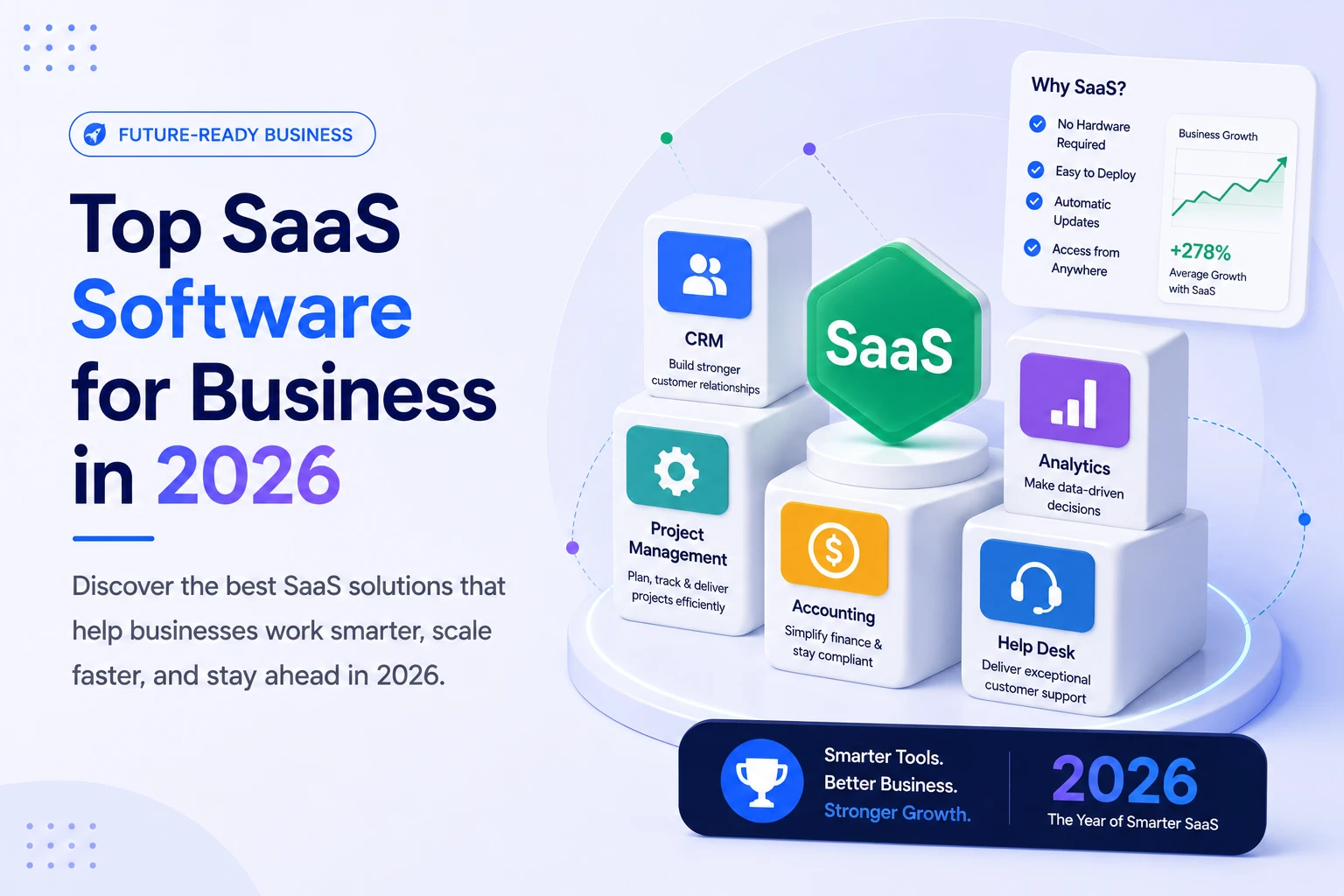
Businesses today use multiple SaaS tools to manage different parts of their operations. Instead of relying on manual processes or disconnected systems, companies are building integrated SaaS stacks that help teams work faster and make better decisions. The following SaaS software solutions are widely used by businesses to improve efficiency, manage data, and support long-term growth.
CRM Software for Managing Customer Relationships
As businesses grow, managing customer data manually becomes difficult. CRM software solves this problem by organizing customer information, communication history, and sales activities in one system.
Sales teams can track leads, monitor deals in the pipeline, and follow up with prospects more effectively. With better visibility into customer interactions, businesses can improve sales performance and build stronger customer relationships.
Project Management Software for Team Productivity
Managing projects across multiple teams can become complex without the right tools. Project management software helps businesses plan tasks, assign responsibilities, and track project progress.
These platforms provide features such as task boards, project timelines, and workflow automation. Teams can collaborate more efficiently, stay aligned on deadlines, and ensure projects are completed on time.
Accounting Software for Financial Management
Handling finances manually often leads to errors and delays. Accounting SaaS platforms simplify financial management by automating processes such as invoicing, expense tracking, and financial reporting.
Businesses can monitor cash flow, generate financial reports, and maintain accurate records through a centralized cloud system. This helps organizations manage their finances more efficiently and make informed financial decisions.
Communication and Collaboration Tools for Modern Teams
With remote and hybrid work becoming common, effective team communication is essential. Collaboration SaaS tools allow employees to communicate through instant messaging, video meetings, and shared workspaces.
These platforms help teams exchange information quickly, collaborate on tasks, and keep discussions organized. As a result, businesses can maintain productivity even when teams work from different locations.
Customer Support Software for Better Service
Customer expectations continue to increase, and businesses need efficient systems to manage support requests. Helpdesk SaaS platforms allow companies to track customer inquiries, manage support tickets, and respond faster.
Many tools also include live chat, automated responses, and knowledge bases. These features help businesses provide consistent customer support while improving response times and service quality.
E-commerce Platforms for Online Sales
Businesses that sell products online need reliable platforms to manage their digital stores. E-commerce SaaS solutions provide tools for product management, payment processing, order tracking, and inventory management.
These platforms make it easier for businesses to launch online stores, manage orders, and scale their e-commerce operations without complex development.
HR and Payroll Software for Workforce Management
Managing employee information, attendance, and payroll manually can be time-consuming. HR SaaS platforms automate many HR processes, including employee record management, leave tracking, and payroll calculations.
By using HR software, businesses can reduce administrative work and ensure HR operations remain organized and accurate.
How to Choose the Right SaaS Software for Your Business
Choosing the right SaaS software is important because the tools a business uses directly affect productivity, efficiency, and long-term growth. Before selecting a SaaS platform, companies should evaluate several important factors to ensure the software fits their operational needs.
Key factors to consider when choosing SaaS software:
Identify your business needs
Understand what problems the software should solve. For example, some businesses may need CRM tools for managing customers, while others may require accounting, HR, or project management solutions.
Check integration capabilities
The SaaS platform should integrate easily with other tools your business already uses. Good integrations help create a connected system where data flows smoothly between applications.
Evaluate scalability
Choose software that can grow with your business. Scalable SaaS platforms allow you to add users, features, or modules as your company expands.
Review security features
Since SaaS platforms store data in the cloud, it is important to select software that provides strong security measures such as encryption, access control, and regular data backups.
Compare pricing and plans
SaaS tools usually offer different subscription plans based on features and number of users. Businesses should compare plans and select one that fits their budget and requirements.
Choosing the right SaaS software helps businesses build a reliable digital ecosystem that improves collaboration, automates processes, and supports business growth.
Manage Business Operations with WorkDo
Businesses often use multiple SaaS tools for CRM, HR, accounting, project management, and collaboration. Managing separate platforms can create complexity and data fragmentation. WorkDo provides an integrated SaaS and ERP platform that helps businesses manage multiple operations from a single system. Instead of using many disconnected tools, companies can centralize workflows and streamline processes with a unified platform.
Key capabilities offered by WorkDo include:
- CRM for managing leads and customer relationships
- HRM tools for employee management and payroll
- Accounting modules for financial tracking and reporting
- Project management tools for task and team coordination
- Inventory and business management modules
- Flexible add-ons to customize the platform for different business needs
By combining multiple business tools in one platform, WorkDo helps companies reduce software complexity and build a scalable SaaS ecosystem that supports long-term growth.
Benefits of Using SaaS Software for Businesses
Businesses choose SaaS software because it simplifies operations and reduces the complexity of managing traditional software systems. Some of the key advantages include:
Cost Efficiency
SaaS software usually works on a subscription model, which means businesses do not need to invest heavily in hardware, servers, or IT infrastructure.
Easy Accessibility
Because SaaS applications run in the cloud, teams can access them from anywhere using a web browser. This makes it easier for remote and distributed teams to collaborate.
Automatic Updates
SaaS providers regularly update their platforms with new features, security improvements, and performance enhancements without requiring manual installation.
Business Scalability
Companies can easily upgrade plans, add users, or enable additional modules as their operations grow.
Faster Implementation
Unlike traditional enterprise software, SaaS platforms can usually be implemented quickly without long deployment processes.
Future of SaaS Software in 2026 and Beyond
The SaaS industry continues to evolve as businesses adopt new technologies and digital transformation accelerates. Several trends are expected to shape the future of SaaS platforms:
- AI-powered automation – SaaS tools will increasingly use artificial intelligence to automate workflows, analyze data, and generate insights.
- Integrated business platforms – Companies will prefer platforms that combine CRM, HR, accounting, and project management in one ecosystem.
- Industry-specific SaaS solutions – More SaaS tools will be designed specifically for industries such as healthcare, manufacturing, retail, and logistics.
- Low-code and no-code customization – Businesses will be able to customize software and create workflows without advanced programming knowledge
- Stronger cloud security – SaaS providers will continue improving security features to protect sensitive business data.
These trends show that SaaS will remain a core part of modern business technology.
Conclusion
SaaS software has become essential for modern businesses. Cloud-based platforms help organizations automate processes, improve collaboration, and scale operations efficiently.
From ERP and CRM systems to marketing automation and analytics platforms, companies rely on multiple SaaS tools working together to create integrated digital ecosystems.
As technology evolves, businesses that adopt scalable SaaS solutions will be better positioned to remain competitive and innovate in the future.
 Frequently Asked Questions (FAQs)
We're Here to Help - Let's Talk
Have questions about our solutions, customization services, or business tools? Our team is here to help you. let's talk.