workdo sale image

Get 50% off all Add-Ons today! Need more? Check Bulk Discounts!

get 50% off
Hotel Management System

Hotel Management System Benefits - What Every Property Gains After Implementation

Implementing a complete hotel management system produces measurable outcomes across every department. Front desk shifts become shorter. Double bookings stop. Restaurant revenue becomes trackable. Guests check in faster and leave better reviews. The finance team closes months with a complete ledger rather than a spreadsheet patchwork.

This page covers what those outcomes look like in practice, and what makes this system different from every subscription-based alternative.

Switching

What Switching to a Hotel Management System Actually Means

Switching to a hotel management system means replacing manual, disconnected operations with a connected software platform. For most properties that means a paper booking register becomes a real-time reservation calendar.

Phone-based maintenance coordination becomes a tracked work order system. Month-end spreadsheet reconciliation becomes an always-current accounting ledger.

The scope of the change depends entirely on how operations were managed before. For small independent hotels moving off paper records, the transformation is immediate and visible on day one.

For larger properties running multiple disconnected tools - a separate PMS, a separate restaurant system, a separate accounting platform - a unified system eliminates the manual data transfer that was costing staff hours every day.

Beyond operational change, a connected system establishes a data foundation that did not previously exist. Guest preferences, stay history, complaint records, maintenance costs per room, restaurant performance by item and period, event revenue by category - none of this is trackable at scale without a system connecting every department.

Once it is, the decisions those insights enable are qualitatively different from those made on gut feeling and end-of-month summaries.


The outcomes are not hypothetical.

Properties using connected hotel management systems consistently report saving 3-4 hours of front desk administrative time daily.

Direct booking rates improve by 25-30% when a built-in booking portal replaces third-party dependency.

Guest satisfaction scores improve 30-40% when staff spend less time on administration and more time with guests.

Operations

Operational Benefits - What Changes at the Front Desk and Across Departments

  1. Manual Processes Replaced by Automated Workflows

    Every routine task that currently depends on a staff member remembering to do it becomes a system-triggered event after implementation. Reservation confirmations send automatically. Pre-arrival reminders reach guests on WhatsApp without anyone drafting a message.

    Invoices generate when bookings are confirmed. Overdue balances surface on the dashboard without a report being run. Staff who previously spent mornings catching up on administrative tasks from the previous shift spend those hours on guest-facing work instead.

  2. Double Bookings and Overbookings Eliminated

    Room availability updates the moment any booking is created, modified, or cancelled - across the admin dashboard and the guest-facing booking portal simultaneously. The system prevents double bookings before they happen, not after a guest arrives to find their room already occupied. For properties where a single overbooking incident damages a relationship with a guest who has stayed multiple times, this is not a marginal benefit.

    The prevention extends beyond room reservations. Parking slots, event venue bookings, and locker allocations all track availability in real time - the same instant-update logic that prevents a double-booked room also prevents a parking slot assigned to two guests or a conference room reserved for two events at the same time. Every bookable resource in the hotel operates on a single, real-time availability layer.

  3. Every Department Operating From the Same Data

    Without a unified system, the front desk, restaurant, events team, and finance department each maintain their own records. A guest who books a dinner reservation through the restaurant and a conference room through the events team appears in two separate systems with no connection between them.

    The front desk has no visibility into either when the guest checks in. The finance team has no automatic way to combine all three revenue streams into one guest folio at checkout.

    After implementation, every department accesses the same guest record, the same booking history, and the same financial picture - from one login, in real time. When a restaurant order is placed against a room, it posts to the guest folio immediately. When a parking slot is booked by a registered guest, it links to their profile.

    When an event ticket is purchased, the revenue flows directly into the hotel's financial reports. The integration is not a scheduled sync or a manual export - it is the same data layer serving every department simultaneously.

    This is what "connected operations" means in practice, and it is what a genuinely unified system delivers, rather than a collection of separately licensed tools stitched together.

Guest Experience

Guest Experience Benefits - What Guests Notice Immediately

Faster Check-In, Recognized Returning Guests

The guest profile pulls up at the front desk with full booking history, stated preferences, previous stay notes, uploaded documents, and payment records - before the guest reaches the desk. Check-in takes minutes. Returning guests feel recognized rather than re-processed.

A staff member who can reference a guest's previous stay preferences in the first thirty seconds of an interaction creates a materially different experience than one who is entering their details for the first time.

WhatsApp Communication That Guests Actually Open

Email confirmation open rates in hospitality average below 25%. WhatsApp messages regularly exceed 90% open rates.

Reservation confirmations, pre-arrival reminders, and post-stay thank-you messages reach guests on WhatsApp automatically - triggered by booking events without any manual step from the hotel team. For properties serving guests in India, Southeast Asia, the Middle East, and Latin America, WhatsApp is not an optional communication channel - it is the primary one.

Self-Service Through the Hotel Service Portal

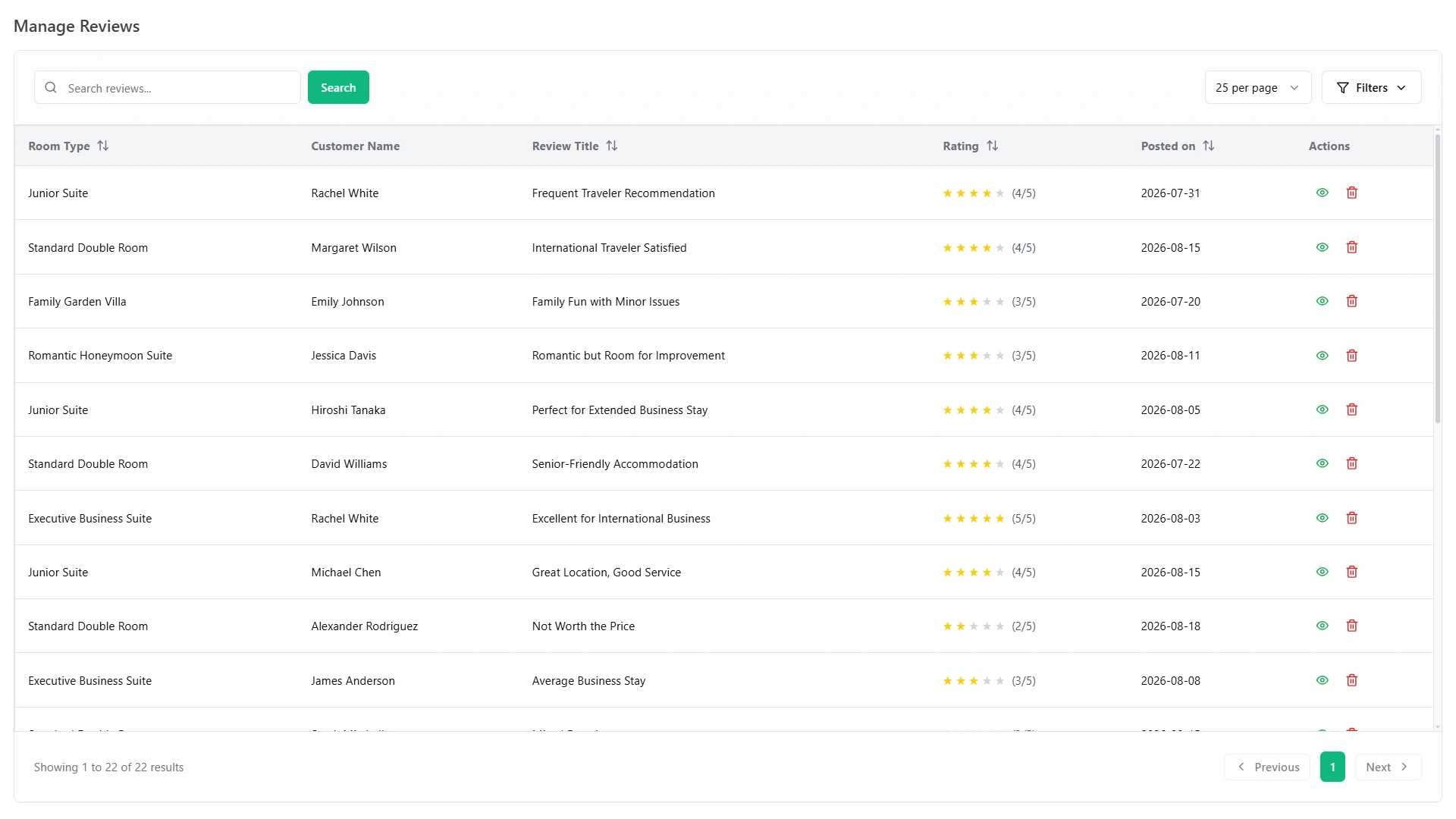
The guest-facing hotel service portal lets registered guests view their booking history, manage upcoming reservations, access invoices, scan QR codes at dining tables to order food, book parking, and request locker access - all from their own device. Every routine question that would previously generate a call to the front desk becomes self-served. When guests can access what they need without waiting for a staff member, satisfaction improves and front desk contact volumes decrease.

Revenue

Revenue Benefits - What Changes on the Hotel's Top Line

Direct Bookings Through the Built-In Booking Portal

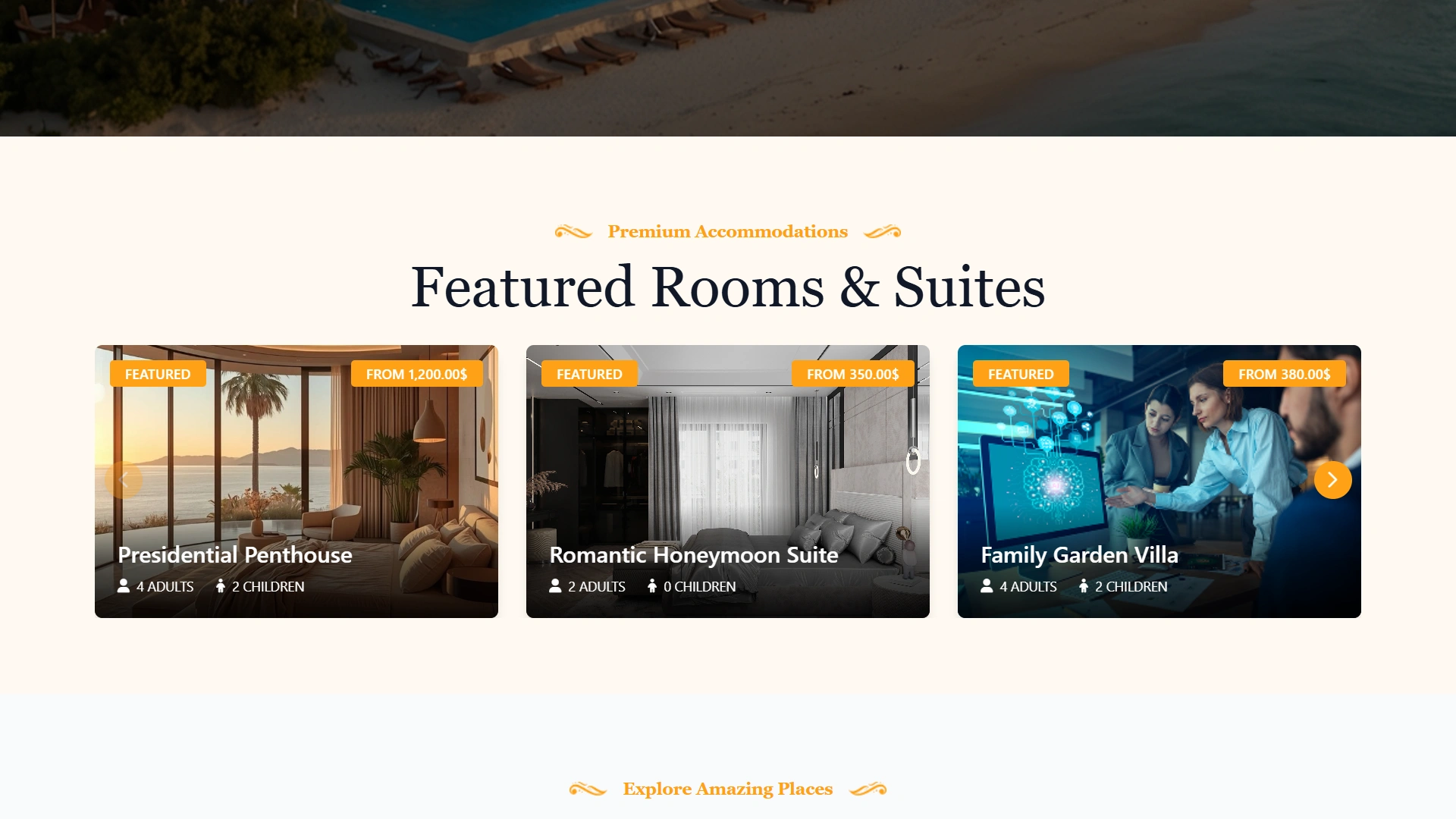
Every booking made through the hotel's own portal rather than an OTA retains a commission that would otherwise have been paid to the channel. The built-in booking portal gives prospective guests a direct booking option with real-time room availability, photos, pricing, coupon codes, and payment processing - without requiring a third-party booking engine subscription. Properties that invest in direct booking capability consistently report 25-30% improvements in direct reservation rates.

Hotel booking site with featured rooms and suites

Restaurant, Events, Parking, and Lockers as Connected Revenue Streams

Most hotel management software systems track room revenue. This system tracks every revenue stream across the property - and opens operational capacity for revenue streams that may not have existed before.

  • Restaurant revenue becomes visible and manageable: total orders by period, top-selling items, table occupancy performance, and daily income tracked alongside room revenue in the same dashboard.
  • Event and banquet revenue is captured through online ticket booking, confirmed with automatic payment processing, and reported in the same financial view as accommodation income - without a separate events platform or manual reconciliation.
  • Parking revenue tracks per slot type, per booking, and by period - accessible from the same financial dashboard as every other department.
  • Safe deposit locker income from membership plans and rental fees appears in the same revenue picture - a revenue line many hotels have but few track accurately.

Financial Reporting That Drives Decisions

With double-entry accounting built into the hotel management system, the finance team's monthly close changes from a compilation exercise to a review. The General Ledger, Balance Sheet, Trial Balance, and per-department expense reports are always current - updated automatically as every room charge, restaurant bill, parking fee, event ticket, and operational expense is recorded. The question shifts from "how do we find this number" to "what does this number tell us and what do we do next."

The asset register tracks every piece of hotel furniture, equipment, and fixture with purchase cost, location, and automatic depreciation - giving the finance team an accurate capital value picture at any time without a separate fixed-asset tool.

Petty cash management tracks day-to-day staff expenditures through an approval workflow, with immutable records after each approval. Vendor contracts link renewal dates to alert triggers, so no supplier agreement lapses unnoticed.

Hotels with a complete, connected financial picture make pricing, staffing, and capital decisions faster and with more confidence than properties still compiling end-of-month figures by hand.

Cost

The Financial Benefit No Subscription Alternative Can Match

Every benefits article about hotel management software is written by a company that charges a monthly subscription - typically $100-$500 per month depending on property size and modules. That means every benefit they describe comes attached to a cost that grows every year the hotel operates.

This is the only hotel management software where the financial benefit compounds differently.

  1. Year 1:

    One-time purchase. Every module included. Full source code. No recurring licence.

  2. Year 2:

    Zero additional cost. Same system. Same features. No renewal invoice.

  3. Year 3-5:

    Identical. The operational benefits continue. The cost does not.

For a property that would otherwise pay $250 per month for a comparable subscription, the cumulative saving over five years exceeds $15,000. That is money that stays in the operation rather than flowing to a vendor's recurring revenue model.

  • No per-room pricing penalty as the property grows.

    Subscription-based hotel management solutions typically charge per room, per property, or per user.

    Adding 20 rooms or a second property increases the monthly cost proportionally. This system covers any number of rooms, any number of properties, and any number of users for the same one-time cost.

  • Data stays on your own server.

    Guest payment records, booking histories, financial data, and operational logs are stored on your infrastructure - not a third-party cloud.

    No vendor pricing change affects your access. No service discontinuation puts your data at risk. No compliance question requires you to ask a vendor what they do with guest information.

  • Full source code included.

    Your technical team can modify any feature, build any integration, or extend the system in any direction - without vendor permission, without waiting for a product roadmap, and without paying an enterprise development premium for capabilities the base product should have included.

Before & After

Before and After - What This System Changes

  • Before: Room availability tracked in a spreadsheet, updated manually when the phone rings with a new booking.

    After: Real-time availability updating automatically the moment any booking is confirmed, modified, or cancelled - across every device the team uses.

  • Before: Restaurant orders taken on paper, passed to the kitchen verbally, with no record of what was ordered, by whom, or when.

    After: QR code table ordering with order-to-kitchen in real time, occupancy tracked per table, and dining charges automatically posted to the relevant guest folio.

  • Before: Guest complaints logged in a WhatsApp group, followed up verbally, with no formal record of resolution.

    After: Every complaint raised formally, assigned to a staff member, tracked to resolution with a satisfaction rating collected from the guest at close.

  • Before: Non-guest visitors logged in a paper register at the front desk - no searchable record, no incident history, no visibility into who is currently on the property.

    After: Every visitor digitally logged with name, purpose, host, and badge number - a real-time timeline of who is on-site, with incidents formally recorded and searchable.

  • Before: Vendor contracts stored in email threads, renewal dates missed, agreement terms disputed because no one has the signed version accessible.

    After: Every contract created from a template, signed digitally by both parties, renewal dates monitored automatically with alerts firing before any agreement lapses.

  • Before: Month-end accounting requires pulling records from three different systems, reconciling by hand, and compiling a report that is already out of date by the time it is finished.

    After: The Balance Sheet, General Ledger, and per-department expense reports are always current - month-end is a review, not a construction project.

  • Before: Paying $200-500 per month for hotel management software that covers fewer operational areas and charges more every time a room or user is added.

    After: One purchase, every module, no recurring cost regardless of how the property grows.

Own It

Own Your Hotel Management Software Outright - From Day One

Choosing a hotel management system comes down to one question: which system, at what cost, under what terms. This system answers those questions differently from every subscription alternative - one purchase, every module, your data on your server, your brand on the platform, your technical team able to modify anything.

The outcomes described on this page - time savings, error elimination, revenue expansion, guest satisfaction improvement, financial clarity - are what a complete hotel management system delivers. The difference is that this one stops costing you money after day one.

Hotel receptionist taking a call at the front desk
Faq's

Frequently Asked Questions About Hotel Management System Benefits

Key benefits include automated front desk operations, elimination of double bookings, real-time financial reporting, guest profile management, WhatsApp communication, restaurant and events management, parking and locker tracking, and a full activity audit trail.
It delivers faster check-in, personalized service through guest history records, automatic WhatsApp confirmations and reminders, QR-code restaurant ordering from the table, and structured post-stay feedback - reducing wait times and missed service moments.
Ownership means one payment in Year 1 and zero recurring cost in every year that follows. For a property otherwise paying a monthly SaaS subscription, the cumulative saving over five years typically exceeds the initial purchase cost several times over.
Revenue increases through direct guest bookings via the built-in portal, plus restaurant, events, parking, and locker operations as additional income streams, alongside real-time financial data for optimizing rates and occupancy decisions.
Self-hosted software keeps all guest data, booking history, and financial records on your own server. No vendor holds your operational data, no price increase affects your access, and your system continues running regardless of what the provider changes.
Yes. The multi-workspace architecture manages multiple hotel properties from one admin dashboard, with separate data and reporting per property. No per-property pricing penalty applies - the same system manages one property or twenty at the same cost.